



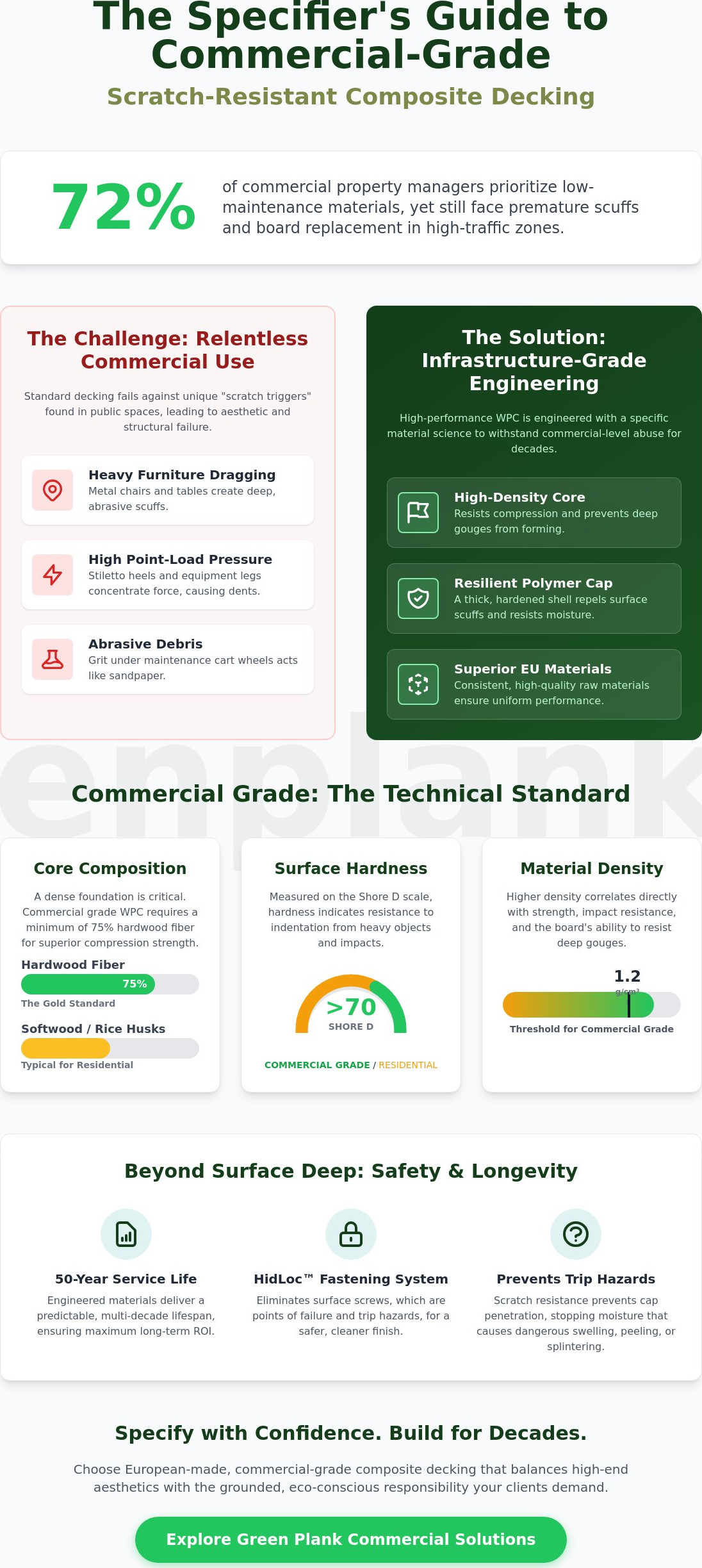
Over 72% of commercial property managers now prioritize low-maintenance materials, yet many still face the frustration of replacing scuffed boards within just a few years of installation. You know that a high-traffic zone, such as a restaurant terrace or public boardwalk, is a relentless environment where furniture dragging and heavy footfall are constant. Aesthetic degradation isn't just a visual nuisance; it signals a failure in long-term ROI and creates unnecessary safety concerns regarding surface integrity.
This guide helps you master composite decking scratch resistance for commercial use by exploring the engineering behind high-density WPC. We promise to show you how to specify surfaces that maintain their premium appearance for decades, even under the most rigorous conditions. You'll learn about the technical advantages of using 75% hardwood fiber combined with European manufacturing standards. We will explore the material science of 2026, including the role of proprietary caps and the path to achieving a 50-year service life. By the end, you'll have the data needed to balance high-end aesthetics with the grounded, eco-conscious responsibility your clients demand.
Key Takeaways
- Understand the critical role of Shore D hardness ratings in distinguishing between decorative surfaces and truly resilient commercial-grade materials.
- Identify why a 75% hardwood fiber composition is essential for achieving the compression strength required to resist permanent scuffs and dents.
- Evaluate the technical necessity of solid profiles and specific cap thicknesses when specifying composite decking scratch resistance for commercial use.
- Discover how HidLoc™ Hidden Fastening systems eliminate surface-level penetrations, reducing both trip hazards and potential points of material failure.
- Apply maintenance strategies and furniture selection criteria that protect the polymer shell and uphold long-term aesthetic standards in public spaces.
Table of Contents
- Defining Scratch Resistance in Commercial WPC Environments
- The Engineering of Durability: Hardwood Fiber vs. Softwood Cores
- Commercial Grade Comparison: Specifying the Right WPC Profile
- Maintenance and Protection Strategies for High-Traffic Decks
- Specifying Green Plank for Commercial Infrastructure Projects
Defining Scratch Resistance in Commercial WPC Environments
In the rigorous environment of public infrastructure, the term "scratch-proof" is a misnomer that specifiers should avoid. No material is entirely immune to damage under extreme conditions; however, high-performance engineering ensures that composite decking scratch resistance for commercial use meets the demands of high-traffic zones. While residential decks face occasional foot traffic, commercial installations must withstand a relentless barrage of abrasive forces. The goal of a professional specifier is to select a material where the polymer cap is resilient enough to repel surface scuffs and dense enough to prevent deep gouges from becoming permanent fixtures of the landscape.
Commercial environments introduce unique "scratch triggers" that don't exist in private backyards. Heavy metal patio furniture is frequently dragged across the surface. Stiletto heels concentrate hundreds of pounds of pressure into a single square centimeter. Maintenance equipment and cleaning carts often carry debris that acts like sandpaper under wheel pressure. When a surface fails to resist these triggers, the resulting aesthetic degradation does more than just look poor; it actively devalues the property and suggests a lack of facility oversight.
The Role of Surface Hardness in Public Spaces
The durability of Wood-plastic composites (WPCs) is often measured using the Shore D hardness scale. Residential boards may suffice with lower ratings, but commercial infrastructure requires a Shore D hardness typically exceeding 70 to resist indentation from heavy objects. Surface texture also plays a strategic role. Deep, realistic embossing helps mask micro-scratches that occur over time, ensuring the deck maintains a uniform appearance despite heavy use. Commercial Grade WPC is technically defined as a material with a density exceeding 1.2g/cm³.
Beyond Aesthetics: Why Scratches Matter for Safety
Surface integrity is a primary safety concern for any public project. Deep gouges can penetrate the protective polymer cap, exposing the internal wood-fiber core to moisture and microbial attack. This exposure leads to swelling or the "peeling" effect often seen in low-quality imported boards, which creates significant trip hazards. Furthermore, the relationship between surface texture and slip resistance is vital. A compromised surface can alter the material's R-rating, potentially leading to non-compliance with safety standards. Maintaining composite decking scratch resistance for commercial use ensures that the boards remain smooth, splinter-free, and safe for public interaction for their entire service life.
By prioritizing high density and superior cap hardness, specifiers protect the long-term ROI of the project. A deck that resists furniture dragging and heavy footfall remains a maintenance-free asset rather than a liability. This focus on engineering precision reflects a commitment to both quality and the safety of the end-user.
The Engineering of Durability: Hardwood Fiber vs. Softwood Cores
The structural integrity of a composite board begins at the molecular level, specifically within the ratio of organic fiber to polymer. While many residential products rely on softwood flour or rice husks, infrastructure-grade performance requires a more robust foundation. A 75% hardwood fiber ratio serves as the gold standard for achieving composite decking scratch resistance for commercial use. Hardwood fibers are naturally denser and more resistant to compression than their softwood counterparts. This internal "backbone" ensures that when heavy objects are dragged across the surface, the board resists deep gouging rather than yielding to the pressure.
Material density is not merely a technical specification; it's a predictor of long-term ROI. European-sourced raw materials provide a level of consistency that is often missing in global commodity markets. By utilizing 100% EU raw materials, manufacturers can guarantee a uniform distribution of fibers throughout the profile. This consistency is supported by Forest Products Laboratory research, which indicates that the mechanical properties of wood-plastic composites are heavily influenced by the species and quality of the wood component. Choosing hardwood-based WPC over softwood alternatives results in a board that is significantly harder and less prone to the surface "bruising" that plagues lower-density products.
Hardwood Fiber: The Secret to High-Density Cores
The high concentration of hardwood fiber provides exceptional thermal stability, which is critical for projects in fluctuating European climates. To fully appreciate the benefits, it's helpful to understand how is wpc made through precision extrusion. During this process, the hardwood fibers are encapsulated in polymer, creating a core that resists the expansion and contraction cycles that cause surface stress. This stability prevents the micro-fissures that often lead to premature wear and tear in high-traffic zones. Specifiers can explore commercial infrastructure profiles that prioritize this material integrity for public works.
HDPE vs. PVC: Which Polymer Resists Scratches Better?
The choice of polymer is just as vital as the fiber. Green Plank utilizes 25% High-Density Polyethylene (HDPE) because it offers a superior balance of impact resistance and flexibility. While PVC-based decks are often marketed for their hardness, they can become brittle over time, especially when exposed to UV radiation and cold temperatures. This brittleness makes PVC more prone to chipping and cracking under heavy impact. In contrast, HDPE maintains its structural resilience while significantly reducing the CO2 footprint of the project. This commitment to Cradle to Cradle ownership ensures that durability never comes at the expense of ecological responsibility.
Commercial Grade Comparison: Specifying the Right WPC Profile
Selecting the correct profile is a matter of matching engineering specifications to site-specific demands. In the European Union, the EN 15534 standard provides a rigorous framework for evaluating composite decking scratch resistance for commercial use. Unlike non-regulated imports that often lack third-party verification, European-engineered boards undergo standardized testing for surface hardness and impact resistance. This ensures that the material you specify performs exactly as promised over its 50-year service life. This regional reliability allows for specific long-term performance guarantees that reflect true engineering confidence.
The cap is the board's first line of defense. Specifiers must distinguish between a thin decorative coating and a functional protective shell. A commercial-grade cap should be thick enough to withstand deep abrasive contact without exposing the core. This thickness ensures that even if a surface scratch occurs, it remains within the polymer layer, preventing moisture ingress and maintaining the board's aesthetic integrity. This feature provides the benefit of a maintenance-free surface that resists the wear of daily commercial operations.
Solid Profiles for Heavy-Duty Infrastructure
Hollow boards are frequently marketed for their lower weight and cost, yet they often fail in commercial settings due to high point-load pressure. When heavy furniture or maintenance equipment concentrates weight on a small area, the thin walls of a hollow profile risk structural failure. Solid WPC profiles eliminate 'internal collapse' risks common in budget hollow boards. Solid boards like Terra Tuff are mandatory for high-traffic infrastructure because they allow for precise perimeter cutting and secure anchoring of heavy furniture without compromising the board's integrity. This solid construction provides the foundational strength required for public boardwalks and urban plazas.
Technical Comparison: Green Plank vs. Trex Alternatives
Understanding how European-engineered WPC compares to trex decking alternatives is essential for global projects. While many North American brands offer reputable products, the European manufacturing model prioritizes 100% EU raw materials for superior quality control and safety compliance. This commitment to regional sourcing reduces the CO2 footprint while ensuring a consistent material density that global commodity imports cannot match. A 50-year commercial warranty serves as a proxy for this durability, providing peace of mind for long-term infrastructure investments.
Choosing between the Terra Tuff and Smart System lines depends on the projected traffic levels. Terra Tuff is designed for ultra-high traffic zones like public piers and restaurant terraces, featuring maximum density and scratch resistance. The Smart System offers a versatile solution for high-traffic commercial spaces, balancing premium aesthetics with the same core durability. Both systems utilize the HidLoc™ Hidden Fastening System to ensure a smooth, fastener-free surface that protects the polymer cap from installation-related damage and eliminates trip hazards for the public.
Maintenance and Protection Strategies for High-Traffic Decks
Maintaining the high-end aesthetic of a commercial deck requires more than occasional sweeping. It involves a proactive approach to preserving the polymer cap. While composite decking scratch resistance for commercial use is engineered into the core, surface-level care ensures the material remains maintenance-free for decades. Professionals understand that long-term ROI is directly linked to these operational protocols. A well-maintained surface reflects a commitment to quality and respects the natural beauty of the space.
Winter maintenance requires specific tools to avoid accidental damage. Metal shovels can gouge even the hardest polymer surfaces, leading to permanent scars. Plastic shovels or snow blowers with rubber blades are the only recommended choices for clearing snow from commercial boardwalks. For ice removal, calcium chloride or rock salt is generally safe for capped composites, though the surface should be rinsed once the thaw is complete to prevent salt film buildup. These simple steps protect the engineering confidence built into every board.
Preventative Design for Commercial Projects
Design choices made during the planning phase significantly impact the longevity of the deck surface. Abrasive grit is the primary cause of micro-scratches in public plazas. Strategically placed entrance mats at all transition points capture sand and gravel before they reach the decking. Furthermore, furniture selection plays a vital role. Specifying furniture with wide, non-marring protective glides prevents the point-load scratching that occurs when metal legs are dragged across the surface. For technical layout details, specifiers should consult a deck installation guide to ensure thermal expansion gaps are correctly calculated, preventing edge friction between boards.
Long-Term Cleaning and Care
Routine cleaning protocols preserve the polymer cap's scratch-resistant properties and UV stability. While capped composites are highly resilient, they are not indestructible. Pressure washing must be handled with care; use a fan-tip nozzle at a maximum pressure of 1500 PSI and maintain a distance of at least 30 centimeters from the surface. This prevents etching the polymer shell. For more intensive care, view our commercial maintenance specifications to identify approved cleaning agents.
- Using pH-neutral cleaning agents that preserve the integrity of the UV-resistant shell.
- Applying low-pressure water streams to remove surface debris without etching the polymer.
- Addressing burnish marks promptly to maintain a uniform surface sheen across high-traffic zones.
Minor scuffs can often be managed through the "heat and brush" technique. A professional heat gun can gently soften the polymer shell, allowing a fine-wire brush to blend the scuff back into the embossed grain. This process requires precision but effectively restores the aesthetic integrity of high-performance WPC without the need for board replacement. This ability to repair rather than replace aligns with the principles of Cradle to Cradle ownership and sustainable building management.
Specifying Green Plank for Commercial Infrastructure Projects
Specifying materials for public works requires a balance of engineering precision and ethical responsibility. The Terra Tuff line has become the preferred choice for European public infrastructure because it addresses the core requirements of high-traffic environments. When evaluating composite decking scratch resistance for commercial use, this profile offers a density and surface hardness that exceeds standard residential products. This performance is backed by a 50-year service life warranty, which serves as a testament to our engineering confidence in the most demanding zones.
Professional specifiers and architects can request technical data sheets and physical samples directly to support commercial tenders. These documents provide the empirical evidence needed for compliance with safety standards and building codes. By choosing a product made in the EU with 100% European raw materials, projects benefit from regional reliability and a significantly reduced CO2 footprint. This grounded approach ensures that the longevity of the installation matches the environmental credentials required for modern urban development.
HidLoc™: The Secret to Surface Integrity
Installation methods often dictate the long-term success of a commercial deck. Traditional face-screwing methods create hundreds of surface penetrations that can lead to splintering and localized material failure. The HidLoc™ Hidden Fastening System eliminates these risks by securing the boards from the side. This approach ensures a completely smooth, fastener-free surface that protects the polymer cap from installation-related damage. Beyond the aesthetic advantage, this system reduces installation time and labor costs in large-scale projects while eliminating trip hazards for the public.
A Commitment to Circular Construction
Modern infrastructure must align with the principles of the circular economy. Integrating sustainable building materials into your BREEAM or LEED project is a strategic decision that enhances the property's long-term value. Green Plank products are 100% recyclable, ensuring they remain part of a closed-loop system throughout the commercial property lifecycle. This Cradle to Cradle ownership model reflects a forward-thinking approach to construction that respects nature while delivering high-end performance.
Specifying the right material is the first step toward a maintenance-free future. If you are currently designing a high-traffic public space or a premium commercial terrace, contact our commercial technical team for a project-specific durability assessment. We provide the technical expertise and material science required to ensure your outdoor space maintains its aesthetic integrity for decades.
Securing Long-Term Performance for Public Infrastructure
Mastering composite decking scratch resistance for commercial use requires a shift from viewing surfaces as merely decorative to seeing them as precision-engineered assets. You've seen how a 75% hardwood fiber core and solid profiles provide the necessary Shore D hardness to withstand the rigors of public foot traffic and heavy furniture. By specifying materials with 100% EU raw materials and Cradle to Cradle certified manufacturing, you ensure that durability and ecological ethics work in tandem.
The path to a maintenance-free outdoor space is defined by these technical choices and supported by a 50-Year Commercial Warranty. This level of engineering confidence allows you to design with the future in mind, knowing the aesthetic integrity of your project is protected. Experience the material quality firsthand and Request a Commercial Sample Pack of Terra Tuff Decking to begin your next sustainable infrastructure project. We look forward to helping you build spaces that respect nature while standing the test of time.
Frequently Asked Questions
Is composite decking truly scratch-proof for commercial use?
No material is entirely scratch-proof, but high-performance WPC is engineered to be highly scratch-resistant. Commercial environments involve extreme abrasive forces that can challenge any surface. While the polymer cap repels most daily scuffs, severe impact or dragging sharp metal objects can still cause damage. The primary goal of specifying composite decking scratch resistance for commercial use is to ensure aesthetic integrity over decades of heavy use rather than absolute immunity.
Which Green Plank product is most resistant to heavy furniture dragging?
Terra Tuff Composite Decking is the superior choice for environments where heavy furniture dragging is expected. Its solid profile and 75% hardwood fiber core provide the high density needed to resist intense point-load pressure. This engineering prevents the internal collapse and deep gouging often seen in hollow or softwood-based alternatives. It provides a grounded, reliable surface that maintains its premium appearance even in busy restaurant or hospitality settings.
Can I use a pressure washer on scratch-resistant composite boards?
You can use a pressure washer, provided you follow specific safety parameters to protect the polymer shell. Use a fan-tip nozzle and keep the pressure below 1500 PSI at a distance of at least 30 centimeters from the surface. Improper use at excessively high pressure can etch the polymer and compromise the material's long-term resistance. Following these guidelines ensures the deck remains maintenance-free without risking the integrity of the UV-resistant cap.
How do I repair a deep gouge in a capped composite deck board?
Deep gouges in capped boards can often be repaired using a professional heat gun and a fine-wire brush. By carefully softening the polymer cap with heat, you can re-blend the grain to mask the damage effectively. This technique requires precision to avoid overheating the material. For extensive structural damage in a high-traffic zone, replacing the individual board is often the most effective long-term solution to maintain safety and aesthetics.
Does the color of the decking affect how visible scratches are?
Mid-tone colors with variegated grain patterns are most effective at masking surface scuffs and micro-scratches. Very dark or very light solid colors tend to highlight debris and surface abrasions more clearly than natural earth tones. Selecting a heavily textured finish further enhances the visual composite decking scratch resistance for commercial use by breaking up light reflections across the surface planes. This choice balances high-end design with practical, long-term performance.
Are hidden fasteners like HidLoc™ suitable for high-traffic public boardwalks?
HidLoc™ Hidden Fastening Systems are specifically designed for the rigorous demands of high-traffic public boardwalks and urban plazas. These systems eliminate surface-penetrating screws, which prevents the splintering and trip hazards often associated with traditional face-fastening. They provide a smooth, fastener-free aesthetic that respects the natural flow of the space. This system also allows the boards to expand and contract naturally without compromising the structural integrity of the installation.
What is the difference between residential and commercial scratch warranties?
Commercial scratch warranties typically focus on physical integrity under constant use, whereas residential warranties prioritize stain and fade resistance for lighter traffic. Commercial coverage often includes stricter requirements regarding load-bearing and installation methods. Green Plank offers a 50-year service life warranty for its commercial infrastructure profiles. This specific guarantee reflects an engineering confidence that is rare in the industry and provides long-term ROI for public works.
How does temperature affect the scratch resistance of WPC decking?
Extreme heat can slightly soften the polymer cap, which makes the surface more susceptible to temporary indentation under heavy, concentrated loads. Hardwood-based WPC offers greater thermal stability than softwood or rice-husk alternatives. This stability ensures the material maintains its hardness and density even during peak summer temperatures. Choosing a material with a 75% hardwood fiber ratio provides the necessary backbone to resist surface deformation in fluctuating European climates.
Specifikér produktet
Brug denne guide i en Green Plank-specifikation
Tekniske WPC-artikler skal understøtte de kommercielle sider — ikke konkurrere med dem. Fortsæt til kompositterrasse, TerraTuff, Nordeka eller de tekniske downloads.