




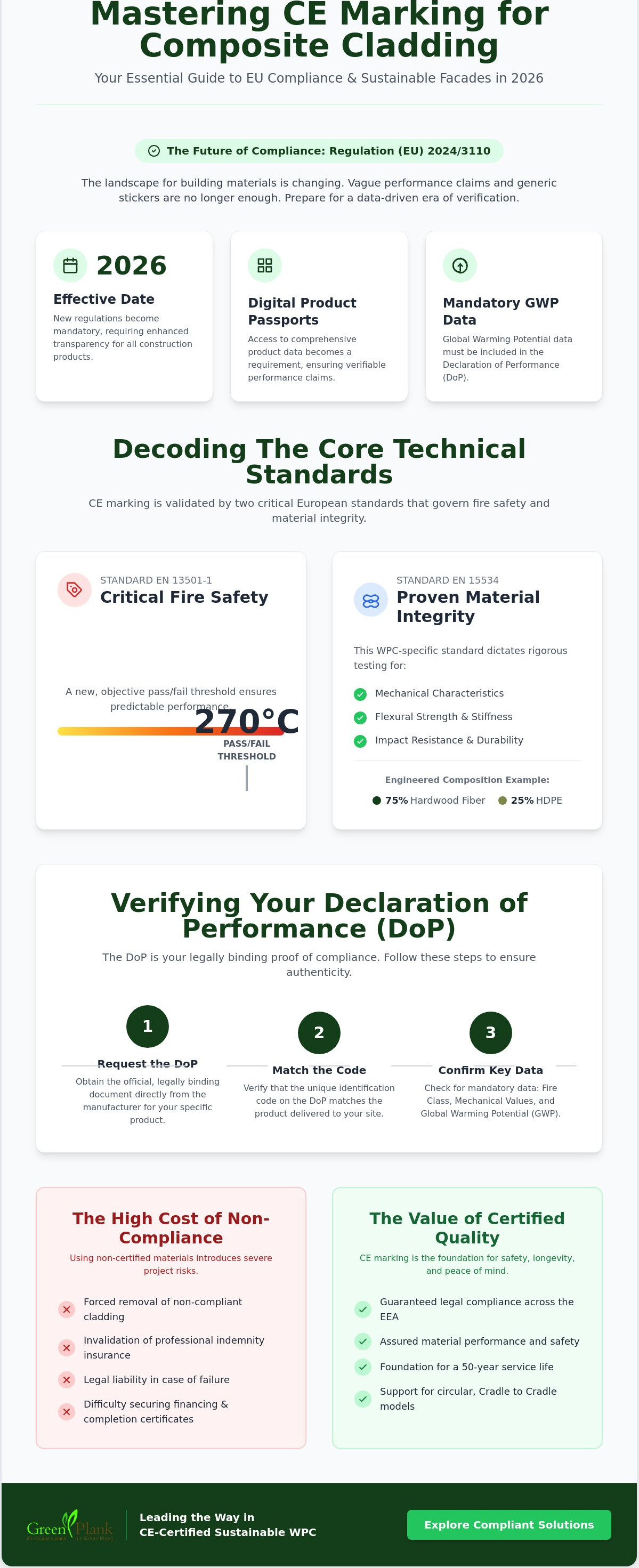
If you believe a generic sticker guarantees your building's safety, you're risking more than just a regulatory fine. In 2026, the landscape for building materials has shifted under Regulation (EU) 2024/3110, making ce marking for composite cladding the only reliable bridge between legal compliance and material sustainability. Relying on vague performance claims is a liability that modern architects and developers can't afford, especially as fire safety standards become more objective and data-driven.
You probably recognize the difficulty of distinguishing between a high-quality WPC profile and an inferior import with questionable technical backing. This guide provides the clarity you need to master the latest EU requirements, ensuring your facades meet the 270°C pass/fail threshold set by the updated EN 13501-1 standards. We'll examine the mandatory inclusion of Global Warming Potential data in your Declaration of Performance and show you how to verify durability for a 50-year service life. By the end, you'll have the framework to select manufacturers who prioritize transparent documentation and engineering excellence.
Mastering the technical and legal requirements of ce marking for composite cladding is essential for ensuring project safety and long-term compliance. This summary outlines the critical standards and verification steps necessary to maintain a 50-year service life for modern facades.
- Regulatory Compliance: Understand the shift to Regulation (EU) 2024/3110 and the new obligations for digital product passports and environmental data in 2026.
- Material Performance: Utilize EN 15534 testing protocols to verify the mechanical characteristics, flexural strength, and impact resistance of WPC profiles.
- Fire Safety Standards: Confirm adherence to the updated EN 13501-1 classifications to ensure cladding meets the rigorous 270°C temperature-based safety thresholds.
- Verification Protocols: Learn the precise steps to validate a Declaration of Performance (DoP) by matching unique identification codes to your specific project needs.
- Sustainable Reliability: Explore the benefits of 100% EU raw materials and engineering standards that support a circular, Cradle to Cradle ownership model.
Table of Contents
- What is CE Marking for Composite Cladding and Why Does It Matter?
- Technical Standards: Understanding EN 15534 for WPC Cladding
- Fire Safety and Thermal Performance Standards in 2026
- How to Verify a Declaration of Performance (DoP) for Your Project
- Green Plank: Leading the Way in CE-Certified Sustainable WPC
What is CE Marking for Composite Cladding and Why Does It Matter?
CE marking for composite cladding is far more than a decorative badge on a pallet of boards. It's a mandatory declaration that a construction product meets the essential requirements of European Union directives. For architects and developers, understanding What is CE Marking is the first step in ensuring a project survives the rigorous scrutiny of building inspectors. Under the Construction Products Regulation (CPR) 305/2011, this mark serves as a technical passport. It indicates that the material's performance has been assessed according to a harmonized European standard, ensuring that every board provides the safety it promises.
In 2026, the stakes for compliance are higher than ever. Insurance providers now demand verifiable performance data before providing coverage for commercial facades. A simple sticker on the packaging is insufficient. You must possess a legally binding Declaration of Performance (DoP). This document links the product to its specific test results. It provides the transparency required for official building sign-offs. Mastering the nuances of ce marking for composite cladding ensures your project remains both safe and legally sound. Our role as a responsible innovator is to provide this data clearly, allowing you to focus on design without the fear of regulatory failure.
The Legal Framework for Exterior Facades
The mandatory nature of CE marking applies to all permanent building structures within the European Economic Area. This framework ensures that materials can move freely across borders. It requires they meet the same rigorous safety and environmental benchmarks. Using non-certified materials in commercial developments carries severe risks:
- Forced removal of non-compliant cladding at the developer's expense.
- Invalidation of professional indemnity insurance for architects.
- Legal liability in the event of structural or fire safety failures.
- Difficulty in securing building completion certificates and project financing.
We prioritize regional reliability by ensuring every profile we manufacture adheres to these strict EU protocols. This commitment to engineering precision protects both the builder and the end-user.
CE Marking vs. Quality Guarantees
It's vital to distinguish between regulatory compliance and long-term durability. CE marking proves that a product meets minimum safety thresholds at the point of sale. Quality guarantees focus on the material's behavior over decades. Our engineering confidence is reflected in our 50-year service life warranties. This longevity is only possible because we use 100% EU raw materials. Sourcing locally allows us to maintain consistent material science standards. High-quality inputs lead to predictable performance. Predictable performance ensures lasting peace of mind. While the CE mark confirms the product is safe to install today, our warranty confirms it will remain beautiful and functional for half a century.
Technical Standards: Understanding EN 15534 for WPC Cladding
While general building codes provide a broad safety net, the EN 15534 series serves as the definitive technical benchmark for Wood-Polymer Composites (WPC). This specific European standard dictates how manufacturers must assess material behavior, from thermal expansion to long-term structural integrity. Achieving ce marking for composite cladding requires rigorous adherence to these protocols, ensuring that the blend of organic and synthetic materials performs predictably in diverse climates. The current version, EN 15534-1:2014+A1:2017, provides the testing methods that validate whether a product is fit for the demanding environment of a building's exterior envelope.
The core of this performance lies in the material science of the profile. Our engineered ratio of 75% hardwood fiber and 25% high-density polyethylene (HDPE) is designed specifically to meet these European benchmarks. Hardwood fibers provide the necessary stiffness and structural "backbone," while the HDPE encapsulates those fibers to prevent moisture ingress. This synergy is verified through boiling tests and water absorption cycles. Under the Construction Products Regulation (CPR), these results must be documented and accessible, proving that the cladding will not swell or warp beyond strict tolerances when exposed to the elements. For professionals seeking reliable materials, you can view our technical specifications to see how these ratios translate into site-ready performance.
Mechanical Performance Requirements
Architectural applications demand high bending resistance and a stable modulus of elasticity. Even with our focus on low-density profiles to reduce structural load, the material must withstand high-stress wind loads and physical impacts. We test every profile for flexural strength to ensure it maintains its shape under pressure. This mechanical stability ensures that the facade remains secure and aesthetically aligned, even when subjected to the extreme temperature fluctuations common in European summers and winters.
Durability and Biological Resistance
Longevity is a product of resistance. EN 15534 requires testing against wood-destroying fungi and accelerated aging to simulate decades of exposure. UV stability tests are equally critical; they ensure the pigment remains consistent and the polymer does not become brittle over time. These technical hurdles are the reason we can offer a 50-year service life. For a deeper look at how these standards influence long-term project success, consult our Guide to Sustainable Exterior Facades. This technical rigour ensures that the visual appeal of the building is matched by its enduring safety.
Fire Safety and Thermal Performance Standards in 2026
The updated fire safety standard for construction products, EN 13501-1, which came into force on January 31, 2026, has fundamentally changed how we evaluate facade safety. This regulation replaces subjective visual checks with a rigorous, temperature-based assessment system. The pass/fail threshold is now set at a definitive 270°C, a benchmark that demands absolute precision in material composition. For architects and safety officers, ce marking for composite cladding provides the only verified assurance that a product won't contribute to fire spread in high-occupancy environments. This technical transparency is vital for securing insurance and meeting the stringent safety expectations of modern commercial developments.
Achieving a Class B or C fire rating requires a sophisticated blend of engineering and high-quality inputs. We utilize 100% EU raw materials because they offer a level of predictability that generic imports simply cannot match. When you source materials from outside the EU, the inconsistent nature of the recycled content can lead to "hot spots" where fire retardants are unevenly distributed. By maintaining control over our supply chain, we ensure that the fire-resistant additives are perfectly homogenized throughout the profile. This material science approach ensures that every board installed on your project performs exactly as documented in the technical files.
Reaction to Fire (R2F) Classifications
Fire safety isn't just about how a material burns; it's also about the smoke and debris it produces. The European classification system breaks this down into "s" (smoke production) and "d" (flaming droplets) ratings. Most high-performance WPC profiles aim for a B-s2, d0 or C-s3, d0 rating, which is critical for ensuring clear evacuation routes during an emergency. Our Smart System and Terra Tuff lines are engineered specifically to meet these rigorous safety benchmarks. Advanced fire retardants within the WPC matrix chemically react with the HDPE polymer to create a protective char layer, effectively starving the flame of oxygen and preventing rapid spread. This engineering precision provides the safety required for tall buildings and complex architectural structures.
Thermal Insulation and U-Values
While the primary role of cladding is protection and aesthetics, its impact on the building's thermal envelope is significant. WPC cladding acts as a protective shield for the primary insulation layer, reducing thermal bridging and enhancing the building's overall energy efficiency. This contribution is a key factor in reducing the total CO2 footprint of a project over its 50-year service life. Coordinating your ce marking for composite cladding data with broader sustainable building materials strategies allows you to create a facade that is both safe and ecologically responsible. We also focus on the thermal expansion coefficient, ensuring our profiles maintain structural integrity through the intense heat cycles of European summers without warping or compromising the airtightness of the building envelope.
How to Verify a Declaration of Performance (DoP) for Your Project
Verifying a Declaration of Performance is the most critical step in the procurement process. It transitions your project from theoretical planning to legal certainty. A valid DoP for ce marking for composite cladding is a manufacturer's promise that the material will perform as tested. Without this document, the CE mark on the packaging is legally meaningless. To protect your development, follow these five verification steps:
- Locate the unique identification code: Each product type must have a specific code that matches the DoP to the physical material delivered to the site.
- Verify the intended use: Ensure the document explicitly states "exterior wall cladding" or "external use," as interior-only ratings won't satisfy facade safety requirements.
- Check the AVCP system: The Assessment and Verification of Constancy of Performance (AVCP) system indicates the level of third-party involvement; fire-rated cladding typically requires System 3 or higher.
- Audit the declared values: Compare the fire reaction and mechanical strength data against the project specifications and the EN 15534 standards discussed previously.
- Confirm EU-based details: A legitimate DoP must list an EU-based manufacturer or authorized representative with clear contact information for accountability.
This systematic approach ensures that you aren't just buying boards; you're investing in a certified system. If you need assistance reviewing documentation for your next project, you can contact our technical team for certified DoP records. We provide the engineering precision required to satisfy even the most demanding building inspectors.
Red Flags in Manufacturer Documentation
Identifying non-compliant documentation requires a keen eye for detail. One common deception is the "China Export" mark, which mimics the European Conformity logo but lacks the proper spacing and legal standing. Forged or expired certificates are another risk, often originating from suppliers who lack the 100% EU raw materials required for consistent performance. We recommend requiring third-party lab verification from recognized European bodies. This transparency is a hallmark of regional reliability. It separates responsible innovators from those seeking shortcuts at the expense of project safety.
Integrating DoP Data into Project Specifications
Using CE data effectively allows you to justify material choices to stakeholders and building inspectors with engineering confidence. When specifying a facade, it's essential that the DoP covers the entire assembly. For example, our HidLoc™ hidden fastening systems are tested as part of the total system to ensure structural stability. You must ensure the DoP specifically references the profile and color being installed. This alignment between documentation and physical installation creates a rhythmic, reliable quality to the project's technical file. It ensures the facade remains maintenance-free and compliant for its full service life.
Green Plank: Leading the Way in CE-Certified Sustainable WPC
Green Plank represents the intersection of engineering precision and ecological responsibility. While many manufacturers treat ce marking for composite cladding as a final checklist item, we view it as the starting point for our manufacturing standards. Our commitment to utilizing 100% EU raw materials isn't just about regional pride; it's about material stability. By sourcing locally, we ensure that the hardwood fibers and high-density polyethylene (HDPE) in our profiles meet the exact chemical and mechanical specifications required for long-term facade safety. This level of control allows us to deliver a product that doesn't just meet the minimum EU requirements but consistently exceeds them through superior material science.
Our proprietary blend of 75% hardwood fiber and 25% HDPE is the result of years of refinement. This specific ratio provides the structural rigidity of traditional timber, while the polymer encapsulation prevents the decay typically associated with organic materials. It's a feature-benefit logic that defines our approach: high hardwood content provides natural aesthetics, while the engineered HDPE ensures a maintenance-free life cycle. This engineering confidence is why Green Plank remains the preferred choice for both high-traffic commercial infrastructure and premium residential facades across the continent.
Sustainability Meets Regulatory Precision
True sustainability requires more than just recycled content; it requires a commitment to a circular economy. Our Cradle to Cradle ownership model ensures that every profile is designed with its entire life cycle in mind. We've optimized our low-density engineering to reduce the total weight of the cladding, which lowers the CO2 footprint during transport and installation. As a family-owned European manufacturer with over 20 years of history, we've seen the industry evolve. We've remained steadfast in our belief that high-end quality and environmental ethics are not mutually exclusive. Choosing Green Plank means supporting a manufacturing process that respects nature while delivering the technical data builders need for total compliance.
Expert Support for Specifiers and Architects
We understand that architects and specifiers face immense pressure to ensure 100% legal compliance for building facades. To support this, we provide open access to comprehensive technical data sheets and Declarations of Performance (DoP) for all our products. Whether you're working on a bespoke residential project or a large-scale commercial development, our team is available to consult on profiles that require specific CE-verified attributes. We believe in providing the documentation you need to justify your material choices to stakeholders and building inspectors with absolute certainty. Explore Green Plank’s range of CE-certified WPC wall cladding today.
Future-Proofing Your Facade with Certified Engineering
The transition to the 2026 construction regulations signifies a new era of material accountability and structural transparency. Mastering the technical requirements for ce marking for composite cladding is the only way to ensure your project remains compliant under the latest EU mandates. By aligning your specifications with the updated EN 13501-1 fire safety benchmarks and rigorous EN 15534 mechanical tests, you eliminate the risks associated with non-certified materials. You don't have to compromise on aesthetics to achieve this level of legal and physical security.
Our identity as a responsible innovator is built on 100% EU-sourced raw materials and a circular Cradle to Cradle ownership model. This engineering precision allows us to provide up to 50-year service life warranties, giving you the peace of mind that your facade will endure. We invite you to Download our Technical Data and CE Certifications to integrate these verified standards into your next development. Let the longevity of our products speak for the quality of your design.
Frequently Asked Questions
Is CE marking mandatory for composite cladding in the EU?
Yes, CE marking is a legal requirement for all composite cladding sold and installed within the European Economic Area. This mandate falls under the Construction Products Regulation (CPR). It ensures that every permanent building structure meets essential health and safety benchmarks. Without this mark, products cannot be legally traded or used in commercial developments, protecting the project from legal liability and ensuring regional reliability.
What is a Declaration of Performance (DoP) for WPC cladding?
A Declaration of Performance (DoP) is a legally binding document that details the technical characteristics of the cladding. It bridges the gap between the physical product and its verified test results. Manufacturers are legally responsible for the accuracy of this data. For professionals, the DoP is the primary tool used to verify that the ce marking for composite cladding matches the specific fire safety and strength requirements of the project.
Does CE marking guarantee that composite cladding is fireproof?
No, CE marking doesn't indicate that a material is fireproof. Instead, it provides a verified Reaction to Fire classification under the EN 13501-1 standard. This classification tells you how the material contributes to fire growth, smoke production, and flaming droplets. It allows architects to select Class B or C materials that meet the specific safety needs of their building design while ensuring regulatory compliance through engineering precision.
What is the difference between EN 15534 and generic CE marking?
EN 15534 is the specific European standard that defines the testing protocols for wood-plastic composites. A generic CE mark simply indicates conformity, but EN 15534 compliance proves the material has undergone rigorous assessments for moisture resistance, flexural strength, and thermal expansion. This distinction is vital because generic marks often lack the material science depth required for long-term outdoor performance in varying European climates and high-stress architectural applications.
Can I use non-CE certified cladding for a private residential project?
You shouldn't use non-certified cladding even for private residential projects. While enforcement varies, building inspectors and insurance providers often require CE documentation for final sign-offs. Installing non-compliant materials can complicate future property sales and invalidate home insurance policies. Choosing certified products ensures your home respects nature while maintaining its long-term value and structural safety. It's a matter of choosing regional reliability over questionable imports.
How does Green Plank ensure its cladding meets European CE standards?
We maintain compliance by using 100% EU raw materials and conducting regular third-party laboratory audits. Our manufacturing process follows the strict guidelines of our Cradle to Cradle ownership model, ensuring every profile is both safe and sustainable. This commitment to quality allows us to provide the transparent technical documentation that specifiers need to guarantee ce marking for composite cladding for high-end developments and complex commercial infrastructure.
Does a CE mark expire for construction products?
The CE mark itself doesn't expire, but the underlying Declaration of Performance must remain current. If a manufacturer changes the raw material blend or if the EU updates the harmonized standards, a new assessment is required. The 2026 updates to fire safety standards mean many older DoP documents must be re-evaluated to ensure they meet the new temperature-based assessment systems. We prioritize forward-thinking engineering to keep our documentation updated.
Are all composite materials tested the same way for CE marking?
No, testing methods vary significantly based on the material's composition and its intended application. WPC cladding is tested under the EN 15534 series, which focuses on the unique behavior of wood-fiber reinforced polymers. Other composites, like pure PVC or fiber cement, follow different harmonized standards. This specificity ensures that the testing environment accurately reflects the real-world stresses the material will face over its 50-year service life in diverse environments.
Specifikér produktet
Brug denne guide i en Green Plank-specifikation
Tekniske WPC-artikler skal understøtte de kommercielle sider — ikke konkurrere med dem. Fortsæt til kompositterrasse, TerraTuff, Nordeka eller de tekniske downloads.