



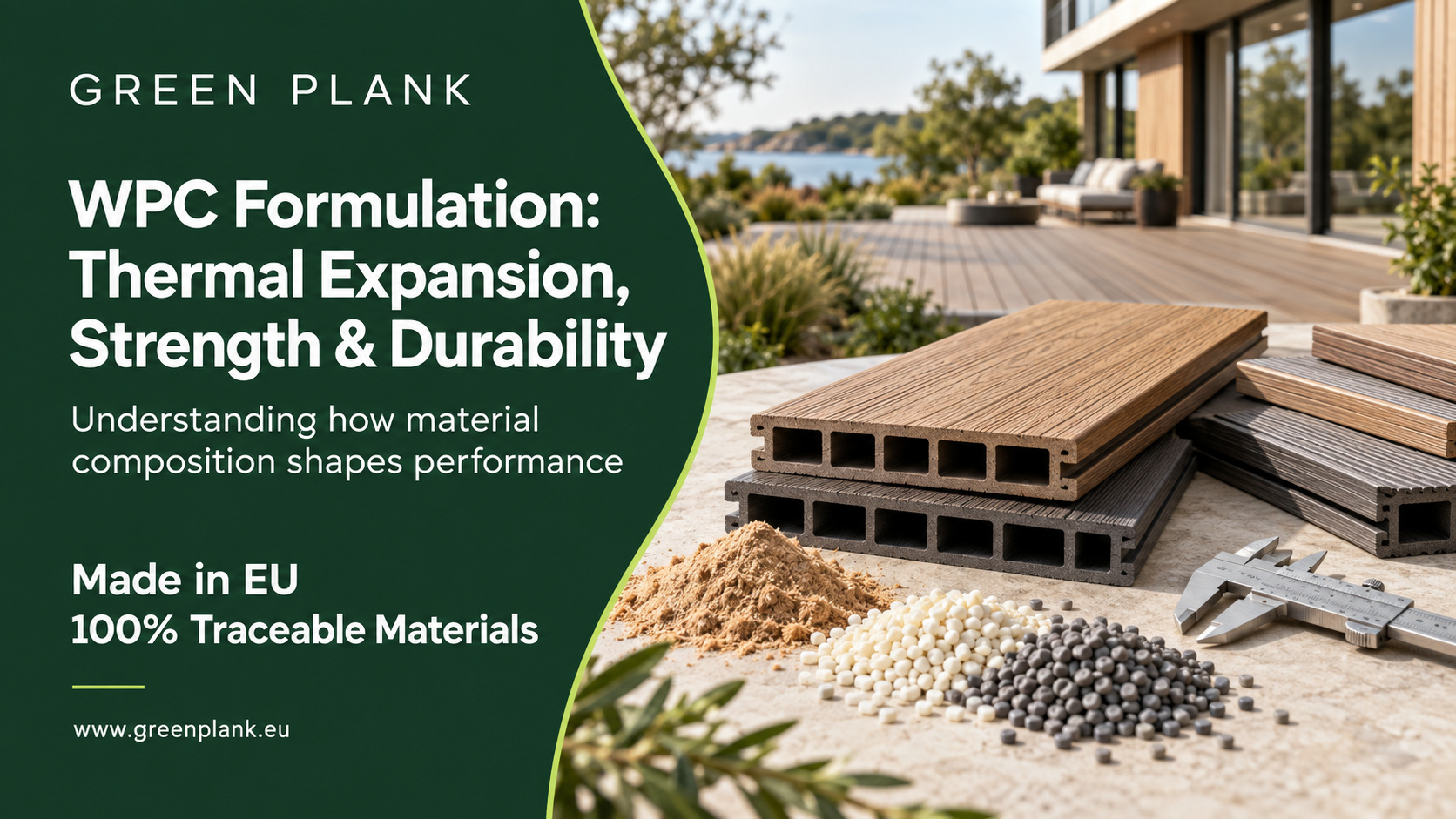
WPC Formulation: Thermal Expansion, Strength & Durability
What makes one wood-plastic composite perform differently from another? The answer is rarely a single ingredient. Premium WPC is an engineered system in which natural fibre, polymer, coupling technology, stabilisers, processing aids and manufacturing conditions work together to determine the properties of the finished profile.
Three characteristics are particularly important for outdoor decking: thermal expansion, mechanical strength and long-term durability. These properties are interconnected. Changing the wood-to-polymer ratio may improve one characteristic while creating new demands elsewhere in the formulation.
Green Plank principle: There is no universal percentage that guarantees premium WPC. Performance comes from balancing fibre quality, polymer properties, interface bonding, additives, extrusion control and profile engineering.
Understanding the basic WPC formulation
A typical WPC combines lignocellulosic material with a thermoplastic polymer and a relatively small but technically important additive package. Depending on the manufacturer, the natural component may be wood flour, wood fibre, bamboo or another plant-based material, while polymers can include polyethylene, polypropylene or PVC.
Green Plank focuses on PVC-free, HDPE-based WPC manufactured with a high proportion of European wood fibre. A representative formulation is approximately 75% European wood fibres, 15% HDPE and 10% functional additives, with individual formulations adapted according to profile and performance requirements.
| Component | Main role in WPC |
|---|---|
| Wood fibre | Contributes stiffness, material character and a high natural-fibre fraction |
| HDPE | Creates the thermoplastic matrix and helps encapsulate fibres |
| Coupling agent | Improves interaction between wood fibre and polymer |
| Lubricants/process aids | Support controlled mixing, extrusion and surface formation |
| UV/oxidation stabilisers | Help protect the material during processing and outdoor exposure |
| Pigments | Provide colour and contribute to the finished appearance |
1. Why does WPC expand and contract?
WPC contains a thermoplastic matrix, and thermoplastics change dimensions as temperature changes. A decking board exposed to summer sunlight may become considerably warmer than it is during a cold winter period, so some movement is normal.
Wood fibre modifies the behaviour of the polymer matrix and can constrain part of its thermal movement when fibre dispersion and bonding are effective. However, wood itself interacts with moisture. The dimensional stability of WPC is therefore determined by the complete composite rather than by polymer or fibre alone.
Factors affecting thermal movement
- polymer type and grade;
- wood-fibre percentage;
- fibre orientation and dispersion;
- fibre-polymer adhesion;
- profile geometry and wall thickness;
- board length;
- temperature range;
- colour and solar exposure;
- installation and fastening method.
This is why one generic expansion figure should not automatically be applied to every WPC product. Product-specific technical information and installation instructions should always take priority.
2. Does more wood fibre reduce thermal expansion?
Increasing fibre loading can reduce the proportion of thermoplastic in the composite and may restrain some polymer movement. This is one reason high-fibre formulations can offer attractive dimensional characteristics when they are correctly engineered.
But simply increasing wood content is not enough. At high loading, the available polymer must effectively wet, distribute and bind a large fibre surface area. Poor dispersion or insufficient bonding can create voids and weak interfaces, reducing the advantages expected from the formulation.
High wood content requires high process control
The higher the fibre loading, the more important fibre moisture, particle size, polymer rheology, compatibilisation, lubrication and extrusion stability become. Premium High Wood WPC is an engineering achievement, not simply a recipe with less plastic.
3. What determines WPC strength?
Mechanical strength is created by the interaction of several components. Wood fibres can contribute stiffness, while the polymer matrix binds the composite and transfers loads between fibres. The interface between the two phases is therefore critical.
Important strength-related variables include:
- fibre type and quality;
- fibre loading and particle geometry;
- polymer properties;
- coupling-agent efficiency;
- dispersion and internal porosity;
- profile cross-section and reinforcement ribs;
- extrusion and cooling conditions.
For architects, finished-board flexural data and application-specific support-spacing requirements are more useful than judging structural capability from wood percentage alone.
4. The critical role of fibre-polymer bonding
Wood fibres are hydrophilic, while HDPE is comparatively non-polar and hydrophobic. Without suitable interface engineering, these two materials do not naturally form the strongest possible bond.
Compatibilisers such as maleic-anhydride-grafted polyethylene, commonly known as MAPE, are widely used in polyethylene-based wood composites. They help improve interaction between the wood component and polymer matrix, supporting stress transfer and composite integrity.
The correct coupling system depends on the actual fibre, polymer, loading level and processing conditions. Excessive or insufficient dosage can affect performance and economics, so formulation development should be supported by production trials and testing.
5. Polymer grade influences processing and performance
Not all HDPE grades behave identically. Melt-flow characteristics, molecular structure, density and consistency influence how the polymer processes with high levels of wood fibre.
For high-filled profile extrusion, manufacturers generally need sufficient melt strength and suitable rheology rather than simply selecting a high-flow injection-moulding resin. Polymer selection should be matched to the extruder, screw configuration, fibre loading, additives and target profile.
| Polymer consideration | Why it matters |
|---|---|
| Melt-flow behaviour | Influences pressure, flow and profile stability |
| Melt strength | Helps maintain profile shape during extrusion |
| Consistency | Supports repeatable production |
| Thermal stability | Important during processing and service |
| Compatibility | Must work with fibre, coupling agent and additive package |
6. Moisture control affects strength and durability
Natural fibres can contain and absorb moisture. During extrusion, excessive moisture can turn into vapour and contribute to porosity, unstable processing or surface defects. Internal voids can then influence mechanical properties and moisture pathways.
Premium production therefore requires controlled fibre preparation, drying, storage and feeding. Moisture management may not be visible in the finished board, but it is one of the important differences between a controlled industrial process and an inconsistent one.
7. How additives contribute to long-term durability
Outdoor decking experiences UV radiation, oxygen, rain, temperature cycles, frost, dirt and mechanical use. The polymer and wood fibre alone cannot address every exposure condition.
A carefully designed additive system may include antioxidants, UV stabilisation, pigments, processing aids, lubricants and coupling technology. These ingredients represent a relatively small part of the formulation but can have a substantial influence on processing stability and long-term performance.
Durability should therefore never be predicted simply from a 70%, 75% or 80% wood-content claim.
8. Profile design is part of the formulation strategy
The same compound can perform differently when extruded into different profiles. Wall thickness, hollow chambers, reinforcement ribs, board width and surface geometry influence stiffness, weight and load distribution.
A carefully engineered hollow profile can provide efficient use of material while maintaining the required performance. A solid profile may be preferred for other applications. The correct comparison is therefore not simply solid versus hollow but tested profile versus tested profile.
9. Durability also depends on installation
Even a well-formulated WPC requires correct installation. Thermal movement must be accommodated, water must drain away and the underside of the decking needs appropriate ventilation according to the system design.
Professional installation should consider:
- correct joist spacing for the specific profile;
- adequate board-end and perimeter expansion gaps;
- appropriate substrate slope and drainage;
- ventilation below the decking;
- manufacturer-approved clips and fasteners;
- correct treatment of board joints and fixed structures.
Material engineering and installation engineering should therefore be considered together when evaluating long-term durability.
10. How should premium WPC be evaluated?
| Performance area | What professionals should examine |
|---|---|
| Thermal expansion | Product-specific dimensional data and installation guidance |
| Strength | Flexural performance, profile geometry and support spacing |
| Moisture | Water absorption, fibre encapsulation and manufacturing quality |
| Weathering | UV, oxidation and colour-stability strategy |
| Manufacturing | Raw-material and extrusion consistency |
| Durability | Finished-product testing plus correct installation |
Green Plank's formulation philosophy
Green Plank's European WPC strategy combines a high proportion of European wood fibre with HDPE and a carefully selected functional additive package. The objective is not simply to maximise wood content but to achieve an effective balance between stiffness, dimensional behaviour, moisture resistance, processability and long-term outdoor performance.
European raw-material traceability, controlled fibre quality, polymer selection, compatibilisation, extrusion technology and profile engineering are all part of this approach. The result is a PVC-free WPC concept designed around the complete composite system rather than one headline percentage.
Formulation defines potential; manufacturing turns that potential into performance. The final board must still be consistently extruded, correctly engineered, appropriately tested and properly installed.
Conclusion
Thermal expansion, strength and durability in WPC are interconnected properties. More fibre can change stiffness and thermal behaviour, more polymer can influence encapsulation and toughness, while coupling agents and stabilisers can strongly affect how the complete system performs.
The most effective WPC formulation is therefore not the one with the highest percentage of any single ingredient. It is the formulation in which wood fibre, polymer, interface chemistry, additives, processing technology and profile design are engineered to work together.
For architects, distributors and professional buyers, finished-product performance and technical documentation should ultimately carry more weight than a formulation percentage alone.
Sources
- https://greenplank.eu/">Green Plank – European WPC and composite building products
- https://www.sciencedirect.com/topics/materials-science/wood-plastic-composite">ScienceDirect Topics – Wood Plastic Composites
- https://www.fpl.fs.usda.gov/">USDA Forest Products Laboratory – Wood and wood-composite research
- https://plasticseurope.org/">Plastics Europe – Polymer materials and circularity information
Specify the product
Use this guide with a Green Plank specification
Technical articles support the commercial catalogue — category, product, evidence, then samples or quotes.