

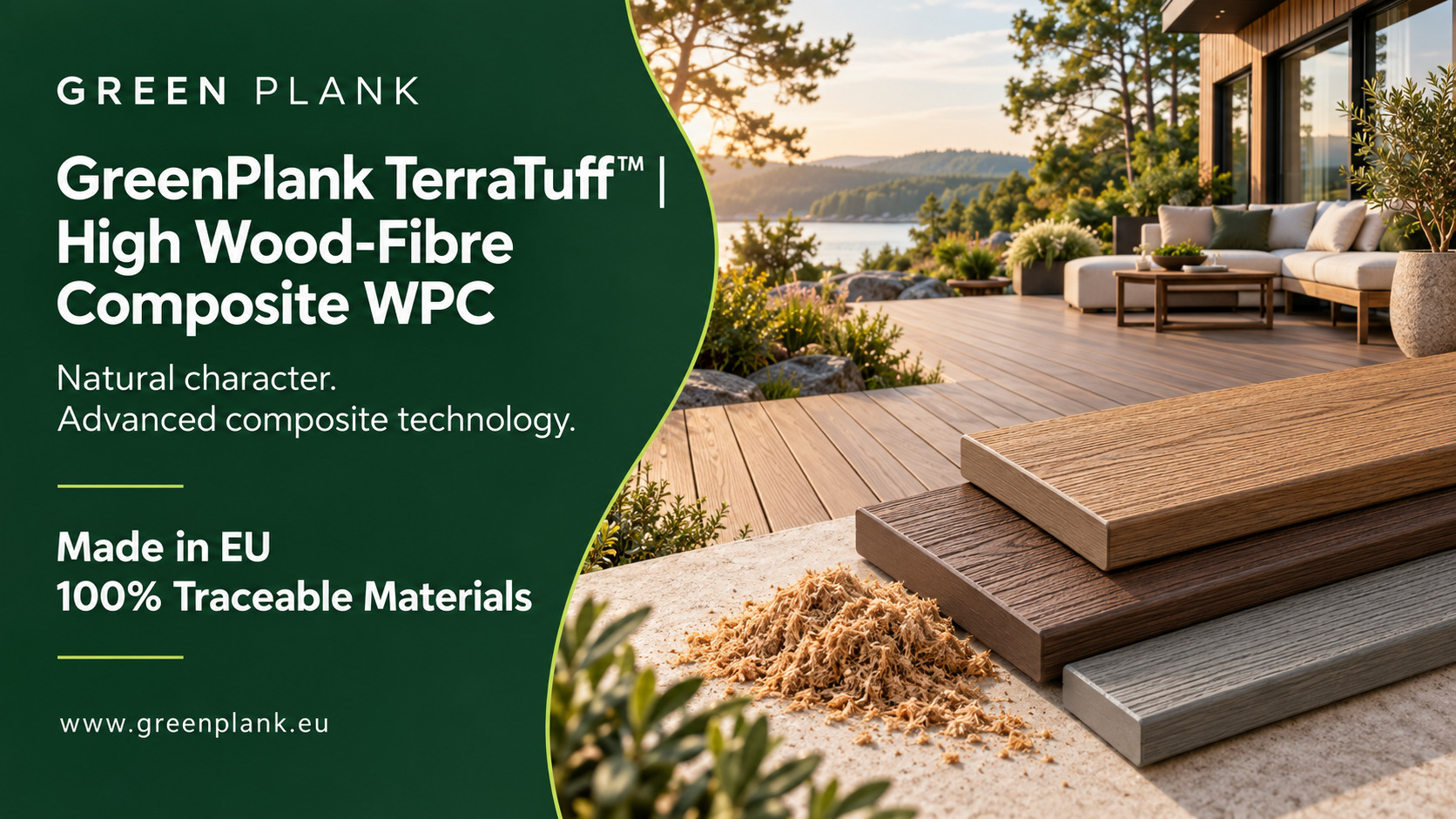
GreenPlank TerraTuff™: High Wood-Fibre Composite WPC
Premium composite decking should offer more than an attractive wood appearance. For architects, homeowners, contractors and commercial developers, the real value comes from the complete material system: carefully selected raw materials, controlled manufacturing, dimensional stability, outdoor durability, practical installation and low ongoing maintenance.
GreenPlank TerraTuff™ is developed around this philosophy. It combines high wood-fibre WPC engineering with a protective surface concept designed for contemporary outdoor environments. Manufactured in Europe, TerraTuff™ represents Green Plank's approach to creating PVC-free composite decking with a high proportion of European wood fibre and controlled HDPE technology.
TerraTuff™ philosophy: High wood content is only the beginning. Premium WPC requires quality fibres, the right polymer, effective bonding, functional additives, controlled extrusion and an engineered surface working together as one system.
What is TerraTuff™?
TerraTuff™ is Green Plank's high-performance composite decking concept developed for outdoor applications where appearance, durability and ease of ownership are important. The WPC core is based on a high proportion of European wood fibre combined with HDPE and functional additives, while the capped surface provides an additional engineered exterior layer.
This construction allows the core and surface to perform complementary roles: the wood-rich composite provides the structural foundation, while the outer layer is designed to enhance surface protection and visual consistency.
Why High Wood-Fibre WPC?
Wood fibre is not simply filler. In a properly formulated composite, natural fibres can contribute stiffness, influence dimensional behaviour and reduce the proportion of thermoplastic required. High wood-fibre loading can therefore be an attractive route to premium WPC, but it also places greater demands on formulation and manufacturing.
Important factors include:
- consistent European wood-fibre quality;
- controlled fibre moisture;
- defined particle size and cleanliness;
- suitable HDPE rheology;
- effective fibre-polymer compatibilisation;
- carefully balanced lubricants and processing aids;
- UV and oxidation protection;
- controlled extrusion and profile calibration.
High fibre content requires high manufacturing control
As wood-fibre loading increases, effective dispersion and fibre-polymer bonding become increasingly important. Premium High Wood WPC is therefore not created by adding more wood alone; it requires a formulation and extrusion process specifically engineered for the material.
The TerraTuff™ material approach
Green Plank's wider WPC technology is based on a representative formulation of approximately 75% European wood fibres, 15% HDPE and 10% functional additives. Individual product formulations and surface systems can be adapted according to performance and manufacturing requirements.
| Material element | Function |
|---|---|
| European wood fibre | Provides the high natural-fibre content and contributes to composite stiffness |
| HDPE matrix | Binds and encapsulates fibres within the thermoplastic composite |
| Coupling technology | Supports interaction between wood fibre and polyethylene |
| Functional additives | Support processing, stabilisation, colour and outdoor performance |
| Engineered cap layer | Provides an additional protective and decorative surface |
Why fibre-polymer bonding matters
Wood fibre is naturally hydrophilic, whereas HDPE is comparatively non-polar and hydrophobic. Simply mixing the two materials does not automatically create an optimal interface. Premium polyethylene-based WPC therefore requires appropriate compatibilisation.
Coupling technologies such as maleic-anhydride-grafted polyethylene are commonly used in wood/polyethylene composites to improve interaction between the natural fibre and polymer matrix. Effective bonding can support stress transfer and create a more integrated composite structure.
This becomes particularly important in high-fibre formulations because a relatively small polymer fraction must interact with a large fibre surface area.
What does the capped surface add?
Capped WPC uses co-extrusion technology to create a dedicated surface layer around or over the composite core. Rather than asking the core formulation to perform every function, manufacturers can engineer the surface specifically for outdoor exposure and aesthetics.
Depending on the specific surface formulation and profile, the cap concept can provide benefits such as:
- enhanced resistance to everyday surface staining;
- additional protection for the composite core;
- consistent colour and surface appearance;
- wood-inspired embossing and visual design;
- easier routine cleaning;
- greater design flexibility for premium decking collections.
The performance of capped decking still depends on the complete system. Cap adhesion, core quality, processing conditions and profile design must all be correctly controlled.
Designed for European outdoor environments
Outdoor decking experiences changing temperatures, rain, sunlight, moisture, frost and repeated pedestrian use. These conditions make dimensional engineering and installation particularly important.
Like other thermoplastic composites, TerraTuff™ responds to temperature changes. Correct board spacing, perimeter clearances, ventilation, drainage and support spacing should therefore follow the technical instructions for the specific profile.
This is especially relevant for long boards, where small dimensional changes per linear metre can accumulate over the full board length.
Strength is more than material percentage
A high wood-fibre percentage alone does not determine the load capacity of decking. Mechanical behaviour depends on fibre quality, bonding, polymer characteristics, internal porosity and the geometry of the finished profile.
For professional projects, several factors should be considered together:
| Performance area | What matters |
|---|---|
| Stiffness | Fibre content, bonding and profile geometry |
| Load distribution | Cross-section, wall thickness and internal structure |
| Dimensional stability | Formulation, temperature, moisture and board length |
| Surface performance | Cap technology, colour, texture and exposure |
| Installed performance | Joist spacing, ventilation, drainage and fastening |
Low-maintenance outdoor living
One of the main reasons homeowners and commercial clients choose composite decking is the opportunity to reduce routine surface maintenance compared with conventional timber decking.
TerraTuff™ does not require the traditional cycle of sanding, staining and oiling associated with many exposed timber surfaces. Normal care instead focuses on routine cleaning and keeping the deck free from accumulated dirt and debris.
Practical maintenance includes:
- regular sweeping;
- cleaning spills reasonably quickly;
- washing the surface according to Green Plank guidance;
- keeping board gaps clear for drainage;
- maintaining airflow around the substructure;
- periodically inspecting fasteners, edges and supporting structures.
Architectural freedom with colours and lengths
Modern composite decking should support design rather than restrict it. TerraTuff™ is developed with contemporary architecture in mind, allowing designers to combine wood-inspired surfaces with a controlled, repeatable appearance.
Green Plank's TerraTuff™ production strategy includes practical board lengths such as 3, 4, 5 and 6 metres, helping architects and installers plan different terrace dimensions while reducing unnecessary joints where project conditions allow.
A broad colour strategy also makes the system suitable for contemporary residential terraces, hospitality environments, waterfront projects and public-facing outdoor areas. Project-specific colours may be possible subject to order volume and manufacturing requirements.
European production and traceable materials
Green Plank places particular emphasis on European manufacturing and European raw-material sourcing. For professional buyers, regional production can provide advantages beyond geography.
Potential benefits include:
- greater visibility into raw-material origin;
- closer manufacturing and quality control;
- shorter supply chains for European projects;
- more responsive production planning;
- European technical documentation and project support;
- reduced dependence on long intercontinental shipping routes.
Origin alone does not guarantee quality, which is why Green Plank combines European sourcing with material specifications, process control and product engineering.
TerraTuff™ compared with conventional timber decking
| Consideration | TerraTuff™ WPC | Conventional timber |
|---|---|---|
| Routine oiling/staining | Not normally required | Often required depending on timber and desired appearance |
| Material consistency | Engineered composite | Natural variation |
| Surface design | Controlled colours and textures | Natural grain and species dependent |
| Dimensional movement | Thermal and moisture-related movement must be accommodated | Primarily moisture-related movement |
| Maintenance planning | Cleaning and inspection focused | May include cleaning, oiling, staining or refinishing |
Where can TerraTuff™ be used?
The combination of high wood-fibre composite technology, capped surface design and low-maintenance characteristics makes TerraTuff™ relevant to a broad range of outdoor projects, subject to product-specific technical requirements.
- private terraces and patios;
- balconies and rooftop outdoor areas;
- hospitality terraces;
- restaurants and cafés;
- poolside environments where the specified system is suitable;
- waterfront and marina-related projects;
- commercial outdoor spaces;
- landscape and public-space projects.
What should professional buyers evaluate?
When comparing TerraTuff™ with another composite decking system, architects and distributors should look beyond colour and price. Useful questions include:
- Where are the decking and its principal raw materials produced?
- What type and percentage of wood fibre are used?
- Which polymer system is used?
- How is fibre-polymer compatibility managed?
- Is the product capped or uncapped?
- What board lengths and colours are available?
- What support spacing applies to the selected profile?
- What expansion and ventilation requirements apply?
- Which maintenance procedures are recommended?
- What technical documentation and warranty conditions are available?
TerraTuff™: more than a wood-fibre percentage
The premium character of TerraTuff™ is not based on one headline number. High European wood-fibre content is an important part of the material philosophy, but performance depends on how those fibres are prepared, bonded and processed together with HDPE and functional additives.
The capped surface, profile engineering, extrusion control, European sourcing and installation system complete the concept. This systems approach is what transforms raw ingredients into a practical architectural decking product.
Green Plank TerraTuff™: High wood-fibre content. PVC-free HDPE composite technology. European production. Engineered surfaces. Designed for durable, attractive and low-maintenance outdoor spaces.
Conclusion
TerraTuff™ represents Green Plank's approach to modern premium WPC: combining a high proportion of European wood fibre with HDPE composite engineering and a protective capped surface.
For architects, contractors, distributors and homeowners, the important advantage is not simply the percentage of wood in the board. It is the complete combination of controlled raw materials, fibre-polymer bonding, functional additives, co-extrusion technology, profile engineering, European manufacturing and correct installation.
That complete-system approach is what allows TerraTuff™ to bring the appearance and material character of wood-inspired decking together with the practical advantages expected from contemporary composite technology.
Sources
- https://greenplank.eu/">Green Plank – European WPC and composite building products
- https://www.sciencedirect.com/topics/materials-science/wood-plastic-composite">ScienceDirect Topics – Wood Plastic Composites
- https://www.fpl.fs.usda.gov/">USDA Forest Products Laboratory – Wood and wood-composite research
- https://single-market-economy.ec.europa.eu/sectors/construction/construction-products-regulation-cpr_en">European Commission – Construction Products Regulation
Specify the product
Use this guide with a Green Plank specification
Technical articles support the commercial catalogue — category, product, evidence, then samples or quotes.