



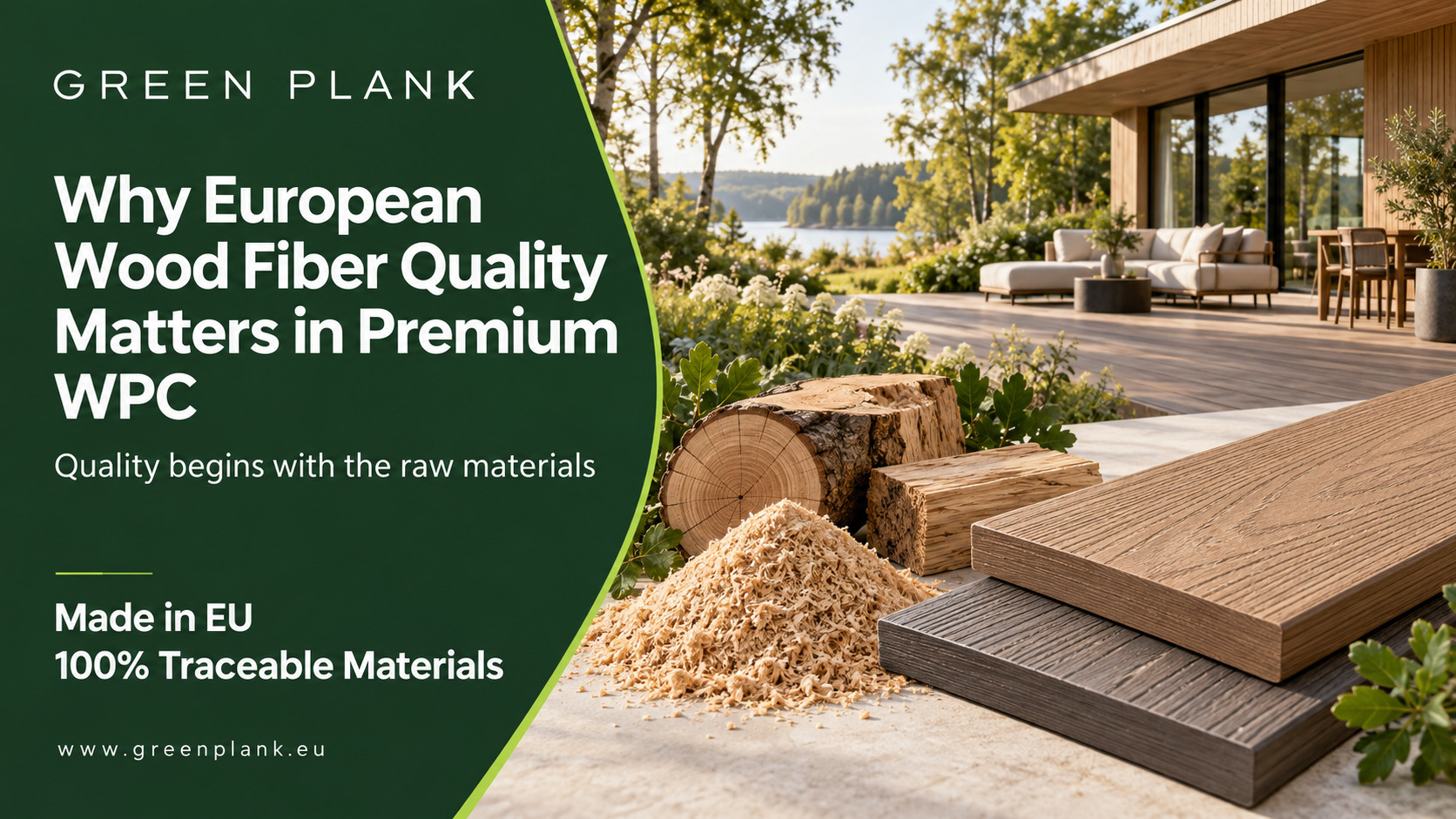
Why European Wood Fiber Quality Matters in Premium WPC
Wood fiber is sometimes described as little more than filler in wood-plastic composite. In a premium WPC formulation, however, it is a critical engineering material. Its species, moisture level, particle geometry, purity, preparation and consistency can influence extrusion behaviour, mechanical properties, dimensional stability, surface quality and long-term outdoor performance.
This becomes particularly important in High Wood WPC, where natural fiber represents the majority of the formulation. When 70% or more of a composite consists of wood-based material, the quality of that material cannot be separated from the quality of the finished board.
Green Plank perspective: High wood content creates value only when the wood fiber itself is carefully selected, prepared, controlled and effectively integrated with the polymer matrix.
Wood fiber is an active part of the composite
In WPC, wood fibers interact mechanically and chemically with the thermoplastic matrix. They can contribute stiffness, influence thermal behaviour and help reduce the proportion of polymer required. At the same time, natural fibers introduce technical challenges because they absorb moisture and must be dispersed effectively during processing.
Important wood-fiber characteristics include:
- wood species and source;
- moisture content;
- particle-size distribution;
- fiber geometry and aspect ratio;
- purity and contamination level;
- bulk density and feeding consistency;
- thermal condition during processing;
- traceability between batches.
A premium WPC producer therefore evaluates wood fiber as a controlled raw material rather than simply purchasing the lowest-cost wood flour available.
1. Why does European sourcing matter?
European sourcing can provide advantages when it is combined with effective supplier qualification and traceability. Regional supply chains can make it easier to understand where raw materials originate, maintain closer communication with suppliers and reduce long-distance transportation.
European wood-processing industries also generate side streams that can potentially be transformed into valuable composite raw materials rather than treated as low-value residues. Using suitable fibers from established processing streams can support resource efficiency when quality is carefully controlled.
However, European origin alone does not guarantee premium quality. A manufacturer must still specify moisture, particle size, cleanliness and consistency. Geography provides context; quality control delivers performance.
2. Hardwood species can influence WPC behaviour
Different wood species have different densities, anatomical structures and chemical compositions. These differences can influence grinding, feeding, moisture interaction and compatibility with the polymer matrix.
Green Plank's approach focuses on controlled European wood fibers, including hardwood sources such as beech and oak within its material strategy. For high-fiber formulations, consistent sourcing is valuable because changing fiber characteristics can alter extrusion behaviour even when the percentage shown on the recipe remains unchanged.
| Fiber characteristic | Why it matters in WPC |
|---|---|
| Wood species | Influences density, structure and processing behaviour |
| Moisture | Can affect porosity, extrusion stability and surface quality |
| Particle size | Influences feeding, dispersion and composite structure |
| Purity | Reduces unpredictable contamination and processing variation |
| Consistency | Supports repeatable extrusion from batch to batch |
| Traceability | Improves raw-material transparency and quality management |
3. Moisture control is fundamental
Wood is hygroscopic, meaning that it interacts with moisture in the surrounding environment. During WPC production, excessive fiber moisture can become particularly problematic because the material is processed at elevated temperatures.
If moisture is not adequately managed, vapour generation can contribute to unstable extrusion, internal voids or surface defects. Those effects can influence both appearance and physical properties.
A hidden quality factor
Consumers see the colour and texture of a decking board, but they cannot see how carefully the fiber was dried before extrusion. Moisture control is one of the less visible manufacturing disciplines that can separate controlled premium production from inconsistent WPC manufacturing.
4. Particle size affects more than appearance
Wood fiber must be transported, mixed and distributed through a viscous thermoplastic melt. Particle geometry therefore affects processing as well as the internal structure of the composite.
If particles are excessively large, irregular or inconsistent, feeding and dispersion may become more difficult. Very fine particles behave differently and increase available surface area. A controlled particle-size distribution helps the manufacturer maintain predictable compound behaviour.
The optimum fiber geometry depends on the extrusion system, polymer, fiber loading, coupling technology and desired profile. Premium production is therefore based on a defined specification rather than an uncontrolled mixture of wood particles.
5. High wood content increases the importance of fiber quality
Consider two WPC formulations that both contain 70% wood fiber. One uses clean, dry and consistently sized fiber. The other uses material with varying moisture, particle size and contamination. Although both products can advertise the same 70% wood content, their processing consistency and finished properties may be very different.
The challenge becomes even greater as fiber loading increases because the available polymer must wet and bind a larger quantity of natural material.
For High Wood WPC, manufacturers must carefully coordinate:
- fiber moisture and particle distribution;
- HDPE grade and melt behaviour;
- coupling-agent technology;
- lubrication and processing aids;
- mixing and dispersion;
- extrusion temperature and pressure;
- cooling and profile calibration.
6. Fiber-polymer bonding determines how the materials work together
Wood fibers are hydrophilic, while polyethylene is comparatively non-polar and hydrophobic. This difference means that simply mixing wood and HDPE does not automatically create an optimally bonded composite.
Coupling agents such as maleic-anhydride-grafted polyethylene are widely used in wood/polyethylene composites to improve interaction between the natural fiber and polymer matrix. Better interface engineering can support more effective stress transfer and composite integrity.
Fiber quality is important here as well. Moisture, contamination and surface characteristics can influence how effectively the complete formulation works.
7. How fiber quality influences mechanical performance
Wood fiber can contribute stiffness to a thermoplastic composite, but performance depends on successful dispersion and bonding. Poorly distributed fibers, internal voids or weak interfaces can reduce the effectiveness of the reinforcement.
The mechanical behaviour of a finished WPC profile is therefore influenced by several interconnected variables:
| Performance factor | Influenced by |
|---|---|
| Flexural stiffness | Fiber loading, quality, bonding and profile geometry |
| Strength | Interface quality, dispersion, polymer and void content |
| Impact behaviour | Polymer characteristics, fiber level and formulation |
| Creep behaviour | Material system, load, temperature and profile design |
| Dimensional stability | Fiber, polymer, moisture, temperature and geometry |
8. Fiber quality and moisture resistance
Wood fibers naturally interact with water, while HDPE has much lower water affinity. Premium WPC formulation aims to distribute and encapsulate fibers effectively within the polymer matrix while creating a strong interface between the two phases.
Moisture behaviour depends on fiber loading, encapsulation, bonding, porosity, profile design and exposed surfaces. High-quality dry fiber and controlled processing help manufacturers manage these factors more consistently.
This is why a high wood percentage should always be considered together with water-absorption performance and manufacturing quality.
9. Fiber quality can influence dimensional stability
WPC dimensional behaviour is a combination of polymer response to temperature and natural-fiber response to moisture. Good formulation seeks to balance these mechanisms.
Higher fiber loading can constrain some thermal movement of the polymer matrix when bonding and dispersion are effective. At the same time, moisture interaction with the natural component must be controlled. Consistent fiber quality helps manufacturers achieve more predictable behaviour from one production batch to another.
Product-specific installation guidance remains essential because board length, profile geometry, colour, exposure and temperature range also affect movement in service.
10. Traceability is part of premium raw-material management
Traceability allows manufacturers to understand where materials originate and to maintain defined specifications across supply batches. For architects and professional buyers, this can provide greater transparency than a generic statement such as contains wood fiber.
Useful questions include:
- Where does the wood fiber originate?
- Which wood species or processing streams are used?
- How is moisture controlled?
- Is particle size specified?
- How is contamination managed?
- Are incoming batches tested or documented?
- How is the fiber stored before production?
- Is raw-material traceability maintained?
European wood fiber and sustainability
Sustainability should be assessed across the complete product lifecycle. Using European wood-processing side streams as composite raw material can support resource efficiency, while regional sourcing can shorten supply chains compared with importing equivalent raw materials over very long distances.
However, environmental performance also depends on manufacturing efficiency, polymer source, product durability, maintenance, transport and end-of-life options. Premium WPC should therefore combine responsible sourcing with long service life and efficient material use.
Green Plank's European High Wood approach
Green Plank develops PVC-free WPC around a high proportion of controlled European wood fiber. A representative formulation is approximately 75% European wood fibers, 15% HDPE and 10% functional additives, with individual formulations adapted to product requirements.
The objective is not simply to advertise a high fiber percentage. Green Plank's material philosophy combines European sourcing, traceability, controlled fiber preparation, appropriate HDPE technology, compatibilisation, functional additives, extrusion control and engineered profile geometry.
Premium WPC begins before extrusion. If the wood fiber entering the factory is inconsistent, wet or contaminated, sophisticated machinery cannot fully compensate for poor raw-material control. Consistency starts with the fiber itself.
Conclusion: quality starts with the raw material
European wood fiber can be an excellent foundation for premium WPC, but its value comes from more than geographical origin. Species, moisture, particle geometry, cleanliness, consistency and traceability determine how effectively the fiber can be transformed into a high-performance composite.
For High Wood WPC in particular, fiber quality becomes central to processing stability, mechanical performance, dimensional behaviour, moisture management and finished-product consistency.
For architects, distributors and professional buyers, the better question is therefore not simply how much wood fiber does this WPC contain? It is what quality of fiber is being used, where does it come from and how carefully is it controlled?
Sources
- https://greenplank.eu/">Green Plank – European WPC and composite building products
- https://www.sciencedirect.com/topics/materials-science/wood-plastic-composite">ScienceDirect Topics – Wood Plastic Composites
- https://www.fpl.fs.usda.gov/">USDA Forest Products Laboratory – Wood and wood-composite research
- https://www.fao.org/forestry/">FAO Forestry – Forest resources and sustainable wood use
Specify the product
Use this guide with a Green Plank specification
Technical articles support the commercial catalogue — category, product, evidence, then samples or quotes.