



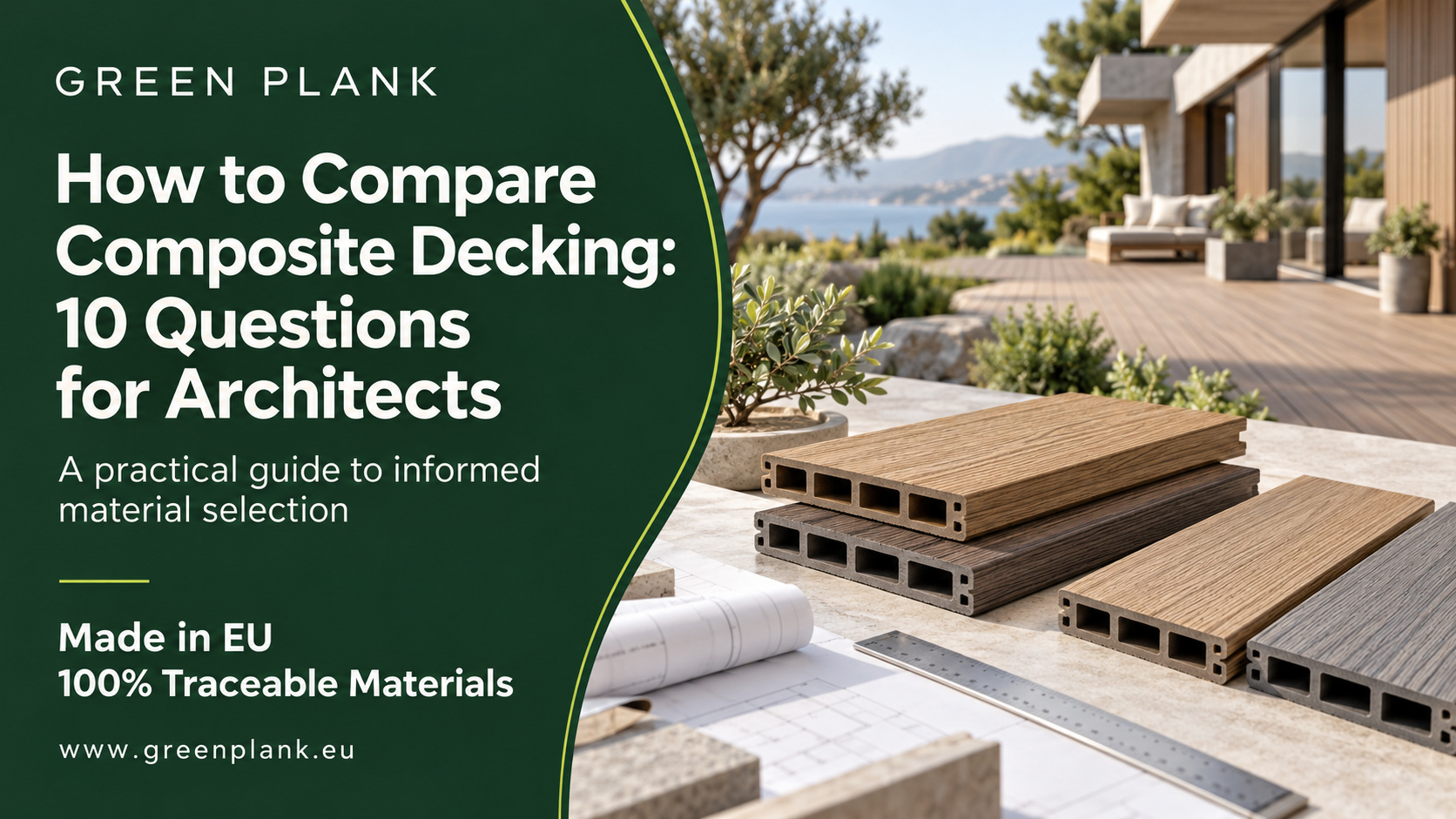
How to Compare Composite Decking: 10 Questions for Architects
Composite decking can look remarkably similar from one manufacturer to another, yet its composition, structural performance, dimensional behaviour, installation requirements and long-term maintenance can differ considerably. For architects, landscape architects, developers and specification professionals, choosing a decking system therefore requires more than comparing colour samples and price per square metre.
A professional assessment should examine the complete system: raw materials, formulation, profile design, manufacturing consistency, technical documentation, installation details and expected performance in the intended environment. The following ten questions provide a practical framework for evaluating WPC decking before it is specified for residential, commercial or public projects.
Green Plank specification principle: Compare decking as an engineered system rather than simply as a board. Composition, profile geometry, substructure, fixings, ventilation and installation details all contribute to long-term performance.
1. What is the decking actually made from?
Begin with the material formulation. WPC normally combines lignocellulosic material such as wood fibre with a thermoplastic polymer and functional additives. However, percentages and raw-material quality vary between products.
Ask the manufacturer to identify:
- wood-fibre percentage and source;
- polymer type, such as HDPE, PP or PVC;
- whether the polymer is virgin, recycled or a controlled blend;
- compatibilisers and functional additives;
- UV and oxidation protection;
- pigments and processing aids.
Green Plank's European high-wood-fibre approach is based around approximately 75% European wood fibres, 15% HDPE and 10% functional additives. The system is PVC-free. The formulation should always be considered together with manufacturing quality and profile engineering rather than judging performance from one percentage alone.
2. How consistent and traceable are the raw materials?
Consistency is particularly important for architectural specifications where boards may be supplied over several deliveries or project phases. Variations in fibre moisture, particle size, polymer characteristics or additives can affect extrusion behaviour and finished-board properties.
Architects should therefore ask whether raw materials are traceable and whether incoming materials are subject to defined quality controls. European sourcing can also provide advantages where shorter, more transparent supply chains and documented material origins are project priorities.
3. What technical performance has been documented?
Marketing descriptions such as premium, strong or durable are not substitutes for technical information. Request documentation relevant to the actual application and profile being specified.
| Property | Why architects should check it |
|---|---|
| Flexural performance | Helps evaluate stiffness, loading and required support spacing. |
| Water absorption | Relevant to moisture exposure and dimensional behaviour. |
| Slip performance | Important for terraces, walkways and public environments. |
| UV/weathering performance | Provides information about outdoor ageing and appearance. |
| Thermal expansion | Influences board gaps, end clearances and installation detailing. |
| Fire performance | May be essential depending on building type and local requirements. |
4. How dimensionally stable is the system?
WPC contains a thermoplastic phase, so temperature changes can cause expansion and contraction. Wood fibre can also interact with moisture. The magnitude of dimensional movement depends on formulation, board geometry, colour, temperature range, moisture exposure and manufacturing quality.
Architects should request clear installation guidance covering expansion allowances, board-end spacing, perimeter clearance and fixing strategy. A system designed to accommodate predictable movement is preferable to one where dimensional behaviour is addressed only after installation.
5. What support spacing does the profile require?
Joist spacing has direct consequences for structural design, material quantities, labour and project cost. Two boards with similar dimensions can require different support centres because profile geometry and mechanical performance differ.
Ask for the manufacturer's maximum permitted joist spacing for the exact application. Residential terraces, heavily trafficked commercial areas, stairs and diagonal installations may require different support arrangements.
Specification tip
Never transfer installation spacing from one composite product to another simply because the boards have similar dimensions. Use the technical requirements for the exact product, profile and application.
6. How is drainage and ventilation managed?
A successful terrace is more than its visible surface. Water must be able to drain, and the substructure should allow appropriate ventilation. Poor drainage or restricted airflow can create persistent moisture conditions and increase the risk of dirt accumulation and installation problems.
When reviewing a system, check requirements for:
- ground clearance and ventilation;
- drainage direction and substrate slope;
- distance from walls and fixed structures;
- board-to-board gaps;
- joist arrangement;
- water evacuation around clips and intersections.
7. What does the complete installation system include?
Decking should be evaluated as a system consisting of boards, joists or supports, clips, screws, start/end fixings and finishing details. Concealed fixing systems can create a clean architectural appearance, but the clips must also maintain appropriate spacing and allow the boards to behave as intended.
Ask whether the manufacturer supplies detailed instructions for edge boards, stairs, picture-frame borders, board joints, transitions and unusual geometries. Good documentation can reduce uncertainty for contractors and improve consistency across larger projects.
8. What maintenance will actually be required?
Composite decking is commonly selected because it avoids many maintenance operations associated with conventional timber decking. Nevertheless, low maintenance does not mean zero maintenance.
Outdoor surfaces still collect leaves, dust, pollen, food residue and atmospheric dirt. Periodic cleaning and inspection remain sensible. Architects should compare products according to realistic maintenance requirements rather than broad maintenance-free claims.
| Consideration | Traditional timber | Quality WPC |
|---|---|---|
| Routine cleaning | Required | Required |
| Regular oiling/staining | Often required depending on timber/system | Normally not required |
| Surface weathering | Natural ageing can be substantial | Depends on formulation, colour and exposure |
| Maintenance planning | Typically more intensive | Generally lower |
9. What is the environmental and lifecycle story?
Sustainability assessment should go beyond a single recycled-content percentage. Material origin, manufacturing location, transport distance, expected service life, maintenance requirements and end-of-life possibilities can all influence the broader environmental profile.
For European projects, locally or regionally manufactured products can also reduce long-distance transport compared with products shipped across continents. Green Plank focuses on European manufacturing and traceable European raw materials as part of its approach to responsible material sourcing.
For projects with formal sustainability objectives, request supporting documentation rather than relying solely on environmental marketing statements.
10. What is the lifecycle value, not just the purchase price?
The lowest initial board price does not necessarily produce the lowest project cost. Architects and developers should consider the complete installed and operational cost over the expected service period.
- Calculate boards and substructure requirements.
- Include clips, screws, trims and accessories.
- Consider installation labour and construction complexity.
- Estimate cleaning and maintenance requirements.
- Consider replacement risk and expected service conditions.
- Compare warranty scope and technical support.
This lifecycle perspective is especially relevant for hotels, housing developments, schools, municipal spaces, waterfronts and other projects where maintenance access and future disruption have financial consequences.
A practical architect's comparison checklist
| Question | What to request |
|---|---|
| 1. Composition? | Material percentages and polymer type |
| 2. Raw-material quality? | Origin, traceability and quality control |
| 3. Tested performance? | Technical data and relevant test documentation |
| 4. Dimensional stability? | Expansion and installation guidance |
| 5. Support spacing? | Application-specific joist centres |
| 6. Drainage? | Ventilation, slope and clearance requirements |
| 7. Installation system? | Boards, clips, screws and construction details |
| 8. Maintenance? | Cleaning and care instructions |
| 9. Sustainability? | Material origin and available environmental documentation |
| 10. Lifecycle value? | Installed cost, maintenance, warranty and support |
Why specification quality matters
The best composite decking for an architectural project is not necessarily the board with the highest wood content, the most polymer, the thickest profile or the lowest price. Performance comes from the relationship between formulation, raw-material consistency, profile engineering, extrusion quality and correct installation.
For architects, the objective should therefore be to select a documented system whose technical characteristics match the project's climate, loading, aesthetics, maintenance strategy and expected service conditions.
Green Plank develops PVC-free WPC solutions in Europe with a focus on European wood fibres, controlled formulations, traceable materials and products designed for demanding outdoor applications. Asking the right questions at specification stage makes it easier to compare alternatives objectively and create outdoor environments designed for long-term value.
Sources
- https://greenplank.eu/">Green Plank – composite decking and outdoor building products
- https://single-market-economy.ec.europa.eu/sectors/construction/construction-products-regulation-cpr_en">European Commission – Construction Products Regulation
- https://www.sciencedirect.com/topics/materials-science/wood-plastic-composite">ScienceDirect Topics – Wood Plastic Composite
Specify the product
Use this guide with a Green Plank specification
Technical articles support the commercial catalogue — category, product, evidence, then samples or quotes.