



Could the invisible core of your deck be the reason it fails in five years, or the reason it remains pristine for fifty? Most homeowners prioritize the aesthetic grain of a board, yet the structural integrity of your outdoor living space depends entirely on the hidden matrix within. When you ask what is the best core for composite decking, you're really asking which material can withstand moisture and temperature fluctuations without warping. It's a matter of engineering precision meeting environmental ethics.
We understand the frustration of navigating conflicting claims about HDPE versus PVC or hardwood versus softwood fibers. You deserve a deck that remains stable for decades while respecting the natural world. Discover how material composition, fiber ratios, and polymer selection determine the longevity and stability of your composite deck. We'll break down the science of fiber ratios, the benefits of European raw materials, and the specific material selections that ensure your investment delivers a service life of up to 50 years.
Key Takeaways
- Identify the structural role of the internal matrix to ensure your deck remains flat and stable regardless of seasonal temperature shifts.
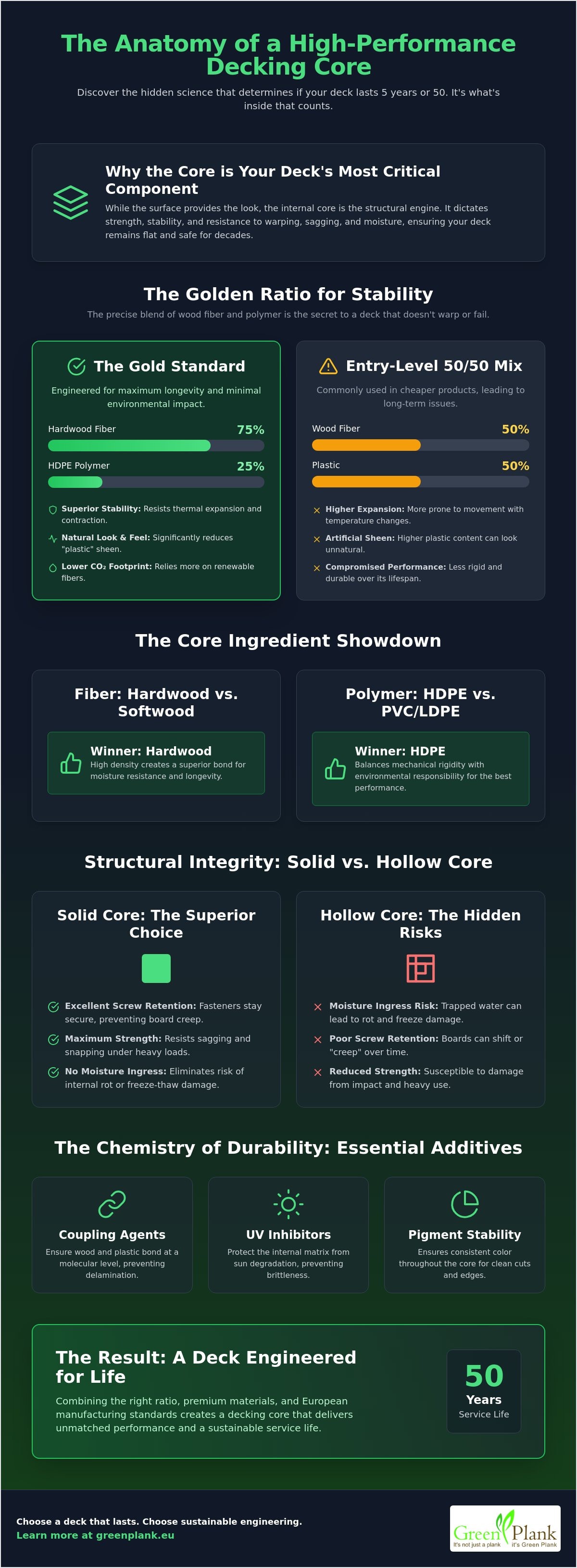
- Discover why the 75% hardwood to 25% HDPE ratio is the engineering standard when determining what is the best core for composite decking.
- Evaluate the performance differences between HDPE and PVC to select a material that balances mechanical rigidity with environmental responsibility.
- Learn how the high density of hardwood fibers creates a superior bond within the polymer matrix for enhanced moisture resistance and longevity.
- Understand the value of European manufacturing standards and how they support a sustainable service life of up to 50 years.
Understanding the Anatomy: What is a Composite Decking Core?
While the surface of a deck captures the eye, the internal core serves as the engine room of the board. This hidden layer dictates how the material responds to heavy foot traffic and shifting weather. A WPC core is a homogenized blend of organic fibers and thermoplastic polymers. Understanding this composition is vital when determining what is the best core for composite decking, as it directly impacts the board's tensile strength and load-bearing capacity. These Wood-plastic composites (WPCs) rely on this internal matrix to maintain structural integrity over decades of use. When engineers evaluate these materials, they prioritize a core that resists the natural urge of organic fibers to expand when exposed to humidity.
Modern engineering utilizes co-extrusion to wrap this core in a protective outer shell, known as capping. While the cap resists fading and scratches, the core provides the essential skeleton. This division of labor ensures the product remains beautiful on the outside and uncompromisingly strong on the inside. A high-quality core prevents the board from sagging or snapping under pressure, ensuring the deck remains a safe, level surface for its entire lifespan. By focusing on the internal chemistry, manufacturers can guarantee a level of regional reliability that standard timber simply cannot match.
Solid Core vs. Hollow Core: Which is Superior?
The choice between solid and hollow profiles often depends on the specific application, yet for most high-end projects, the solid core is the clear winner. Solid cores are generally superior because they offer excellent screw retention. This density ensures that fasteners stay secure, preventing boards from shifting or "creeping" over time. While hollow cores are sometimes used in commercial infrastructure profiles to reduce weight, they carry significant moisture ingress risks. If water becomes trapped within the internal chambers of a hollow board, it can lead to internal rot or freeze-thaw expansion that compromises the entire structure. For a deck intended to last 30 to 50 years, the density of a solid core provides a necessary foundation of confidence.
The Role of Additives in Core Stability
A premium core is more than just wood and plastic; it's a sophisticated chemical assembly designed for long-term performance. Additives play a quiet but critical role in maintaining this stability. When investigating what is the best core for composite decking, you must consider these three essential components:
- Coupling agents: These ensure the wood fibers and plastic bond at a molecular level, preventing internal delamination.
- UV inhibitors: They protect the internal matrix from degradation, ensuring the core won't become brittle even if the cap is damaged.
- Pigment stability: Consistent coloring throughout the matrix prevents unsightly edges if the board is cut or notched during installation.
This precise engineering allows the core to function as a unified material rather than a loose mixture of ingredients. It's this commitment to material science that enables professional-grade decking to offer such extensive performance guarantees.
Wood Fiber vs. Plastic Ratios: Finding the Golden Ratio for Stability
The structural stability of an outdoor living space is rarely accidental. It's the result of precise material ratios that balance the organic rigidity of timber with the protective qualities of polymers. While many entry-level products utilize a 50/50 split of wood and plastic, engineering data for 2026 suggests this often leads to compromised performance. When professionals evaluate what is the best core for composite decking, they look beyond the surface grain to the specific ratio of fiber to polymer. A high-density matrix featuring 75% hardwood fiber and 25% High-Density Polyethylene (HDPE) has emerged as the gold standard for long-term stability.
This specific ratio serves a dual purpose. First, it significantly reduces the artificial, "plastic" sheen that plagues many low-quality boards. Second, it addresses the physics of thermal expansion. Polymers naturally expand and contract with temperature changes; wood fibers do not. By increasing the organic content to 75%, the board gains a natural skeleton that resists internal movement. This high organic content also supports a lower CO2 footprint, as it relies more heavily on renewable fibers than petroleum-based plastics. The manufacturing of WPC at this level of precision requires sophisticated homogenization to ensure the fibers are perfectly encapsulated, preventing moisture absorption while maintaining maximum rigidity.
The Problem with High-Plastic Cores
Cores with high polymer concentrations often struggle in extreme climates. These boards exhibit increased thermal expansion and contraction, which can lead to warped joists or popping fasteners. Beyond structural concerns, high-plastic cores retain more heat on summer days, making them uncomfortable for barefoot use. The aesthetic trade-off is equally significant. Boards with excessive plastic content look artificial and lose the matte, textured finish that defines premium outdoor spaces. For those seeking a sophisticated finish, exploring high-fiber composite solutions ensures a surface that looks and feels like natural timber without the maintenance burden.
Why 75% Hardwood Fiber is the Professional Choice
Professional installers prioritize materials that offer predictable performance. A core composed of 75% hardwood fiber provides the natural rigidity required for 600 mm joist spacing in private residential projects. This stiffness prevents the "bouncy" feel associated with thinner or high-plastic alternatives. Hardwood fibers also offer improved fire resistance compared to high-polymer blends, as the dense organic material chars rather than melts. By utilizing 100% EU raw materials, this engineering approach ensures regional reliability and adheres to the highest environmental standards. This combination of European craftsmanship and material science results in a board that is built for decades, not just seasons.
HDPE vs. PVC vs. LDPE: Which Polymer Core Wins?
The polymer matrix acts as the adhesive binder that locks organic fibers into a rigid structure. While industry competitors often treat all plastics as interchangeable, the specific density of the polymer determines whether a board will remain straight or begin to sag under its own weight. When builders investigate what is the best core for composite decking, they must choose between High-Density Polyethylene (HDPE), Polyvinyl Chloride (PVC), and Low-Density Polyethylene (LDPE). HDPE stands as the industrial benchmark because it offers high tensile strength and superior impact resistance. It's tough. Empirical research on WPC mechanical properties confirms that HDPE cores maintain their structural integrity better than lower density alternatives.
PVC is often marketed for its extreme rigidity, yet this hardness comes with a significant trade-off. It's prone to brittleness, especially as it ages, and presents substantial challenges during the recycling process. Conversely, LDPE is frequently found in cheaper, imported decking boards. This low-density material lacks the internal "grip" needed to hold wood fibers securely, which often results in boards that sag or creep over time. HDPE offers the best balance of environmental safety and mechanical performance. By selecting a core engineered with high-density polymers, you ensure the deck remains a stable platform for decades.
The Environmental Impact of Polymer Choices
Sustainability isn't just about using recycled content; it's about what happens to that material at the end of its life. HDPE is a highly recyclable thermoplastic that fits perfectly into the circular economy. This aligns with the principles of Cradle to Cradle ownership, where materials are designed to be reclaimed and repurposed rather than discarded. Processing PVC is significantly more difficult and often involves additives that are less environmentally friendly. Choosing an HDPE core ensures you're avoiding "forever chemicals" and toxic stabilizers that can leach from lower quality composites. A responsible innovator prioritizes a core matrix that respects nature while delivering professional grade performance.
Performance in Extreme Temperatures
Outdoor materials must endure a massive thermal range, from the biting cold of Swedish winters to the intense radiation of direct summer sunlight. HDPE maintains a level of flexibility that prevents cracking in freezing temperatures, a common failure point for more brittle PVC boards. The density of the core also influences heat deflection. A dense, well-homogenized core resists softening on hot afternoons, ensuring the boards don't lose their load-bearing capacity when the sun is at its peak. For a deeper look at how these materials integrate into modern architecture, see our guide on What is WPC Composite Decking? The Complete Guide to Sustainable Outdoor Living. This technical approach guarantees a deck that remains safe and level regardless of the season.
The Hardwood Advantage: Why Fiber Species Matters
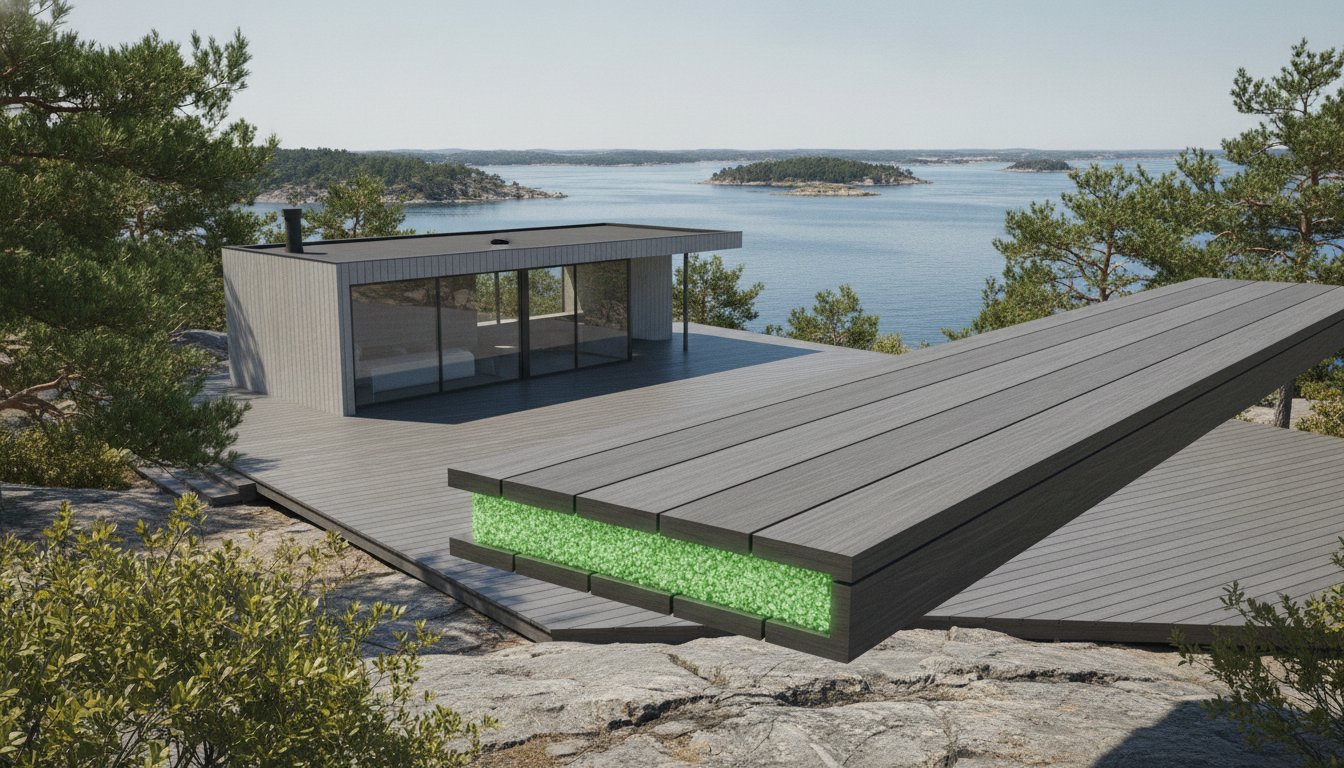
The species of wood fiber within the matrix defines the internal architecture of your deck. While many manufacturers utilize generic wood waste or softwood byproducts like pine and spruce, these materials are naturally porous and less stable. When engineers determine what is the best core for composite decking, they prioritize hardwood fibers for their exceptional density and low moisture absorption. Hardwood fibers possess a tighter cell structure. This density provides a superior mechanical grip for the HDPE polymer, creating a unified material that resists internal stress and environmental pressure.
The size and shape of these fibers also dictate the final board's finish. Large, irregular softwood flakes can create weak points or a fuzzy surface texture. By contrast, precision-milled hardwood fibers allow for a more consistent, matte appearance that mimics the elegance of natural timber. Sourcing 100% EU hardwood ensures that every fiber meets strict quality standards while significantly reducing transport-related CO2 emissions. This commitment to regional sourcing reflects a broader shift toward Sustainable Building Materials: The 2026 Guide to Circular Construction. It is a choice that prioritizes both manufacturing quality and ecological ethics.
Density and Durability
Low-density cores often lead to spongy decks that flex uncomfortably underfoot. This excessive movement puts immense pressure on fasteners, which can eventually lead to fastener failure and loose boards. Hardwood fibers provide the necessary rigidity to support a 50-year service life. They don't compress easily. This structural stiffness ensures that your deck remains level and secure for decades, providing a premium experience that matches the high-end aesthetic of your home. You can view our hardwood-reinforced decking collections to see how this material science translates into lasting beauty.
Moisture Resistance from the Inside Out
The primary enemy of any wood-based product is moisture, yet hardwood offers a natural defense. Hardwood is inherently more resistant to fungal decay than softwood, providing an extra layer of security within the core. This is a critical factor when deciding what is the best core for composite decking in coastal or damp regions. Through advanced encapsulation technology, every individual hardwood fiber is completely surrounded by HDPE. This process creates a waterproof barrier at the molecular level. When reviewing technical data sheets, look for low core absorption rates. A high-quality hardwood core will show minimal weight gain in submersion tests, proving its ability to withstand humid environments without swelling.
Green Plank’s Core Technology: Sustainable Engineering
Green Plank applies engineering precision to environmental ethics through the Terra Tuff and Smart System decking lines. These profiles utilize the high-fiber matrix discussed throughout this guide to achieve a level of structural stability that defines the premium market. When professionals evaluate what is the best core for composite decking, the answer lies in our proprietary homogenization process. This technique ensures that hardwood fibers and HDPE polymers are fused into a consistent, high-strength core that remains stable under internal stress. This density provides the perfect foundation for HidLoc™ hidden fastening systems, ensuring a precise core-to-clip fit that prevents board creep over time. We back this engineering confidence with a 50-year warranty, a primary signature of our commitment to quality.
Made in the EU: Why Origin Defines Quality
Regional reliability is a core identity marker of our manufacturing process. Every deck board we produce adheres to strict EU chemical regulations, including REACH standards, ensuring your outdoor space is free from harmful toxins. Localized raw material sourcing significantly reduces our CO2 footprint compared to overseas alternatives. This geographical branding signals both a high design sensibility and ethical manufacturing standards. For those comparing global brands, our guide on Why European-Engineered WPC is the Sustainable Choice in 2026 details why local engineering is the superior choice for European projects. We believe that professional standards should never come at the expense of the environment.
The Future of Circular Decking
Sustainability is a long-term performance metric. Green Plank cores are engineered for Cradle to Cradle ownership, meaning every board is designed for end-of-life recycling. Our low-density engineering approach reduces material waste during production without sacrificing the board's tensile strength. This responsible innovation ensures that your deck is as sustainable as it is beautiful. In summary, the Green Plank core represents the peak of 2026 engineering because it combines:
- 75% Hardwood Fiber: Provides natural rigidity and reduces thermal expansion.
- 25% HDPE Matrix: Delivers high-density protection and full recyclability.
- EU Manufacturing: Guarantees strict chemical safety and reduced transport emissions.
- 50-Year Warranty: Offers the ultimate peace of mind for high-end consumers.
Choosing the right core is the most important decision in your decking journey. By prioritizing material science and environmental ethics, you're not just building a deck; you're investing in a sustainable legacy.
Engineering Your Outdoor Legacy
Material science dictates that a deck's longevity is built from the inside out. You've learned that the 75% hardwood and 25% HDPE ratio provides the necessary rigidity to prevent warping, while European manufacturing ensures compliance with the highest safety standards. Determining what is the best core for composite decking requires looking past the surface to find a balance of density and environmental responsibility. By prioritizing hardwood fibers over softwoods and HDPE over lower density polymers, you ensure a stable foundation that resists the elements for decades. This technical approach transforms a simple outdoor space into a high-performance architectural feature that doesn't sacrifice ethics for aesthetics.
Take the next step in creating a maintenance-free sanctuary that respects nature. Our products utilize a Cradle to Cradle ownership model, ensuring that every board contributes to a circular economy. Explore Green Plank's High-Performance WPC Collections to discover the regional reliability of boards backed by a 50-year warranty and 100% EU raw materials. We invite you to build with the confidence of a sustainable craftsman, knowing your investment is engineered to endure. Your future outdoor living space starts with the right core today.
Frequently Asked Questions
Is a solid core better than a hollow core for composite decking?
Solid cores are superior for almost all residential and high-end commercial applications because they provide maximum structural density. This density ensures that HidLoc™ Hidden Fastening Systems remain secure without the risk of fasteners pulling through the material. While hollow profiles reduce shipping weight, they are susceptible to internal moisture accumulation and freeze-thaw damage. A solid profile eliminates these internal voids, providing a stable platform that feels substantial and quiet underfoot.
What is the difference between HDPE and PVC cores?
HDPE and PVC differ primarily in their chemical stability and environmental footprint. HDPE is a flexible, highly recyclable thermoplastic that maintains its integrity in extreme cold, making it ideal for regional reliability. PVC offers high rigidity but is often prone to brittleness and presents significant recycling challenges at the end of its life. When asking what is the best core for composite decking, HDPE is the preferred choice for those prioritizing a circular economy and long-term impact resistance.
Does the core of the composite board affect its color fading?
The core material doesn't directly determine surface color fading, as that is the primary role of the protective outer capping. However, a high-quality core is typically pigmented to match the surface, ensuring that any deep scratches or end-cuts remain inconspicuous. This internal coloring maintains the board's aesthetic integrity even after years of heavy use. A well-pigmented core reflects the manufacturing quality expected in premium, European-engineered decking.
Can the core of a composite deck rot if it contains wood?
A properly engineered composite core won't rot because the plastic matrix completely encapsulates the organic fibers. This molecular barrier prevents moisture from reaching the wood, effectively neutralizing the risk of fungal decay. Using hardwood fibers further enhances this resistance, as hardwood is naturally denser and less prone to moisture absorption than softwood alternatives. This encapsulation technology is what allows for performance guarantees extending up to 50 years in private residential settings.
Why is hardwood fiber better than softwood for the core?
Hardwood fibers are better than softwood because their dense cell structure provides a superior mechanical bond with the polymer matrix. Softwoods like pine or spruce are naturally more porous, which increases the risk of moisture ingress if the encapsulation is compromised. By utilizing 100% EU hardwood raw materials, manufacturers can produce a core that is significantly more rigid and stable. This choice directly impacts the board's ability to resist sagging and maintain its original dimensions.
How does the core material affect thermal expansion?
Core composition is the primary factor in managing thermal expansion and contraction. While polymers naturally move with temperature changes, the wood fibers within the core act as a stabilizing skeleton that restricts this movement. A higher ratio of wood fiber, such as the 75% hardwood blend used in high-performance profiles, ensures the deck remains flat and secure. This engineering precision is essential for maintaining tight gaps and preventing stress on the substructure during seasonal shifts.
Is a 100% plastic core better than a wood-plastic composite core?
WPC cores are generally superior to 100% plastic options because they offer better thermal stability and a more natural aesthetic. Full plastic boards often look artificial and exhibit extreme expansion rates, which can lead to warped joists and failed fasteners. A wood-plastic composite core provides the rigidity of timber with the durability of modern polymers. This balance makes WPC the ideal material for those seeking a maintenance-free outdoor space that retains the grounded feel of natural wood.
What should I look for in a composite decking technical data sheet?
When reviewing a technical data sheet to determine what is the best core for composite decking, prioritize the moisture absorption rate and the thermal expansion coefficient. A high-quality core should show less than 1% moisture absorption after 24 hours of submersion. Additionally, look for density measurements and certifications for EU raw materials to ensure the product meets strict safety and environmental standards. These data points provide an objective measure of the board's long-term engineering confidence.
Specify the product
Use this guide with a Green Plank specification
Technical articles support the commercial catalogue — category, product, evidence, then samples or quotes.