



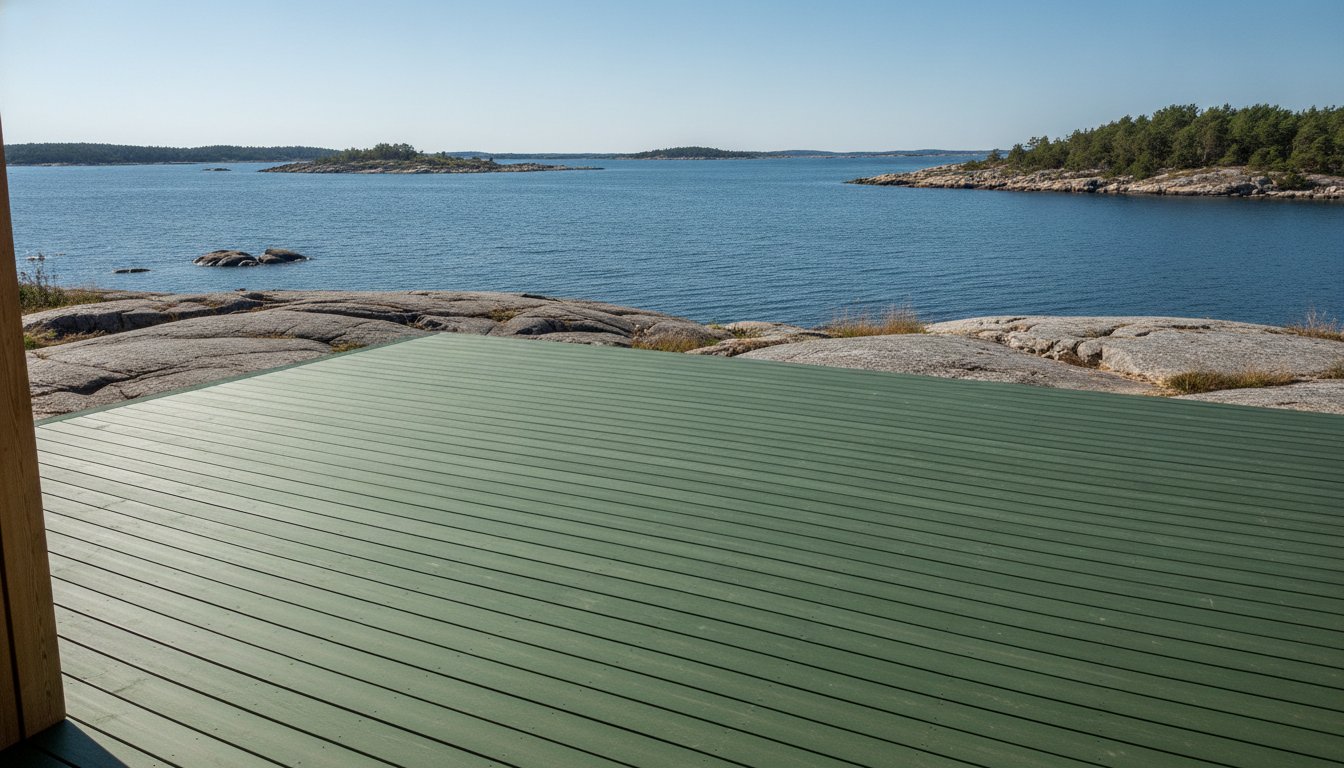
Why do most coastal decks begin to fail from the inside out within just five years of installation? If you've lived near the shore, you've seen the relentless combination of salt spray and humidity turn expensive timber into a splintered, graying liability. It's frustrating to invest in a seaside retreat only to spend every other season sanding, staining, and replacing corroded hardware. Selecting a high-performance saltwater resistant decking material is no longer just about aesthetics. It's about structural survival in an environment that naturally degrades traditional building materials.
We believe that true quality is measured by how well a structure respects its environment over decades. This guide explores why high-density WPC composite is the superior choice for coastal durability, offering a service life of 30 to 50 years with virtually zero maintenance. You'll discover the engineering behind our 75% hardwood fiber and 25% HDPE blend, the necessity of stainless steel fastening systems, and the sustainable certifications that define modern European manufacturing. We provide the technical clarity you need to build a space that balances premium performance with a deep commitment to the natural world.
Key Takeaways
- Understand the science of salt crystal expansion to prevent the internal cellular destruction common in traditional coastal timber.
- Evaluate the performance of various options to select the most durable saltwater resistant decking material for high-humidity environments.
- Discover why a 75% hardwood fiber and 25% HDPE composition creates a superior structural skeleton compared to softwood-based alternatives.
- Identify how hidden fastening systems eliminate rust traps and protect the structural integrity of your deck's substructure.
- Learn how European manufacturing and circular design principles ensure a 30 to 50 year lifespan without the need for toxic chemical treatments.
What Makes a Decking Material Saltwater Resistant?
Building by the sea requires a fundamental shift in engineering mindset. It's a battle against chemistry and physics. Saltwater resistance is the material’s capacity to maintain structural integrity under constant chloride exposure. Unlike inland environments, coastal zones subject structures to a relentless cycle of wetting and drying with mineral-rich water. Selecting a true saltwater resistant decking material requires looking beyond surface-level aesthetics to the molecular composition of the board. True durability in these regions is built on two pillars: chemical inertness and high density.
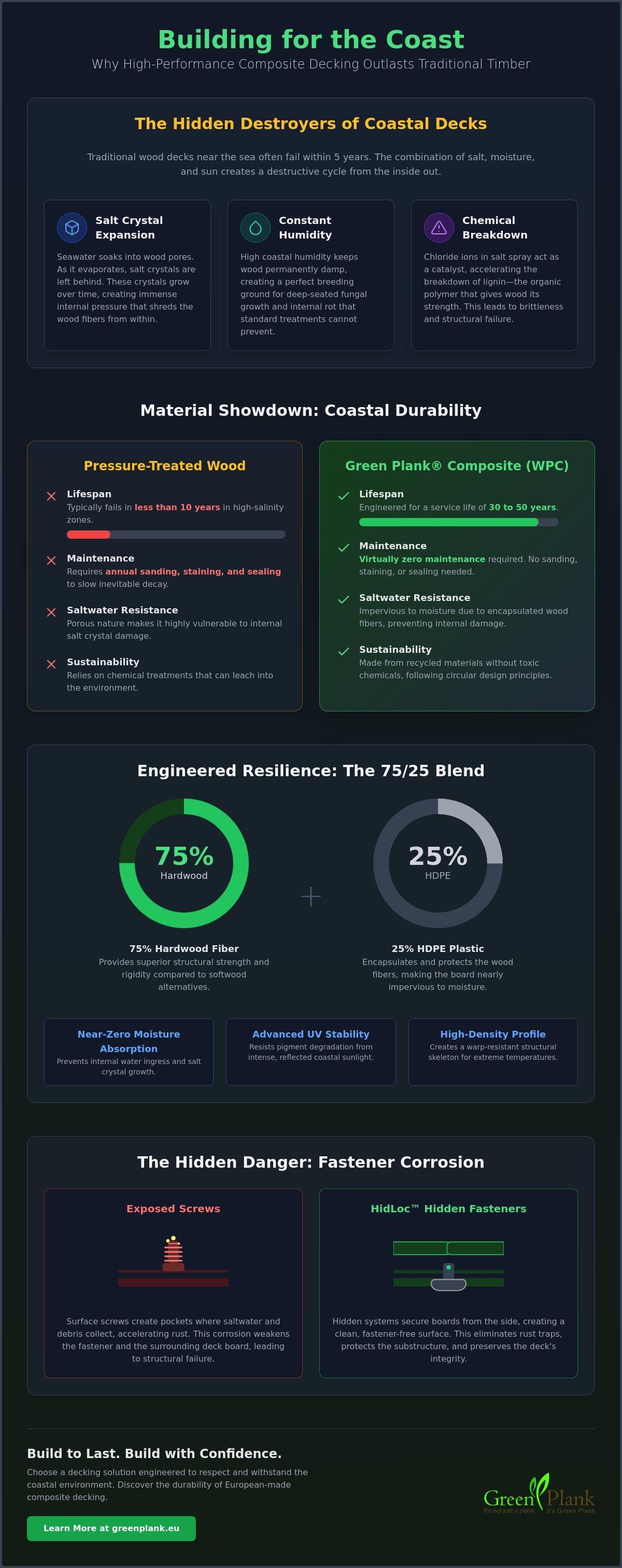
Traditional timber fails at the coast because of its natural porosity. When seawater enters wood cells and evaporates, it leaves behind microscopic salt deposits. These crystals grow over time, creating massive internal pressure that shreds the wood fibers from the inside out. This phenomenon, known as salt crystal expansion, is the primary cause of the deep cracks and structural softening seen in seaside piers and decks. Engineered stability is the only way to bypass this organic decay.
The Chemistry of Coastal Corrosion
Salt spray does more than just deposit minerals; it acts as a catalyst for chemical breakdown. Chloride ions accelerate the oxidation of lignin, the organic polymer that provides wood with its strength and rigidity. When lignin breaks down, the wood becomes brittle and loses its ability to hold fasteners securely. High humidity levels further complicate this by creating a permanent moisture reservoir within the material, which promotes deep-seated fungal growth and internal rot. It's vital to remember that a material labeled as "waterproof" may not be saltwater resistant. While waterproof materials repel liquid, saltwater resistant materials must also resist the chemical aggression of salt ions.
Performance Metrics for Marine Environments
Engineered solutions like Wood-plastic composites (WPC) address these challenges through advanced material science. By encapsulating wood fibers in high-density polyethylene (HDPE), the material becomes nearly impervious to moisture. When evaluating materials for your coastal project, focus on these specific engineering standards:
- Moisture Absorption: Premium coastal boards maintain absorption rates near zero to prevent internal crystal growth.
- UV Stability: Intense coastal sunlight is magnified by water reflection, requiring advanced UV inhibitors to prevent pigment degradation.
- Material Density: High-density profiles provide the structural skeleton necessary to resist warping under extreme temperature shifts.
Our approach moves away from organic vulnerability toward professional-grade reliability. We utilize a 75% hardwood fiber and 25% HDPE blend, manufactured to strict European standards, to ensure the deck remains as stable as the day it was installed. This transition from natural wood to high-performance composites ensures that your outdoor space respects nature while withstanding its most corrosive elements.
Comparing Decking Materials for Coastal Areas
Choosing a saltwater resistant decking material involves more than a simple price comparison. It requires an evaluation of how different substances respond to the chemical aggression of the sea. While pressure-treated wood remains a common entry point, its performance in high-salinity zones is often disappointing. Tropical hardwoods and synthetic PVC offer alternatives, but each brings specific challenges regarding environmental ethics and physical stability. Finding a balance between longevity and ecological responsibility is the hallmark of a well-engineered coastal project.
Pressure-Treated Wood: The Budget Fallacy
Pressure-treated (PT) wood is frequently selected for its low initial cost, yet it represents a significant budget fallacy. The copper-based chemicals used to treat the wood aren't permanently bonded to the fibers. In a saltwater environment, these treatments eventually leach out, leaving the organic material vulnerable to the salt crystal expansion and internal rot. You'll likely face a cycle of annual sanding, staining, and sealing that never truly stops the degradation. In high-salinity zones, the lifespan of PT wood is typically less than 10 years. Even species that are marketed as naturally decay resistant often struggle with the abrasive reality of constant salt spray and intense UV exposure.
Tropical hardwoods like Ipe and Teak are prized for their density, but they're not without flaws. Beyond the ethical concerns of logging in sensitive rainforest ecosystems, these woods undergo a "silvering" effect. Without constant oiling, the vibrant colors fade to a weathered gray within months. Homeowners also report that 100% PVC decking, while moisture-proof, feels hollow underfoot and can become brittle during the extreme temperature shifts common on the coast. This lack of organic fiber means the boards expand and contract significantly, which can lead to warped profiles or loosened fasteners over time.
WPC Composite: The Engineered Advantage
We position WPC composite decking as the balanced, high-performance solution for modern coastal construction. By combining 75% hardwood fiber with 25% HDPE, the material provides the structural "skeleton" of wood with the chemical protection of advanced polymers. Encapsulated fibers prevent salt from penetrating the core, ensuring the boards remain stable for 30 to 50 years. This engineering choice results in several practical advantages:
- High-density composition ensures a solid, premium feel underfoot that mimics natural timber.
- Integrated UV inhibitors maintain color consistency without the need for toxic stains.
- Low moisture absorption eliminates the risk of internal salt crystallization and structural failure.
The maintenance schedule for composite is remarkably simple compared to wood. While timber requires expensive biannual treatments to survive salt air, a composite deck only needs occasional cleaning with soap and water. If you're planning a project that requires long-term resilience, you can explore our professional-grade composite systems designed specifically for marine climates. This engineered approach provides a zero-maintenance aesthetic that respects both your time and the surrounding environment.
Engineering Resilience: The Green Plank 75/25 Blend
Engineering for the coast isn't about guesswork; it's about precise material ratios. While many manufacturers rely on generic "wood-plastic" descriptions, we disclose our technical composition to ensure professional-grade reliability. We utilize a specific 75% hardwood fiber and 25% high-density polyethylene (HDPE) composition. This ratio is the foundation of a high-performance saltwater resistant decking material. By prioritizing a high wood-to-polymer ratio, we achieve the structural stiffness required for commercial infrastructure while the HDPE provides a protective, inert binder that resists chemical degradation.
Our 75/25 blend creates a hydrophobic barrier that salt cannot penetrate. This engineering choice is critical because it addresses the internal decay issues discussed earlier in this guide. Building durable coastal decks requires an understanding of how materials interact with moisture and UV stress over decades. By sourcing 100% EU raw materials, we maintain a consistent density across every board. This eliminates the risk of toxic fillers or inconsistent recyclables that often plague lower-quality imports. Our commitment to European manufacturing standards ensures that each profile meets the rigorous demands of maritime climates.
Hardwood Fiber vs. Softwood Fillers
The type of organic fiber used in a composite board determines its long-term stability. Most competitors utilize softwood flour, which is essentially a byproduct of pine or cedar. These fibers are less dense and more prone to expansion when temperatures fluctuate. We use 75% hardwood fiber because it provides a superior structural skeleton. This choice results in commercial-grade stiffness and significantly better impact resistance. Hardwood fibers also contribute to a natural, high-friction surface, which enhances long-term slip resistance even when the deck is wet from salt spray or rain.
Low-Density vs. High-Performance Profiles
There is a common misconception that high-performance boards must be heavy and difficult to install. We've engineered our Terra Tuff and Smart System lines to offer a "Low Density" advantage. This means the profiles are easier to handle and ship, reducing the overall carbon footprint of the project without sacrificing strength. These systems are specifically designed for extreme environments where traditional timber would fail within years. By combining high-density raw materials with intelligent profile design, we deliver a saltwater resistant decking material that balances engineering precision with practical, on-site efficiency. This approach ensures a 30 to 50 year lifespan for private and commercial spaces alike.
The Hidden Danger: Fastener Corrosion and the HidLoc™ Solution
A deck is only as strong as its weakest connection. Even the highest quality saltwater resistant decking material can fail prematurely if the fastening method is flawed. Traditional top-down screwing is the most common failure point in coastal construction. When a screw is driven through the face of a board, it creates a permanent reservoir for salt and moisture. This "Rust Trap" effect occurs as salt spray accumulates around the screw head, creating a concentrated micro-environment of corrosion. Over time, this salt-saturated water travels down the screw shaft, leading to internal rot within the structural joists that the decking is meant to protect.
We solve this structural vulnerability with our HidLoc™ Hidden Fastening Systems. By utilizing clips that fit into the side grooves of our WPC profiles, we eliminate the need for surface penetrations. This engineering choice ensures that the boards can expand and contract naturally with the sharp temperature shifts common in maritime climates. Proper movement is essential; restricted boards often warp or shear their fasteners when they cannot breathe. Our hidden system provides a secure hold while maintaining the long-term integrity of the entire deck assembly.
Eliminating the "Mushrooming" Effect
Top-screwing into composite materials often results in "mushrooming," where the displaced polymer is pushed upward around the screw head. This isn't just an aesthetic flaw; it compromises the protective cap of the board and creates a safety hazard. A smooth, fastener-free walking surface is vital for the aspirational lifestyle of a seaside home. It ensures a safe environment for bare feet and maintains the "seamless" luxury look that high-end projects demand. By preserving the upper surface of the board, you ensure that the protective barrier remains completely intact against the elements.
Joist Protection in Saltwater Zones
The longevity of your deck depends heavily on the health of the subframe. Hidden clips significantly reduce the number of holes drilled into your joists, which limits the entry points for corrosive saltwater. For the best results in coastal areas, we recommend using aluminum subframes or high-quality treated timber protected by joist tape. You can find detailed technical advice on framing and substructure prep in our Professional Deck Installation Guide. This comprehensive approach ensures that the foundation of your space is as resilient as the surface itself.
To secure your coastal project with professional-grade hardware and a screw-free finish, view our HidLoc™ Hidden Fastening Systems. Our commitment to engineering precision ensures your outdoor space remains stable and beautiful for decades.
Sustainability and Longevity in Coastal Construction
Building in a maritime environment requires a commitment to both performance and ecological responsibility. Choosing a saltwater resistant decking material shouldn't come at the cost of global forest health. Tropical hardwood logging often destroys vital ecosystems to provide "naturally" resistant timber that still requires toxic chemical treatments to survive. We choose a different path. Our regional supply chain utilizes 100% EU raw materials, which reduces the carbon footprint of your project while ensuring consistent material density. This engineering precision allows us to deliver a product that balances high-end quality with a grounded, eco-conscious responsibility.
Our manufacturing process is designed to minimize waste and emissions. By prioritizing regional reliability and professional standards, we ensure that every profile meets the rigorous demands of coastal durability. This transition from organic decay to engineered stability is the only way to protect both your investment and the surrounding environment. We let the longevity and environmental credentials of our products speak for themselves, offering a solution that respects nature from its inception to its eventual lifecycle conclusion.
Cradle to Cradle: A New Standard for Decking
Circularity is more than a concept; it's a manufacturing philosophy. Our Cradle to Cradle ownership model ensures that every board is designed for a continuous lifecycle. We minimize waste by repurposing production scraps and using recycled high-density polymers, creating a high-performance product that respects nature. This circular design prevents the "take-make-waste" cycle common in traditional construction. You can learn more about these principles in our Sustainable Building Materials Guide. Our process focuses on reducing CO2 emissions while maintaining the structural "skeletons" required for extreme seaside environments.
The 50-Year Warranty vs. The 5-Year Rot Cycle
The financial justification for premium composite is found in the total cost of ownership (TCO). Traditional timber decks in high-salinity zones often enter a "rot cycle" within five years, requiring expensive replacement or intensive labor. Our systems offer a long service life with a warranty of up to 50 years. This longevity provides peace of mind for commercial infrastructure, public piers, and private residences alike. It's a calculation of value over time. A single installation of our saltwater resistant decking material outlasts several generations of pressure-treated wood, effectively eliminating the need for recurring resource extraction.
Invest in a space that balances aspirational lifestyle with engineering confidence. By choosing a material built on circular principles and regional quality, you ensure that your coastal project remains stable and beautiful for decades. Choose engineering over imitation. Choose a deck that respects the shoreline as much as you do.
Building for the Next Generation of Coastal Living
Coastal construction doesn't have to be a constant battle against the inevitable. By selecting a high-performance saltwater resistant decking material, you move away from the temporary fixes of traditional timber toward a permanent, engineered solution. We've detailed how the combination of high-density hardwood fibers and professional-grade HDPE creates a barrier that salt simply cannot penetrate. When you pair this material with hidden fastening systems, you protect the structural integrity of your entire project from the hidden dangers of corrosion.
Our commitment to regional reliability is backed by a service life warranty of up to 50 years. We utilize 100% EU-sourced raw materials to ensure consistent quality and a reduced carbon footprint. As a Cradle to Cradle Certified manufacturer, we don't just build decks; we contribute to a circular economy that respects the very nature we enjoy. Explore our Saltwater-Tested WPC Collections and discover how professional engineering can transform your outdoor space. It's time to build a sanctuary that stands firm against the tide and looks beautiful for decades to come.
Frequently Asked Questions
Is composite decking really resistant to saltwater?
High-quality composite decking is engineered to be nearly impervious to saltwater damage. Unlike natural timber, which absorbs moisture and suffers from salt crystal expansion, our WPC blend uses high-density polyethylene to encapsulate hardwood fibers. This creates a hydrophobic barrier that prevents chloride ions from penetrating the core. It's the ideal choice for a saltwater resistant decking material because it maintains structural integrity without the risk of internal rot.
Does salt air cause composite decking to fade over time?
Professional-grade composite boards are designed with integrated UV inhibitors to resist fading from both intense sun and salt air. While traditional wood turns gray within months of coastal exposure, our WPC profiles maintain their pigment consistency for decades. This chemical stability ensures that your deck retains its premium aesthetic without the need for constant restaining. Our manufacturing process ensures that the color is bonded deep within the material's structure for long-term performance.
Which is better for a beach house: PVC or WPC decking?
WPC decking is generally the superior choice for beach houses due to its balanced density and natural feel. While PVC is moisture-proof, it often lacks the structural stiffness of wood and can feel hollow or brittle underfoot. Our 75/25 hardwood and HDPE blend provides the authentic weight of timber with the chemical resistance of advanced polymers. This combination ensures the deck doesn't warp or expand excessively during the sharp temperature swings common on the coast.
Do I need special screws for a deck near the ocean?
You must use corrosion-resistant hardware, specifically Grade 316 stainless steel, for any coastal installation. Standard fasteners will oxidize rapidly in salt air, leading to structural instability and unsightly rust stains. We recommend utilizing our HidLoc™ Hidden Fastening Systems to eliminate surface screws entirely. This approach protects the joists from moisture penetration and ensures a smooth, safe walking surface that isn't compromised by the corrosive marine environment.
How do I clean salt residue off my composite deck?
Cleaning salt residue only requires a simple wash with mild soap and warm water. You don't need specialized chemical cleaners or high-pressure washers, which can damage the surface of some boards. Regularly rinsing your deck with fresh water helps prevent mineral buildup and maintains the material's slip resistance. This low-maintenance requirement is a primary benefit of choosing a professional-grade saltwater resistant decking material for your seaside retreat.
Can Green Plank decking be used for public piers and marinas?
Our commercial infrastructure profiles are specifically engineered for high-traffic public areas like piers and marinas. These boards offer the durability required to withstand constant salt spray and heavy pedestrian use. With a service life warranty of up to 50 years, our WPC systems provide a reliable foundation for government and commercial projects. The high-density composition ensures that the profiles remain stable even under the most demanding maritime conditions.
Does saltwater affect the slip resistance of composite boards?
Saltwater itself doesn't degrade the slip resistance of our boards, but mineral deposits should be rinsed away to maintain surface friction. Our WPC decking is manufactured with a textured hardwood finish that provides excellent grip even when wet. This feature is a result of our 75% hardwood fiber content, which creates a natural, high-friction surface. It ensures safety for bare feet in environments where splashing and high humidity are constant factors.
What is the best subframe material for a saltwater resistant deck?
Aluminum or high-quality treated timber with joist protection tape are the most effective subframe materials for coastal zones. While the decking boards resist salt, the underlying structure is equally vulnerable to corrosion. Aluminum offers the highest level of chemical inertness, while treated timber requires careful sealing at every cut point. Ensuring your foundation is as resilient as your WPC surface is essential for achieving a 30 to 50 year lifespan in a marine climate.
Specify the product
Use this guide with a Green Plank specification
Technical articles support the commercial catalogue — category, product, evidence, then samples or quotes.