



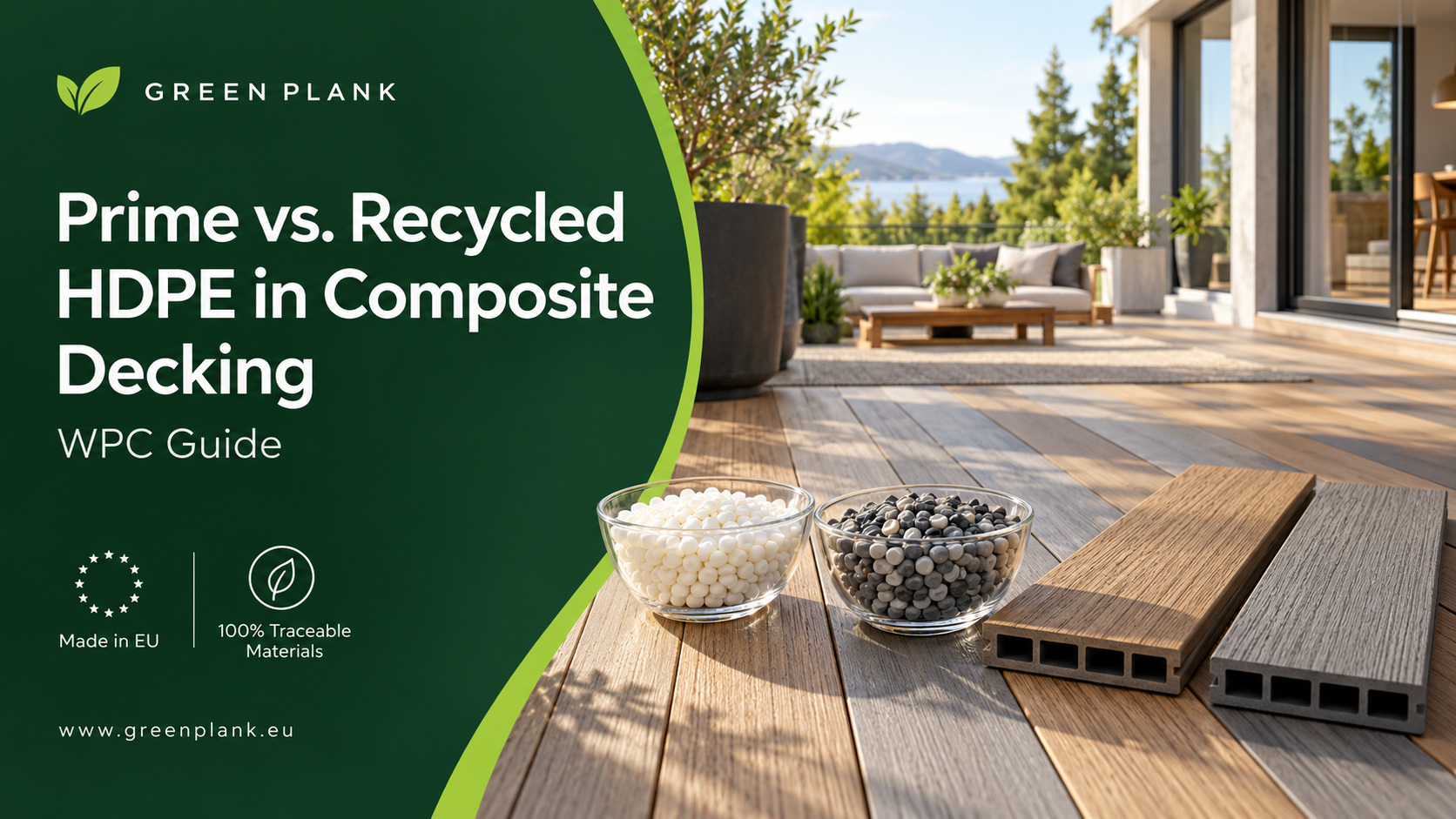
Prime vs. Recycled HDPE in Composite Decking: What Really Matters?
HDPE is one of the most widely used thermoplastic matrices in wood-plastic composite decking. It binds the wood fibres, contributes to moisture resistance and influences extrusion behaviour, dimensional performance, toughness and long-term durability. But not all HDPE raw materials are identical.
One of the most important formulation decisions is whether to use prime, or virgin, HDPE, recycled HDPE, or a carefully controlled combination. Recycled polymer can provide valuable circular-economy benefits, while prime HDPE can offer tighter control over polymer properties and production consistency. The right choice depends on much more than the words prime or recycled.
Green Plank perspective: A premium WPC should be evaluated as a complete engineered system. Polymer quality, wood-fibre quality, additives, compatibility, processing conditions, profile geometry and quality control all contribute to the finished product.
What is prime HDPE?
Prime HDPE, often called virgin HDPE, is polymer produced from primary petrochemical feedstock to a defined commercial specification. A selected extrusion-grade HDPE can provide controlled density, melt-flow characteristics and mechanical properties from batch to batch.
For high-filled WPC extrusion, this consistency is particularly valuable. When a formulation contains a large percentage of wood fibre, relatively small changes in polymer rheology can influence extrusion pressure, motor load, fibre wetting, surface quality and dimensional control.
Potential advantages of prime HDPE
- More predictable melt-flow and rheological behaviour.
- Consistent density and polymer properties.
- Lower risk of unknown polymer contamination.
- Better control when developing demanding formulations.
- Repeatable processing conditions between production batches.
- Clear technical documentation from established resin suppliers.
What is recycled HDPE?
Recycled HDPE is produced by recovering polyethylene products or industrial waste streams and converting the material into usable polymer feedstock. Depending on the source, it may be post-industrial recycled material, post-consumer recycled material or a controlled blend.
High-quality recycled HDPE can be a valuable raw material for WPC. Composite products are particularly interesting applications for recycled polymers because the plastic is combined with natural fibre to create a durable building product. However, recycled HDPE quality can vary considerably depending on collection, sorting, washing, contamination, previous use and reprocessing history.
The key issue is consistency
The question should therefore not simply be whether recycled HDPE is good or bad. A better question is: How controlled and consistent is the recycled polymer stream?
A carefully characterised industrial recycled HDPE stream may be significantly more predictable than an inconsistent mixed-polymer recyclate.
Prime vs. recycled HDPE: key differences
| Factor | Prime HDPE | Recycled HDPE |
|---|---|---|
| Raw-material consistency | Typically high and specification-controlled | Can range from excellent to highly variable |
| Melt-flow consistency | Generally predictable | Depends on source and recycling process |
| Contamination risk | Generally low | Requires effective sorting and quality control |
| Previous processing history | No previous product-use cycle | May have experienced processing and ageing |
| Colour consistency | Generally easier to control | Can require additional control |
| Circular material use | Limited recycled content | Supports reuse of existing plastic resources |
| WPC suitability | Excellent with correct grade | Excellent when quality is controlled and validated |
1. Melt Flow Index matters in WPC extrusion
One important polymer parameter is Melt Flow Rate, commonly referred to as MFR or MFI. It provides an indication of how a thermoplastic flows under defined test conditions. For WPC profile extrusion, the objective is not simply to select the highest-flowing polymer.
High wood-fibre formulations need sufficient melt strength and suitable rheology to transport and encapsulate the fibre while maintaining stable pressure and profile geometry. A polymer that flows too easily may not provide the processing behaviour required for a heavily filled extrusion compound.
Green Plank's development approach for high-wood-content HDPE WPC focuses on relatively low-MFI, high-molecular-weight extrusion-grade HDPE, with the final grade confirmed through production trials. The optimum specification depends on equipment, fibre loading, additives, screw design and target profile.
2. Why recycled HDPE can be more variable
Recycled HDPE may originate from containers, industrial products, pipes, crates or other polyethylene applications. These products were originally manufactured from different resin grades and may contain different stabilisers, pigments and processing histories.
Without sufficient sorting and testing, a recycled stream can therefore show variation in:
- melt-flow rate;
- density;
- molecular-weight distribution;
- pigment and colour;
- residual contamination;
- oxidative stability;
- presence of other polymers;
- odour and volatile content.
This does not mean recycled HDPE cannot be used for premium WPC. It means its specification and incoming quality control become especially important.
Recycled content is not a substitute for engineering
Environmental benefits and technical performance should be considered together. A durable product made with recycled polymer requires controlled feedstock, appropriate stabilisation, effective fibre-polymer compatibility and disciplined manufacturing.
3. Does prime HDPE automatically make better decking?
No. Prime HDPE provides a controlled polymer starting point, but it cannot compensate for poor fibre preparation, inadequate compatibilisation, incorrect lubrication, excessive moisture, unstable extrusion or weak profile design.
Likewise, a WPC made from properly characterised recycled HDPE can perform very well when its formulation and manufacturing process have been developed around that material.
This is why architects and buyers should avoid judging composite decking solely from a recycled-content percentage or the word virgin on a specification sheet.
4. Fibre-polymer bonding is equally important
Wood fibre and polyethylene have different surface chemistries. Effective compatibility between these phases is therefore fundamental to high-performance WPC. Coupling agents such as maleic-anhydride-grafted polyethylene are commonly used in wood/polyethylene composites to improve interfacial interaction.
Good bonding can contribute to more effective stress transfer and help reduce pathways for moisture around poorly bonded fibre interfaces. Polymer grade, coupling-agent level, fibre moisture and dispersion should therefore be developed as one formulation system.
5. What about durability and weathering?
Outdoor decking is exposed to sunlight, temperature cycles, rain, frost, moisture and mechanical loading. Long-term performance consequently depends on the entire material package, including antioxidants, UV stabilisation, pigments, fibre quality and polymer stability.
Recycled polymers may have experienced previous heat, processing and environmental exposure. Their stabilisation requirements should therefore be evaluated rather than assumed. Prime HDPE starts with a more defined processing history, but the finished WPC still requires an appropriate outdoor stabilisation system.
6. Sustainability: recycled is valuable, but the complete lifecycle matters
Using recycled HDPE can reduce demand for virgin plastic feedstock and keep existing polymer resources in productive use. These are important circular-economy advantages. At the same time, sustainability assessment should consider the complete product system rather than one ingredient.
Relevant factors include:
- origin and traceability of raw materials;
- recycled and renewable material content;
- manufacturing energy and waste;
- transport distances;
- expected service life;
- maintenance requirements;
- material efficiency;
- possibilities for recycling at end of life.
A product with high recycled content but poor durability may not automatically represent the best environmental outcome. Long service life and efficient material use are also important.
Green Plank's approach to premium HDPE WPC
Green Plank develops PVC-free WPC around a high proportion of European wood fibre and controlled HDPE technology. A representative formulation is approximately 75% European wood fibres, 15% HDPE and 10% functional additives, with formulations adapted according to product and performance requirements.
For demanding high-wood-fibre formulations, Green Plank places particular importance on polymer consistency, suitable melt behaviour, fibre quality, compatibilisation and controlled extrusion. Prime HDPE can provide an excellent reference platform where maximum raw-material consistency is required. Controlled recycled HDPE can also have an important role when its properties are properly specified and validated.
What should professional buyers ask?
| Question | Why it matters |
|---|---|
| Is the HDPE prime, recycled or blended? | Clarifies the polymer source. |
| Is MFR/MFI controlled? | Helps indicate processing consistency. |
| Is polymer density specified? | Supports material identification and consistency. |
| How is recycled material tested? | Shows whether variability is actively managed. |
| Which coupling system is used? | Relevant to fibre-polymer interaction. |
| How is outdoor stability addressed? | Important for long-term exposure. |
| Is finished-product performance tested? | More meaningful than raw-material claims alone. |
Prime or recycled HDPE: which is better?
For maximum formulation control and repeatability, a correctly selected prime extrusion-grade HDPE offers clear technical advantages. For circular material use, a high-quality and well-characterised recycled HDPE can be an attractive option. Neither choice should be evaluated independently from the rest of the composite.
The best WPC comes from balancing polymer quality, fibre quality, additives, interface engineering, extrusion control and profile design. That complete-system approach is more meaningful than simply asking whether the plastic is virgin or recycled.
Sources
- https://greenplank.eu/">Green Plank – European WPC and composite building products
- https://www.sciencedirect.com/topics/materials-science/wood-plastic-composite">ScienceDirect Topics – Wood Plastic Composites
- https://plasticseurope.org/">Plastics Europe – Plastics, circularity and material information
- https://www.iso.org/standard/83905.html">ISO – Plastics terminology and recycled plastics framework
Specify the product
Use this guide with a Green Plank specification
Technical articles support the commercial catalogue — category, product, evidence, then samples or quotes.