



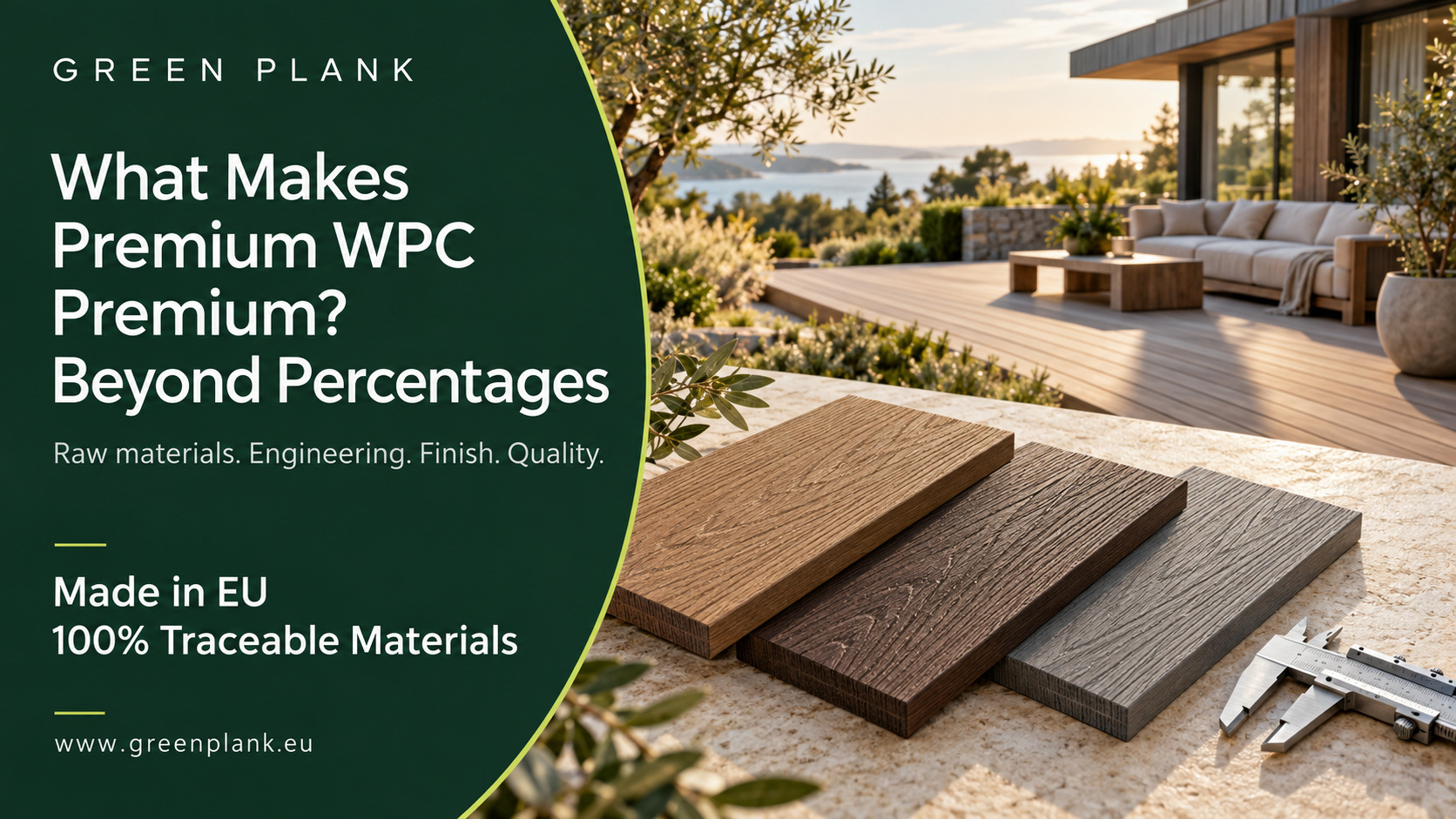
What Makes Premium WPC Premium? Beyond Percentages
When composite decking is compared, attention often goes first to percentages: 60% wood fibre, 70% wood fibre, 30% polymer or a certain amount of recycled material. These figures are useful, but they tell only part of the story. Two WPC products with apparently similar percentages can behave very differently outdoors because the quality of the ingredients, formulation, manufacturing process and profile engineering may be completely different.
A premium wood-plastic composite is therefore not defined by one impressive number. It is an engineered material system in which wood fibre, polymer, coupling agents, stabilisers, pigments, processing conditions and profile geometry work together.
Green Plank principle: Percentages describe how much material is present. Premium performance depends on what those materials are, how consistently they are controlled and how effectively they work together.
1. Wood-fibre percentage is only the beginning
A high wood-fibre content can offer important advantages. It can contribute to stiffness, reduce the proportion of polymer required and help create the material character expected from wood-based composites. However, simply adding more fibre does not automatically produce better decking.
The quality of that fibre matters enormously. Important variables include:
- wood species and source;
- particle and fibre-size distribution;
- moisture content before extrusion;
- purity and contamination control;
- fibre preparation and drying;
- consistency between production batches;
- traceability of the raw material.
Excessive moisture can create steam during extrusion and contribute to porosity or surface defects. Poor particle-size control can influence dispersion and processing. This is why premium WPC production requires controlled fibre rather than simply a high percentage of inexpensive wood filler.
2. Polymer quality matters as much as polymer quantity
The polymer forms the continuous thermoplastic matrix around the natural fibres. In HDPE-based WPC, its rheology, molecular characteristics, density, purity and consistency influence processing and finished-product behaviour.
Two formulations may both contain 15% or 20% HDPE while using polymers with very different properties. Prime extrusion-grade HDPE, controlled recycled HDPE and mixed recycled streams do not necessarily behave identically.
| Polymer factor | Why it matters in premium WPC |
|---|---|
| Melt-flow behaviour | Influences extrusion stability, fibre wetting and profile formation |
| Molecular characteristics | Contribute to melt strength and mechanical behaviour |
| Consistency | Helps maintain stable production between batches |
| Contamination control | Reduces unpredictable processing and material variation |
| Thermal stability | Important during processing and long-term material performance |
3. The fibre-polymer interface is critical
Wood fibres are naturally hydrophilic, while polyethylene is comparatively hydrophobic. Without effective compatibility between these two phases, the composite may not transfer stresses efficiently and microscopic gaps can develop around poorly bonded fibres.
Premium formulations therefore commonly use coupling technology such as maleic-anhydride-grafted polyethylene, often referred to as MAPE, in polyethylene-based WPC. Its purpose is to improve interaction between the wood component and polymer matrix.
Good interface engineering can support mechanical performance and help create a more integrated composite structure. The correct coupling-agent level must be developed together with fibre content, polymer grade, lubrication and processing conditions.
Premium WPC is about balance
More wood is not automatically better. More polymer is not automatically better. More additives are not automatically better. The objective is to create the correct balance between stiffness, toughness, moisture behaviour, processing, dimensional stability, appearance and long-term outdoor performance.
4. Additives may be a small percentage but have a major role
The additive package is one of the least visible differences between basic and carefully engineered WPC. Although additives represent a relatively small proportion of the formulation, they can perform essential functions.
A professional formulation may incorporate:
- coupling agents for fibre-polymer compatibility;
- lubricants and processing aids;
- antioxidants;
- UV stabilisation;
- pigments and colour-control systems;
- other functional additives selected for the product design.
The quality, compatibility and dosage of these components can matter more than simply publishing a total additive percentage.
5. Moisture control separates controlled production from guesswork
Natural fibre contains moisture, and moisture management is particularly important when wood is processed at elevated temperatures with thermoplastics. The fibre must be prepared and dried appropriately before or during processing according to the production system.
Effective moisture management helps manufacturers achieve:
- more stable extrusion;
- lower risk of internal voids;
- better surface consistency;
- more reliable profile dimensions;
- improved repeatability from batch to batch.
This production discipline is rarely visible when consumers look at a finished board, yet it can be fundamental to product quality.
6. Extrusion quality determines how the formulation becomes a product
An excellent formulation can still produce an inadequate board if extrusion is poorly controlled. Temperature profile, screw design, mixing, residence time, extrusion pressure, cooling, line speed and calibration must work together.
Premium manufacturers monitor production parameters rather than relying solely on the recipe. Stable processing helps produce consistent board dimensions, density, surface finish and internal structure.
Important manufacturing controls include:
- controlled raw-material dosing;
- consistent fibre moisture;
- stable melt temperature and pressure;
- effective fibre dispersion;
- controlled profile calibration;
- consistent cooling;
- dimensional inspection;
- batch and finished-product quality control.
7. Profile engineering is part of material performance
A decking board is not simply a rectangular piece of WPC. Hollow-chamber geometry, wall thickness, board width, reinforcement ribs, surface design and support conditions influence how loads are distributed.
A well-engineered hollow profile can use material efficiently while maintaining the required stiffness. A solid profile may be appropriate where different loading, geometry or application requirements apply.
| Premium WPC element | What should be evaluated? |
|---|---|
| Raw materials | Origin, purity, traceability and consistency |
| Wood fibre | Species, moisture, size and preparation |
| Polymer | Grade, rheology, consistency and suitability |
| Interface | Effective coupling between fibre and polymer |
| Additives | UV, oxidation, processing and colour systems |
| Profile design | Geometry, wall thickness and structural efficiency |
| Manufacturing | Extrusion stability and dimensional control |
| Testing | Mechanical, moisture, dimensional and weathering performance |
8. Dimensional stability requires formulation and installation
WPC responds to changes in temperature and environmental conditions. The thermoplastic component expands when heated and contracts when cooled, while natural fibres interact with moisture. The magnitude of movement depends on formulation, profile geometry, temperature range, board length and installation conditions.
Premium product engineering aims to understand and control these movements, but correct installation remains essential. Expansion spaces, ventilation, drainage, joist spacing and fastening systems should follow the manufacturer's product-specific instructions.
A high-quality board installed incorrectly can still develop problems. Premium performance therefore includes both product engineering and professional installation guidance.
9. Outdoor durability is a complete-system challenge
Decking is exposed to UV radiation, rain, moisture, freeze-thaw cycles, temperature changes, foot traffic and surface contamination. Long-term resistance cannot be created by one ingredient alone.
Outdoor durability is influenced by polymer stability, fibre encapsulation, antioxidants, UV stabilisers, pigments, surface technology, drainage, profile design and installation. Capped products add another engineered surface layer that can provide additional protection and aesthetic possibilities when correctly designed.
10. Testing is more meaningful than marketing percentages
For architects, distributors and professional buyers, finished-product performance data can provide more useful information than formulation percentages alone. Depending on the intended application, relevant evaluations may include flexural properties, impact behaviour, water absorption, dimensional changes, thermal cycling, creep, slip characteristics and artificial or natural weathering.
The important point is that the finished board should demonstrate the required performance. A technically impressive recipe has limited value if the final profile is not consistently manufactured and validated.
Green Plank's High Wood WPC philosophy
Green Plank develops PVC-free European WPC products with a strong focus on high wood-fibre content, controlled raw materials and engineered processing. A representative Green Plank formulation is approximately 75% European wood fibres, 15% HDPE and 10% functional additives, with individual formulations adapted to product requirements.
The percentage is only one part of the concept. Green Plank's approach places importance on European fibre sourcing, material traceability, polymer selection, fibre-polymer compatibility, functional additives, extrusion control, profile engineering and product-specific quality management.
The premium difference: A 75% wood-fibre claim tells you how much wood is present. It does not tell you the moisture level, fibre quality, polymer grade, bonding quality, extrusion stability, profile engineering or finished-board performance. Those details are where premium WPC is created.
How should architects and buyers compare premium WPC?
Instead of comparing products only by percentages, ask suppliers for a broader technical picture:
- Where do the wood fibres and polymer come from?
- Are the raw materials traceable and consistent?
- How is fibre moisture controlled?
- Which polymer family and grade are used?
- How is fibre-polymer compatibility achieved?
- What outdoor stabilisation system is incorporated?
- How is profile geometry engineered for the intended application?
- Which finished-product tests are performed?
- What installation requirements apply?
- What technical documentation and warranty support are provided?
Conclusion: Premium WPC is engineered, not simply mixed
Premium WPC cannot be reduced to a wood percentage, polymer percentage or recycled-content claim. Those numbers provide useful information, but quality comes from the interaction of raw materials, formulation, interface chemistry, additives, extrusion technology, profile design, testing and installation.
The most valuable question is therefore not simply, “How much wood does this WPC contain?” It is, “How has the complete composite system been engineered to deliver consistent performance over time?” That is the difference between comparing recipes and evaluating genuinely premium WPC.
Sources
- https://greenplank.eu/">Green Plank – European WPC and composite building products
- https://www.sciencedirect.com/topics/materials-science/wood-plastic-composite">ScienceDirect Topics – Wood Plastic Composites
- https://www.fpl.fs.usda.gov/">USDA Forest Products Laboratory – Wood and wood-composite research
- https://www.iso.org/">International Organization for Standardization – Materials and testing standards
Specify the product
Use this guide with a Green Plank specification
Technical articles support the commercial catalogue — category, product, evidence, then samples or quotes.