


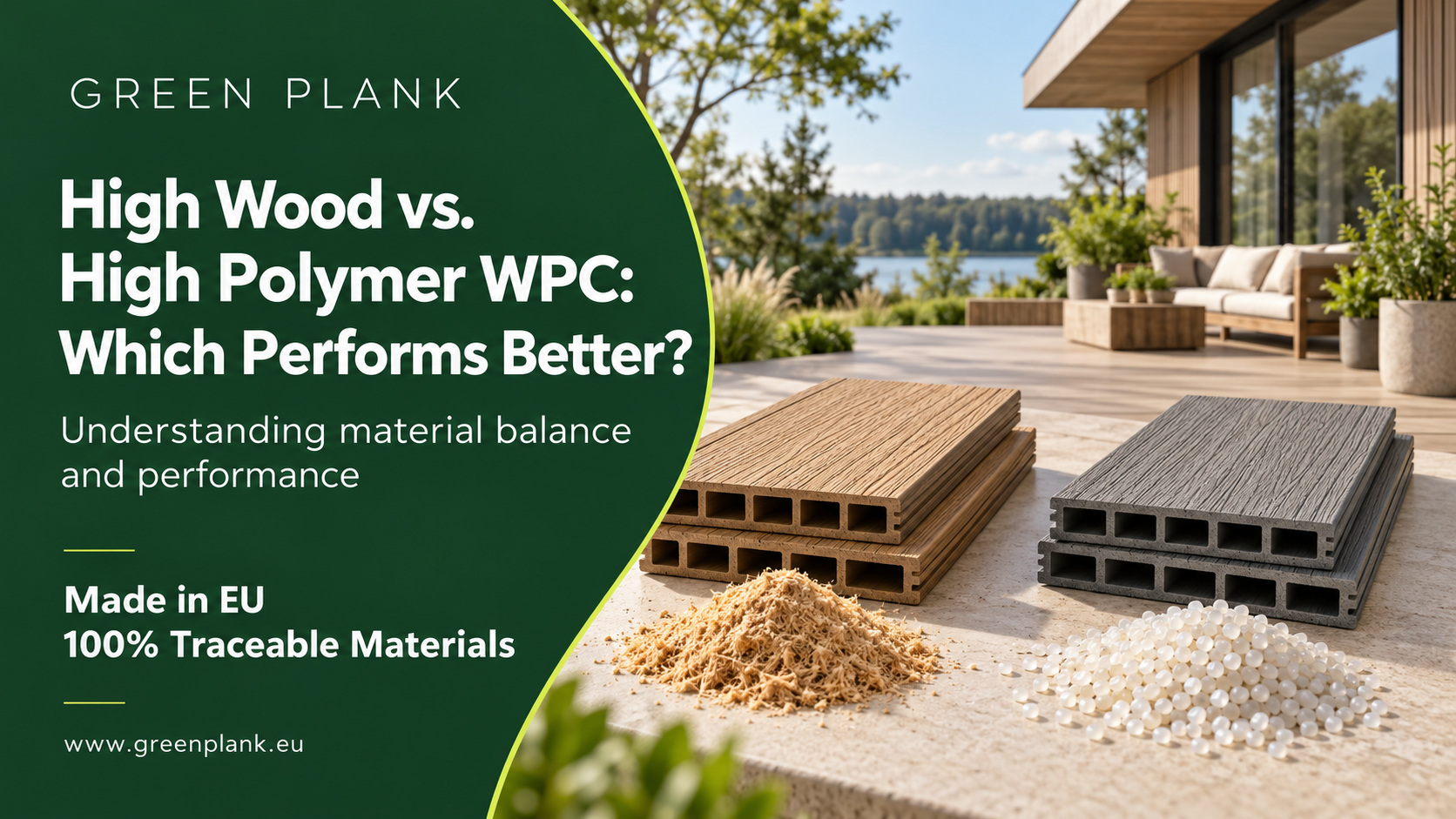
High Wood vs. High Polymer WPC: Which Performs Better?
One of the most important decisions in wood-plastic composite design is the balance between natural fibre and polymer. Some WPC products use a relatively high percentage of wood fibre, while others rely on a larger polymer fraction. At first glance, the comparison seems simple: more wood should make the product more wood-like, while more plastic should improve moisture resistance. In practice, WPC engineering is considerably more complex.
Wood-fibre content influences stiffness, density, thermal behaviour, moisture interaction and processing. Polymer content affects fibre encapsulation, toughness, melt behaviour and dimensional response. Additives, coupling technology, fibre quality, profile geometry and extrusion control can be just as important as the percentages themselves.
Green Plank perspective: The best WPC is not automatically the formulation with the most wood or the most polymer. Premium performance comes from finding the right balance between fibre, polymer, additives, manufacturing technology and profile design.
What is High Wood WPC?
High Wood WPC uses a comparatively large proportion of wood fibre or wood flour relative to the polymer matrix. Depending on formulation and manufacturing technology, high wood content can contribute to stiffness and create a composite with a strong natural-fibre character while reducing the proportion of thermoplastic required.
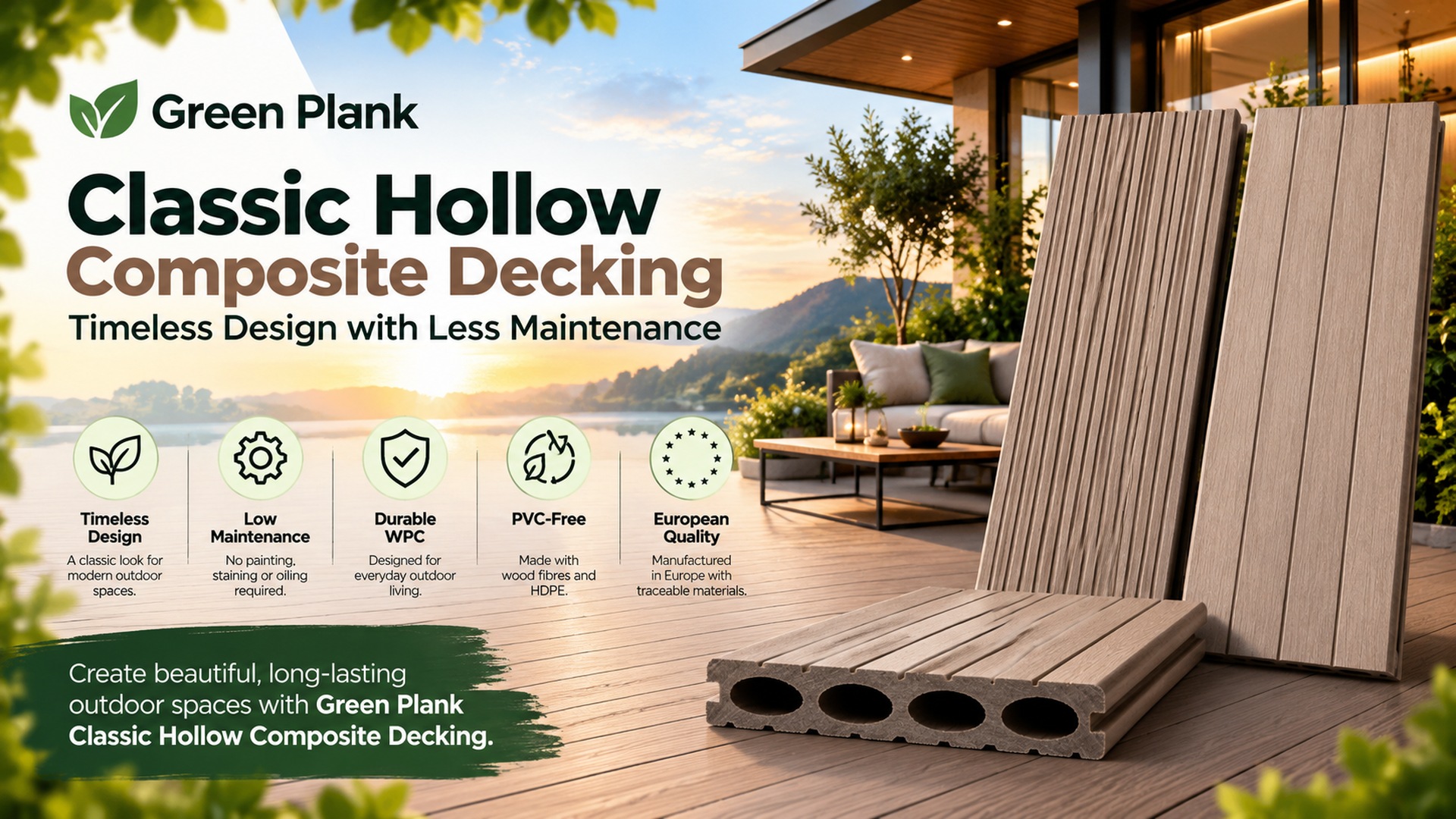
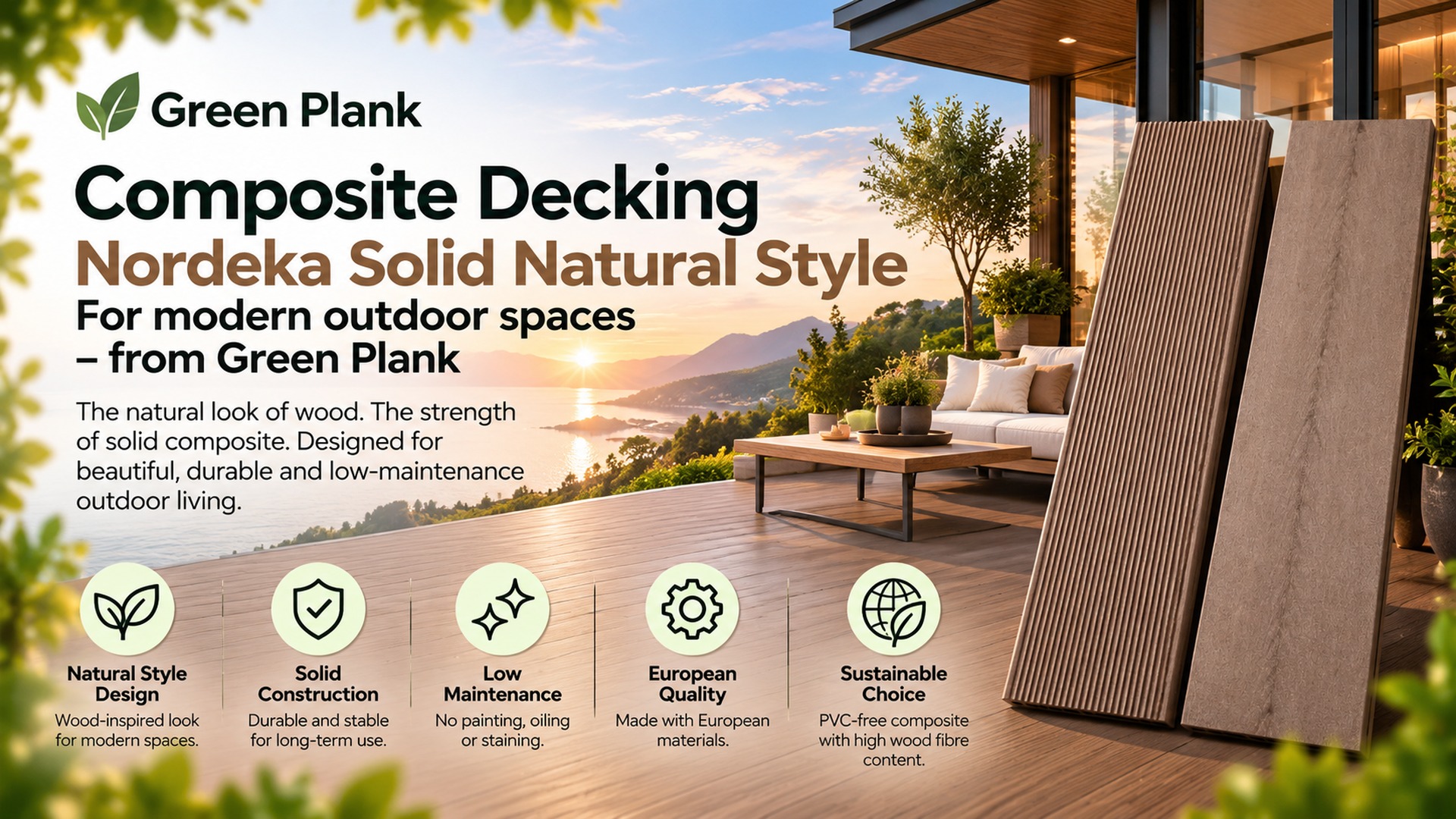
Green Plank follows a high-wood-fibre philosophy. A representative PVC-free formulation is approximately 75% European wood fibres, 15% HDPE and 10% functional additives, with formulations adjusted according to the profile and intended performance.
Producing WPC at this level of fibre loading requires careful control of fibre moisture, particle size, polymer rheology, compatibilisation, lubrication and extrusion conditions.
What is High Polymer WPC?
High Polymer WPC contains a greater proportion of thermoplastic relative to natural fibre. The additional polymer matrix can make fibre encapsulation easier and may influence toughness, moisture behaviour and processing characteristics.
However, increasing polymer content also changes the material balance. Depending on polymer type, profile geometry and formulation, it may affect density, stiffness, thermal movement, material cost and the proportion of renewable fibre in the product.
High Polymer WPC can therefore be an appropriate engineering choice for certain products, but more polymer does not automatically mean greater durability or better overall decking performance.
High Wood vs. High Polymer WPC at a glance
| Factor | High Wood WPC | High Polymer WPC |
|---|---|---|
| Natural-fibre content | Higher | Lower |
| Polymer content | Lower | Higher |
| Stiffness potential | Can be high with good bonding and dispersion | Depends on polymer and reinforcement level |
| Fibre encapsulation | More demanding at high fibre loading | Generally easier with more polymer matrix |
| Moisture sensitivity | Requires excellent fibre protection and processing | Can benefit from lower exposed fibre fraction |
| Processing | More demanding compound rheology | May offer easier melt flow depending on formulation |
| Renewable fibre proportion | Higher | Lower |
| Premium potential | Excellent when correctly engineered | Excellent when correctly engineered |
1. Which formulation provides greater stiffness?
Natural fibres can increase the stiffness of thermoplastic composites when they are properly dispersed and bonded to the polymer matrix. For decking, stiffness is important because it influences deflection and the relationship between board geometry and support spacing.
A well-engineered High Wood WPC can therefore achieve strong flexural characteristics. However, simply adding more fibre indefinitely does not guarantee higher performance. At excessive loading or with inadequate processing, the polymer may struggle to wet and encapsulate the fibres effectively, increasing the risk of voids, poor dispersion and weak interfaces.
The optimum fibre level is consequently a formulation question rather than a competition for the highest percentage.
2. Fibre-polymer bonding becomes increasingly important
Wood fibre is hydrophilic while HDPE is comparatively hydrophobic. This difference makes the interface between the two materials critical, particularly in High Wood formulations where a large amount of fibre surface must interact with a relatively small polymer fraction.
Compatibilisers such as maleic-anhydride-grafted polyethylene are commonly used in polyethylene-based WPC to improve fibre-polymer interaction. Effective interface engineering supports stress transfer and helps create a more integrated composite.
The High Wood challenge
Using more wood fibre successfully requires more engineering, not less. Fibre preparation, moisture control, polymer selection, coupling technology, lubrication and dispersion become increasingly important as fibre loading rises.
3. Which performs better against moisture?
The polymer matrix itself has relatively low water affinity compared with wood. Increasing polymer content can therefore help provide more polymer around the natural fibres. However, the moisture behaviour of a finished WPC depends on much more than the fibre-to-polymer ratio.
Important factors include:
- quality and moisture content of the wood fibre;
- fibre-polymer bonding;
- dispersion and encapsulation;
- internal porosity;
- profile geometry;
- exposed cut ends and surfaces;
- manufacturing consistency.
A carefully manufactured High Wood WPC can achieve strong outdoor moisture performance, while a poorly processed High Polymer product can still contain voids or other weaknesses. Finished-product testing provides a more reliable comparison than percentages alone.
4. Which has lower thermal expansion?
Thermoplastic polymers expand and contract with temperature. Introducing wood fibre into the polymer matrix can alter the dimensional response of the composite. In general engineering terms, higher fibre loading can constrain some polymer movement when fibre dispersion and bonding are effective.
That does not mean every High Wood board will expand less than every High Polymer board. Polymer type, fibre orientation, profile geometry, board length, colour, temperature range and manufacturing conditions all influence dimensional behaviour.
Architects should therefore compare product-specific thermal and dimensional information and follow the manufacturer's installation requirements for expansion clearances.
5. Does more polymer make WPC more durable?
Not necessarily. More polymer can improve fibre encapsulation and reduce the relative amount of moisture-sensitive natural material, but outdoor durability also depends on UV protection, oxidation stability, pigment system, fibre quality, interface bonding and manufacturing quality.
Likewise, high wood content is not automatically a durability disadvantage. A properly engineered High Wood formulation can deliver long-term outdoor performance when the fibres are appropriately prepared, bonded and protected within the composite.
6. What about surface temperature?
Decking exposed to direct sunlight can become warm regardless of whether it uses a High Wood or High Polymer formulation. Surface temperature is strongly affected by colour, solar absorption, surface texture, airflow, exposure and profile design.
Wood content may influence thermal properties, but it should not be used alone to predict how hot a finished decking surface will become. Light and dark colours of the same WPC formulation can behave differently under identical sunlight.
7. Which formulation is lighter?
Board weight cannot be predicted from wood/polymer percentage alone. Material density matters, but profile design is equally important. Hollow chambers, internal ribs, wall thickness, board dimensions and surface geometry determine the amount of material used per linear metre.
A well-designed hollow High Wood profile may use substantially less material than a thick solid profile. For architects and contractors, weight per linear metre or square metre is therefore more useful than simply comparing formulation percentages.
8. Processing quality can decide the winner
High Wood WPC places substantial demands on extrusion technology. Large quantities of fibre increase compound viscosity and can affect pressure, torque, feeding and surface quality. Fibre moisture must also be tightly managed.
A controlled production process should address:
- fibre drying and storage;
- particle-size consistency;
- accurate dosing of fibre, polymer and additives;
- effective mixing and dispersion;
- stable extrusion temperature and pressure;
- controlled cooling and calibration;
- dimensional inspection and finished-product testing.
High Polymer formulations can offer a larger continuous polymer phase, but they still require disciplined processing and stabilisation. Neither approach compensates for poor manufacturing.
9. Sustainability is more than polymer percentage
High Wood WPC contains a greater proportion of lignocellulosic material and a lower polymer fraction, which can be attractive when increasing renewable fibre content is a design objective. High Polymer products may incorporate recycled polymer, creating a different circular-material strategy.
A meaningful sustainability comparison should consider the complete lifecycle:
- origin and traceability of wood fibre;
- prime or recycled polymer content;
- manufacturing location and efficiency;
- transport distances;
- material use per square metre;
- expected service life;
- maintenance requirements;
- end-of-life possibilities.
10. How should architects compare the two?
| Ask the manufacturer | What it reveals |
|---|---|
| What is the complete formulation? | Balance between fibre, polymer and additives |
| What fibre is used? | Quality, origin and traceability |
| Which polymer grade is used? | Processing and material consistency |
| How is fibre bonded to polymer? | Interface engineering |
| What is the board weight? | Material and profile efficiency |
| What joist spacing is permitted? | Structural efficiency and installation cost |
| What testing is available? | Actual finished-product performance |
Green Plank's High Wood approach
Green Plank's PVC-free WPC strategy is based on a high proportion of European wood fibre combined with controlled HDPE technology and functional additives. A representative formulation is approximately 75% European wood fibres, 15% HDPE and 10% functional additives.
The objective is not simply to achieve a high wood percentage. Green Plank's approach focuses on fibre quality, European raw-material traceability, polymer selection, compatibilisation, moisture management, controlled extrusion and profile engineering.
Performance comes from balance: High Wood WPC can offer excellent stiffness, material efficiency and a high renewable-fibre proportion, but only when the formulation and production technology are capable of handling that fibre loading consistently.
Which performs better?
There is no universal winner. High Polymer WPC can provide advantages in fibre encapsulation and certain processing conditions. High Wood WPC can provide high stiffness, reduce polymer proportion and increase the share of natural fibre. Both approaches can produce excellent or poor products depending on how they are engineered.
For premium decking, the better question is not “How much wood or plastic does it contain?” but “How effectively has the entire composite been engineered and validated?”
For Green Plank, a carefully controlled High Wood HDPE formulation provides the preferred balance for its European WPC strategy. For architects and professional buyers, finished-product performance, technical documentation, installation requirements and manufacturing consistency should ultimately determine which WPC is best for a project.
Sources
- https://greenplank.eu/">Green Plank – European WPC and composite building products
- https://www.sciencedirect.com/topics/materials-science/wood-plastic-composite">ScienceDirect Topics – Wood Plastic Composites
- https://www.fpl.fs.usda.gov/">USDA Forest Products Laboratory – Wood and wood-composite research
- https://plasticseurope.org/">Plastics Europe – Polymer and circularity information
Specify the product
Use this guide with a Green Plank specification
Technical articles support the commercial catalogue — category, product, evidence, then samples or quotes.