



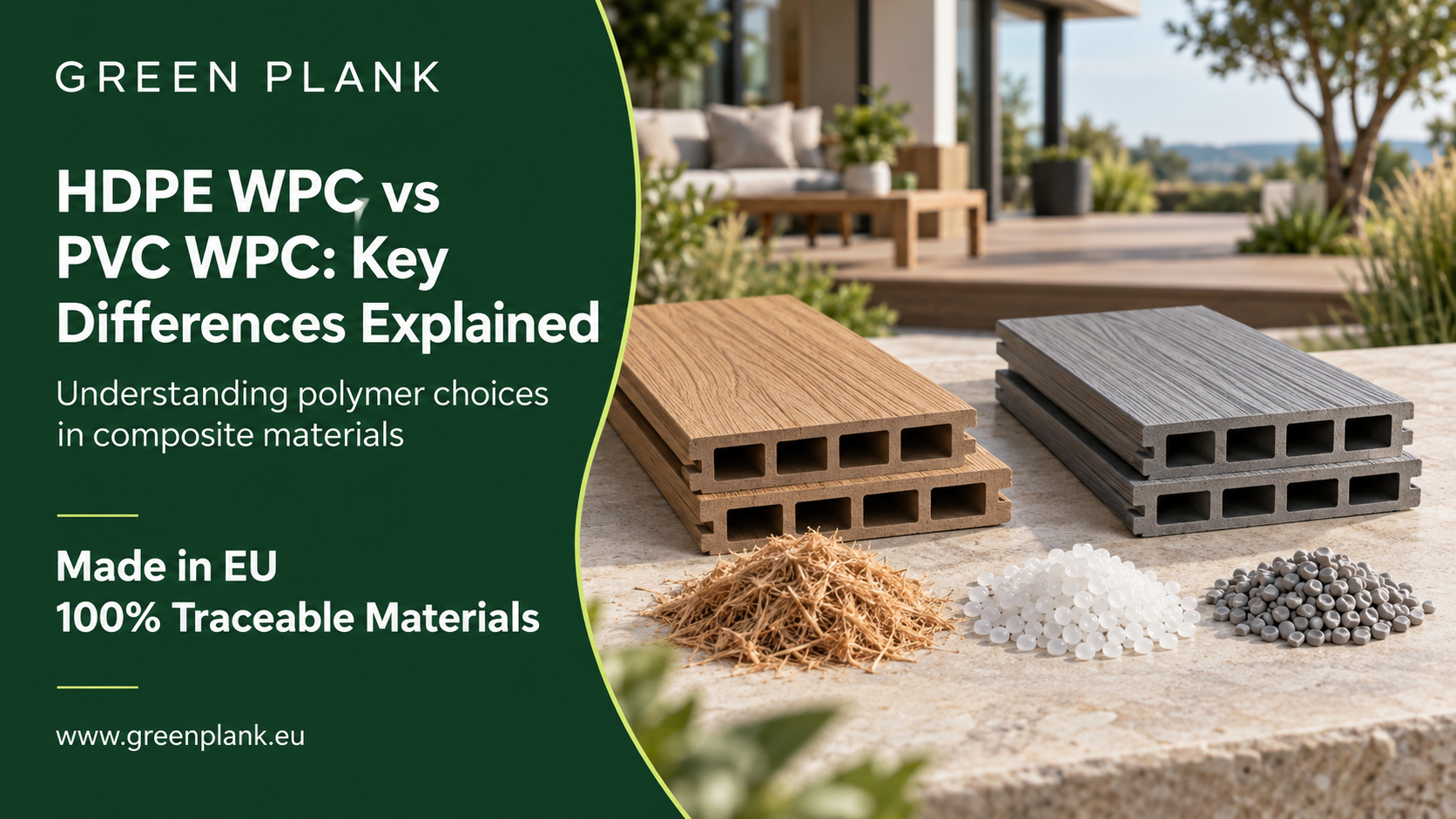
HDPE WPC vs PVC WPC: Key Differences Explained
Wood-plastic composite is not one single material. The term WPC describes a family of composites in which wood or other lignocellulosic fibres are combined with a thermoplastic polymer and functional additives. One of the most important differences between WPC products is therefore the polymer matrix used to bind the natural fibres.
Two common approaches are HDPE-based WPC and PVC-based WPC. Both can be engineered into durable outdoor products, but HDPE and PVC have different polymer characteristics, processing requirements and formulation strategies. For architects, distributors and professional buyers, understanding these differences is more useful than simply asking which material is better.
Green Plank perspective: Polymer type matters, but it does not determine WPC quality by itself. Fibre quality, polymer grade, additives, fibre-polymer bonding, extrusion control, profile engineering and correct installation must all be considered.
What is HDPE WPC?
HDPE WPC uses high-density polyethylene as the thermoplastic matrix. Wood fibres are compounded with HDPE together with coupling agents, lubricants, stabilisers, pigments and other functional additives according to the required product performance.
HDPE is widely used in durable plastic products and can be processed into wood-filled composites. In a properly engineered WPC formulation, the polymer matrix helps encapsulate the natural fibres and contributes to moisture resistance, toughness and processing behaviour.
Green Plank focuses on PVC-free, HDPE-based WPC. A representative high-wood-fibre formulation is approximately 75% European wood fibres, 15% HDPE and 10% functional additives, with formulations adjusted according to product and performance requirements.
What is PVC WPC?
PVC WPC uses polyvinyl chloride as its principal thermoplastic matrix. Wood flour or fibre is combined with PVC and an additive system designed around the processing and performance requirements of the material.
PVC has different chemistry and processing behaviour from polyethylene. PVC formulations generally require carefully designed stabilisation and processing systems because the polymer is processed within a controlled thermal window. Well-engineered PVC composites can be used successfully in profiles and building applications.
The important point is that HDPE WPC and PVC WPC are different composite systems rather than interchangeable versions of the same recipe.
HDPE WPC vs PVC WPC: quick comparison
| Factor | HDPE WPC | PVC WPC |
|---|---|---|
| Polymer matrix | High-density polyethylene | Polyvinyl chloride |
| Polymer family | Polyolefin | Vinyl polymer |
| Wood compatibility | Normally requires effective coupling technology | Requires formulation adapted to PVC and wood |
| Processing | Designed around polyethylene rheology and fibre loading | Requires PVC-specific thermal and processing control |
| Moisture resistance | Can be excellent with good fibre encapsulation | Can be excellent with correct formulation |
| Dimensional behaviour | Depends on formulation, profile and temperature | Depends on formulation, profile and temperature |
| Recycling stream | HDPE belongs to established polyolefin material streams | Requires PVC-compatible recycling streams |
| Green Plank approach | PVC-free HDPE-based technology | Not Green Plank's core WPC system |
1. Polymer chemistry is fundamentally different
HDPE is a polyolefin consisting primarily of carbon and hydrogen, while PVC contains chlorine within its polymer structure. This fundamental chemical difference affects density, thermal behaviour, processing technology, additive requirements and recycling routes.
For WPC manufacturers, the polymer is not simply a binder. Its rheology must allow the compound to transport a high loading of wood fibre through the extruder while maintaining sufficient melt behaviour for profile formation and calibration.
2. Fibre-polymer bonding in HDPE WPC
Wood fibre is polar and hydrophilic, while polyethylene is comparatively non-polar and hydrophobic. This creates an interface challenge in HDPE WPC. Coupling agents such as maleic-anhydride-grafted polyethylene are commonly used to improve interaction between wood fibres and polyethylene.
Effective bonding and dispersion help create a more integrated composite structure. Poor compatibility can contribute to weak interfaces and less efficient stress transfer.
The formulation matters more than the label
A product identified as HDPE WPC is not automatically premium, and a PVC-based product is not automatically inferior. Raw-material quality, fibre preparation, additives, manufacturing consistency, profile design and finished-product testing provide a much more meaningful basis for comparison.
3. Processing requirements differ
Wood fibres are sensitive to excessive processing temperatures, so WPC extrusion must balance polymer processing with protection of the natural component. HDPE and PVC require different extrusion strategies.
For high-filled HDPE WPC, manufacturers must control variables such as:
- wood-fibre moisture and particle size;
- HDPE melt-flow characteristics;
- coupling-agent dosage;
- lubrication and processing aids;
- barrel and die temperatures;
- extrusion pressure and torque;
- cooling and profile calibration.
PVC-based WPC requires its own stabiliser, lubricant and processing package. Comparing the two technologies therefore requires looking at the complete formulation rather than polymer percentage alone.
4. Which WPC is stronger?
There is no universal answer. Mechanical performance depends on wood-fibre loading, fibre quality, polymer characteristics, bonding, void content, density, profile geometry and manufacturing quality.
A well-formulated HDPE WPC can provide strong flexural performance and toughness. A properly engineered PVC WPC can also achieve strong mechanical properties. Architects should therefore request finished-product test information instead of assuming that polymer type alone determines strength.
5. Moisture performance depends on fibre encapsulation
Both HDPE and PVC themselves have low affinity for water compared with natural wood fibres. In WPC, however, the wood component remains important to moisture behaviour.
Water can interact with exposed or insufficiently encapsulated fibres, particularly at cut ends, damaged surfaces or poorly bonded interfaces. Moisture resistance therefore depends on:
- fibre quality and moisture control;
- fibre-polymer interface;
- dispersion and encapsulation;
- internal porosity;
- profile and surface design;
- manufacturing consistency.
Simply identifying the polymer as HDPE or PVC does not provide enough information to predict water absorption of the finished decking board.
6. Thermal expansion and dimensional stability
Thermoplastics respond to temperature changes, so WPC decking expands and contracts as outdoor conditions change. Wood fibres modify the behaviour of the polymer matrix, but they do not eliminate thermal movement.
The dimensional response of a finished board depends on polymer type, wood content, fibre orientation, profile geometry, board length, colour, temperature range and installation conditions.
For this reason, manufacturers should provide product-specific instructions covering board spacing, perimeter clearance, ventilation, drainage and fixing. Generic expansion figures should not replace technical data for the actual profile.
7. Surface temperature is more complex than polymer choice
It is sometimes assumed that one WPC polymer system will automatically remain cooler than another. In practice, surface temperature under sunlight is strongly influenced by colour, solar absorptance, surface texture, exposure, airflow, profile geometry and material composition.
Dark decking generally absorbs more solar energy than lighter colours. Therefore, architects designing exposed terraces should evaluate the finished product and colour rather than predicting surface temperature from HDPE or PVC alone.
8. Weight and profile efficiency
Material density influences board weight, but profile geometry can be equally important. Hollow chambers, wall thickness, internal ribs and overall dimensions determine how much composite material is used per linear metre.
| Specification question | Why it matters |
|---|---|
| Weight per linear metre? | Affects handling, logistics and structural dead load |
| Solid or hollow profile? | Influences material use and profile engineering |
| Maximum joist spacing? | Affects substructure quantity and installed cost |
| Wall and rib design? | Influences structural efficiency |
| Finished-board testing? | Shows actual performance rather than theoretical assumptions |
9. Sustainability should be evaluated across the lifecycle
An environmental comparison should consider more than polymer chemistry. Relevant factors include raw-material origin, recycled content, renewable fibre content, manufacturing energy, transport, maintenance, expected service life and end-of-life options.
HDPE can be sourced as prime material, controlled recycled material or blends depending on the product strategy. PVC also has established recycling pathways when compatible collection and processing systems are available.
For European projects, regional manufacturing and traceable raw materials can additionally reduce supply-chain distances and improve transparency. Green Plank's strategy focuses on European production and traceable European raw materials.
10. What should architects and buyers compare?
Instead of asking only whether decking is HDPE WPC or PVC WPC, professional buyers should request information about the complete product:
- What percentage and type of natural fibre is used?
- Where does the fibre come from?
- Which polymer and grade are used?
- Is the polymer prime, recycled or blended?
- How is fibre-polymer compatibility managed?
- Which UV and oxidation protection is incorporated?
- How is moisture controlled during manufacturing?
- What mechanical and dimensional testing is available?
- What joist spacing and expansion clearances are required?
- What technical documentation and warranty support are provided?
Why Green Plank chooses HDPE-based, PVC-free WPC
Green Plank's product philosophy is centred on high-wood-fibre, PVC-free composite technology manufactured in Europe. A representative formulation uses approximately 75% European wood fibres, 15% HDPE and 10% functional additives.
The objective is not simply to use HDPE instead of PVC. The wider approach combines controlled European wood fibres, suitable HDPE technology, fibre-polymer compatibility, functional additives, profile engineering and controlled extrusion.
This distinction is important: premium WPC is created by the complete material and manufacturing system, not by the polymer name alone.
Conclusion: HDPE WPC or PVC WPC?
HDPE WPC and PVC WPC are both established composite technologies, but their polymer chemistry, processing strategies and formulation requirements differ. Neither should be evaluated from a single percentage or isolated property.
For architects, developers and distributors, the most reliable comparison is based on raw-material quality, traceability, fibre-polymer bonding, mechanical performance, moisture behaviour, dimensional stability, profile design, installation requirements and long-term technical support.
Green Plank chooses a PVC-free HDPE-based approach because it aligns with its high European wood-fibre formulation and European manufacturing strategy. Ultimately, however, premium performance comes from engineering the entire WPC system correctly.
Sources
- https://greenplank.eu/">Green Plank – European WPC and composite building products
- https://www.sciencedirect.com/topics/materials-science/wood-plastic-composite">ScienceDirect Topics – Wood Plastic Composites
- https://www.fpl.fs.usda.gov/">USDA Forest Products Laboratory – Wood and wood-composite research
- https://plasticseurope.org/">Plastics Europe – Polymer and circularity information
Specify the product
Use this guide with a Green Plank specification
Technical articles support the commercial catalogue — category, product, evidence, then samples or quotes.