



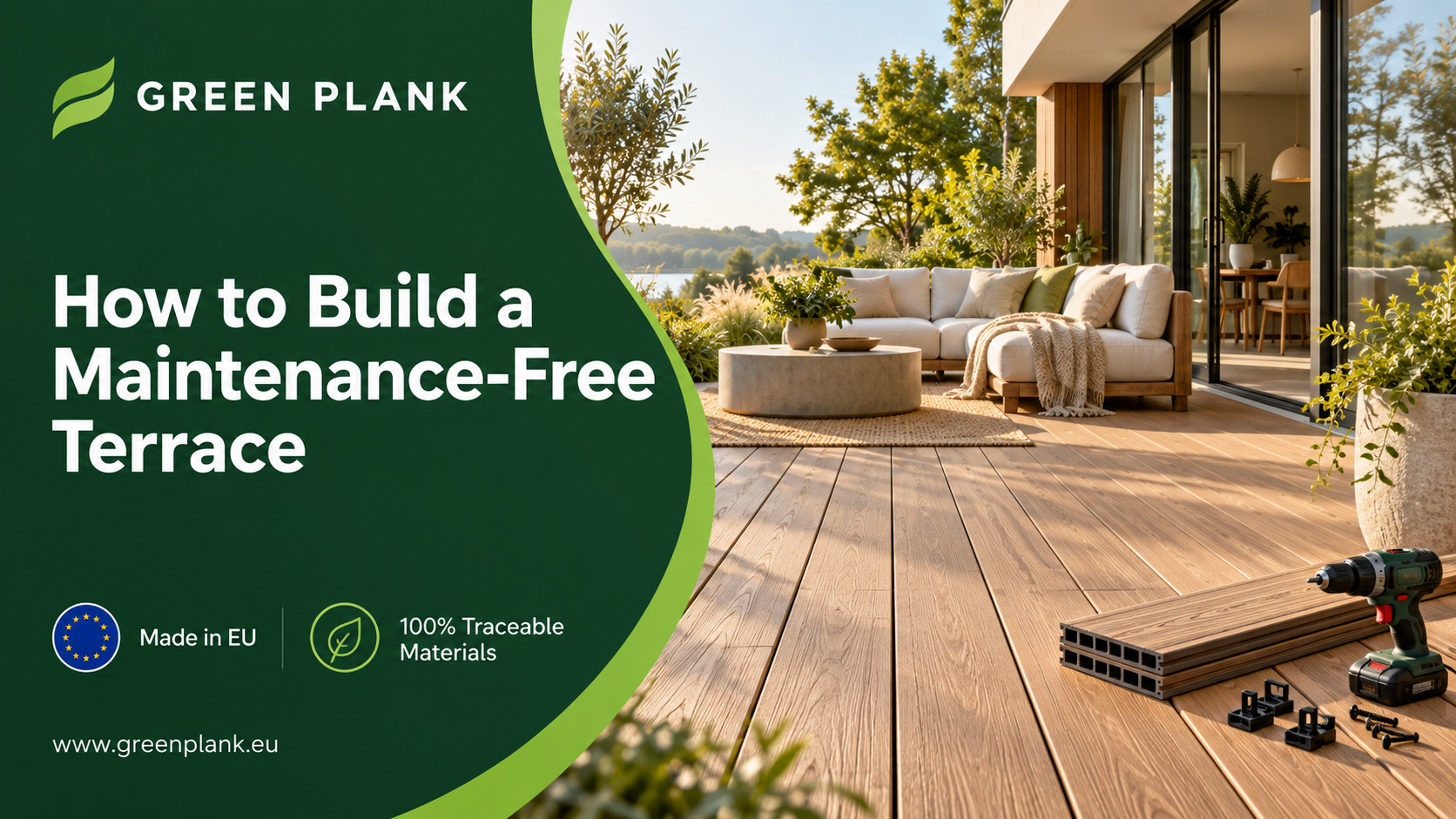
How to Build a Maintenance-Free Deck – from Green Plank
A beautiful outdoor deck should be a place to enjoy, not a project that demands constant sanding, staining and surface treatment. This is one reason homeowners, architects and professional contractors increasingly consider WPC composite decking when planning low-maintenance outdoor spaces.
Strictly speaking, no outdoor deck is completely maintenance-free. Leaves, dirt and environmental deposits still need to be removed, drainage should remain clear and the structure should occasionally be inspected. A better objective is therefore a low-maintenance deck designed to minimise routine upkeep.
Achieving that result depends on much more than choosing a composite board. The decking, substructure, fixings, ventilation, drainage and installation details must work together as a complete system.
Green Plank principle: Build for low maintenance from the ground up. Good material selection cannot compensate for poor drainage, inadequate ventilation or incorrect installation.
1. Start with the Right Decking Material
WPC stands for Wood Plastic Composite. It typically combines wood-based fibres with a thermoplastic polymer and additives. Different manufacturers and product families use different formulations, profiles and surface technologies, so the term WPC does not describe one universal material specification.
Compared with traditional timber decking, WPC generally eliminates routine painting, staining and oiling associated with many exposed timber deck systems. However, both materials still require cleaning and appropriate construction.
| Consideration | WPC Composite | Traditional Timber |
|---|---|---|
| Routine cleaning | Required | Required |
| Painting or staining | Normally not part of routine care | May be required depending on species and finish |
| Material movement | Temperature-related movement must be considered | Moisture-related movement must be considered |
| Installation | Product-specific system required | Species and system-specific requirements |
| Appearance | Consistent manufactured profiles and colours | Natural variation in grain and colour |
2. Choose the Appropriate WPC Profile
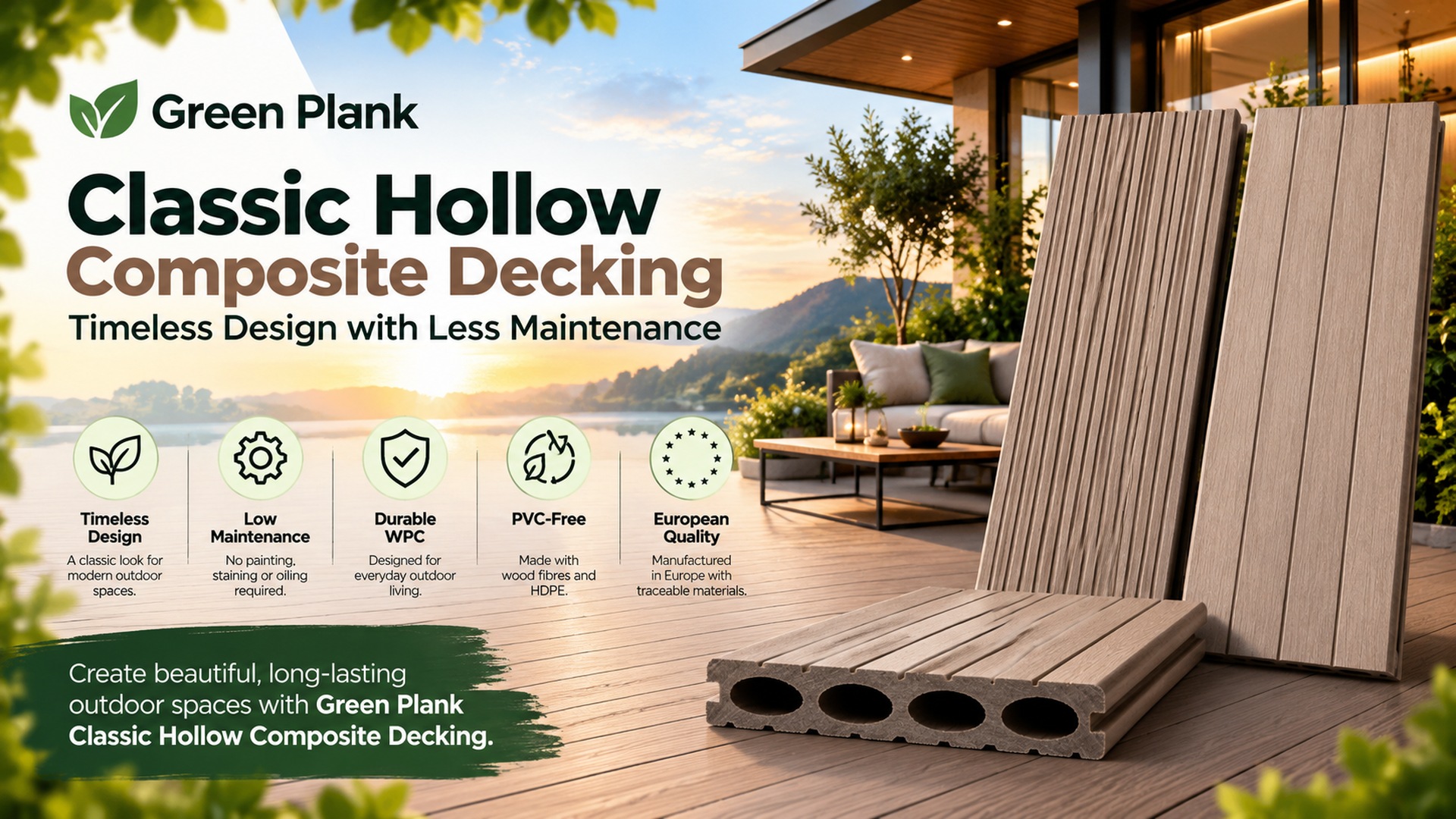
Not all composite decking boards are constructed in the same way. Profile geometry affects weight, installation requirements and suitability for different applications.
| Profile | Construction | What to Evaluate |
|---|---|---|
| Hollow WPC | Internal chambers reduce material use | Support spacing, loads and end details |
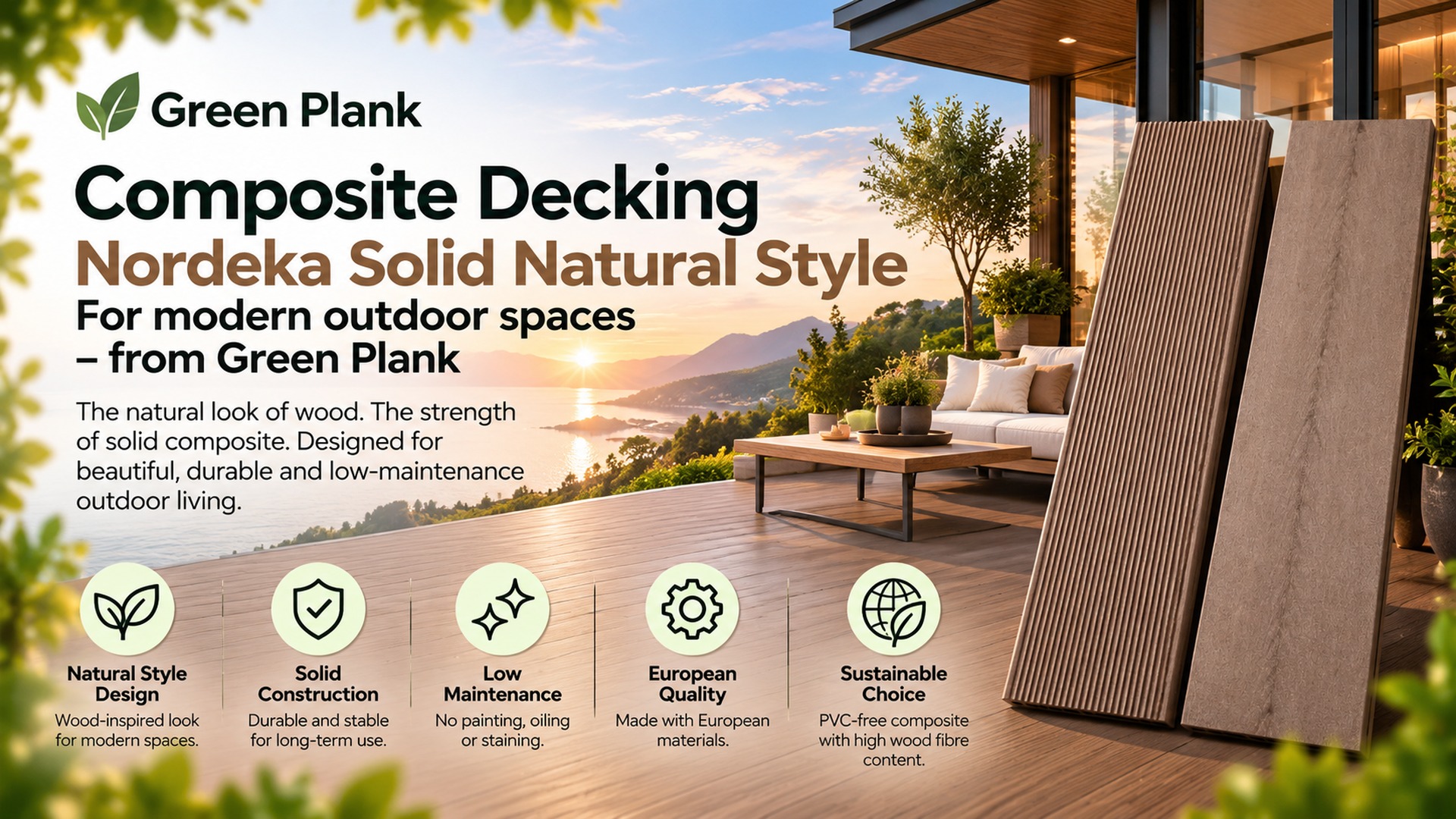
| Solid WPC | Profile without large internal chambers | Weight, structure and intended application |
| Capped/co-extruded WPC | Composite core with an additional outer layer | Cap construction, surface, warranty and application |
Green Plank offers different decking families including TerraTuff™, Nordeka™, Classic™ and Sapphire™. Rather than assuming one profile is best for every project, select the board according to the application, expected use and product-specific technical requirements.
3. Build a Stable Foundation
The foundation is one of the most important parts of a low-maintenance deck. A premium surface installed over an unstable or poorly drained base can still create future problems.
Before installing the substructure, make sure the foundation provides adequate support and allows water to move away from the deck. The exact foundation design depends on the site, deck height, ground conditions and structural requirements.
A good foundation strategy should consider:
- stable and correctly prepared support points;
- appropriate drainage away from buildings;
- space beneath the deck for required air circulation;
- access to drainage routes where necessary;
- structural requirements for the intended use.
4. Get the Substructure Right
The visible decking receives most of the attention, but the substructure determines how the boards are supported. Joists must be correctly positioned and installed according to the requirements of the selected decking profile.
There is no universal joist spacing for all WPC products. Residential use, commercial applications, board geometry, installation angle and expected loading can require different support distances. Diagonal installations, for example, can require closer support than boards installed perpendicular to the joists.
Installation tip: Never copy the joist spacing from another composite brand or profile. Use the current installation guide for the exact board being installed.
5. Design Drainage and Ventilation into the Deck
Water management should be planned before the first board is installed. Rainwater and cleaning water need a route away from the deck, while the space beneath the boards should provide the ventilation required by the decking system.
A practical design should avoid unnecessary areas where water can remain trapped around boards, joists or fixed structures. This becomes particularly important around walls, thresholds, planters and other permanent features.
- Prepare the base and required fall.
- Plan the position of joists and support points.
- Identify how water will leave the structure.
- Maintain required ventilation beneath the boards.
- Keep drainage paths and board gaps unobstructed.
6. Allow for Thermal Movement
WPC contains a thermoplastic component and responds to temperature changes. Board dimensions can therefore change as temperatures rise and fall. The amount of movement depends on factors including formulation, profile, board length and installation temperature.
This is particularly relevant for long boards, installations exposed to direct sunlight and locations with substantial seasonal temperature variation.
A universal expansion gap should not be applied to every WPC product. End gaps, perimeter clearances and board-to-board details should follow the manufacturer's current installation instructions for the specific profile and installation conditions.
7. Use the Correct Fixing System
A complete composite deck is more than decking boards. Clips, screws, starter components, finishing profiles and substructure elements influence how the finished system performs.
Hidden clip systems can provide consistent spacing and a clean surface, but components should be compatible with the selected profile. Substituting unrelated fixings simply because they appear similar can alter the way boards are restrained or allowed to move.
Before installation, confirm:
- recommended starter and intermediate clips;
- compatible screws and fasteners;
- requirements at board ends and joints;
- perimeter clearances;
- maximum permitted support spacing;
- special instructions for stairs, borders or diagonal layouts.
8. Think in Square Metres, Not Just Price per Metre
A low-maintenance deck should also be evaluated as a complete investment. Comparing only the price per linear metre can be misleading because different board widths require different quantities to cover the same area.
For example, a 150 mm board installed with an assumed 5 mm calculation gap has an effective coverage width of 155 mm. The approximate requirement would therefore be:
1 ÷ 0.155 = approximately 6.45 linear metres per m².
The 5 mm gap above is only a mathematical example and is not an installation recommendation. Actual spacing must follow the product-specific instructions.
For a meaningful comparison, include decking boards, substructure, clips, screws, finishing components, installation, expected maintenance and potential replacement costs. ISO 15686-5 provides an international framework for life-cycle costing of buildings and constructed assets.
9. Plan for Easy Cleaning
Low maintenance does not mean zero cleaning. A deck exposed to trees, food, soil, pollen or heavy foot traffic will require periodic care regardless of the surface material.
Simple preventive maintenance can include:
- sweeping away leaves and loose debris;
- keeping gaps and drainage routes clear;
- cleaning spills according to the product instructions;
- checking edges, clips and visible structural components;
- avoiding cleaning methods that are not approved for the surface.
10. Consider Traceability and Documentation
For professional buyers and larger projects, maintenance planning starts with knowing what has been installed. Product identification, technical documentation and traceability can make future replacement, expansion or claims management easier.
Green Plank is a Swedish brand with European production in Klaipėda, Lithuania. The company works with European raw materials and traceability through its supply chain. Selected Green Plank WPC products use a high proportion of European hardwood fibres, including beech and oak, combined with HDPE and additives; exact formulations vary by product.
European origin alone should not be treated as proof of superior performance or lower environmental impact. Technical properties, documentation and project suitability should be evaluated independently.
What About Warranty?
Warranty terms vary between Green Plank product families. Selected TerraTuff™ products are offered with residential warranties of up to 50 years, subject to the applicable product and warranty conditions. Other ranges have different warranty periods, while commercial and professional applications may be subject to separate terms.
A warranty period should not be confused with a guaranteed technical service life. Correct installation, intended application and compliance with warranty conditions remain important.
10-Step Low-Maintenance Deck Checklist
- Select a WPC profile suitable for the intended application.
- Read the current product-specific installation guide.
- Prepare a stable, correctly drained foundation.
- Install the substructure at the specified spacing.
- Provide appropriate ventilation beneath the deck.
- Plan drainage before installing the boards.
- Allow for product-specific thermal movement.
- Use compatible clips, screws and finishing components.
- Keep drainage routes accessible for routine cleaning.
- Retain product, installation and warranty documentation.
Conclusion: Build for Less Maintenance from Day One
The closest practical approach to a maintenance-free deck is not a single miracle material. It is a well-designed low-maintenance system. Choosing an appropriate WPC board is only the beginning; the foundation, substructure, drainage, ventilation, thermal movement and fastening system are equally important.
By planning the complete deck rather than focusing only on the visible boards, homeowners and professionals can create an outdoor space that requires less routine upkeep and is easier to manage over time. Green Plank's European WPC systems provide several profile options for projects where low-maintenance outdoor living is a priority.
Sources
- Green Plank – WPC decking products and technical information
- ISO 15686-5 – Buildings and constructed assets: Life-cycle costing
- U.S. Forest Service – Research on moisture durability of wood-plastic composites
- EUR-Lex – Regulation (EU) 2024/3110 on construction products
Specify the product
Use this guide with a Green Plank specification
Technical articles support the commercial catalogue — category, product, evidence, then samples or quotes.