



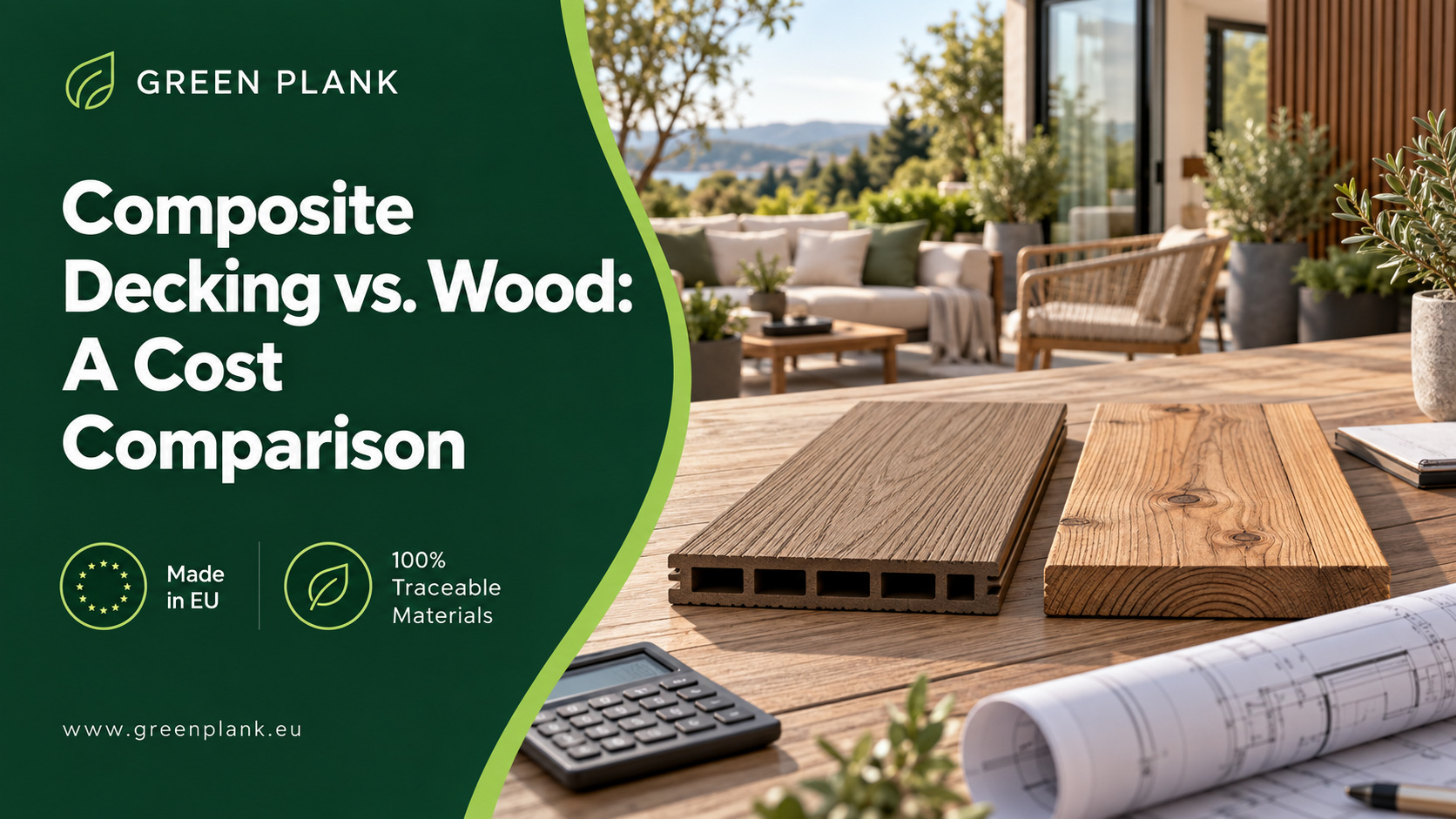
Composite Decking vs. Wood: A Price Comparison from Green Plank
When planning a new terrace, balcony, pool surround, boardwalk or commercial outdoor area, price is naturally one of the first considerations. Traditional timber may appear less expensive at the point of purchase, while premium composite decking can require a higher initial investment. But the price paid for the boards is only one part of the real cost.
A meaningful comparison should consider the complete installed system and the costs that may follow during years of use. Cleaning, staining, oiling, repairs, labour, replacement boards and disruption can all influence the total cost of ownership.
Green Plank therefore recommends comparing lifecycle value rather than board price alone. A well-engineered WPC deck is designed to reduce recurring surface-treatment requirements while delivering consistent appearance and outdoor performance.
The cheapest decking on day one is not automatically the lowest-cost decking over its service life. A better question is: what will the complete terrace cost to install, maintain and keep attractive over the years?
1. What determines the real price of decking?
Consumers often compare products using a price per square metre or linear metre. This is useful as a starting point, but two decking products with similar board prices can produce very different final project costs.
A realistic decking budget should consider:
- decking boards and expected material waste;
- substructure and supporting joists;
- clips, screws and other fastening components;
- transport and handling;
- installation labour;
- cleaning and routine maintenance;
- oils, stains, paints or preservatives where required;
- future repairs and replacement;
- access restrictions or downtime for commercial projects.
2. Initial cost: wood can have the advantage
Many commonly available softwood decking products have a relatively low initial material price. This makes timber attractive when the immediate construction budget is the dominant consideration.
However, wood decking covers a broad range of products. Pressure-treated softwood, thermally modified timber and premium hardwood can have very different purchase prices, durability expectations and maintenance requirements. It is therefore misleading to speak about one universal price for wood.
Composite decking also varies considerably. Board construction, wood-fibre content, polymer quality, profile geometry, surface technology, pigmentation, production location and warranty can all influence price.
| Cost factor | Traditional wood | Quality WPC composite |
|---|---|---|
| Initial board price | Often lower for standard softwood | Often higher initially |
| Surface treatment | May require periodic treatment | Normally no painting or oiling |
| Routine cleaning | Required | Required |
| Colour development | Natural weathering occurs | Product-specific weathering occurs |
| Long-term labour | Can increase with maintenance | Typically focused on cleaning and inspection |
| Price predictability | Depends strongly on species and maintenance | Higher initial cost can reduce recurring treatment costs |
3. Maintenance changes the long-term calculation
This is where the economic comparison becomes more interesting. Exterior timber is exposed to sunlight, moisture, temperature changes, dirt and biological influences. Depending on the wood species, construction, climate and desired appearance, maintenance may include cleaning, sanding and application of protective finishes.
Each maintenance cycle can involve both material and labour costs. For homeowners doing the work themselves, there is also a time cost. For hotels, restaurants, housing associations and municipalities, maintenance can require contractors, temporary closures and operational planning.
WPC decking is generally selected for a different maintenance model. Routine cleaning and inspection remain important, but painting, staining and oiling are normally not part of regular WPC maintenance.
Think beyond the maintenance product
A tin of decking oil may not look expensive, but the complete maintenance cost can include cleaning, preparation, application, drying time, labour and repeating the process across a large deck. On commercial sites, temporary loss of access can add another indirect cost.
4. A better comparison: lifecycle cost
Lifecycle costing evaluates expenditure over a chosen period rather than only at purchase. This approach is especially useful for projects expected to remain in service for many years.
A simplified calculation can be expressed as:
Total decking cost = materials + installation + maintenance + repairs + replacement-related costs.
For example, imagine two terraces of identical size. Terrace A uses a lower-priced timber board. Terrace B uses a premium composite board with a higher purchase price. If Terrace A requires repeated surface treatments and more maintenance labour while Terrace B mainly requires routine cleaning, the initial price difference can narrow over time.
The actual result depends on local labour rates, timber species, WPC product, exposure, installation quality, maintenance frequency and the evaluation period. For this reason, Green Plank recommends project-specific calculations rather than universal claims about a fixed payback period.
5. Installation costs matter too
Decking boards are only the visible layer of a complete system. Joists, support spacing, drainage, ventilation, fasteners, board dimensions and installation speed can all affect the final price per square metre.
When comparing quotations, ask whether each price includes:
- decking boards;
- expected cutting waste;
- joists or substructure;
- clips, screws and starter fasteners;
- edge finishing;
- delivery;
- installation labour;
- site preparation;
- future maintenance requirements.
A product with an attractive board price can become less competitive if it requires substantially more supporting material or labour. Conversely, efficient board lengths and a well-designed installation system can improve the economics of the complete project.
6. Board life is only one part of durability
Long-term value depends on how the complete decking system performs. For WPC, important variables include wood-fibre quality, polymer properties, coupling technology, moisture control during manufacturing, additives, profile geometry and extrusion consistency.
Installation is equally important. Correct joist spacing, expansion gaps, drainage and ventilation help the decking system accommodate outdoor conditions.
Green Plank's approach uses a high proportion of European wood fibre combined with HDPE and functional additives. A representative formulation is approximately 75% European wood fibres, 15% HDPE and 10% functional additives, although formulations vary according to product requirements.
7. What about capped composite decking?
Modern capped WPC adds a protective engineered surface around the composite core. Green Plank TerraTuff™ is an example of this approach. Capped technology is intended for projects where enhanced surface protection, colour design and a premium finish are important considerations.
Capped products can carry a higher initial price than basic timber or conventional uncapped composite profiles, so the comparison should again focus on the required performance, maintenance expectations and total project value rather than purchase price alone.
8. Cost considerations for homeowners and professional projects
| Project type | Cost priorities | Why composite may be considered |
|---|---|---|
| Private terrace | Budget, appearance, maintenance time | Less recurring surface treatment |
| Apartment development | Consistency, maintenance planning | Predictable appearance and simplified upkeep |
| Hotel or restaurant | Downtime, appearance, labour | Reduced need for treatment closures |
| Public space | Lifecycle cost, maintenance, documentation | Useful for long-term asset planning |
| Waterfront project | Exposure, maintenance access, durability | Engineered outdoor material system |
9. Sustainability also has an economic dimension
Material efficiency is not only an environmental question. Products that use resources efficiently, require fewer maintenance interventions and can remain functional for a long period may also reduce resource-related costs during use.
For European projects, regional manufacturing can additionally provide shorter supply routes, faster replenishment and improved communication with the manufacturer compared with long intercontinental supply chains.
Green Plank manufactures WPC in Europe using traceable European raw materials. The company focuses on PVC-free HDPE-based composites with high wood-fibre content, combining regional sourcing with controlled manufacturing and product-specific engineering.
10. Questions to ask before comparing decking prices
Instead of asking only which decking is cheaper per square metre, buyers should ask:
- What is included in the quoted price?
- How much substructure is required?
- What board lengths are available?
- How much cutting waste should be expected?
- What maintenance does the manufacturer recommend?
- Does the surface require oil, stain or paint?
- What technical documentation is available?
- What warranty applies to the intended use?
- Where is the product manufactured?
- Can the origin of the raw materials be traced?
Green Plank perspective: Compare decking as a complete installed and maintained system. Board price matters, but material quality, installation efficiency, maintenance and long-term usability determine the real value.
Composite or wood: which offers better value?
Wood remains an attractive material with a natural character and can provide an economical initial solution, particularly where owners are comfortable with regular maintenance. Premium timber species can also offer excellent performance, although their cost structure differs significantly from standard softwood.
Composite decking is particularly attractive when low-maintenance ownership, dimensional consistency, modern design and predictable long-term upkeep are priorities. Its higher initial purchase price should therefore be evaluated against potential savings in repeated surface treatments and maintenance labour.
There is no single cost figure that makes one material universally cheaper. Climate, project size, timber species, composite quality, labour rates and expected service period all affect the calculation.
Conclusion
The most useful comparison between composite decking and wood is not simply today's price per square metre. It is the total investment required to create, maintain and operate the outdoor space over its intended life.
Traditional wood can offer a lower entry price, while high-quality WPC can reduce recurring treatment requirements and provide a more predictable maintenance model. For homeowners, architects, developers and public buyers, lifecycle costing provides a clearer basis for choosing between the two.
Green Plank's European High Wood-Fibre WPC approach is designed for customers who want to combine the visual character of wood-inspired decking with modern composite technology, traceable European materials and reduced routine surface maintenance.
Sources
- https://greenplank.eu/">Green Plank – European composite decking and WPC products
- https://www.fpl.fs.usda.gov/">USDA Forest Products Laboratory – wood and wood-based materials research
- https://www.sciencedirect.com/topics/materials-science/wood-plastic-composite">ScienceDirect Topics – Wood Plastic Composites
- https://environment.ec.europa.eu/topics/circular-economy_en">European Commission – Circular Economy
Specify the product
Use this guide with a Green Plank specification
Technical articles support the commercial catalogue — category, product, evidence, then samples or quotes.