



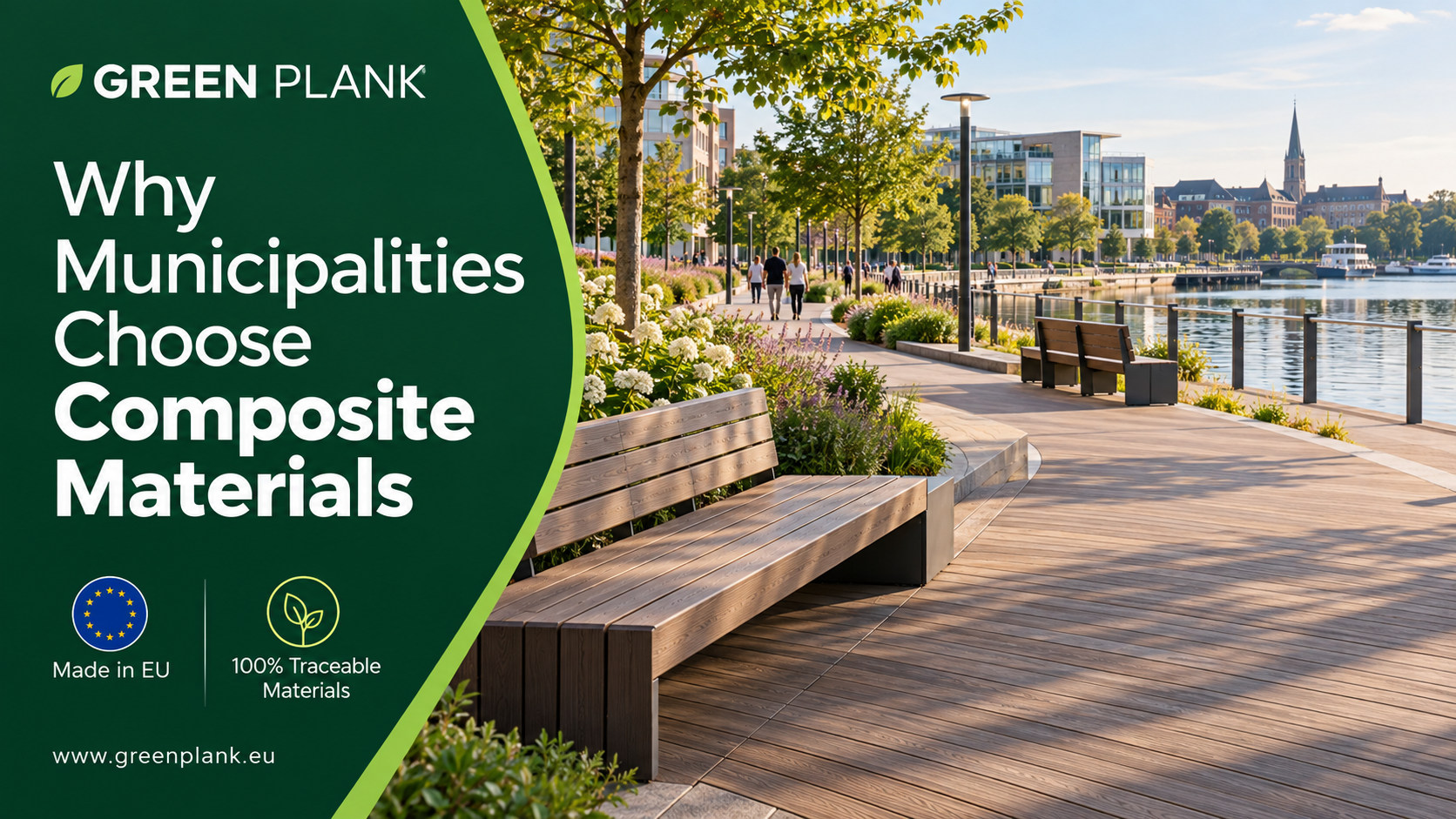
Why Municipalities Choose Composite Materials
Municipalities face a different challenge from private homeowners when selecting materials for outdoor spaces. A public boardwalk, park terrace, waterfront promenade or viewing platform may be exposed to thousands of users, changing weather, cleaning operations and continuous public access. The material must therefore satisfy not only design ambitions but also practical requirements for maintenance, durability, installation and lifecycle value.
This is one reason wood-plastic composite materials are increasingly considered for public outdoor environments. Properly engineered WPC combines natural fibres with a thermoplastic matrix and functional additives to create profiles designed for exterior applications.
For Green Plank, the objective is to provide European-made, PVC-free composite solutions based on a high proportion of European wood fibre, controlled HDPE technology and practical profile engineering.
For municipalities, the best material is rarely the one with the lowest purchase price alone. Procurement decisions should consider installation, maintenance, service requirements, disruption, material efficiency and long-term value together.
Public spaces place demanding requirements on materials
A municipal outdoor project may remain accessible throughout the year and can experience far greater traffic than a residential terrace. Materials can be exposed to rain, sunlight, frost, temperature cycles, dirt, footwear, bicycles, furniture and maintenance equipment.
Public-sector planners therefore need to evaluate several factors simultaneously:
- mechanical and dimensional performance;
- maintenance requirements;
- surface characteristics appropriate to the application;
- weather resistance;
- installation and replacement logistics;
- raw-material and manufacturing transparency;
- lifecycle cost;
- architectural appearance.
1. Lower routine maintenance can reduce disruption
Maintenance in a public environment involves more than the direct cost of materials. Work may require labour, temporary barriers, restricted access and scheduling around visitors or seasonal activity.
Traditional timber can provide an attractive natural appearance, but depending on species, exposure and the desired finish, it may require periodic surface treatment or refinishing. Composite decking follows a different maintenance model. Routine care generally focuses on cleaning, inspection and keeping drainage areas clear rather than regular sanding, staining or oiling.
Maintenance has an operational cost
A promenade closed for maintenance is not simply consuming labour and materials; it may also interrupt pedestrian circulation and reduce public access. Long-term procurement should therefore consider how often intervention may be required.
2. Lifecycle value matters more than initial price
Municipal procurement increasingly benefits from lifecycle thinking. A lower initial purchase price can become less attractive if the material requires frequent maintenance, surface treatments or premature replacement.
A practical lifecycle assessment can include:
| Cost area | Questions for procurement teams |
|---|---|
| Purchase | What is the material cost per installed square metre? |
| Installation | What substructure, fasteners and labour are required? |
| Maintenance | Will regular surface treatment or specialist care be needed? |
| Access disruption | Will maintenance require temporary closure of public areas? |
| Replacement | How easily can individual components be inspected or replaced? |
| End of service | What material recovery or disposal options exist? |
Comparing these factors over the intended service period provides a more meaningful picture than comparing board prices alone.
3. Composite materials offer controlled consistency
Natural timber varies from board to board because knots, grain, density and moisture behaviour are inherent characteristics of wood. This natural variation can be desirable aesthetically, but large municipal projects may also benefit from the more controlled appearance of engineered materials.
WPC profiles can be manufactured with defined dimensions, colours and surface textures. For large promenades, terraces or public seating areas, this can help designers create visual continuity while retaining a wood-inspired character.
Consistency also supports planning. Defined profile dimensions and installation systems can make material quantities, board layouts and substructure requirements easier to calculate.
4. Weather resistance is essential for public projects
Municipal outdoor materials may experience repeated wet-dry cycles, freezing conditions, summer heat and strong solar exposure. WPC is designed around a polymer matrix that helps encapsulate natural fibres, while additives and pigments can be selected to support outdoor performance.
However, not every composite is identical. Weather resistance depends on:
- wood-fibre quality and moisture control;
- polymer type and consistency;
- fibre-polymer bonding;
- UV and oxidation stabilisation;
- profile geometry;
- surface technology;
- manufacturing quality;
- correct installation and drainage.
Municipal buyers should therefore request technical information for the actual product rather than relying on the general term composite decking.
5. Dimensional stability must be engineered into the project
WPC contains thermoplastic and therefore responds to temperature changes. Wood fibres also interact with moisture. The dimensional behaviour of a finished profile depends on formulation, profile geometry, board length, temperature range and installation conditions.
Correct expansion clearances, ventilation and drainage are essential. Long boards on exposed waterfronts or large terraces deserve particular attention because dimensional movement accumulates over the board length.
Professional project specifications should always follow the manufacturer's product-specific installation guidance rather than applying a generic expansion value to every WPC system.
6. Public-space performance starts below the surface
The visible decking board is only one part of a public installation. The substructure must provide stable support, allow drainage and accommodate the fixing system.
Municipal projects should consider:
- required joist spacing for the selected profile;
- expected pedestrian and application loads;
- drainage and substrate slope;
- ventilation beneath the decking;
- board-end and perimeter clearances;
- fastener and clip specifications;
- access for future inspection and maintenance.
Where a project has specific structural, accessibility, fire, slip or other regulatory requirements, the relevant test data and project regulations should be reviewed during specification.
7. Composite materials support contemporary urban design
Municipal spaces increasingly combine architecture, landscape and public infrastructure. Decking may connect cafés, seating, planting, waterfronts, pedestrian routes and recreation areas within one continuous design.
Composite materials can support this approach through controlled colours, wood-inspired textures and profile consistency. Depending on the product system, designers can coordinate decking with cladding, fencing or other landscape elements.
Suitable applications can include:
- urban parks and landscaped terraces;
- waterfront promenades;
- pedestrian boardwalks;
- viewing platforms;
- outdoor cultural spaces;
- hospitality areas on municipal property;
- public courtyards;
- recreational and leisure environments.
8. Material efficiency can influence project economics
The amount of material required for a project depends on more than the board's width. Profile weight, board length, support spacing and substructure design can all influence installed material quantities.
| Design factor | Potential project impact |
|---|---|
| Board weight | Handling, logistics and structural dead load |
| Available lengths | Joints, offcuts and layout efficiency |
| Joist spacing | Quantity of substructure material |
| Profile geometry | Material use and structural efficiency |
| Fixing system | Installation speed and service access |
Municipalities should therefore compare complete installed systems rather than only the price per linear metre of decking.
9. Sustainability requires a complete lifecycle perspective
Environmental responsibility in public procurement should extend beyond a single material claim. Relevant considerations include renewable fibre content, polymer source, manufacturing location, transportation, durability, maintenance and end-of-life possibilities.
Regional European manufacturing can be valuable for European projects by reducing dependence on long intercontinental supply chains and improving visibility into material origin.
Green Plank's strategy focuses on European production, European wood fibre and traceable raw materials. Its high wood-fibre approach also aims to use a substantial natural-fibre component within the composite while maintaining the performance required from an engineered outdoor product.
10. Why raw-material traceability matters to municipalities
Public procurement increasingly requires suppliers to provide meaningful documentation rather than broad marketing statements. Knowing where principal raw materials originate can improve transparency and make product evaluation more structured.
Municipal procurement teams can ask:
- Where is the product manufactured?
- Where does the wood fibre originate?
- What polymer system is used?
- Is the product PVC-free?
- What finished-product testing is available?
- What installation requirements apply?
- What maintenance guidance is provided?
- What warranty conditions apply to the intended use?
Green Plank's approach to public-space WPC
Green Plank develops European-made WPC around a high proportion of European wood fibre combined with HDPE and functional additives. A representative formulation is approximately 75% European wood fibres, 15% HDPE and 10% functional additives, with formulations adapted according to product requirements.
The approach combines raw-material traceability, PVC-free composite technology, fibre-polymer compatibility, extrusion control and engineered profiles. Capped technologies such as TerraTuff™ can provide an additional engineered surface for projects where enhanced surface protection and controlled aesthetics are priorities.
For public projects, premium WPC should be evaluated as a complete system: raw materials, profile engineering, technical performance, installation, maintenance and lifecycle value all matter.
A practical municipal specification checklist
Before specifying composite decking for a park, promenade or public terrace, project teams should review the following:
- Define the expected use and traffic conditions.
- Confirm product-specific structural and support requirements.
- Review relevant slip, fire, accessibility or project-specific requirements.
- Evaluate dimensional movement and installation clearances.
- Plan drainage and ventilation.
- Compare maintenance requirements over the project lifecycle.
- Review raw-material origin and manufacturing location.
- Request relevant technical documentation.
- Calculate installed system cost rather than board price alone.
- Confirm warranty terms for the intended municipal application.
Conclusion
Municipalities choose composite materials because public spaces demand a balance of durability, manageable maintenance, architectural consistency and lifecycle value. WPC can be particularly attractive for parks, promenades, terraces and boardwalks where repeated surface refinishing would create ongoing cost and disruption.
But composite should never be selected on the material name alone. Fibre quality, polymer technology, profile engineering, finished-product testing, installation requirements and manufacturing consistency determine whether a WPC system is appropriate for a specific public project.
Green Plank's European high wood-fibre approach is designed around this complete-system philosophy: combining traceable European materials, PVC-free HDPE composite technology and practical outdoor engineering for the next generation of public spaces.
Sources
- https://greenplank.eu/">Green Plank – European WPC and composite building products
- https://www.sciencedirect.com/topics/materials-science/wood-plastic-composite">ScienceDirect Topics – Wood Plastic Composites
- https://www.fpl.fs.usda.gov/">USDA Forest Products Laboratory – Wood and wood-composite research
- https://environment.ec.europa.eu/topics/circular-economy_en">European Commission – Circular Economy
- https://green-business.ec.europa.eu/green-public-procurement_en">European Commission – Green Public Procurement
Specify the product
Use this guide with a Green Plank specification
Technical articles support the commercial catalogue — category, product, evidence, then samples or quotes.