



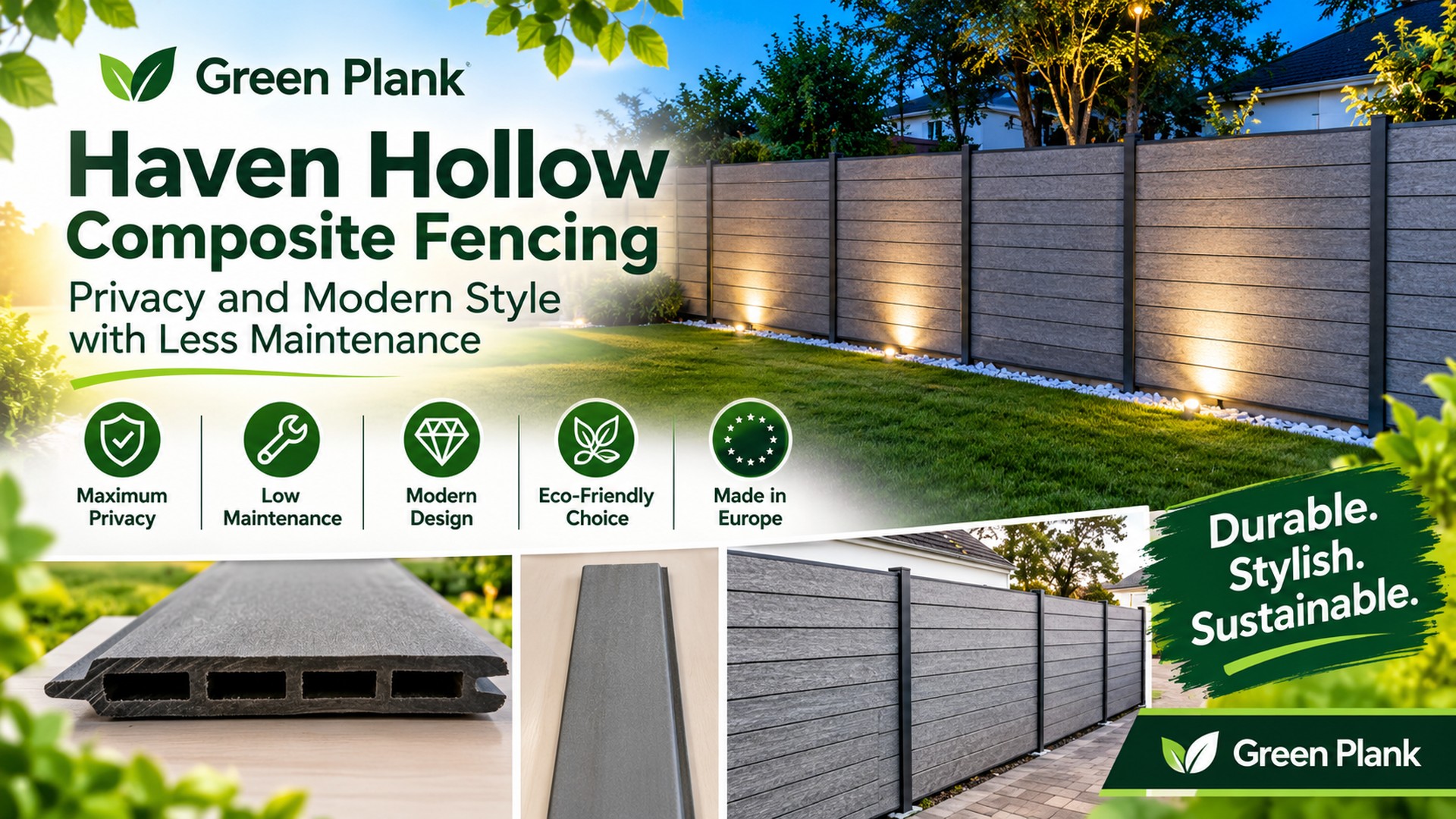
Haven Hollow Composite Fencing: Privacy Meets Contemporary Outdoor Design
A well-designed fence does more than define a property boundary. It creates privacy, contributes to the architectural character of a garden and helps transform an outdoor area into a comfortable extension of the home. Green Plank Haven Hollow Composite Fencing is designed for projects where modern appearance, practical performance and reduced routine maintenance are important.
Combining wood fibres with a polymer matrix, wood-plastic composite (WPC) provides an alternative to conventional timber for outdoor applications. Haven Hollow brings this material concept into a clean, contemporary fencing system suited to private gardens, terraces, residential developments and other landscaped spaces.
Green Plank design principle: A modern privacy fence should complement the architecture, provide dependable outdoor performance and remain attractive without the recurring painting, staining and oiling associated with many traditional timber fences.
Why Choose Composite Fencing?
Traditional timber remains an attractive fencing material, but exterior wood normally requires periodic care to manage its appearance and exposure to moisture, sunlight and changing weather. WPC combines wood-based reinforcement with thermoplastic material to create a more dimensionally controlled outdoor product when correctly formulated, manufactured and installed.
For homeowners, architects, developers and landscape professionals, this can provide several practical advantages:
- Reduced need for painting, staining or oiling.
- Contemporary and consistent surface appearance.
- Resistance to everyday moisture exposure when correctly installed.
- No conventional timber splinters from the composite surface.
- Easy integration with modern garden and terrace architecture.
- Efficient material use through a hollow-profile construction.
Haven Hollow: Designed for Modern Privacy
Privacy is increasingly important in modern residential environments, particularly where terraces, gardens and neighbouring properties are positioned close together. Haven Hollow fencing can create a clear visual boundary while maintaining a refined architectural appearance.
The streamlined board geometry works naturally with Scandinavian and contemporary European design. Rather than making the fence visually dominant, neutral composite tones can provide a calm backdrop for plants, furniture, decking and building façades.
Typical applications
- Private gardens and residential boundaries
- Terrace and patio privacy screens
- Townhouses and multi-family developments
- Outdoor dining and lounge areas
- Pool and leisure environments where permitted by local requirements
- Commercial landscaping and hospitality projects
The Advantage of a Hollow Composite Profile
A hollow profile uses carefully engineered internal cavities rather than making the entire board solid. This can reduce material use and board weight while retaining the geometry required for the intended fencing application. The profile design must, however, always be considered together with post spacing, fixing details, wind exposure and the complete supporting system.
| Feature | Haven Hollow concept | Project benefit |
|---|---|---|
| Profile | Hollow composite construction | Efficient use of material |
| Appearance | Modern, uniform surface | Clean architectural character |
| Maintenance | No routine painting or oiling required | Less recurring surface treatment |
| Material concept | Wood fibre and polymer composite | Combines wood content with polymer performance |
| Application | Outdoor privacy and screening | Suitable for contemporary landscape design |
Less Routine Maintenance Than Traditional Timber
One of the strongest practical reasons for choosing composite fencing is maintenance. Painted or stained timber fencing may require cleaning, preparation and renewed surface treatment over its service life. Composite boards do not require the same conventional painting or oiling cycle.
That does not mean a composite fence is maintenance-free. Outdoor surfaces naturally collect pollen, dust, leaves and atmospheric dirt. Periodic cleaning with water and suitable mild cleaning products helps preserve the appearance. Following Green Plank's current care instructions is recommended for specific stains or cleaning situations.
Simple care routine
- Remove leaves and loose dirt periodically.
- Wash the surface with water when required.
- Use a suitable mild cleaner for persistent dirt.
- Avoid aggressive chemicals unless specifically approved.
- Inspect posts, fasteners and structural components periodically.
Composite Fencing vs. Traditional Timber
The right material depends on architecture, budget, desired appearance and maintenance expectations. The comparison below highlights typical differences rather than guaranteeing identical performance for every product or installation.
| Consideration | Haven Hollow WPC | Traditional timber |
|---|---|---|
| Painting or staining | Normally not required | Often required periodically |
| Visual consistency | Manufactured, controlled appearance | Natural variation between boards |
| Splinters | No conventional wood splintering | Can occur as timber ages |
| Cleaning | Periodic cleaning | Cleaning plus possible surface treatment |
| Design character | Contemporary and consistent | Natural and traditional |
| Weather response | Composite-specific thermal movement | Wood movement linked to moisture |
European Materials and Traceability
Green Plank's broader product philosophy places emphasis on European production, material control and traceability. For professional buyers, these factors can be important alongside appearance and price because consistent sourcing supports documentation, quality control and a more transparent supply chain.
Composite products can also make productive use of wood-based material and thermoplastics. However, environmental performance should be evaluated across the complete product life cycle rather than through a single material percentage. Raw-material sourcing, manufacturing efficiency, transportation, durability, maintenance and end-of-life possibilities all influence the overall environmental profile.
Designing a Complete Outdoor Environment
Haven Hollow fencing can be particularly effective when coordinated with composite decking, cladding and other exterior materials. Repeating complementary colours and textures creates a coherent visual language across a property.
Three practical design approaches
- Nordic minimalism: combine grey or muted fencing with simple planting, stone and restrained architecture.
- Warm contemporary: use wood-inspired shades alongside warm lighting and natural landscaping.
- Architectural contrast: combine darker fencing with light façades, glass and modern metal details.
For larger developments, consistent fencing can also help create a unified identity across multiple terraces, gardens and common outdoor spaces.
Installation Is Critical to Long-Term Performance
Composite fencing must be installed as a complete engineered system. Posts, foundations, board support, clearances and fasteners should be selected for the project and local conditions. Wind loading becomes particularly important with privacy fencing because a largely closed fence surface can experience significant wind pressure.
Good planning should therefore consider:
- Fence height and local planning requirements
- Ground conditions and post foundations
- Post spacing and structural stability
- Expected wind exposure
- Drainage around the base of the system
- Thermal movement and required clearances
- Compatible fasteners and accessories
- Gates, corners and termination details
Project-specific structural requirements and local building regulations should always take priority over general installation guidance.
Understanding Thermal Movement
WPC contains thermoplastic material and therefore changes dimension as temperature changes. Correct expansion allowances are an important part of professional composite installation. Long boards, dark colours and locations exposed to strong sunlight require particular attention.
Installers should use the current Green Plank technical documentation for board clearances, fixing arrangements and other product-specific requirements rather than relying on rules developed for conventional timber fencing.
Where Haven Hollow Adds the Most Value
The product is particularly relevant where the owner wants privacy and a contemporary appearance without committing to the recurring surface-treatment routine of traditional painted or stained timber.
It can be a strong option for new homes, terrace renovations, residential developments and landscape projects where visual consistency is important. For professional projects, specification should also consider structural design, fire requirements where applicable, local regulations and the intended service environment.
Think beyond the fence board. The best result comes from combining the right composite profile with correctly designed posts, foundations, fixings, drainage and installation clearances.
A Modern Boundary for Modern Outdoor Living
Green Plank Haven Hollow Composite Fencing brings together privacy, contemporary design and practical everyday ownership. Its hollow WPC profile offers an efficient composite solution, while the manufactured surface provides a consistent appearance suited to modern European outdoor spaces.
For homeowners, architects and developers seeking an alternative to regularly painted or stained timber, Haven Hollow offers a compelling balance: architectural privacy, coordinated design possibilities and less routine surface maintenance. Correct specification and professional installation remain essential to achieving the intended long-term result.
Sources
- https://greenplank.eu/">Green Plank – Composite outdoor products and product information
- https://www.sciencedirect.com/topics/materials-science/wood-plastic-composite">ScienceDirect – Wood-Plastic Composite overview
- https://www.fpl.fs.usda.gov/">USDA Forest Products Laboratory – Wood and wood-composite research
- https://environment.ec.europa.eu/topics/circular-economy_en">European Commission – Circular Economy
- https://single-market-economy.ec.europa.eu/sectors/construction/construction-products-regulation-cpr/cpr-overview_en">European Commission – Construction Products Regulation overview
Specify the product
Use this guide with a Green Plank specification
Technical articles support the commercial catalogue — category, product, evidence, then samples or quotes.