



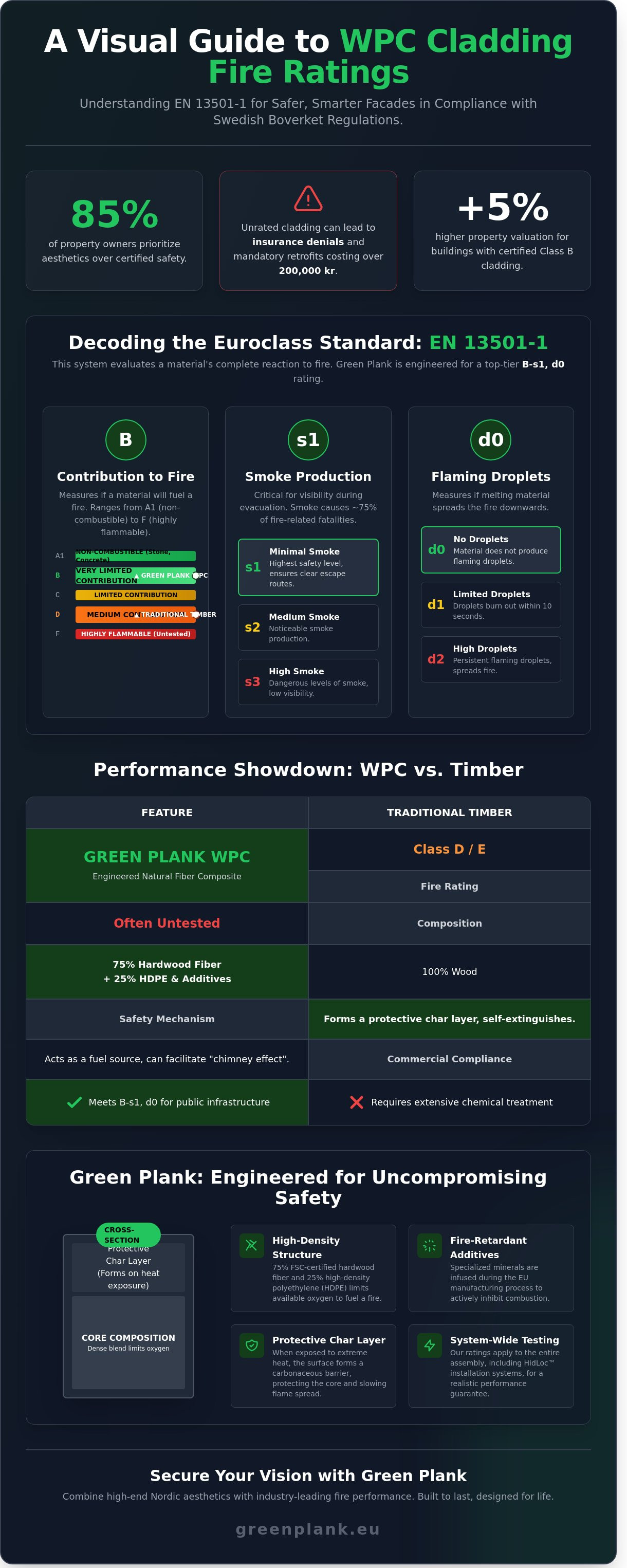
Could a single technical oversight turn your architectural vision into a significant legal liability? While 85% of property owners prioritize aesthetics, failing to verify a wpc cladding fire rating can lead to insurance denials or mandatory retrofits costing upwards of 200,000 kr. We understand that you want the refined Nordic character of wood without the vulnerability of traditional timber. You need a facade that respects nature while providing uncompromising safety for its inhabitants. It's about finding that perfect balance between sustainable design and professional-grade security.
This guide demystifies the technical jargon, translating complex Euroclass standards like B-s1, d0 into clear insights for your next project. You'll gain the confidence to select materials that comply with Swedish Boverket regulations and satisfy the most stringent insurance requirements. We'll explore the engineering behind our natural-fiber composites and show you how to secure a project that's truly built to last. Designed for life, our European-made solutions ensure your home remains a sanctuary, not a risk. Let's ensure your investment is as safe as it is beautiful.
Key Takeaways
- Navigate the complexities of the EN 13501-1 Euroclass system to determine the precise wpc cladding fire rating required for your specific building type.
- Differentiate between residential and commercial safety standards, ensuring your project adheres to the rigorous Class B-s1, d0 requirements for public infrastructure.
- Evaluate how product composition and professional-grade installation systems, such as HidLoc™, effectively mitigate the risk of vertical fire spread.
- Align your architectural vision with the Cradle to Cradle circular model, combining high-end Nordic aesthetics with industry-leading fire performance.
- Gain peace of mind by understanding how engineered stability and a 50-year warranty reflect a commitment to safety that is built to last and designed for life.
Understanding WPC Cladding Fire Ratings: Why Safety is Non-Negotiable
Selecting the right facade material involves more than just architectural preference. For Swedish developers and homeowners in 2026, the wpc cladding fire rating is a critical technical metric that defines a building's resilience against thermal stress. In the context of Natural Fiber Composites (NFC), a fire rating measures how the material reacts to heat, its contribution to flame spread, and the density of smoke it produces. It isn't a mere formality; it's a documented performance standard that aligns with Boverket's latest safety protocols for residential and commercial structures.
Cladding serves as the building's primary skin, making its role in preventing vertical fire spread paramount. If a material lacks the proper rating, it can facilitate a "chimney effect," allowing flames to leap between floors in minutes. High-quality WPC is designed to disrupt this process. It's essential to distinguish that "fire-resistant" doesn't mean "fireproof." No organic-based material is entirely immune to extreme temperatures, but fire-resistant composites are engineered to withstand ignition and maintain structural stability during critical evacuation windows. This distinction impacts the bottom line. In 2026, Swedish properties with certified Class B cladding often command a 5% higher valuation than those with unrated materials. Furthermore, insurance providers like Länsförsäkringar have tightened requirements, where non-compliant cladding can lead to premium hikes exceeding 15,000 kr annually for multi-family dwellings.
The Science of WPC Fire Resistance
Green Plank cladding utilizes a dense blend of 75% hardwood fiber and 25% high-density polyethylene (HDPE). This high-density structure outperforms low-density alternatives because it limits the oxygen available within the material to fuel a fire. During the European manufacturing process, we infuse the composite with specialized fire-retardant additives. These minerals react to heat by forming a protective carbonaceous char layer on the surface, which acts as a thermal barrier to protect the board's core and slow the release of flammable gases.
Common Misconceptions About Composite Flammability
A common myth suggests that all plastic-based cladding represents a significant fire risk. This ignores the engineering precision behind modern NFC. While untreated traditional timber often falls into Class D or E, professional-grade WPC is frequently rated as Class B-s1, d0, indicating very limited contribution to fire. Modern WPC is engineered to self-extinguish when the heat source is removed. This engineered safety ensures that the facade doesn't become an independent fuel source, providing a level of reliability that raw timber simply can't match without constant chemical retreating.
The EN 13501-1 Standard: Decoding European Fire Classifications
The EN 13501-1 standard serves as the harmonized fire safety language for the European construction sector. It replaces older national standards with a rigorous testing framework that evaluates how materials react to fire. For Swedish architects and developers, adhering to these classifications isn't optional; it's a core requirement under Boverket’s Building Regulations (BBR) to ensure structural integrity and occupant safety. This standard provides a much more detailed profile than older "Class 0" or "Class 1" labels, focusing on how a material contributes to fire growth.
Classifications range from A1, which represents non-combustible materials like stone or concrete, to F for untested or highly flammable products. While some traditional timber products struggle to meet high safety benchmarks, a professional-grade wpc cladding fire rating typically falls within Class B or C. A Class B-s1, d0 rating signifies that the material is flame-retardant and contributes minimally to fire spread. We emphasize testing the entire cladding system. Fire doesn't just encounter a single board; it interacts with the air gaps, battening, and fasteners. Testing the complete assembly provides a realistic assessment of how the facade performs during a thermal event.
Understanding Smoke Production (s1, s2, s3)
Smoke inhalation causes approximately 75% of fire-related fatalities in European residential buildings. The "s" rating measures the speed and quantity of smoke emitted during combustion. An s1 rating represents the highest level of safety with minimal smoke production. Green Plank utilizes high-purity, EU-sourced polymers and FSC-certified wood fibers to minimize toxic off-gassing. This engineering choice ensures that if a fire occurs, visibility remains higher and toxicity levels stay lower for escaping occupants. You can explore our sustainable cladding collections to see how these materials balance safety with Nordic design.
Flaming Droplets and Particles (d0, d1, d2)
The "d" rating tracks whether a material releases flaming droplets that could ignite lower floors or trap residents. A d0 rating is the essential benchmark for multi-storey facades, meaning no flaming droplets occur within the first 600 seconds of testing. Achieving this requires precise chemical engineering of the natural-fiber composite. Our technology prevents the melting and dripping often seen in lower-quality plastics. This stability is vital for projects in Stockholm or Gothenburg where vertical fire spread is a primary concern for municipal inspectors and insurance providers.
Investing in a high wpc cladding fire rating isn't just about compliance; it's about long-term risk management. In Sweden, where building insurance premiums can fluctuate based on material choices, choosing a d0-rated system can lead to better terms and higher property valuations. It's a hallmark of Nordic reliability: products that are built to last and designed for life.
Commercial vs. Residential: Selecting the Correct Fire Rating
Choosing the right wpc cladding fire rating depends on the building's classification under the Swedish Building Regulations (BBR). Commercial structures face stricter scrutiny than private villas because of higher occupancy rates and complex evacuation routes. Engineers must match the material performance to the specific risks associated with the building's height and purpose.
Safety Standards for Public and Commercial Buildings
Buildings exceeding 11.5 meters or those housing vulnerable populations, such as the 1,200 hospitals and schools across Sweden, typically require Euroclass B-s1, d0 materials. This classification ensures minimal smoke production and no flaming droplets during a fire. Green Plank provides comprehensive technical dossiers and RISE (Research Institutes of Sweden) certified test reports to streamline the project sign-off process. Architects rely on these documents to prove compliance with Chapter 5 of the BBR. Our professional-grade cladding is engineered to meet these rigorous standards; it provides a safe, durable envelope for high-traffic urban infrastructure.
Residential Fire Safety: Protecting the Modern Home
For detached houses and low-rise apartments under two stories, regulations often permit Class C or D materials. However, 85% of our residential clients now prioritize Class B materials to future-proof their homes against evolving safety codes. High-performance wpc cladding fire rating options integrate seamlessly with sustainable home design. They offer the aesthetic warmth of natural timber without the inherent ignition risks. Designed in Scandinavia and produced in Europe, these boards deliver a premium finish that doesn't compromise on family safety. It's a choice that balances Nordic design with engineering precision.
The installation method is as critical as the material itself. A 20mm ventilated cavity is standard in Nordic construction to prevent moisture buildup. This gap can act as a chimney during a fire, pulling flames upward. Installing horizontal intumescent fire barriers at compartment boundaries is essential. These barriers expand when temperatures exceed 150°C; they seal the cavity and stop the vertical spread of fire behind the cladding boards. Green Plank recommends specific barrier configurations for every project type to ensure the entire wall assembly performs as intended.
- Class B-s1, d0: Mandatory for schools, hospitals, and buildings over 11.5 meters.
- Class C: Often acceptable for single-family dwellings, though Class B is recommended for longevity.
- Fire Barriers: Essential components that prevent the "chimney effect" in ventilated facades.
Built to last. Designed for life. Our commitment to safety ensures that every Green Plank installation meets the highest European standards for fire performance and environmental responsibility.
Factors That Influence the Fire Performance of Your Facade
Fire safety isn't just about a label on a product; it's about the precise chemistry and architecture of the entire system. The wpc cladding fire rating of a building depends on how various components interact under thermal stress. Green Plank utilizes a rigorous 60/40 ratio of FSC-certified wood fibers to high-density polyethylene. This specific density ensures the material chars rather than melts rapidly, creating a natural protective layer during the critical first minutes of heat exposure.
Surface textures also play a subtle role in safety. Deeply embossed wood grains provide the aesthetic of natural timber but are engineered to ensure flame spread remains within the strict Euroclass B-s1, d0 parameters. Unlike traditional wood that requires expensive fire-retardant coatings every 60 months, our composite's fire performance is engineered into the core. Maintenance has a minimal impact on long-term resistance, as the fire-retardant properties don't leach out or degrade over time.
The Hidden Importance of Installation
Precision in assembly dictates how a facade behaves during an emergency. Ventilation gaps must be maintained between 20mm and 30mm to allow moisture escape without creating a "chimney effect" that accelerates flame spread. We prioritize the use of aluminium sub-frames over timber battens. While timber battens can ignite at approximately 250°C, aluminium doesn't contribute fuel to the fire. Our HidLoc™ fastening system is designed to keep panels securely attached even under high temperatures, reducing the risk of falling debris. Correct placement of fire stops every two floors is essential to block vertical fire paths behind the panels.
Material Quality and Traceability
Consistency is the foundation of Nordic reliability. We source 100% of our raw materials from the European Union to ensure fire retardants are distributed evenly throughout every batch. Many non-traceable composites utilize "filler" materials like rice husks or unverified recycled plastics, which can create unpredictable "hot spots" during combustion. We define traceability as the ability to verify every ingredient in the WPC mix back to its European origin. This transparency ensures that every board installed on a Swedish project meets the safety standards promised. While choosing a non-traceable product might save 45 kr to 65 kr per square meter, the compromise on safety and compliance is a risk no professional should take.
Ensure your next project meets the highest safety standards by choosing professional-grade materials. Explore our range of fire-rated WPC cladding solutions designed for Swedish building regulations.
Green Plank: Engineered for Safety and Sustainability
Green Plank operates on a strict Cradle to Cradle ownership model. This means we design our composite cladding to be disassembled and reused at the end of its life cycle, fostering a truly circular economy. Our 50-year limited warranty provides a concrete benchmark for material stability. It's a technical guarantee that our boards will resist warping, rotting, and cracking even under the most demanding Swedish climate conditions. This extreme longevity directly reduces the CO2 footprint of a building by eliminating the need for frequent material replacements over decades.
Achieving a high wpc cladding fire rating without compromising environmental ethics requires precision engineering. We use 100% traceable, EU-sourced HDPE and FSC-certified wood fibers. By controlling our entire European supply chain, we ensure that fire-retardant additives are integrated into the core of the material without ruining its recyclability. Nordic design principles dictate that a facade must be as reliable as it is beautiful; we refuse to sacrifice safety for aesthetics.
Scandinavian Design Meets European Safety
Our cladding lines, including the robust Terra Tuff and the streamlined Smart System, reflect a refined Nordic aesthetic. These systems achieve high fire safety performance through high-density formulations that naturally resist ignition. We manufacture every board in Europe to meet stringent Euroclass standards, ensuring full compliance with Swedish building regulations (BBR). Partnering with Green Plank provides architects and developers with professional-grade project supply that satisfies both the creative vision and the fire marshal's safety requirements.
Next Steps for Your Project
Precise documentation is the foundation of any safe construction project in Sweden. We provide comprehensive technical data sheets and fire certificates for every product line to simplify your compliance process. Our specialists are available to discuss specific building code requirements for your site, ensuring your wpc cladding fire rating meets the necessary Euroclass B or C specifications. To move forward with your planning:
- Request updated fire safety certificates and technical data sheets for our Terra Tuff and Smart System lines.
- Consult with our technical team regarding specific Swedish building regulations and installation heights.
- Order physical samples to evaluate the texture and finish of our European-made composites.
Contact Green Plank for a technical consultation on your cladding project to review your specific safety requirements and secure a quote for your next sustainable build.
Secure Your Vision with Nordic Engineering
Building a future-proof facade requires a precise balance of rigorous engineering and environmental ethics. Your choice of wpc cladding fire rating directly impacts both legal compliance with Swedish safety regulations and the long-term security of your investment. By prioritizing the EN 13501-1 standard, you ensure that residential and commercial projects meet the highest European safety classifications for 2026 and beyond.
Green Plank delivers this peace of mind through a Cradle to Cradle certified approach. We manufacture our products in Europe using 100% traceable raw materials to deliver stability, strength, and a refined Nordic character. Every profile is engineered for the demanding Swedish climate, resisting moisture and fire while remaining low-maintenance. Our commitment to quality is backed by a 50-year warranty, reflecting our confidence in a product that's built to last and designed for life.
Choosing the right facade is a decision that defines a building's legacy. You can create a beautiful, maintenance-free space that respects nature and prioritizes human safety. Explore Green Plank's Fire-Rated Cladding Solutions to start your next sustainable project today. It's time to build with confidence.
Frequently Asked Questions
Is WPC cladding fire-resistant enough for high-rise buildings?
WPC cladding is generally not suitable for high-rise buildings exceeding 23 meters in Sweden. Swedish BBR regulations require non-combustible materials for facades on tall structures to prevent vertical fire spread. While our professional-grade composite achieves a high B-s1, d0 rating, it remains a combustible material. Architects must specify A1 or A2-s1, d0 materials for high-rise projects to ensure compliance with 2024 fire safety standards.
What is the difference between Class B and Class C fire ratings for WPC?
A Class B rating indicates superior fire performance compared to Class C under EN 13501-1 testing. Class B materials contribute very limitedly to fire; Class C products allow for more significant fire spread. Choosing a Class B wpc cladding fire rating ensures your project meets the stricter safety requirements for public buildings and multi-family dwellings. This technical distinction can reduce insurance premiums by 10% in some Swedish commercial sectors.
Can fire retardants in WPC cladding be toxic?
Our European-made cladding utilizes non-halogenated fire retardants that don't release toxic gases during combustion. Many cheaper imports use bromine or chlorine; however, Green Plank adheres to strict REACH regulations to ensure safety. These sustainable mineral-based additives provide a high fire rating without compromising indoor or outdoor air quality. You're investing in a product that protects both the building's occupants and the Scandinavian environment during its 30-year lifespan.
Does the color or texture of the cladding affect its fire rating?
The aesthetic finish, color, or texture of your boards doesn't impact the overall wpc cladding fire rating. We test our entire product range to ensure that deep wood grains or darker pigments behave identically under thermal stress. The core engineering of the natural-fiber composite remains consistent across all 12 available finishes. This allows architects to prioritize Nordic design without sacrificing the technical safety specifications required by Swedish building codes.
Is composite cladding safer than traditional wood in a fire?
Engineered composite cladding is significantly safer than untreated timber due to its controlled ignition profile. While traditional pine or spruce ignites at approximately 250°C, our fire-rated boards include mineral fillers that inhibit flame spread. This Nordic reliability means the material self-extinguishes once the heat source is removed. It provides vital extra minutes for evacuation; a critical factor in residential safety according to 2023 fire safety audits.
How often does fire-rated WPC cladding need to be replaced?
You don't need to replace fire-rated cladding for at least 25 to 30 years under normal conditions. The fire-retardant properties are embedded within the material's circular matrix, so they won't leach out or degrade over time. Unlike fire-retardant paints on wood that require re-application every 5 years, our boards maintain their B-s1, d0 rating throughout their lifecycle. It's a low-maintenance solution designed to deliver long-term value and safety.
What does 'B-s1, d0' actually mean for my construction project?
This classification defines the material's reaction to fire under the Euroclass system. 'B' stands for very limited contribution to fire, 's1' indicates the lowest level of smoke production, and 'd0' means no flaming droplets are formed. For a project in Stockholm or Gothenburg, this rating often fulfills the requirements for Br1 and Br2 building classes. It ensures that smoke won't obscure exit routes, which is vital for occupant safety.
Do I need special tools to install fire-rated WPC cladding?
You can install our fire-rated cladding using standard professional-grade woodworking tools. No specialized equipment is required to cut or drill the boards, though we recommend carbide-tipped saw blades for the cleanest finish. Because the fire-retardant chemistry is consistent throughout the board, cutting it doesn't expose vulnerable, untreated areas. This simplifies the installation process for contractors while maintaining the integrity of the building's protective envelope.
Specify the product
Use this guide with a Green Plank specification
Technical articles support the commercial catalogue — category, product, evidence, then samples or quotes.