


By 2026, Swedish climate declarations will enforce a 20% reduction in carbon limits for new builds, yet the construction sector still generates nearly 10 million tonnes of waste every year. It's a staggering figure that highlights the urgent need for a shift in how we specify. You likely feel the pressure to lower embodied carbon while worrying that green alternatives won't survive the harsh Nordic climate or provide the security of a long-term warranty. Specifying circular economy construction materials shouldn't feel like a gamble on quality or a dance with greenwashing.
This guide reveals how to identify traceable, European-made materials that drastically reduce project CO2 footprints while ensuring 50-year durability. We'll explore the technical advantages of natural-fiber composites and the engineering precision required to move beyond the take-make-waste model. You'll learn how to secure your project's future with professional-grade solutions that are built to last and designed for life.
Key Takeaways
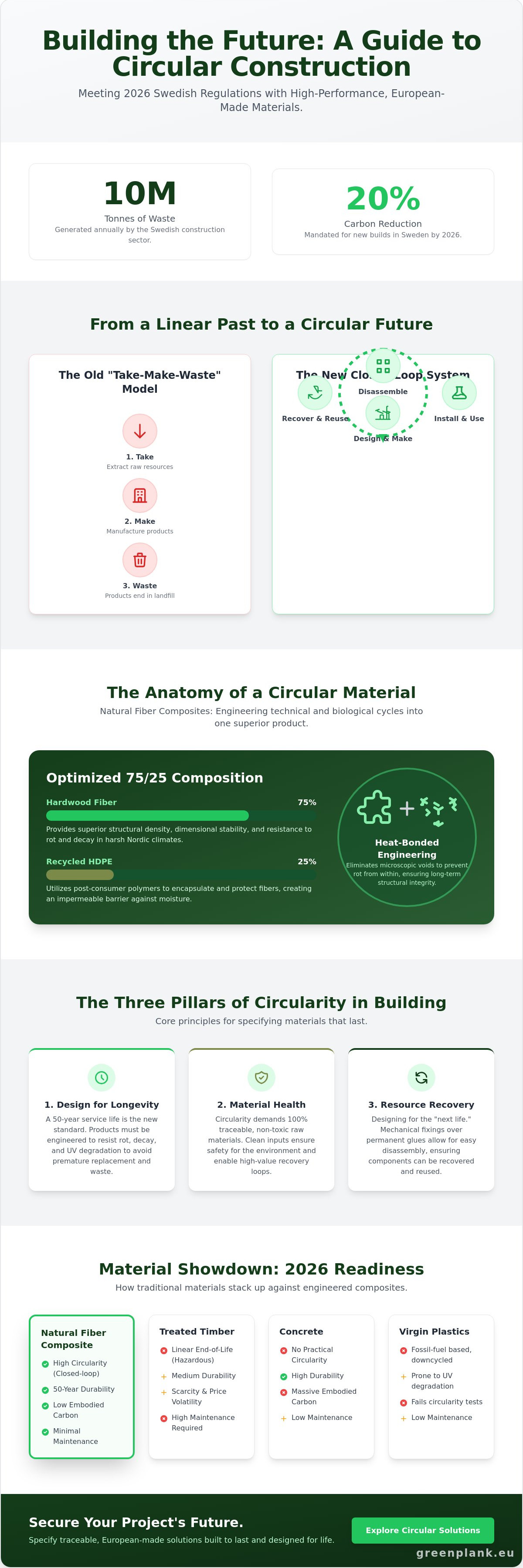
- Transition from linear "take-make-waste" models to closed-loop systems that drastically reduce CO2 footprints and project waste.
- Identify high-performance circular economy construction materials by optimizing the 75% hardwood fiber to 25% HDPE ratio for maximum technical and biological circularity.
- Adopt the "Cradle to Cradle" philosophy to move beyond simple recycling toward a model of long-term material ownership and stewardship.
- Secure superior long-term ROI by specifying engineered composites that offer 50-year durability and minimal maintenance compared to traditional wood.
- Leverage traceable, European-made engineering to meet the rigorous sustainability and performance standards of the Swedish building sector.
What are Circular Economy Construction Materials?
The construction industry is shedding its traditional linear skin. For decades, the sector operated on a "take-make-waste" model, where raw resources were extracted, used in a building, and eventually sent to a landfill. What are Circular Economy Construction Materials? They represent a fundamental shift toward a closed-loop system. These materials are designed to eliminate waste by remaining in use for as long as possible, either through biological regeneration or technical recovery. In Sweden, this transition is no longer optional. It is a calculated response to resource scarcity and climate targets.
By 2026, the European Union's revised Construction Products Regulation (CPR) and the EU Taxonomy will enforce stricter mandates on material circularity. This year marks a definitive turning point for developers and architects. Specifying circular economy construction materials is now the primary method to meet these legal requirements. It's a move from simple recycling, which often results in "downcycling" to lower-quality products, to true circular engineering. Engineered materials are designed from the molecular level to maintain their value across multiple lifecycles. They don't just disappear; they evolve.
Material selection follows two distinct paths: renewable and technical cycles. Renewable cycles involve bio-based materials that can safely return to the biosphere. Technical cycles focus on manufactured components, such as natural-fiber composites, that are kept within industrial loops. These materials are recovered, refreshed, and reused without degrading their structural integrity. It's a system of Nordic reliability. Built to last. Designed for life.
The Three Pillars of Circularity in Building
- Design for longevity: A 50-year service life is the new circular standard. Products must resist rot, decay, and UV degradation to avoid premature replacement.
- Material health: Circularity requires 100% traceable, non-toxic raw materials. You can't recycle what you don't trust. High-performance composites utilize clean, traceable inputs to ensure safety for both the environment and the end-user.
- Resource recovery: Architects must plan for the "next life" of every component. This involves using mechanical fixings instead of permanent glues, allowing for easy disassembly and future reuse.
Why Traditional Materials are Falling Behind
Traditional materials are struggling to keep pace with 2026 sustainability benchmarks. Concrete carries a massive embodied carbon cost, contributing significantly to global emissions. Virgin plastics, often derived from fossil fuels, fail the circularity test because they aren't designed for infinite recovery. Even timber faces challenges. Scarcity is driving prices higher in the Swedish market, and the chemical treatments required for outdoor durability often render the wood hazardous waste at the end of its life. This creates a linear dead-end. For a comprehensive look at modern alternatives, refer to our Sustainable Building Materials: The 2026 Guide to Circular Construction. Choosing circular economy construction materials ensures that your project remains compliant, durable, and ethically sound for decades to come.
The Anatomy of Circular Materials: Natural Fiber Composites
Wood Plastic Composite (WPC) represents a sophisticated integration of technical and biological cycles, moving beyond the linear "take-make-waste" model. It functions as a core pillar of the Circular Economy in Construction by ensuring every component remains productive within the economy. Instead of relying on virgin timber that requires toxic chemical treatments, WPC utilizes repurposed organic fibers and recycled polymers to create a closed-loop system. This material science approach allows us to maintain the highest value of resources for as long as possible.
The Role of Hardwood Fiber in Durability
Hardwood fibers provide the structural backbone of our composites, offering a level of density that softwood alternatives can't match. In the volatile Swedish climate, where temperature fluctuations are common, hardwood maintains superior dimensional stability. We utilize a precise 75% hardwood fiber ratio to ensure the material resists moisture absorption and thermal expansion. The engineering process involves heat-bonding these natural fibers with polymers to eliminate the internal microscopic voids where rot and decay typically begin. Natural Fiber Composites serve as the essential bridge between biology and industry.
- High Stability: Hardwood fibers reduce the risk of warping in extreme Nordic winters.
- Resource Efficiency: Using 75% fiber content maximizes the use of renewable biological resources.
- Engineered Strength: The blending process creates a uniform material that outperforms traditional wood in load-bearing applications.
High-Density Polyethylene (HDPE) as a Circular Carrier
The remaining 25% of the composite consists of High-Density Polyethylene (HDPE), a polymer chosen specifically for its high-grade recyclability. We prefer HDPE over PVC because it's a thermoplastic that can be melted and reshaped multiple times without losing its structural integrity. PVC often contains stabilizers and plasticizers that complicate the recycling process and raise environmental concerns. HDPE ensures that at the end of its 20 to 30 year service life, the material doesn't become waste but rather a raw material for the next generation of products. You can explore the technical advantages of this polymer in our guide on What is WPC Composite Decking? The Complete Guide to Sustainable Outdoor Living.
Our commitment to 100% EU-sourced raw materials is critical for circular traceability. Knowing exactly where every gram of fiber and polymer originates allows us to guarantee the safety and sustainability of the finished product. By engineering low-density, high-strength profiles, we reduce the carbon footprint of transport and installation by up to 40% compared to denser, less efficient materials. This is Nordic reliability at its finest. Designed for life. Built to last. Architects and developers in Sweden are increasingly specifying circular economy construction materials to meet the stringent climate declarations required by Boverket while ensuring a premium, maintenance-free aesthetic.
Beyond Recycling: The Cradle to Cradle Ownership Model
The Cradle to Cradle (C2C) framework moves past the limitations of traditional recycling by treating every component as either a biological or technical nutrient. Traditional manufacturing follows a linear "take-make-waste" path. C2C ensures that circular economy construction materials remain in a closed loop where waste is effectively eliminated. This philosophy shifts the focus from simple product ownership to long-term performance. In this model, manufacturers often retain responsibility for the material life cycle, ensuring it returns to the production facility after decades of service. It's an evolution from selling a product to providing a service that respects the planet's finite resources.
European manufacturing plays a critical role in this transition. By producing within the EU, we adhere to the world's strictest chemical safety standards, specifically the REACH regulation. This ensures material health, which means no toxic off-gassing or hazardous additives enter your living environment. It's a commitment to safety and transparency that overseas imports often fail to provide. Our process focuses on engineering precision to deliver stability and strength without compromising environmental ethics.
Traceability and Local Sourcing
Sourcing building materials from outside the EU can increase a project's logistics-related carbon emissions by 15% to 25%. Local sourcing in Sweden minimizes this hidden environmental cost and supports regional economies. We prioritize transparency in every composite blend we develop. Knowing the exact origin of the recycled polymers and FSC-certified wood fibers is essential for accurate Life Cycle Assessments (LCA). This level of detail provides architects with the verified data needed to meet Swedish environmental certifications like Miljöbyggnad or Svanen.
Designing for Deconstruction
True circularity requires that products can be taken apart as easily as they were assembled. Our HidLoc™ hidden fastening system is engineered for this exact purpose. It allows for the non-destructive removal of decking or cladding boards, making material recovery a reality rather than a theoretical goal. When components are easily detached, they can be repurposed in new projects instead of being sent to a landfill.
- Modular Facades: Systems designed for easy replacement of individual panels to extend the building's aesthetic life.
- Reversible Fastening: Mechanical joints that replace permanent adhesives, allowing for clean material separation.
- Standardized Dimensions: Ensuring components fit future reuse applications across different architectural styles.
Modularity is the key to circular infrastructure because it enables the seamless adaptation, repair, and eventual recovery of building components without destroying their inherent value. Designed in Scandinavia. Produced in Europe. Built to last. Designed for life.
Specifying for Longevity: Evaluating Material ROI
Durability is the primary engine of a sustainable build. While many discussions around circular economy construction materials focus on recyclability at the end of a product's life, the most effective way to reduce resource consumption is to extend the service life of the material itself. High-performance circular composites are engineered to bypass the rapid degradation cycles common in traditional softwoods. By selecting materials that last five decades instead of fifteen, developers significantly reduce the total volume of waste generated over a century.
Maintaining traditional timber in the Swedish climate is a costly commitment. Wood requires annual or biennial sanding, oiling, and chemical treatments to resist moisture and UV damage. These maintenance cycles often cost between 2,000 kr and 5,000 kr per year for a standard 30-square-meter deck. Circular composites eliminate these recurring expenses. They don't require staining or toxic preservatives to maintain their structural integrity. Over a 30-year period, the savings on labor and materials alone often exceed the initial purchase price of the product.
A 50-year warranty transforms the financial profile of a project. It shifts the material from a depreciating asset into a long-term infrastructure investment. For public sector projects or large scale residential developments, this longevity provides a predictable cost model that aligns with Swedish sustainability goals for 2030 and beyond. It is the ultimate expression of our mantra: Built to last. Designed for life.
Circular vs. Linear: A Comparison Framework
Linear construction models prioritize the lowest possible upfront cost. This approach is fundamentally flawed in a circular economy. A "cheap" timber deck that requires replacement after 12 years incurs the cost of demolition, disposal fees at the recycling center, and the price of new materials at future market rates. When you evaluate the total cost of ownership over 30 years, circular economy construction materials are consistently more affordable. They provide a stable, predictable performance that protects the developer's capital and the environment simultaneously.
Performance in Extreme Environments
Swedish coastal regions and northern latitudes demand materials that can withstand salt spray, heavy snow loads, and constant freeze-thaw cycles. Traditional wood often fails in these conditions without aggressive chemical intervention. Engineered composites offer technical superiority because they are moisture-resistant by design. They do not rot or decay, making them the preferred choice for public piers, boardwalks, and high-traffic outdoor spaces. For technical insights on implementing these materials, consult our Professional Deck Installation Guide: Building a Sustainable WPC Outdoor Space.
Explore our range of professional-grade circular decking and cladding solutions today.
Green Plank: Pioneering European Circularity
Green Plank defines the standard for circular economy construction materials by sourcing 100% of raw materials from within the EU. This localized supply chain reduces transport-related CO2 emissions by up to 40% compared to products imported from outside Europe. Our engineering team transforms FSC-certified wood fibers and recycled polymers into high-performance composites that maintain structural integrity for decades. By keeping production within the European Union, we ensure every plank meets stringent environmental and labor standards that global supply chains often overlook.
The Terra Tuff and Smart System lines represent circularity in action. Terra Tuff is specifically engineered to utilize high-recycled content without compromising the refined Nordic aesthetic architects demand. The Smart System employs a modular installation logic, allowing for non-destructive disassembly. This means materials can be recovered and repurposed at the end of a building's life cycle rather than being discarded. Our manufacturing facilities utilize 100% renewable energy, which significantly lowers the embodied carbon of every project we supply.
We provide architects and developers with specialized Cradle to Cradle expertise. This support is vital for projects aiming for Miljöbyggnad or BREEAM-SE certifications in 2026. We don't just sell products; we provide the technical documentation and material transparency required to meet Sweden's evolving climate declaration laws. Our team helps you calculate the long-term carbon savings of choosing durable, circular composites over traditional timber that requires chemical treatments.
Engineered for Life, Built to Last
The philosophy behind our 50-year warranty is simple: the most sustainable product is the one you never have to replace. Our low-density design reduces the total mass of material required for production by 15%, yet it maintains professional-grade strength. This makes Green Plank solutions ideal for large-scale commercial infrastructure projects, such as public piers and high-traffic urban plazas. We continue the Nordic tradition of sustainable craftsmanship by prioritizing durability and low maintenance. Our products don't rot, warp, or require toxic stains, ensuring they remain beautiful and functional in the harsh Swedish climate for half a century.
The Future of Circular Exteriors
Looking toward 2026 and beyond, we're launching new innovations in circular cladding and fencing systems. These upcoming collections focus on "design for disassembly" principles, ensuring every component is 100% recyclable at the end of its service life. We encourage developers to partner with us during the early design phases to optimize material efficiency and reduce site waste. Our technical consultants are ready to assist with custom specifications that align with your sustainability goals. Explore our circular WPC solutions for your next project and discover how Nordic reliability meets the demands of a circular future.
Securing the Next Generation of Swedish Infrastructure
The shift toward 2026 requires more than a passing interest in sustainability; it demands a fundamental change in how we specify materials for the Nordic climate. Transitioning to circular economy construction materials ensures that every project contributes to a closed-loop system while providing the durability that professional-grade developments require. By selecting natural fiber composites engineered with 75% hardwood fiber, architects and contractors secure a high-performance alternative to traditional timber that won't rot or warp under harsh conditions.
Green Plank's commitment to Nordic reliability is reflected in our use of 100% EU raw materials, providing full traceability for every board produced. Our products aren't just designed for aesthetic appeal; they're engineered for performance. This technical precision allows us to offer an industry-leading warranty of up to 50 years, giving developers the confidence that their investment is protected for decades. It's time to build spaces that respect nature without compromising on engineering excellence.
Partner with Green Plank for your sustainable construction projects and lead the way in responsible innovation across Sweden.
Frequently Asked Questions
What are examples of circular economy construction materials?
Natural fiber composites, reclaimed steel, and recycled concrete aggregates are primary examples of circular economy construction materials. In Sweden, timber-based products like cross-laminated timber and Green Plank’s Nordic-engineered WPC decks demonstrate how bio-based residuals find new life. These materials ensure that 100% of the raw components can be reintegrated into production cycles at the end of their 30 year lifespan.
How do circular materials reduce the CO2 footprint of a building?
Circular materials lower a building’s carbon footprint by eliminating the need for virgin resource extraction and reducing manufacturing energy by up to 50%. By utilizing recycled wood fibers and polymers, these products sequester carbon and prevent methane emissions from landfills. This approach helps developers meet the Swedish Climate Declaration requirements that became mandatory for new buildings in January 2022.
Is WPC composite truly a circular material?
High-quality WPC is a circular material when it's engineered for disassembly and reuse. Green Plank’s composite products use 90% recycled content, including post-industrial wood flour and recycled polymers. These materials are designed for life and can be ground down and re-manufactured into new decking profiles. This closed-loop system ensures that zero waste reaches Swedish incineration plants during the manufacturing process.
Why is traceability important in circular construction?
Traceability ensures that every component in a circular system has a documented origin and chemical profile. Professional-grade materials in Europe utilize digital product passports to track the 100% recycled content from source to site. This transparency allows architects to verify that no hazardous substances are present. It guarantees that the material remains safe for recycling in 2056 or beyond.
Are circular construction materials more expensive than traditional ones?
Circular construction materials often carry a 5% to 15% higher initial purchase price but offer lower total cost of ownership through extreme durability. In the Swedish market, the long-term value comes from reduced maintenance and a 20 to 30 year warranty. When you factor in the rising cost of carbon taxes and waste disposal fees in Sweden, circular options become the most financially prudent choice.
What is the difference between recycling and circularity in construction?
Recycling is a single process of converting waste into new items, while circularity is a holistic design philosophy. Circularity focuses on maintaining the highest value of materials through multiple lifecycles without downgrading quality. While recycling might end in a landfill after one more use, circular economy construction materials are designed to return to the production line indefinitely without losing structural integrity.
How long do circular construction materials like WPC last?
Engineered circular WPC is built to last between 20 and 30 years in harsh Scandinavian climates. The material resists rot, decay, and moisture, which are common issues for traditional timber in Sweden. This longevity is backed by extensive testing and professional-grade warranties. It ensures that the environmental investment pays off over decades of maintenance-free use, reducing the need for frequent replacements.
What is the Cradle to Cradle model in building materials?
The Cradle to Cradle model is a certification framework that evaluates products based on material health and circularity. It mandates that every ingredient is either a biological nutrient that returns to the earth or a technical nutrient for industry. This standard ensures that 100% of a building product is safe for humans and the environment. It moves beyond being less bad to create a positive ecological impact.
Specify the product
Use this guide with a Green Plank specification
Technical articles support the commercial catalogue — category, product, evidence, then samples or quotes.