



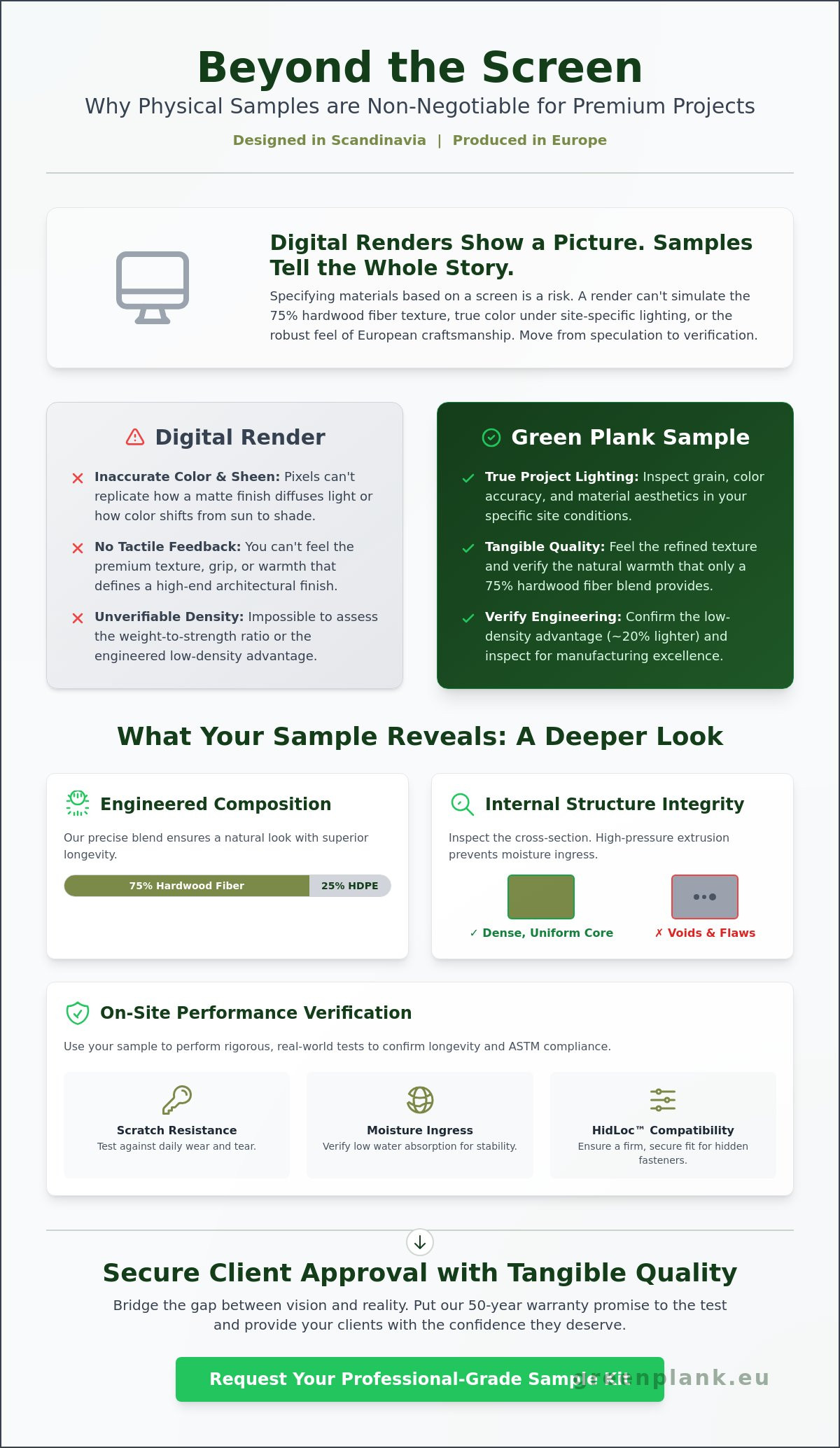
A digital render can simulate a sunset; it cannot simulate the 75% hardwood fiber texture that defines a premium architectural finish. You understand that specifying materials based solely on a screen is a risk your high-stakes project shouldn't take. The tactile difference between a generic imitation and professional-grade composite is the difference between a temporary fix and a 50-year legacy. When you request composite material samples, you move beyond speculation to verify the Nordic reliability and European craftsmanship that define our range.
We agree that seeing is believing, but touching is verifying. This guide explains why physical swatches are essential for testing scratch resistance and ASTM D7032-21 compliance in your specific site conditions. You'll learn how to secure a professional-grade Green Plank kit to confirm HidLoc™ compatibility and secure client approval through tangible quality. We'll preview the engineering behind our sustainable profiles and show you how to ensure your next outdoor space is built to last and designed for life.
Key Takeaways
- Bridge the gap between digital renders and physical reality by inspecting grain, color accuracy, and material density in true project lighting.
- Evaluate the internal engineering of WPC profiles to identify potential manufacturing flaws and verify the European-made quality required for high-stakes installations.
- Compare specialized material kits, such as Terra Tuff for commercial infrastructure or Smart System for residential decking, to find the ideal balance of aesthetics and performance.
- Implement rigorous on-site durability tests, including water absorption and scratch resistance, to confirm the longevity of your chosen composite solution.
- Simplify your client approval process when you request composite material samples through our professional-grade portal for a hands-on verification of our 50-year warranty promise.
Why Physical Samples are Critical for Sustainable Construction
Digital screens often fail to capture the nuanced depth of organic materials. When you request composite material samples, you're not just looking at a color; you're auditing the tactile integrity of the board. High-end architectural projects demand a level of precision that pixels cannot replicate. Our Nordic-engineered profiles rely on a specific interplay of light and shadow that only a physical swatch can reveal. This hands-on approach is the only way to ensure the final installation matches the architectural vision you've promised your client.
Superior performance starts with raw material ratios. Unlike generic products that use high-plastic content, Green Plank utilizes a blend of 75% hardwood fiber and 25% HDPE. Wood-plastic composites (WPCs) of this caliber offer a natural warmth that is immediately apparent upon touch. By holding a sample, you can verify our low-density advantage. This engineering choice reduces the dead load on sub-structures by approximately 20% compared to denser, traditional timber without sacrificing durability. It's a critical factor for large-scale commercial infrastructure where weight-to-strength ratios influence the entire structural design.
Sustainable construction requires a circular mindset. Physical samples allow you to inspect the product's composition as part of a "Cradle to Cradle" material selection process. You can see the traceable European raw materials and the refined finish that eliminates the need for toxic stains or sealants. This verification ensures your material selection aligns with modern environmental ethics. It's about moving beyond the datasheet to confirm that the product is truly built to last and designed for life.
Texture and Aesthetic Authenticity
Achieving a true Scandinavian look requires a matte finish that diffuses light naturally. Many low-grade composites or high-gloss PVC alternatives create a synthetic glare that detracts from a high-end design. With a physical sample, you can assess grain patterns in actual site conditions. Observe how the color depth shifts under midday sun compared to evening shadows. This ensures the aesthetic remains consistent with your vision. It's the difference between a "plastic" feel and a professional-grade architectural finish.
The Role of Samples in Professional Specification
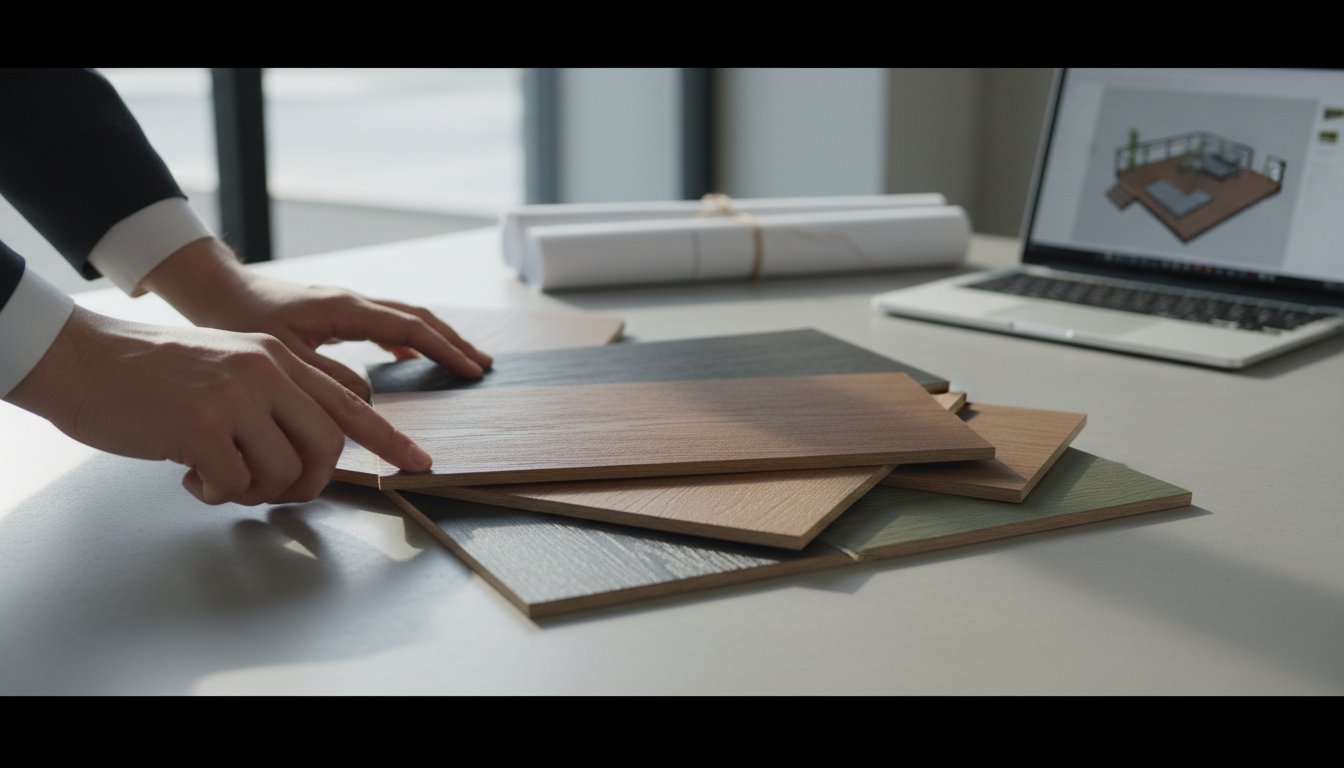
Architects use physical swatches to build cohesive mood boards that resonate with clients. It's much easier to secure approval when a client can feel the refined texture of wpc composite decking. Samples also allow you to verify color consistency across different profiles, ensuring that cladding and fencing systems match perfectly. This level of detail is why professionals always request composite material samples before final specification. It provides the technical and aesthetic confidence required for premium European projects. Designed in Scandinavia. Produced in Europe.
Evaluating Material Quality: What Your Sample Reveals
A physical specimen allows for a level of scrutiny that technical data sheets cannot provide. When you request composite material samples, you're looking for the structural fingerprint of the product. Inspecting the weight-to-strength ratio reveals the precise balance of 75% hardwood fiber and 25% HDPE. This ratio isn't arbitrary; it's engineered to provide the warmth of natural wood with the resilience of high-density polyethylene. A board that feels substantial but remains easy to handle indicates a refined density profile that won't strain your sub-structure.
Take a jeweler’s loupe to the cross-section. You shouldn't see internal voids or manufacturing flaws. A dense, uniform core indicates a high-pressure extrusion process that prevents moisture ingress. This is where performance testing your samples becomes critical. If the core looks porous, the board won't survive the 50-year service life we promise. High-quality WPC should show a consistent distribution of fibers without clumps of unmixed plastic.
Test the HidLoc™ hidden fastening grooves. The clip should seat firmly without play; this ensures the deck remains stable under heavy foot traffic. Check the edge durability by attempting to mar the surface with a metal tool. A professional-grade board resists impact and friction because it's built for life. This tactile verification is the only way to ensure the material lives up to its Cradle to Cradle ownership promise, where every component is designed for circularity and long-term reliability. You can explore our sustainable range to see how these engineering choices manifest in finished projects.
The "Hardwood Heart" Test
Look closely at the fiber distribution within the composite core. 100% EU raw materials result in a more stable board because the quality of the wood fiber and polymer is traceable and consistent. Generic imports often use mixed-source plastics that lead to uneven expansion and contraction. Our European-made boards maintain their profile shape through extreme temperature shifts. This consistency is a hallmark of Nordic reliability; it's what separates a professional-grade material from a temporary imitation.
Surface Engineering and Finish
Evaluate the slip-resistance of different profile textures. The Smart System finish offers a refined, low-maintenance texture that feels natural underfoot. Check the consistency of the grain across the entire sample piece. Low-density engineering is superior for commercial infrastructure because it minimizes structural load while maintaining the high-impact resistance required for public spaces. When you request composite material samples, you're confirming that the surface engineering meets the safety and aesthetic standards your clients expect.
Selecting the Right Sample Kit for Your Project
A generic sample pack rarely satisfies the technical requirements of a complex architectural tender. When you request composite material samples, you should select a kit that mirrors the specific demands of your project's environment. We've developed curated professional kits to ensure you're testing the exact profile geometry and material density required for your build. This targeted approach moves beyond simple color selection; it's a professional consultation tool designed for precise engineering verification.
Terra Tuff kits are specifically engineered for high-traffic commercial infrastructure. These profiles are built to withstand heavy foot traffic and environmental stress, making them the standard for public boardwalks and urban plazas. For modern residential decking, the Smart System swatches highlight a refined finish and a lighter profile that doesn't compromise on durability. If your project involves vertical surfaces or boundary definitions, our specialized wall cladding and fencing system packs provide the tactile proof of quality needed for sustainable exterior facades and private enclosures. Every piece is designed in Scandinavia and produced in Europe to ensure absolute traceability.
Decking vs. Cladding Sample Requirements
The performance criteria for horizontal and vertical surfaces differ significantly. Cladding samples focus on the precision of the interlocking tongue-and-groove system and the "Low Density" advantage that minimizes the load on the building's exterior. You can refer to our composite wall cladding guide for deeper technical context on these vertical applications. In contrast, decking samples prioritize load-bearing feel and foot comfort. Testing these separately ensures that the material's thermal expansion and structural integrity align with its intended orientation. Built to last. Designed for life.
The Professional Specifier Box
Our Specifier Box is more than a collection of swatches. It's a comprehensive design resource that includes actual profile cuts, a full range of color swatches, and detailed technical brochures. This allows you to compare the deep tones of Sapphire and Nordeka against the timeless appeal of our Classic range in real-world lighting. For large-scale commercial tenders, we can provide custom profile samples tailored to your specific architectural drawings. This level of customization ensures that when you request composite material samples, you receive exactly what you need to secure client approval and move toward a successful, sustainable installation.
Performance Testing Your Samples in Real-World Conditions
Once you request composite material samples, the next step is to subject them to the same environmental stressors they'll face for the next five decades. We encourage architects to move beyond visual inspection. A professional-grade material should withstand rigorous physical trials without compromising its structural integrity or aesthetic refinement. These tests provide the empirical evidence needed to justify a premium specification to your clients. It's about verifying that the product is truly built to last and designed for life.
Start with the 24-hour water submersion test. Place your Green Plank sample in a container of water for a full day to observe its swelling resistance. While traditional timber can expand significantly when saturated, our 75% hardwood fiber and 25% HDPE blend is engineered to remain stable. Next, simulate a weekend of hosting by spilling red wine, olive oil, and damp soil onto the surface. Let these sit for several hours before wiping them away with a damp cloth. Our dense surface engineering ensures that stains don't penetrate the core, maintaining a low-maintenance finish that respects your design long after installation.
Thermal stability is equally vital for large-scale projects. Leave your sample in direct sunlight for several hours to monitor heat retention and expansion. European-made composites are designed to manage thermal shifts more effectively than generic imports, preventing the warping that often plagues lower-quality installations. By conducting these site-specific evaluations, you confirm that the material meets the Nordic reliability standards required for high-stakes architectural work.
DIY Durability Benchmarking
Perform a simple coin scratch test by applying firm pressure with the edge of a metal coin across the grain. You'll notice that professional-grade WPC resists deep gouging better than traditional softwood swatches. Compare the Green Plank sample directly to a piece of pressure-treated timber. While the timber may splinter or show immediate wear, the composite maintains its refined Scandinavian character. This benchmarking proves the material's resilience against furniture movement and pet claws, ensuring a maintenance-free outdoor space for years to come.
Verifying the 50-Year Warranty Promise
The longevity of our products is rooted in raw material purity. High-quality WPC outperforms low-grade imports because it lacks the internal contaminants that lead to rot and decay. This purity is achieved through our commitment to 100% EU raw materials. Traceable EU raw materials ensure that the molecular bond of the HDPE remains stable under intense solar radiation, preventing the chalking and fading common in non-European alternatives. This engineering precision is why we confidently offer a long service life and comprehensive warranties up to 50 years. When you're ready to request composite material samples and verify these standards for your next project, you can Request Your Professional WPC Sample Kit today.
How to Request Your Green Plank Sample Pack
Securing the right materials for a high-stakes project requires a streamlined procurement path that respects your professional timeline. When you request composite material samples through our dedicated portal, you're engaging with a system designed for architectural precision. Our process isn't a generic transaction; it's a technical consultation. By providing specific project details, such as estimated square footage or environmental exposure levels, you allow our team to provide tailored material recommendations that align with your structural requirements.
Shipping professional-grade WPC across Europe is handled with Nordic reliability. Because our products are produced in Europe using 100% traceable raw materials, we maintain a reduced CO2 footprint and efficient logistics chains. Most professional kits reach architectural firms within 3 to 5 business days, ensuring your design phase remains on schedule. If your project involves unique constraints, our "Sustainable Craftsmen" are available to discuss custom profile needs or high-traffic commercial infrastructure specifications. We believe that professional support should be as durable as the products we manufacture.
The Request Process for Architects and Contractors
Precision in the request phase prevents complications during the build. We encourage you to include technical specifications, such as joist spacing or load-bearing expectations, when you request composite material samples. Don't forget to request HidLoc™ fasteners along with your boards; testing the complete system is the only way to verify the stability of the hidden fastening mechanism. For a comprehensive understanding of how these components integrate, you should also consult our deck installation guide to review framing requirements and expansion gaps.
From Sample to Sustainable Reality
Physical verification is the final bridge between a conceptual render and a successful installation. With the projected cost of premium composite materials reaching up to $35 per square foot in 2026, sampling is a necessary financial hedge against specification errors. Green Plank supports your transition to sustainable building materials by providing the data and tactile proof required for circular construction. Once you've confirmed the quality, texture, and durability of our European-made profiles, moving to a final project order is a seamless next step. Our commitment to Cradle to Cradle ownership ensures that your project respects both the client's vision and the planet's future. Request your professional WPC sample kit today and experience the difference of Nordic engineering. Designed in Scandinavia. Produced in Europe.
Secure Technical Confidence for Your Next Project
Specifying for longevity requires more than a digital preview. You now understand how a physical audit confirms the 75% hardwood fiber density and the European-made quality of our profiles. These samples provide the technical foundation for verifying slip resistance, color depth, and HidLoc™ compatibility in your site's specific environment. Our commitment to 100% traceable raw materials and a Cradle to Cradle ownership model ensures that every board respects both the landscape and your architectural legacy.
When you request composite material samples, you aren't just ordering a swatch. You're securing a 50-year service life warranty backed by Nordic reliability. It's time to transition from conceptual renders to tangible, sustainable reality. Request Your Professional WPC Sample Kit today to begin your journey toward a maintenance-free outdoor space that respects nature. Built to last. Designed for life.
Frequently Asked Questions
How long does it take to receive composite material samples?
Most professional grade material kits arrive within 3 to 5 business days for projects within the European Union. We utilize established logistics networks to ensure Nordic reliability in our shipping timelines. This efficiency allows architects to maintain project momentum during the critical specification phase. Our streamlined process ensures that technical verification doesn't become a bottleneck for your design schedule.
Are the samples free for commercial architectural projects?
We provide material samples to architects and contractors as a professional service to facilitate high stakes project verification. While we don't operate as a direct to consumer retail shop, we prioritize professional requests to ensure technical standards are met. This approach allows specifiers to audit our 100% traceable raw materials without upfront procurement barriers or unnecessary administrative delays.
Can I request specific colors like Sapphire or Terra Tuff?
You can select specific aesthetic profiles including Sapphire, Nordeka, or Terra Tuff when you request composite material samples. Our portal allows for granular selection so the swatches match your exact design vision. This ensures you can verify the color depth and matte finish of our Scandinavian inspired range under your specific site lighting conditions before final specification.
Do the samples include the HidLoc™ fastening system?
HidLoc™ hidden fastening components are included in professional kits upon request to demonstrate the complete system integration. Testing the clip seating within the groove is essential for verifying the stability of the 600 cc private spans. This hands on check ensures the interlocking mechanism meets the durability requirements of your project's anticipated foot traffic and environmental stress.
What size are the material samples provided by Green Plank?
Standard material samples are typically provided in 100mm to 150mm profile lengths. This size is engineered to reveal the cross sectional integrity and the 75% hardwood fiber distribution without being cumbersome for architectural mood boards. It provides enough surface area for meaningful scratch and stain testing while remaining portable for high end client presentations and material boards.
Can I request samples for both decking and wall cladding at once?
Architects can request a comprehensive pack that includes both decking profiles and wall cladding systems in a single professional shipment. We understand that sustainable exterior facades often require a cohesive aesthetic across horizontal and vertical surfaces. Combining these allows you to verify color consistency and material compatibility across the entire building envelope to ensure a unified architectural result.
Are the samples representative of the 50-year warranty quality?
Every sample is cut from the same production line used for our commercial grade inventory; it's a direct representation of our 50 year service life warranty. When you request composite material samples, you're holding the exact 100% EU raw material blend used in the final installation. This transparency is central to our Cradle to Cradle ownership model and our commitment to engineering precision.
How do I test the UV resistance of my WPC sample at home?
To test UV stability, place half of the sample in direct sunlight while covering the other half with an opaque material for 14 to 30 days. Our European engineered WPC is designed to resist the chalking and fading seen in low grade imports. This simple comparison reveals the long term color retention provided by our high purity HDPE and natural fiber blend, even under intense solar radiation.
Spesifiser produktet
Bruk denne guiden i en Green Plank-spesifikasjon
Tekniske WPC-artikler skal støtte de kommersielle sidene — ikke konkurrere med dem. Fortsett til komposittdekke, TerraTuff, Nordeka eller de tekniske nedlastningene.