




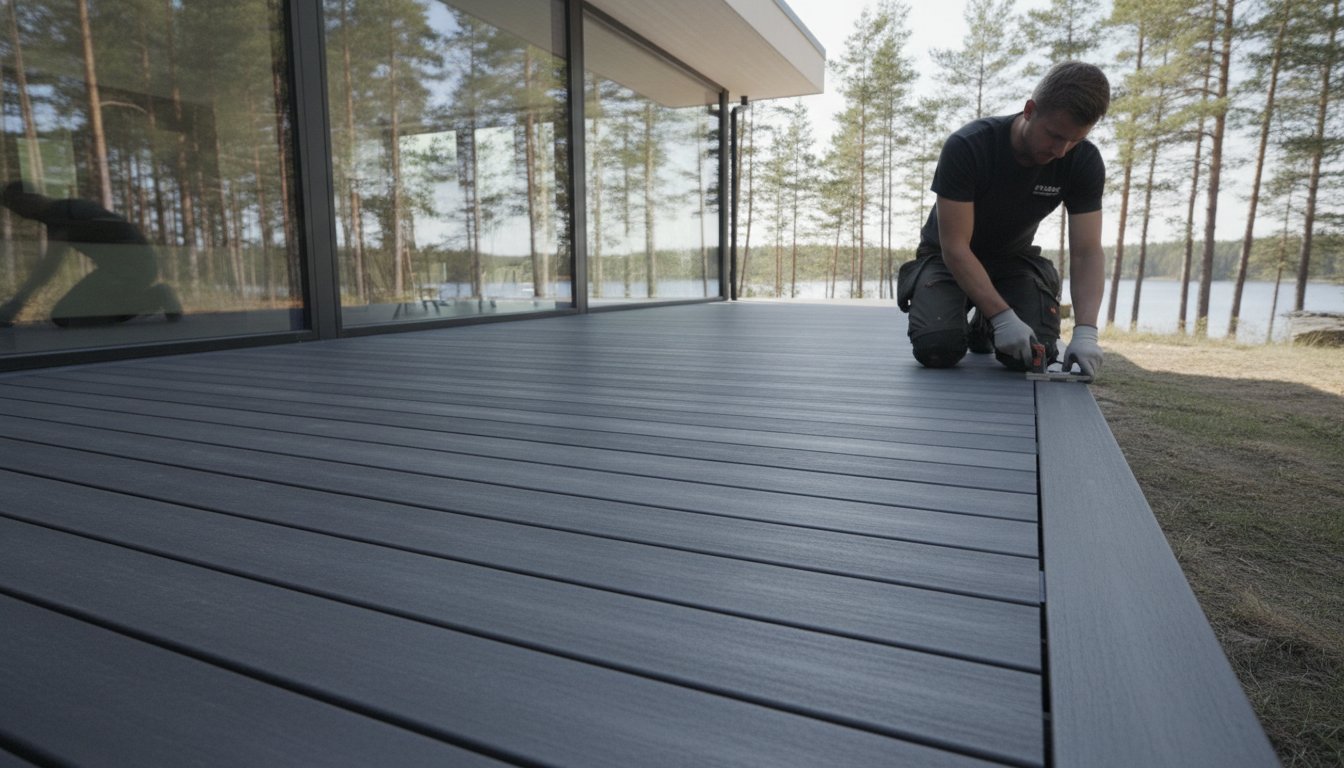
What if the most critical element of your outdoor sanctuary is the one component you should never actually see? Achieving a truly seamless, high-end finish requires more than just selecting premium boards. It demands a sophisticated approach to installing composite decking with hidden fasteners to ensure both structural integrity and aesthetic purity. You likely recognize that visible screw heads do more than just disrupt a clean line. They create unnecessary points of weakness and fail to account for the essential thermal movement of wood-polymer composites.
This professional guide will help you master the technical precision of the HidLoc™ system. By following these engineering standards, you'll create a smooth, barefoot-friendly surface that remains perfectly aligned through every season. We will explore how to maintain consistent drainage gaps and manage board expansion, protecting your investment for the duration of its 50-year warranty. You are about to learn how to combine regional craftsmanship with innovative fastening technology for a deck that respects both the environment and your design vision.
Key Takeaways
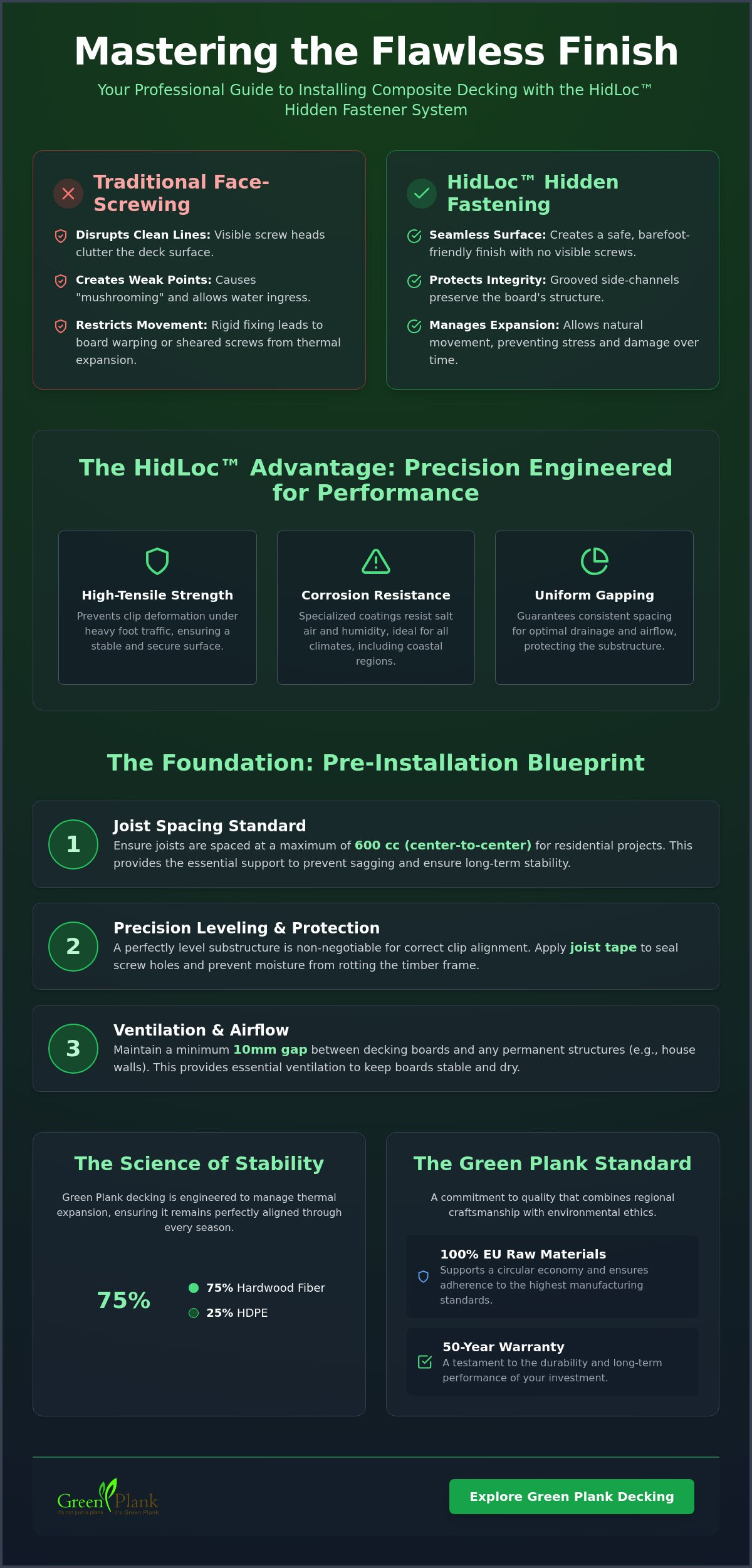
- Understand how the HidLoc™ system utilizes grooved side-channels to create a safe, barefoot-friendly surface without visible screws.
- Learn the precise preparation steps, including adhering to the 600 cc joist spacing standard, to ensure a level and durable foundation.
- Master the step-by-step process for installing composite decking with hidden fasteners to achieve consistent gapping and professional alignment.
- Gain insights into managing thermal expansion by understanding how the 75% hardwood fiber composition responds to regional climate shifts.
- Discover the long-term benefits of using 100% EU raw materials, which support a circular economy and a service life backed by a 50-year warranty.
The Engineering Behind Hidden Fastening Systems
A hidden fastener is more than a simple mounting bracket; it is a precision-engineered bridge between the joist and the deck board. These systems utilize a grooved side-channel, allowing the fastener to grip the board from within rather than piercing the top surface. This design is foundational to the performance of Wood-plastic composites (WPCs), as it respects the material's unique density and thermal properties. By choosing this method, you ensure the board's structural integrity remains uncompromised by surface-level penetrations.
Traditional face-screwing fixes a board rigidly in place. When temperature shifts occur, the material naturally expands, but the screw resists. This tension often leads to sheared fasteners or warped boards over time. When you're installing composite decking with hidden fasteners, you provide the material with the necessary room to breathe. The clips act as a sliding pivot, managing the natural expansion and contraction of high-performance profiles such as Terra Tuff and Smart System.
Aesthetics vs. Structural Integrity
Face-screwing often results in "mushrooming." This occurs when the displaced composite material creates an unsightly bump around the screw head. Hidden systems eliminate this defect entirely, leaving a barefoot-friendly surface that highlights the natural grain of the wood fibers. Beyond the visual appeal, these clips establish consistent gapping across the entire surface. This uniformity promotes optimal drainage and airflow, which prevents moisture from pooling in the joist bays. By reducing entry points for water, you're not just making the deck look better; you're actively extending the life of the entire substructure.
The HidLoc™ Advantage
The HidLoc™ system represents the pinnacle of regional engineering. It is designed specifically for the high-density requirements of European manufacturing standards. Each component features high-grade corrosion resistance, ensuring the hardware matches the longevity of the boards themselves. Mastering the process of installing composite decking with hidden fasteners ensures that your outdoor space remains a sustainable, high-performance asset for decades.
- High-tensile strength prevents clip deformation under heavy foot traffic.
- Weather-resistant coatings resist salt air and high humidity in coastal regions.
- Seamless integration supports the Green Plank 50-year warranty framework.
Choosing HidLoc™ means you are prioritizing a system where the engineering precision matches the environmental ethics of the product. It's a choice for durability, safety, and long-term performance. This approach reflects a commitment to quality that transcends simple aesthetics, focusing instead on the mechanical harmony of the entire deck assembly.
Preparation: The Invisible Foundation of a Flawless Deck
A superior deck isn't built on the surface; it's engineered from the substructure up. Before installing composite decking with hidden fasteners, you must ensure the underlying frame meets exact technical specifications. For private residential applications, we adhere to the 600 cc (center-to-center) joist spacing standard. This specific distance provides the necessary support for the 75% hardwood fiber and 25% HDPE blend, preventing structural sagging and ensuring the material performs as intended over its 50-year service life.
Precision leveling is non-negotiable. If your joists are uneven, the HidLoc™ clips won't align correctly with the side-channels of the boards. This leads to "clipping" issues where the fastener cannot seat properly, creating internal tension that might compromise the flawless finish. Your preparation toolkit should include a high-quality drill, a rubber mallet for gentle board positioning, and a complete set of HidLoc™ fasteners. While staging your materials, keep the WPC boards off the damp ground. Protecting the raw material from ground moisture during the staging phase is vital for maintaining the integrity of the 100% EU raw materials used in the manufacturing process.
Joist Protection and Airflow
Joist tape acts as a critical partner for hidden fastening systems. By sealing the top of the timber frame, you prevent moisture from penetrating the screw holes created by the clips. This small step significantly extends the life of the substructure by preventing rot at the most vulnerable contact points. Additionally, always maintain a 10mm gap between the decking and any permanent structures, such as house walls or pillars. This allowance provides the natural ventilation required by high-density composites, ensuring the boards remain stable and dry from the underside. You can explore our sustainable material specifications to better understand these essential ventilation requirements.
Layout Planning for Grooved Boards
Squaring the first board is the most critical step in the entire process. If the starter board is even slightly out of alignment, the error will compound across every subsequent row, leading to uneven board spacing at the far end of the deck. Take the time to determine the direction of the grain for optimal light reflection. Consistent orientation ensures a uniform appearance when viewed from different angles. To plan your logistics, calculate the number of HidLoc™ clips required by multiplying the number of joists by the number of board rows. This foresight prevents mid-project delays and ensures a steady, logical flow when installing composite decking with hidden fasteners.
Step-by-Step Installation with HidLoc™ Fasteners
The assembly phase is where engineering precision meets practical application. When you're installing composite decking with hidden fasteners, the goal is to create a unified surface that functions as a single, breathable unit. This process relies on a systematic approach to ensure every board is seated correctly and every gap remains uniform. By following these five steps, you'll achieve a professional finish that respects both the material's properties and the project's long-term durability.
- Step 1: Secure the starter clips at the leading edge of your joist frame. These specialized clips provide a firm anchor for your first row without the need for visible face-screws.
- Step 2: Slide the first grooved board firmly into the starter clips. It's essential to verify that this board is perfectly square before proceeding to the next row.
- Step 3: Insert a HidLoc™ clip into the grooved side-channel at every joist intersection. This ensures the board is supported at every structural point.
- Step 4: Drive the fastener screw halfway into the joist. Keeping the tension loose at this stage allows for minor adjustments as you position the subsequent boards.
- Step 5: Secure the final board using perimeter fasteners or a matching WPC skirting. This completes the "floating" aesthetic while maintaining the structural lock.
Securing the Starter Board
The first row dictates the alignment of the entire project. Using specialized edge clips allows you to avoid face-screwing, which preserves the clean aesthetic of the deck's perimeter. You must ensure the board is perfectly parallel to the building facade or your primary reference line. For a deeper look at framing requirements before you begin assembly, consult our deck installation guide. This initial precision prevents cumulative errors that can lead to uneven spacing in later rows.
Intermediate Clipping Techniques
The "Slide and Lock" method is the most efficient way to maintain a consistent 5mm gap across the deck surface. Once the HidLoc™ clips are in place, slide the next board's groove onto the exposed side of the clips. Use a rubber mallet to gently seat the board. This tool provides the necessary force to close the gap without marring the high-quality finish of the WPC. Pay close attention to your drill's torque settings. You don't want to over-tighten the fasteners; they should be snug enough to hold the board but loose enough to allow for the natural thermal movement of the 75/25 hardwood-polymer blend. This balance is what distinguishes a professional installation from a DIY effort.
Managing Thermal Movement and Butt Seams
The high hardwood content of our products, a precise 75/25 blend of natural fibers and HDPE, provides exceptional durability and a natural feel underfoot. This specific material science means the boards respond to temperature changes with greater sensitivity than high-plastic alternatives. When installing composite decking with hidden fasteners, you must account for this thermal breathability to prevent structural issues. The HidLoc™ system is designed to allow boards to glide slightly within the clips, which eliminates the internal stress that causes warping or board distortion over time.
A frequent error in professional installations is face-screwing boards at their ends, particularly at butt seams. This rigid fixing method prevents the board from expanding naturally. This restriction often results in sheared fasteners or "volcanoing" at the surface as the material tries to move against the fixed screw. By utilizing hidden fasteners, you maintain a consistent, floating assembly that preserves the aesthetic integrity of the deck across even the largest spans. This mechanical freedom is essential for any project intended to match our 50-year warranty standards.
The Double-Joist Method for Butt Seams
Every board end must be supported by its own dedicated fastener on a structural joist to ensure long-term stability. We recommend the double-joist or "sister joist" method at every butt seam. This involves installing two joists side-by-side where board ends meet. This configuration provides a wider landing area for the HidLoc™ clips and ensures that each board is independently secured. It also facilitates a clear drainage path between the board ends, preventing moisture from being trapped against the timber frame. Proper gapping at these junctions is a hallmark of regional craftsmanship and engineering precision, ensuring the substructure remains dry and rot-free.
Temperature-Dependent Gapping
The ambient temperature during installation dictates the required gap size for end-to-end joints. In European climates, seasonal shifts are significant, and failing to adjust for the weather can lead to buckled boards in high summer or excessive gaps in deep winter. WPC installed in winter needs larger gaps than in summer to accommodate future expansion. Managing the "creeping" effect on long deck runs is also vital. The cumulative expansion of several boards can exert significant pressure on perimeter framing if not properly calculated. To ensure your project remains flawless throughout the seasons, view our technical installation specifications for precise temperature-based gapping formulas.
The Green Plank Standard: Sustainability and Quality
The final phase of a professional project involves understanding the full lifecycle of the materials you've selected. When you're installing composite decking with hidden fasteners, you aren't just building a surface; you're participating in a circular economy. We utilize 100% EU raw materials to ensure that every board meets a predictable engineering standard. This regional sourcing significantly reduces the CO2 footprint of your project by minimizing transport distances and supporting ethical manufacturing. It also guarantees that the 75% hardwood fiber content remains consistent across every production batch. This consistency is what allows for the precise thermal management and predictable expansion rates required for a high-end finish.
Our "Cradle to Cradle" ownership philosophy means we design every component for the future. The HidLoc™ system isn't a temporary fixture; it's a robust engineering component that supports our 50-year service life warranty. By integrating these high-performance clips with our sustainable WPC, you create an outdoor space that respects nature while providing uncompromising durability. This approach reflects our identity as a responsible innovator, where longevity and environmental ethics are never mutually exclusive.
European Manufacturing Excellence
Installers benefit directly from our commitment to material science. Our boards are engineered for a low-density, high-strength profile, making them easier to handle on-site without sacrificing the structural rigidity required for commercial or private use. You can learn more about the specific engineering and ecological benefits of wpc composite decking in our comprehensive guide. Regional reliability is a core identity marker for our brand. It means you have access to local support and predictable project timelines, avoiding the variables often associated with long-distance imports.
Long-Term Maintenance and Care
Maintaining a flawless finish requires minimal effort but consistent attention. We recommend inspecting your hidden fasteners after the first full season of thermal cycles. Check that the clips remain snug and that the boards haven't shifted against the perimeter framing. When cleaning, avoid harsh chemicals that might corrode the metal components or damage the protective additives in the WPC. A simple solution of mild soap and water is sufficient to preserve the grain's luster. This small investment in care ensures the system functions perfectly for decades. If you have questions about specific site conditions or need assistance with your layout, contact Green Plank for professional project support. Our experts are ready to help you achieve a sustainable, high-performance outdoor finish.
Achieving a Legacy of Outdoor Excellence
Building a deck that withstands the elements while maintaining a pristine finish requires a shift from traditional methods to engineering-led solutions. You now understand how precise joist preparation and the "Slide and Lock" technique create a stable, barefoot-friendly surface. By prioritizing the thermal breathability of high-density WPC, you prevent the common pitfalls of warping and surface damage. This technical approach ensures your outdoor space remains as functional as it is beautiful.
Mastering the art of installing composite decking with hidden fasteners represents a commitment to both craftsmanship and ecological responsibility. We support this vision with 100% EU-sourced raw materials and a Cradle to Cradle Certified™ ownership model that respects the material's entire lifecycle. Every project is an opportunity to create a maintenance-free sanctuary backed by a 50-year warranty on our premium profiles. You don't have to choose between high-end aesthetics and environmental ethics; our systems provide both.
Explore the HidLoc™ Fastening System for Your Next Project and begin your journey toward a flawless, sustainable outdoor finish today. Your investment in quality today will define your comfort for decades to come.
Frequently Asked Questions
How many hidden fasteners do I need per square meter of decking?
You typically need approximately 20 to 22 HidLoc™ fasteners per square meter of decking when adhering to the 600 cc joist spacing standard. This calculation assumes a standard board width of 140mm to 150mm. You should always multiply the number of joists by the total number of board rows to get an exact count. Having a few extra clips on hand ensures you don't stall the project during the final perimeter rows.
Can I use hidden fasteners with non-grooved composite boards?
No, hidden fasteners are designed specifically for grooved profiles like our Smart System and Terra Tuff collections. These boards feature a pre-milled side-channel that allows the clip to sit flush within the material. If you have solid, non-grooved boards, you would need to use a biscuit joiner to create a groove manually. We recommend using factory-milled grooved boards for the most consistent and structurally sound results.
Are hidden fasteners as strong as traditional face-screwing?
Hidden fasteners are engineered to be just as strong as traditional face-screwing while offering superior protection against material stress. By gripping the board from the side, they allow for the natural expansion and contraction of the 75/25 hardwood-polymer blend. Face-screwing creates rigid points that can lead to shearing or board distortion over time. Installing composite decking with hidden fasteners provides a flexible, robust hold that matches our 50-year service life guarantee.
Do hidden fasteners allow for enough drainage and airflow?
Yes, the HidLoc™ system automatically creates a consistent 5mm gap between every board to ensure optimal drainage and ventilation. This spacing is critical for preventing moisture buildup on the joists and allowing the 75% hardwood fiber content to breathe. Proper airflow reduces the risk of rot in the timber frame and ensures the deck surface remains dry and slip-resistant. This engineered spacing is a primary advantage over manual face-screwing.
Can I replace a single board in the middle of the deck if I use clips?
You can replace a single board in the middle of your deck, though the process requires more precision than face-screwed installations. You will need to unscrew the clips from the joists on both sides of the damaged board to slide it out. Once the new grooved board is in place, you can re-secure it using the same HidLoc™ fasteners. This modularity is a key benefit of the "Slide and Lock" installation method used in modern professional projects.
What is the best temperature for installing composite decking with clips?
The ideal temperature for installing composite decking with hidden fasteners is between 10°C and 20°C. If you are installing in extreme heat or cold, you must adjust the end-to-end gapping at butt seams to account for future thermal movement. Boards installed in winter require larger gaps to allow for summer expansion, while summer installations can be placed with tighter gaps. Following these regional climate guidelines ensures a flawless finish that respects the material's properties.
Do I need special tools to install the HidLoc™ fastening system?
You don't need highly specialized machinery, but a standard professional toolkit is essential for a high-end result. A high-quality drill with adjustable torque settings prevents over-tightening of the screws, while a rubber mallet helps seat the boards firmly into the clips without marring the surface. The HidLoc™ clip set itself provides all the specific hardware needed to secure the boards to your joists. Using the correct bit for the clip screws ensures an efficient workflow.
Will hidden fasteners rust or corrode over time?
No, HidLoc™ fasteners are manufactured with high-grade, corrosion-resistant coatings to match the longevity of our premium decking. These materials are specifically tested for durability in European climates, including coastal regions with high salt air and areas with significant humidity. Because they are hidden from direct contact with the elements and foot traffic, they are less prone to wear than exposed face-screws. This engineering choice reflects our commitment to regional reliability and long-term performance standards.
Produkt spezifizieren
Diese Anleitung in einer Green Plank-Ausschreibung nutzen
Technische WPC-Artikel sollen die kommerziellen Seiten stärken — nicht mit ihnen konkurrieren. Weiter zu WPC-Terrasse, TerraTuff, Nordeka oder den technischen Downloads.