

What if the buildings we construct in Stockholm or Gothenburg today weren't just temporary structures, but rather nutrient banks for the next generation of Swedish architecture? You likely understand that the traditional "take-make-waste" model is no longer viable under the 2024 European Green Deal regulations. Specifying materials that simply claim to be "recyclable" often leads to disappointment when those products lose their structural integrity after just a few seasons. Integrating cradle to cradle certified building products into your specifications ensures that every component is safe for human health and ready for a secondary life cycle.
It's time to move beyond the confusion of greenwashing and embrace a clear framework for circular construction. This guide demonstrates how these materials transform the building industry through circular design, material health, and long-term sustainability. We'll examine the technical requirements for material health, the practical ways to meet strict BREEAM-SE standards, and how to select professional-grade materials that support a circular economy while maintaining the refined Nordic character your clients expect. Designed for life and built to last, these materials provide the reliability required for the next era of development.
Key Takeaways
- Learn how the transition from linear "take-make-waste" models to circular "waste-equals-food" systems is redefining modern construction ethics and resource management.
- Discover the five pillars of cradle to cradle certified building products and how prioritizing material health ensures long-term safety for both occupants and the environment.
- Identify how specifying certified materials streamlines compliance with global green building standards like LEED and BREEAM while reducing technical and environmental project risks.
- Explore the engineering behind high-performance WPC composites, where hardwood fiber and HDPE are combined into a traceable, circular nutrient cycle.
- Master the process of auditing your supply chain to prioritize European-made materials that deliver both refined Nordic character and verified sustainability credentials.
Beyond the Label: What Are Cradle to Cradle Certified Building Products?
Cradle to Cradle (C2C) represents the global benchmark for products that are safe, circular, and responsibly manufactured. By 2026, the construction industry in Sweden has moved past surface-level greenwashing. Architects and developers now prioritize cradle to cradle certified building products because they offer a verified pathway to net-zero goals. This framework isn't just about reducing harm. It's about creating a positive footprint by ensuring every material used can return to the earth as a biological nutrient or back into industry as a technical nutrient.
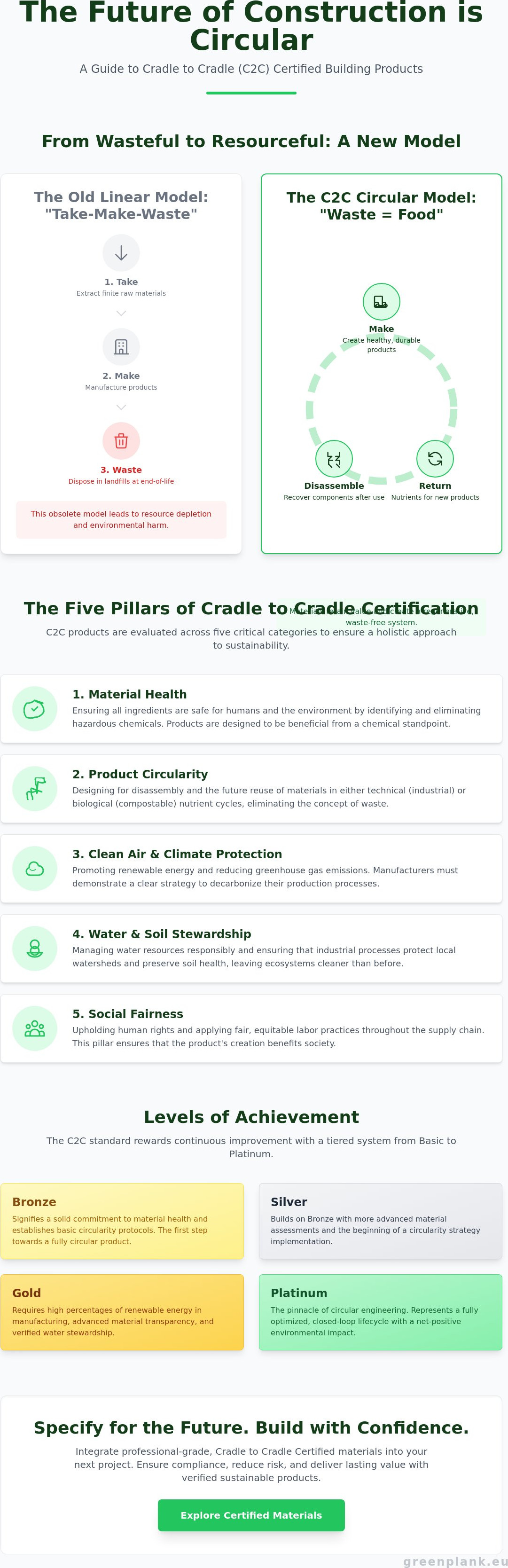
The traditional "take-make-waste" linear model is obsolete. Modern circular construction operates on the principle that waste equals food. While simple recycling often results in downcycling, where material quality degrades over time, the Cradle to Cradle design philosophy ensures materials retain their value across multiple lifecycles. This rigorous standard evaluates five critical categories: material health, product circularity, clean air and climate protection, water and soil stewardship, and social fairness.
The Philosophy of Circular Construction
True sustainability begins at the engineering phase. We design out the concept of waste before the first board is ever produced. By utilizing perpetual nutrient cycles, cradle to cradle certified building products function as material banks for the future. A facade or deck installed today remains a valuable resource in 30 to 50 years. This long-term value retention is a core tenet of Nordic reliability. Designed in Scandinavia. Produced in Europe. Our products are built to last; they're designed for life.
Certification Levels: Basic to Platinum
The C2C standard utilizes a tiered system to reward continuous improvement and manufacturer transparency. This structured approach allows professionals to select materials that align with specific project requirements and environmental ambitions:
- Bronze and Silver: These levels signify a solid commitment to material health and the establishment of basic circularity protocols.
- Gold: This level requires high percentages of renewable energy in manufacturing and advanced material transparency.
- Platinum: The pinnacle of circular engineering, representing a product with a fully optimized, closed-loop lifecycle.
Choosing the right level depends on your specific environmental targets. For a public project in Stockholm aiming for Miljöbyggnad 4.0 or LEED Platinum, Gold-level certification often provides the necessary technical data to secure high scores. It's about professional-grade precision meeting environmental ethics. This certification ensures that every component is traceable and safe for both people and the planet.
The Five Pillars of Circularity in Construction Materials
To achieve a truly circular economy in Sweden's built environment, materials must meet rigorous performance standards that go beyond simple recycling. The framework established by the Cradle to Cradle Products Innovation Institute evaluates products across five critical categories. These pillars ensure that every component serves a purpose beyond its initial installation, moving away from the "take-make-waste" model toward a regenerative system. For cradle to cradle certified building products, these pillars represent a holistic commitment to quality and ethics.
- Material Health: Ensuring all ingredients are safe for humans and the environment by eliminating hazardous chemicals.
- Product Circularity: Designing for disassembly and the future reuse of raw materials in technical or biological loops.
- Clean Air & Climate Protection: Monitoring and reducing the CO2 footprint during production to meet 2030 climate targets.
- Water & Soil Stewardship: Protecting local Swedish ecosystems and watersheds at the manufacturing site.
- Social Fairness: Upholding ethical labour practices and human rights throughout the entire global supply chain.
Designed in Scandinavia. Produced in Europe. This geographical focus ensures that these pillars aren't just theoretical goals but measurable realities. By localizing production, manufacturers can maintain tighter control over environmental impacts and social standards, delivering professional-grade materials that architects can trust. Built to last. Designed for life.
Material Health and Chemical Transparency
Safety starts with what's inside. High-performance building products must be free from the "Red List" of prohibited chemicals, including substances like formaldehyde, halogenated flame retardants, and certain phthalates. These chemicals often off-gas, compromising indoor air quality and complicating the recycling process. Achieving C2C standards requires 100% traceable raw materials, where every ingredient is accounted for down to 100 parts per million. This level of transparency is essential for achieving a circular economy. Third-party verification plays a vital role here, acting as a shield against greenwashing and providing empirical proof that a material is safe for both biology and the biosphere.
Designing for Product Circularity
Engineering for the future means planning for the end of a building's functional life today. Product circularity is the ability of a material to be recovered and upcycled without loss of quality. To achieve this, designers utilize techniques for easy disassembly, such as mechanical hidden-fastener systems rather than permanent adhesives or complex glues. This allows components to be separated cleanly when a structure is renovated or decommissioned. High-density materials, particularly engineered natural-fiber composites, are essential for maintaining structural integrity across these cycles. Their density prevents the warping and degradation common in lower-quality plastics, ensuring the material remains a valuable asset rather than becoming waste. If you're planning a project that requires long-term durability, you might explore our range of sustainable decking solutions to see these engineering principles in action.
Why Architects and Contractors Prioritise C2C Certification in 2026
In 2026, the Swedish construction sector faces a pivotal shift. Professionals no longer view sustainability as an optional luxury. It's a core requirement for risk management and project viability. By selecting cradle to cradle certified building products, architects eliminate the guesswork involved in material health and circularity. This certification ensures every component is safe for humans and the environment, protecting firms from future liability and ensuring compliance with the latest European Union safety directives.
Contractors value these products because they simplify the procurement process. Using materials with verified safety and durability profiles reduces the likelihood of on-site issues or premature material failure. It's about confidence. When a product is engineered for a circular economy, it arrives with a transparent history and a clear plan for its eventual reuse. This Nordic reliability is essential for maintaining the high standards expected in modern Scandinavian architecture.
Impact on LEED and BREEAM Credits
C2C certification provides a streamlined path to high scores in global rating systems. In LEED v4.1, these products contribute directly to Material and Resources (MR) credits, specifically under the "Building Product Disclosure and Optimization" category. For projects targeting BREEAM-SE, the Swedish adaptation of the international standard, C2C documentation simplifies the verification of responsible sourcing. Environmental Product Declarations (EPDs) act as the technical backbone here. They offer transparent, third-party verified data on the carbon footprint of a facade or deck. This synergy is vital for achieving Net Zero targets by 2030, as it accounts for embodied carbon from day one.
Long-Term ROI of Sustainable Building Materials
Investing in high-quality materials reduces the total cost of ownership. While traditional timber might require annual oiling or staining costing upwards of 150 kr per square meter in labor and materials, engineered composites remain stable without chemical treatments. This durability translates to significant savings over a 30-year lifecycle. Property owners see enhanced asset value through documented sustainability credentials, which attract premium tenants and lower vacancy rates. You can explore more about these financial and environmental benefits in our guide to Sustainable Building Materials: The 2026 Guide to Circular Construction. Choosing products that are built to last and designed for life ensures that initial capital expenditure yields long-term dividends.
Tightening European environmental regulations, such as the Ecodesign for Sustainable Products Regulation (ESPR), mean that non-circular materials will soon face higher taxes or potential restrictions. Architects use cradle to cradle certified building products to future-proof their designs against these shifts. Beyond compliance, there's the undeniable aesthetic of premium engineering. High-end facades and decks crafted from natural-fiber composites offer a refined Nordic character. They provide the warmth of wood without the inevitable decay, ensuring the building's visual appeal remains intact for decades.
- Reduced Maintenance: No sanding, painting, or sealing required.
- Traceable Quality: 100% traceable raw materials sourced within Europe.
- Weather Resistance: Engineered to withstand harsh Swedish winters and coastal humidity.
WPC Composites: A Case Study in Cradle to Cradle Material Health
Wood Plastic Composite (WPC) serves as a primary example of how technical and biological nutrients merge through circular engineering. By combining 75% FSC-certified hardwood fibers with 25% high-density polyethylene (HDPE), these materials create a closed-loop system that mirrors natural cycles. This specific ratio ensures the product remains fully recyclable at the end of its 30-year lifespan, preventing the "downcycling" common in traditional construction materials. Choosing cradle to cradle certified building products means looking beyond the surface; it requires a deep dive into the molecular safety of the components.
European-made WPC stands apart from many imported alternatives that often hide toxic additives like lead, cadmium stabilizers, or phthalates. Green Plank produces its profiles in Europe to ensure 100% traceability of raw materials, adhering to the highest safety standards. This localized production reduces transport emissions and guarantees that no harmful off-gassing occurs in residential or commercial spaces. It's a professional-grade solution designed specifically for the rigorous demands of the Swedish climate. The engineering focus remains on low-density, high-durability designs that use less raw material to achieve superior structural strength.
The Role of Recycled HDPE in Circularity
Transforming plastic waste into high-performance infrastructure profiles prevents non-biodegradable polymers from entering Swedish landfills. HDPE provides exceptional chemical stability in harsh outdoor environments, resisting moisture and salt without the need for toxic sealants. It's a fundamental component explained in What is WPC Composite Decking? The Complete Guide. By repurposing post-industrial waste, Green Plank reduces the demand for virgin petroleum-based plastics while maintaining structural integrity. The resulting material is inert, meaning it won't leach chemicals into the soil or groundwater over decades of use.
Hardwood Fiber and CO2 Sequestration
Utilizing hardwood by-products allows for significant carbon sequestration within the building's envelope. The composite matrix encapsulates these organic fibers, protecting them from fungal decay and eliminating the need for chemical preservatives. High hardwood content enhances the Nordic character of modern facades, providing the tactile warmth of natural timber with engineered precision. This approach aligns with Sweden's 2045 climate neutrality goals by locking carbon into durable, low-maintenance structures that won't rot or warp. By using FSC-certified sources, the material cycle supports responsible forest management while providing a premium aesthetic for cradle to cradle certified building products.
Built to last. Designed for life. Green Plank’s commitment to material health ensures that every deck, fence, and cladding profile contributes to a healthier built environment.
Specifying for the Future: Integrating C2C Products into Your Project
Transitioning to circular construction in Sweden requires a shift from linear procurement to a lifecycle-based audit. Developers must verify that every component meets the rigorous standards of cradle to cradle certified building products. This process starts with a deep dive into the Material Health Certificate (MHC). You aren't just buying a board; you're verifying a complete chemical inventory. By auditing your supply chain for material health, you ensure that every element can safely return to the technical or biological cycle without leaching toxins into the Swedish environment.
Selecting Traceable European Materials
Materials sourced from outside the EU often carry hidden risks. A lack of chemical transparency can compromise a building's circular potential and its rating in local systems like SundaHus or Byggvarubedömningen (BVB). Choosing European-engineered products ensures compliance with the REACH regulation (EC 1907/2006), which restricts hazardous substances. This regional focus also guarantees higher social fairness standards and lower transport emissions. For professionals looking beyond standard options, understanding Trex decking alternatives reveals why European-engineered WPC is the sustainable choice for 2026 projects.
Practical Implementation and Installation
Circular design is only effective if the product can be recovered at its end-of-life. Traditional face-screwing or gluing creates "monstrous hybrids" that inevitably end up in landfills. Green Plank systems utilize hidden fastening clips to allow for non-destructive disassembly. This is a technical solution that ensures components can be reused or recycled after decades of service. To implement this, developers should focus on three core areas:
- Mechanical Fixings: Use hidden fasteners to protect the material integrity of the natural-fiber composite.
- Material Passports: Document the exact composition and installation method to facilitate future recovery.
- Take-back Alignment: Partner with manufacturers who have established infrastructure for recycling used cladding and decking.
Evaluating warranties is another critical step. In the Swedish climate, a 30 to 50-year guarantee is a primary signal of circular durability. It isn't just a promise; it's proof that the product won't need premature replacement. This longevity keeps raw materials in the loop for longer, reducing the total carbon footprint of the project. The procurement of cradle to cradle certified building products ensures that "Built to last" becomes a technical reality rather than a marketing claim.
The next step for developers is to establish a "Circular Minimum" for all 2026 tenders. Start by auditing your current suppliers and prioritizing those with transparent, European-made credentials. To see how these principles are applied to high-performance outdoor solutions, explore Green Plank’s range of C2C-inspired building products. Designed in Scandinavia. Produced in Europe. Built to last. Designed for life.
Designing the Circular Skyline
The shift toward circular construction isn't just a trend; it's a structural requirement for the Swedish building sector. By prioritizing cradle to cradle certified building products, architects and developers are securing project longevity while meeting strict 2026 environmental standards. We've explored how material health and technical cycles turn raw resources into high-performance assets. Green Plank supports this transition by utilizing 100% EU traceable raw materials to manufacture solutions that are engineered for circularity and a low CO2 footprint. Our professional-grade WPC composites offer up to 50-year service life warranties; this ensures that today's investments remain stable and beautiful for decades. These products aren't just sustainable; they're a commitment to engineering precision and Nordic reliability. It's time to specify materials that respect both the project's budget and the planet's future. Designed in Scandinavia. Produced in Europe. Built to last. Designed for life.
Download our Technical Guide to Sustainable WPC Solutions to see how our engineered composites integrate into your next circular project.
Choosing the right materials today creates a legacy of quality for the generations of tomorrow.
Frequently Asked Questions
What are the main requirements for a product to be Cradle to Cradle Certified?
To achieve certification, a product must meet rigorous criteria across five performance categories. These include material health, product circularity, clean air and climate protection, water and soil stewardship, and social fairness. Under the Version 4.0 standard released in 2021, products undergo third party assessment every two years to ensure they maintain these ethical and engineering standards. Each category is rated from Bronze to Platinum based on the depth of the sustainability commitment.
How does C2C certification differ from LEED or BREEAM?
Cradle to Cradle is a product-specific certification, while LEED and BREEAM assess the environmental performance of an entire building project. Using cradle to cradle certified building products earns direct points toward these broader building schemes. For instance, C2C products can contribute up to 2 points under the LEED v4.1 Material Ingredients credit. This synergy allows architects in Sweden to simplify their documentation process while ensuring high material health for every component.
Can composite decking really be considered a circular building product?
High-quality natural-fiber composites are circular when they're designed for disassembly and reuse. Green Plank utilizes up to 90% recycled content, including FSC-certified wood fibers and recycled polymers. These materials are engineered to stay in a technical cycle. By avoiding toxic glues and using mechanical fasteners, the decking can be reclaimed and reprocessed into new professional-grade planks at the end of its 30-year lifespan without losing material quality.
Are Cradle to Cradle certified products more expensive than traditional materials?
Initial purchase prices for circular materials may be 10% to 20% higher than conventional options due to rigorous testing and traceable sourcing. However, the total cost of ownership in Sweden is often lower. A standard timber deck requires oiling every 12 months, costing approximately 50 kr per square meter in materials alone. C2C certified composites eliminate these maintenance costs; this provides a financial break-even point within 5 to 7 years.
What happens to C2C building products at the end of their service life?
Products enter either a biological or technical cycle depending on their specific composition. Technical materials, like our natural-fiber composites, are collected and shredded to create raw material for future production runs. This closed-loop system prevents waste from entering Swedish landfills. Because the material health is verified, these recycled inputs don't carry the toxic legacy often found in older, non-certified construction waste that complicates recycling efforts.
Why is material health so important in the Cradle to Cradle framework?
Material health ensures every ingredient in a product is safe for humans and the surrounding environment. The C2C framework screens against a Restricted Substances List containing over 1,000 chemicals. This is vital for indoor air quality and long-term soil health. In Sweden, where we spend 90% of our time indoors, using cradle to cradle certified building products guarantees that no volatile organic compounds or heavy metals leach into our living spaces.
Is C2C certification valid internationally for global construction projects?
The Cradle to Cradle Certified Products Program is an international standard recognized in over 80 countries. It provides a universal language for sustainability that transcends local regulations. For a Swedish developer working on a project in London or Berlin, C2C certification ensures the material meets global benchmarks for circularity. This consistency is why 345 companies worldwide have already certified thousands of products under this rigorous, trustworthy framework.
How do I verify if a building product is truly Cradle to Cradle certified?
You can verify any claim by searching the official Cradle to Cradle Certified Product Registry managed by the C2C Products Innovation Institute. Every legitimate certificate has a unique ID number and a specific expiration date. Always ask your supplier for the current certificate summary. This document details the achievement level for each of the five categories; it ensures the product meets the professional-grade standards required for modern Nordic construction.
Produkt spezifizieren
Diese Anleitung in einer Green Plank-Ausschreibung nutzen
Technische WPC-Artikel sollen die kommerziellen Seiten stärken — nicht mit ihnen konkurrieren. Weiter zu WPC-Terrasse, TerraTuff, Nordeka oder den technischen Downloads.