



The lowest quote on your desk today might actually be the most expensive line item in your ten-year budget. While traditional timber often appears cost-effective at checkout, the recurring expenses for oils, stains, and structural repairs in the Swedish climate can triple that initial figure before the decade is out. You likely understand that quality requires an upfront investment, yet justifying those additional thousands of kronor to stakeholders or family members remains a challenge. This guide provides a professional framework for using a composite decking cost calculator to master your project estimates with engineering precision.
Accurate estimation begins with understanding that not all composite boards are engineered equally. A precise composite decking cost calculator must account for board density and profile architecture. Solid profiles offer superior impact resistance and sound dampening, making them the standard for high-end residential projects. For instance, high-performance systems like Composite Decking FreshDeck illustrate the importance of material density in achieving structural stability. Hollow profiles reduce material weight and initial transport costs, yet they require specific end-caps to prevent moisture ingress. Regarding the Swedish climate, where thermal fluctuations are significant, the polymer-to-fiber ratio dictates the expansion coefficient.
We'll move beyond simple per-meter pricing to account for critical variables like subframe stability and specialized fastener systems. You'll learn how to calculate the long-term ROI of low-maintenance, natural-fiber composites and gain the data needed to support a sustainable, professional-grade choice. We examine the specific costs of Nordic installation requirements to ensure your outdoor space is truly built to last and designed for life.
Key Takeaways
- Move beyond misleading "price per square meter" metrics to understand the true total cost of substructure, labor, and professional-grade materials.
- Utilize a comprehensive composite decking cost calculator to accurately determine material requirements based on specific board profiles and your chosen laying pattern.
- Evaluate the long-term financial ROI by projecting maintenance savings in SEK over a 50-year lifecycle compared to traditional timber.
- Learn to optimize structural integrity by adjusting joist spacing and board density to meet the rigorous demands of both residential and commercial Swedish projects.
- Discover how European-made, engineered systems provide the stability and durability required for a maintenance-free outdoor space that respects nature.
Beyond the Basics: What a Composite Decking Cost Calculator Often Misses
Most homeowners and contractors begin their project by using a basic composite decking cost calculator. While these tools provide a helpful baseline, they rarely capture the full complexity of a professional-grade installation. A deck is an engineered system, not just a collection of boards. Relying solely on a "price per square meter" figure is often misleading because it ignores the specific demands of the Swedish climate. Heavy snow loads and intense moisture cycles require a robust approach to estimating that goes beyond the surface material.
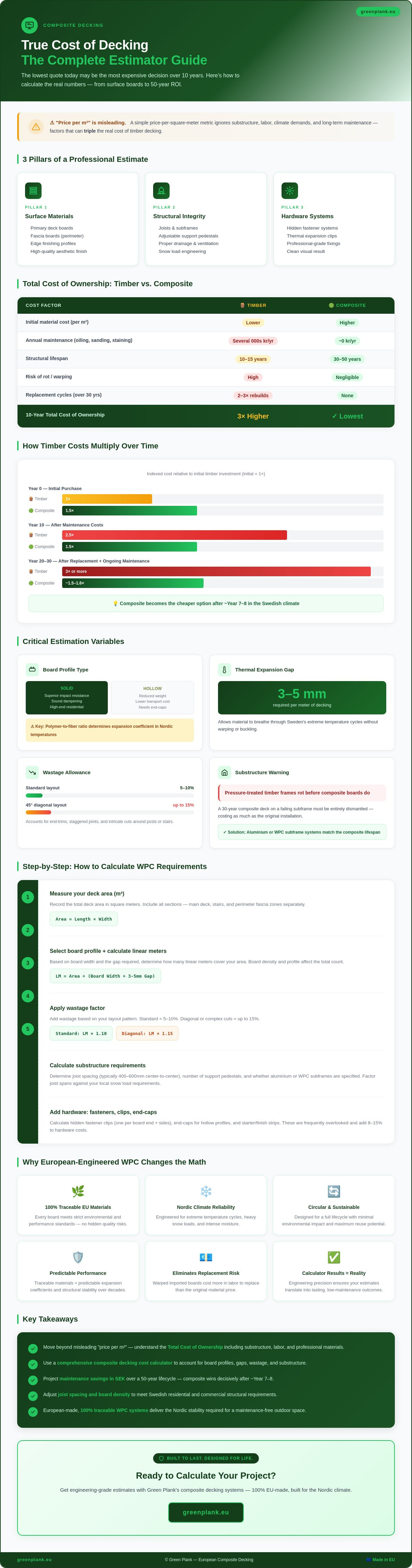
The true value of a project is found in its Total Cost of Ownership (TCO). While the initial investment for premium European-made WPC might be higher than traditional timber, the financial math shifts over time. In Sweden, professional maintenance for a wood deck can cost several thousand kr every year. Composite decking eliminates the need for sanding, staining, and oiling. When you calculate the expenses over a 20 or 30 year lifespan, the engineered solution is almost always the most economical choice. It's a matter of investing in durability today to avoid replacement costs tomorrow.
The Three Pillars of a Professional Decking Estimate
A comprehensive estimate must account for three distinct categories to ensure the project remains on budget and structurally sound, a principle followed by premium construction firms like BigDecks when planning high-end outdoor spaces:
- Surface Materials: This includes the primary deck boards, fascia boards for a clean perimeter, and specialized edge finishing profiles. High-quality finishes define the aesthetic character of the space.
- Structural Integrity: The subframe is the foundation of your investment. You must factor in the cost of joists, subframes, and adjustable support pedestals. These components ensure proper drainage and ventilation.
- Hardware Systems: Professional installations utilize hidden fasteners rather than traditional screws. These systems allow for natural thermal expansion and contraction without compromising the visual appeal of the deck.
Why European-Engineered WPC Changes the Math
The origin of your raw materials dictates the long-term stability of your deck. Green Plank utilizes 100% traceable EU raw materials to ensure every board meets strict environmental and performance standards. Many imported alternatives lack this traceability, which increases project risk. If a board warps or fails due to poor manufacturing, the labor cost to replace it often exceeds the original material price.
Choosing European-engineered products provides a level of Nordic reliability that cheaper imports cannot match. When you understand what is WPC composite decking and how it's manufactured, the benefits of a circular, sustainable product become clear. Traceable materials deliver predictable performance in extreme temperatures. This engineering precision ensures your composite decking cost calculator results translate into a lasting, low-maintenance reality. Our products are built to last and designed for life.
The Anatomy of an Estimate: Material and Structural Variables
Accurate estimation begins with understanding that not all composite boards are engineered equally. A precise composite decking cost calculator must account for board density and profile architecture. Solid profiles offer superior impact resistance and sound dampening, making them the standard for high-end residential projects. Hollow profiles reduce material weight and initial transport costs, yet they require specific end-caps to prevent moisture ingress. Regarding the Swedish climate, where thermal fluctuations are significant, the polymer-to-fiber ratio dictates the expansion coefficient.
Installers must account for thermal expansion by utilizing specific fixing gaps. For every meter of decking, a 3mm to 5mm gap is typically required to allow the material to breathe without warping. Professional estimators always include a 5-10% wastage factor in their final figures. This margin isn't for errors; it accounts for end-trims, staggered joints, and the intricate cuts required around posts or stairs. Complex patterns like a 45-degree diagonal layout can push this requirement to 15% to ensure a clean finish.
Substructure and Framing Requirements
The longevity of your deck depends on what's underneath. While pressure-treated timber frames are common in Sweden, they often rot long before the composite boards reach their 30-year limit. Aluminum or composite subframes offer a circular solution that matches the lifespan of the surface. Ground preparation also shifts the budget. Concrete pads provide a permanent foundation, while adjustable pedestals allow for rapid leveling on uneven terrain. For demanding environments, Terra Tuff Composite Decking provides the engineering strength required for high-load commercial spans, often allowing for wider joist spacing without compromising structural integrity. Built to last. Designed for life.
Fastening Systems: Hidden vs. Exposed
Fastening choices impact both the visual finish and the installation timeline. Hidden fastening systems, such as HidLoc™, eliminate the need for pre-drilling and face-screwing. This system can reduce labor time by 30% compared to traditional screw-down methods. Beyond efficiency, a fastener-free surface is safer for bare feet and prevents moisture from entering the core of the board through screw holes. It creates a seamless, Nordic aesthetic that highlights the natural grain of the material. To see how these components fit your specific project dimensions, you can browse our sustainable decking ranges and technical specifications. This approach ensures your composite decking cost calculator results reflect a professional-grade installation that respects both your budget and the environment.
Evaluating Long-Term ROI: Composite vs. Traditional Timber
A precise composite decking cost calculator does more than sum up the initial invoice. It analyzes the total cost of ownership over the structure's lifespan. While pressure-treated timber or Siberian larch may present a lower entry price, they carry an "invisible mortgage" of recurring expenses. In the Swedish climate, fluctuating temperatures and heavy snow loads accelerate the degradation of organic wood fibers, necessitating a rigorous maintenance schedule to prevent rot.
The financial trajectory of these materials diverges sharply over time:
- 10-Year Horizon: A timber deck typically requires five cycles of sanding and staining. At professional rates in Sweden, this adds approximately 15,000 kr to 25,000 kr in labor and material costs for a standard 30-square-meter space.
- 25-Year Horizon: Most softwoods reach structural failure within 12 to 15 years. By year 25, a homeowner has likely paid for a complete deck replacement, effectively doubling their initial investment.
- 50-Year Horizon: Premium natural-fiber composites remain structurally sound. Green Plank provides a 50-year warranty on select professional-grade ranges, serving as a definitive financial safeguard that timber cannot match.
Our products are designed in Scandinavia and produced in Europe to withstand these specific environmental pressures. When you use a composite decking cost calculator, the elimination of replacement cycles represents the single largest saving in your project's lifecycle.
The Hidden Costs of "Cheap" Wood
Maintenance is a drain on both capital and time. A standard restoration cycle for a wooden deck involves 12 to 20 hours of labor. This includes deep cleaning with specialized detergents, mechanical sanding to remove graying fibers, and the application of protective oils. These chemicals are not only expensive but often contain volatile organic compounds (VOCs) that impact the local ecosystem. Choosing a high-performance alternative removes these recurring debts. For a deeper dive into these efficiencies, consult our Low Maintenance Decking Guide.
Sustainability as a Financial Asset
Green Plank utilizes a circular manufacturing model, incorporating 75% recycled hardwood fiber into our natural-fiber composite. This engineering choice delivers stability and strength while aligning with modern "Cradle to Cradle" principles. In the Swedish real estate market, sustainability is increasingly tied to property valuation. High-quality, eco-certified materials are viewed as low-risk assets by future buyers. Sustainable materials reduce carbon tax liabilities in commercial builds by lowering the total embodied carbon emissions of the structure. This makes professional-grade composite a strategic choice for both private residences and large-scale urban developments. Built to last. Designed for life.
Step-by-Step: How to Calculate Your WPC Decking Requirements
Accurate estimation is the foundation of any successful Swedish outdoor project. When you use a composite decking cost calculator, the output is only as reliable as the measurements you provide. Precise calculations prevent the waste of premium materials and ensure your budget remains intact. Whether you're planning a simple terrace in Stockholm or a multi-level deck in Gothenburg, following a structured methodology is essential for a professional result.
Step 1: Measuring for Precision
Begin by calculating the total square meterage of your space. For standard rectangular decks, multiply the length by the width. If your design includes irregular shapes or multiple levels, break the area into smaller geometric sections and sum them up. It's vital to consult the Smart System WPC guide to align your measurements with specific product widths. For instance, the Nordeka line typically features a 140mm width, while the Classic series offers 150mm. This 10mm difference significantly alters the total board count over a large area.
Your laying pattern dictates your waste factor. Horizontal layouts are efficient; a 5% to 7% waste multiplier usually covers cutting errors. If you choose a diagonal pattern, increase this multiplier to 15%. This extra material accounts for the complex angle cuts required at the deck edges. Measuring twice ensures you order exactly what you need, reflecting the Nordic commitment to efficiency and resource respect.
Step 2: Determining Hardware Counts
The longevity of your deck depends on its hidden infrastructure. To maintain the clean, screw-free aesthetic of Green Plank decking, you must calculate your clips and fasteners with engineering precision. In most Swedish residential projects, joists are spaced at 300mm or 400mm centers. This spacing determines your clip density. Use these standard metrics for your composite decking cost calculator inputs:
- Standard Hidden Clips: Plan for 20 to 25 clips per square meter. This range accounts for varying board widths and ensures every intersection is secured.
- Start and Finish Clips: These specialized fasteners secure the perimeter boards. You'll need one for every joist intersection along the start and end of the deck.
- Subframe Screws: Choose screws specifically engineered for your joist material. For Swedish pressure-treated timber joists, stainless steel fasteners are non-negotiable to prevent corrosion.
Don't overlook the finishing elements. Fascia boards and skirting provide a polished, professional look that hides the subframe. Measure the total linear meters of the deck's exposed perimeter to determine your fascia requirements. This step transforms a simple platform into a refined architectural feature. Built to last, these components ensure your deck resists the harsh Scandinavian climate for decades.
Ready to bring your vision to life with sustainable, high-performance materials? Explore the full range of Green Plank composite solutions and accessories.
Optimizing Your Project with Green Plank’s Engineered Systems
A digital tool like a composite decking cost calculator provides an essential baseline for your budget. However, moving from a general estimate to a finished Swedish landscape requires engineering precision. Green Plank operates on a core philosophy: Designed in Scandinavia. Produced in Europe. We manufacture all products within the EU using 100% traceable raw materials. This proximity eliminates the supply chain volatility often seen with imported goods; it ensures your project timelines remain intact while maintaining a lower carbon footprint.
Our production model prioritizes circularity and professional-grade durability. By sourcing 100% of our raw materials within Europe, we maintain strict control over the physical properties of every board. This results in a product that resists the harsh Nordic climate, from sub-zero winters to high UV exposure in the summer. It's a reliable choice for those who value both aesthetic refinement and environmental ethics. We don't just sell planks; we provide engineered systems designed for stability and strength.
The Green Plank Advantage for Specifiers
Specifiers choose our natural-fiber composite for its optimized low-density, high-strength ratio. This specific engineering ensures extreme durability without the excessive weight of traditional materials. It's particularly effective for rooftop terraces in Stockholm or expansive public boardwalks where weight loads are critical. Our commitment to quality is backed by a 50-year warranty. This offers long-term security for large-scale infrastructure investments. You can explore the engineering behind our sustainable composite wood to understand the manufacturing process that enables such longevity. Built to last. Designed for life.
Requesting a Technical Quote
An initial calculation in kr is just the starting point for a successful build. For commercial partners and large-scale residential developments, the next step involves transitioning from a composite decking cost calculator estimate to a professional technical specification. We encourage you to provide our technical support team with your architectural drawings. This allows us to generate a precise bill of materials, including specific substructures and hidden fastener systems. Precision planning can reduce on-site material waste by up to 15%.
Our technical team understands the nuances of Swedish building regulations and load-bearing requirements. We provide the data necessary to satisfy both environmental certifications and structural safety codes. Contact Green Plank for a professional project quote to transform your initial estimate into a detailed, ready-to-build technical specification. We're here to ensure your outdoor space respects nature while delivering a maintenance-free lifestyle for decades.
Secure Your Investment with Engineering Precision
A composite decking cost calculator provides the initial framework for your budget, but a successful project in the Swedish climate requires looking beyond the base price per square meter. You've seen how structural variables and long-term maintenance costs shift the financial landscape over time. While traditional timber might seem cheaper at the point of sale, the total cost of ownership often grows significantly when you account for annual oils and stains. Green Plank systems eliminate these recurring expenses through Cradle to Cradle certified manufacturing and 100% traceable EU raw materials. We engineer our products for stability and a refined Nordic character; this ensures your outdoor space remains a permanent asset rather than a maintenance burden. We back this engineering confidence with a 50-year service life warranty, the longest in the industry. It's time to move from a rough estimate to a professional plan that respects both your budget and the planet. Built to last. Designed for life.
Request a Professional Project Estimate from Green Plank
We look forward to helping you realize your vision for a sustainable, high-performance outdoor living space.
Frequently Asked Questions
How much more does composite decking cost than pressure-treated wood?
High-quality natural-fiber composite typically requires an initial investment of 600 kr to 1,200 kr per square meter, while pressure-treated pine often costs between 200 kr and 400 kr in the Swedish market. While the upfront price is higher, composite eliminates the annual 1,500 kr to 3,000 kr maintenance costs associated with oils and stains. It's an engineered solution designed for life that pays for itself within seven to ten years.
What is the standard wastage percentage I should use for a decking calculator?
You should account for a 10% wastage factor for standard rectangular layouts and up to 15% for complex diagonal patterns or curved edges. This buffer ensures you have enough material to manage offcuts and minor installation errors without delaying your project. Using a precise composite decking cost calculator helps you order the correct volume of traceable, European-made boards while minimizing environmental impact from excess waste.
Do I need to include the cost of a new subframe when replacing a wood deck?
You must include a new subframe if the existing timber joists show signs of rot or structural decay, which occurs in 85% of renovation projects over 10 years old. Composite boards have a lifespan of 20 to 30 years, often outlasting the 15 year average life of a standard pressure-treated subframe. Professional-grade installations utilize aluminum or high-durability joists to ensure the foundation matches the longevity of the decking.
How many hidden fasteners do I need per square meter of composite decking?
Most standard installations require between 18 and 22 hidden fasteners per square meter when joists are spaced at 400 mm centers. This calculation accounts for the clips needed at every joist intersection for each board. Precise fastening is critical for the stability of natural-fiber composite, as it allows for the controlled thermal expansion and contraction necessary in the variable Nordic climate.
Does the color of the composite decking affect the overall project cost?
Standard colors within a specific product line generally share the same price point, though premium multi-tonal finishes can increase material costs by 10% to 15%. These advanced pigments are engineered to resist UV degradation and maintain their Scandinavian aesthetic for decades. Choosing a color that complements your property's architecture adds long-term value without significantly altering the results of your composite decking cost calculator.
Is there a cost difference between hollow and solid composite boards?
Solid composite boards typically cost 20% to 30% more than hollow profiles due to the higher density of raw materials used in their production. Solid boards offer superior impact resistance and are the preferred choice for commercial zones or high-traffic residential areas. Hollow profiles provide a cost-effective, lightweight alternative that maintains the same durability and circular manufacturing standards as our solid professional-grade options.
How does the cost of WPC decking impact the resale value of a property?
Real estate data indicates that high-quality composite decking can provide a return on investment of up to 70% to 80% upon property resale. Potential buyers in Sweden value the low-maintenance nature of WPC, as it removes the burden of annual sanding and oiling. A sustainable, well-documented outdoor space acts as a premium extension of the home, signaling that the property is built to last.
What are the installation labor costs for composite vs. wood decking?
Labor costs for installing composite decking in Sweden typically range from 800 kr to 1,200 kr per square meter, which is approximately 15% higher than wood installation. This difference accounts for the precision required for hidden fastener systems and the specific gapping needed for thermal expansion. Professional installers prefer these engineered systems because they deliver a consistent, high-end finish that minimizes future maintenance issues.
Produkt spezifizieren
Diese Anleitung in einer Green Plank-Ausschreibung nutzen
Technische WPC-Artikel sollen die kommerziellen Seiten stärken — nicht mit ihnen konkurrieren. Weiter zu WPC-Terrasse, TerraTuff, Nordeka oder den technischen Downloads.