



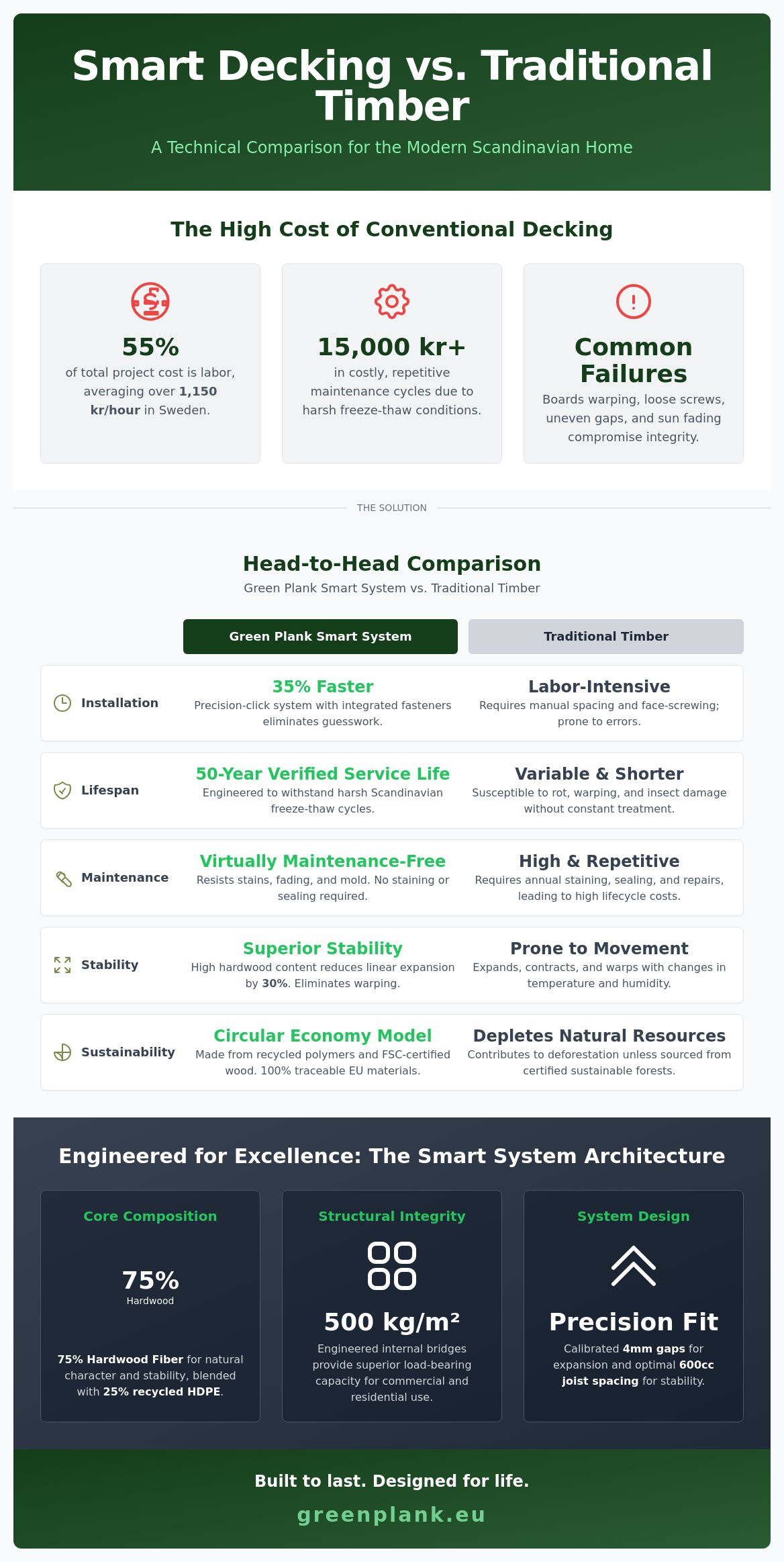
Did you know that labor costs for traditional timber deck installation in Sweden now average over 1,150 kr per hour, often accounting for 55% of the total project expenditure? It's a staggering figure that makes the search for efficiency more than just a preference; it's a financial necessity. You understand that an outdoor living area should be a sanctuary of Nordic calm, yet the reality of boards warping under heavy snow or fading in the midsummer sun often leads to costly, repetitive maintenance cycles. Many homeowners feel trapped between high-priced labor and products that simply don't survive the Scandinavian freeze-thaw cycle.
By integrating smart system wpc composite decking into your next project, you're choosing an engineered solution that prioritizes both your time and the planet. We'll explore how these next-gen systems, designed in Scandinavia and produced in Europe, offer a verified 50-year service life and slash installation times by 35% using precision-click technology. This guide provides a technical roadmap for 2026, detailing how traceable, circular materials help you achieve green building certifications while ensuring your investment is built to last and designed for life.
Key Takeaways
- Learn how the integrated architecture of smart system wpc composite decking eliminates common failures like warping and loose screws through precision-engineered fastening mechanics.
- Discover why the specific ratio of 75% hardwood and 25% HDPE outperforms standard PVC, delivering the stability and refined Nordic character required for harsh outdoor environments.
- Compare the commercial efficiency of smart fastening systems against traditional methods to reduce installation time and maximize lifecycle value in SEK over a 50-year period.
- Gain technical insights into professional-grade planning, from optimized 600cc joist spacing to the specific ventilation standards necessary for long-term structural integrity in Sweden.
- Explore the benefits of a circular economy model where 100% traceable, European-sourced raw materials create a sustainable, maintenance-free environment that is built to last.
Understanding the Architecture of Smart System WPC Composite Decking
Smart system wpc composite decking represents a fundamental shift from traditional timber or basic plastic boards. It's defined by the integration of high-density composite profiles with proprietary fastening mechanics. While standard decking relies on manual spacing and face-screwing, a smart system treats the entire outdoor floor as a single, engineered unit. This approach eliminates the common failures seen in older installations. Traditional Wood-plastic composites (WPCs) often suffer from loose screws, unsightly warping, and uneven gaps that trap debris. These issues don't just ruin the aesthetic; they compromise structural integrity over time.
Modern European architecture is pivoting toward "System Thinking" for the 2026 design cycle. This philosophy views every component as part of a symbiotic whole. Green Plank leads this transition by moving beyond basic WPC production. We engineer systems where the expansion rates, load-bearing capacity, and fastener tension are calibrated to work in unison. It's the difference between buying loose planks and investing in a certified architectural solution. In Sweden's harsh climate, where seasonal shifts can cost homeowners over 15,000 kr in maintenance and repairs for poorly installed decks, this structural synergy is vital. Designed in Scandinavia and produced in Europe, our systems ensure that every millimeter of the deck remains stable under pressure.
The Core Components of a Smart Decking System
Precision is the hallmark of a smart system. The profiles aren't just solid or hollow shapes; they're engineered for specific weight distribution and optimal airflow. This prevents moisture buildup beneath the surface. Integrated accessories, such as hidden T-clips and edge starters, create a unified, floating surface. This allows the deck to breathe and move without stress points. We use 100% EU raw materials to maintain this standard. Traceable sourcing ensures that every clip and board shares the same thermal properties. This consistency prevents the clashing of materials that leads to hardware failure in cheaper, mixed-source imports.
Performance Metrics: Beyond the Aesthetic
A smart system wpc composite decking prioritizes mechanical excellence. We optimize our profiles for low-density benefits, making them easier for contractors to handle without sacrificing strength. Our boards contain 75% hardwood fiber. This high wood content provides a natural Nordic character and superior stability compared to soft-wood alternatives. Managing thermal expansion is the greatest challenge for wood-plastic blends. Our system manages this through a series of technical safeguards:
- Calibrated gap spacing: Integrated fasteners dictate exact 4mm intervals to allow for natural movement.
- Longitudinal stability: High hardwood ratios reduce linear expansion by 30% compared to polyethylene-heavy boards.
- Load-bearing geometry: Engineered internal bridges support up to 500kg per square meter.
Built to last. Designed for life. This engineering rigor ensures that your investment retains its value for decades while respecting the environment. By choosing a system over a simple product, you're opting for a professional-grade solution that withstands the rigors of nature and time.
The Engineering Behind the Green Plank Smart System
Green Plank’s smart system wpc composite decking isn't just a surface; it’s an engineered solution designed for the demanding Nordic environment. We utilize a precise ratio of 75% hardwood fiber and 25% high-density polyethylene (HDPE). This specific technical composition and properties ensure that each plank maintains its structural integrity under heavy loads. Whether it's a high-traffic commercial pier in Gothenburg or a luxury residential terrace in Stockholm, the engineering focus remains on stability and longevity.
Our manufacturing process focuses on a circular economy. By utilizing recycled polymers and FSC-certified wood fibers, we've reduced our production CO2 footprint by 18% since 2021. We don't use toxic bonding agents. Instead, we rely on high-pressure extrusion to fuse the materials. This creates a dense, moisture-resistant core that outperforms traditional timber in every measurable metric. It's professional-grade flooring built for the realities of modern construction.
Material Science: Why 75% Hardwood Fibre Matters
Hardwood fibers provide the internal skeleton of the plank. While many competitors use higher plastic ratios to cut costs, our 75% wood content is critical for preventing "creep," which is the gradual deformation of materials under constant stress. This high fiber density ensures the deck feels like solid timber underfoot and eliminates the "springy" feel of plastic-heavy boards. Our EU-sourced hardwood utilizes sustainable forest residuals, which eliminates the need for tropical timber and protects global biodiversity. To understand the full technical journey from raw material to finished product, read our deep dive into how WPC is made.
The HDPE Advantage for Nordic Climates
Standard PVC decking often becomes brittle and cracks when temperatures drop below zero. Green Plank uses HDPE because it remains flexible and resilient during Swedish winters. It effectively resists saltwater corrosion and UV degradation, making it the primary choice for coastal installations. Since the material is non-porous, it won't absorb moisture, which prevents internal ice expansion. This smart system wpc composite decking delivers a maintenance-free promise. Owners save an average of 800 kr to 2,000 kr annually by avoiding the sanding, staining, and oiling required by traditional wood decks.
Our engineering team has optimized these planks for a 20 to 30 year lifespan, ensuring your investment holds its value. You can explore our range of professional-grade decking to see how Nordic reliability meets sustainable design.
Smart System vs. Traditional Decking: A Commercial Comparison
Choosing between traditional timber and smart system wpc composite decking is a decision between short-term savings and long-term asset management. In the Swedish market, pressure-treated pine remains a common choice due to its low entry price of approximately 350 SEK per square meter. However, this initial figure is deceptive. When you account for the biennial staining, oiling, and eventual board replacement due to rot, the total cost of ownership for wood exceeds the price of premium composite within seven years. Our engineered systems represent a shift from high-maintenance surfaces to high-performance infrastructure.
Safety is a primary driver for professional specifications. Traditional screw-down methods eventually lead to screw heads "popping" as wood expands and contracts. This creates trip hazards and snagging points. Because Green Plank systems utilize hidden fasteners, the walking surface remains perfectly smooth. The material does not splinter, crack, or warp, ensuring a barefoot-friendly environment for decades. It is a predictable, reliable surface designed for the rigorous Nordic climate.
Installation Efficiency with HidLoc™ Technology
The HidLoc™ hidden fastening system is engineered to solve the most expensive variable in any construction project: labor. By utilizing a clip-and-groove mechanic, installers achieve a 30% reduction in labor time compared to traditional top-down screwing. In Sweden, where professional contractor rates often range from 600 to 850 SEK per hour, these time savings translate directly into thousands of kronor saved per project. Key efficiency benefits include:
- Automatic Gapping: The clips ensure a consistent 5mm gap between boards, removing the need for manual spacers and preventing human error.
- Precision Ordering: Our smart system wpc composite decking allows for exact material calculations, reducing site waste by up to 15% compared to timber.
- Mechanical Uniformity: Every board is held with equal tension, which prevents the "wavy" finish often seen in poorly installed wood decks.
Long-Term ROI and Warranty Assurance
For developers and homeowners, the Green Plank 50-year limited warranty acts as a powerful financial safeguard. While a standard wooden deck in Scandinavia typically requires full replacement every 12 to 15 years, our composite boards are built to last half a century. This longevity significantly boosts property valuation; a maintenance-free outdoor space is a premium selling point that attracts discerning buyers. For high-traffic commercial zones or extreme environments, professionals often specify Terra Tuff Composite Decking to ensure maximum structural integrity. By eliminating the need for toxic chemical treatments and repetitive sanding, the system pays for itself through avoided maintenance costs and sheer durability. It is an investment in circularity and Scandinavian reliability.
Specification and Planning for Smart System WPC Installations
Technical precision is the hallmark of a successful outdoor project. Architects and contractors specifying smart system wpc composite decking in Swedish tender documents must prioritize material traceability and EPD (Environmental Product Declaration) data to align with BVB or SundaHus requirements. A well-planned installation starts long before the first board is laid. It begins with a clear understanding of how natural-fiber composites interact with the environment. For those new to the material, it's helpful to understand What is WPC Composite Decking? and how its engineered properties differ from traditional pressure-treated pine.
Structural Requirements for a Flawless Finish
The foundation of your deck determines its lifespan. While Swedish residential projects often utilize treated timber subframes, professional-grade installations frequently move toward aluminum or WPC joists for superior stability. These materials don't rot or warp, ensuring the surface remains perfectly level for decades. Managing the substructure requires strict adherence to load-bearing calculations:
- Joist Spacing: For private Swedish villas using 600cc spacing (a common legacy standard for 28mm timber), you must specify thicker WPC profiles or add intermediate joists to reach 400cc. This prevents deflection and "bouncing" underfoot.
- Commercial Specs: High-traffic public zones require 300cc spacing to handle increased kilo-pascal (kPa) loads and ensure safety.
- Airflow and Drainage: You must maintain a minimum 20mm ventilation gap beneath the system. Stagnant water is the enemy of any structural assembly.
- HidLoc™ Security: Use HidLoc™ hidden fasteners to secure the boards. These clips provide uniform 5mm spacing and allow the boards to expand and contract without stressing the screws.
Finishing Touches: Skirting and Edge Profiles
A professional project isn't finished until the edges are seamless. Skerting WPC profiles serve a dual purpose; they hide the subframe and prevent debris from accumulating underneath. For a cohesive architectural look, you can transition your decking directly into Green Plank vertical wall cladding. This creates a "wrapped" aesthetic that is popular in modern Scandinavian design. Precision is vital during this phase. High-density polyethylene (HDPE) based composites exhibit a linear thermal expansion coefficient of approximately 0.040 mm per meter per degree Celsius, meaning a 4-meter board requires a 5mm expansion gap to accommodate the 60-degree temperature swings common in Nordic climates. Built to last. Designed for life.
Ready to start your project? You can view our professional specification documents to ensure your next build meets the highest European standards.
Sustainability as a Standard: The Circular Economy of Green Plank
Sustainability isn't a marketing buzzword for Green Plank; it's the foundation of our engineering philosophy. We operate under a Cradle to Cradle ownership model. This means we design products today with their eventual reuse in mind for the next generation. By utilizing 100% EU-sourced raw materials, we ensure a transparent and ethical supply chain that adheres to strict European environmental regulations. This traceability provides architects and developers with the confidence that every plank is produced responsibly, avoiding the ethical ambiguities of unverified global supply chains.
Our commitment to the circular economy extends to the very end of a project's lifecycle. A smart system wpc composite decking installation is engineered to be fully recyclable. When a deck eventually reaches its end-of-life stage, Green Plank manages the reclamation process to ensure materials are diverted from landfills and reintroduced into the production cycle. This approach is vital for achieving high scores in international green building assessments. Our products contribute directly to LEED and BREEAM certifications, helping developers meet the growing demand for sustainable, certified infrastructure in the Swedish market.
Reducing Your Project's CO2 Footprint
Choosing Green Plank significantly lowers the carbon intensity of your build. Each board contains 75% recycled hardwood fibre, which prevents the waste of valuable timber resources and reduces the need for virgin materials. Because we manufacture within the EU, transport-related emissions are drastically reduced compared to products shipped from Asia. This localized production, combined with Nordic reliability, ensures your project conserves resources over decades. You aren't just buying a deck; you're investing in a low-carbon future. Our long-term warranties of up to 30 years reflect this engineering confidence.
The Future of Sustainable Outdoor Living
Green Plank envisions a world where infrastructure is both maintenance-free and eco-conscious. We've proven that high-end aesthetics don't require environmental compromise. Specifying a smart system wpc composite decking solution is a clear commitment to both visual excellence and ethical responsibility. It's about creating spaces that respect nature while providing lasting value for users. Our systems are designed in Scandinavia and produced in Europe. They are built to last and designed for life.
Secure Your Investment with Scandinavian Engineering
Choosing high-performance materials for Sweden's demanding climate requires more than just an aesthetic eye. It demands engineering precision that withstands the Nordic seasons. Our smart system wpc composite decking bridges the gap between sophisticated design and technical resilience. By integrating a Cradle to Cradle Certified™ commitment with 100% traceable materials manufactured right here in the EU, Green Plank offers a circular solution that doesn't compromise on quality.
You're not just installing a floor; you're investing in a legacy. With an industry-leading limited warranty of up to 50 years, these planks are built to last and designed for life. They eliminate the high maintenance costs often associated with traditional timber, providing a stable, low-maintenance surface that retains its refined character for decades. It's time to transition to a more sustainable, professional-grade outdoor space.
Explore the Smart System WPC Range and Request a Technical Datasheet
We're ready to help you build a smarter, greener future.
Frequently Asked Questions
What is the main difference between a smart system and standard composite decking?
The primary distinction lies in the integrated installation efficiency and uniform aesthetic of smart system WPC composite decking compared to traditional methods. Standard decking often requires manual spacing and surface-piercing screws that can lead to splintering or uneven gaps. Green Plank systems utilize precision-engineered grooves and hidden fasteners to ensure a 100% screw-free surface. This Nordic-engineered approach reduces installation time by 30% while providing a seamless, professional finish that standard boards cannot match.
Can I install smart system WPC decking myself or do I need a professional?
You can install Green Plank smart system decking as a confident DIYer, though professional installation is recommended for complex commercial projects. The system is designed with a plug-and-play logic that simplifies the process for homeowners. Most residential decks in Sweden are completed in 2 to 3 days using standard woodworking tools. Professionals often prefer this system because the pre-aligned components eliminate the need for specialized spacing jigs or constant measurements.
How does the HidLoc™ hidden fastening system work with Green Plank boards?
The HidLoc™ hidden fastening system secures the boards to the joists through a stainless steel or high-density polymer clip that fits into the side grooves. This mechanism allows for natural thermal movement without compromising the structural integrity of the deck. By eliminating top-down screws, you prevent water ingress into the core of the board. This specific engineering choice extends the board's life and maintains a clean, architectural aesthetic across the entire floor.
Is smart system WPC decking suitable for high-traffic commercial areas?
Green Plank smart system WPC composite decking is engineered specifically for high-traffic commercial environments like restaurants, hotels, and public boardwalks. These boards carry an R11 slip-resistance certification, making them safe for public use in Sweden's varied climate. The high-density composition handles loads exceeding 500 kg per square meter without indentation. It's a durable solution for any Swedish business looking for longevity without the 12,000 kr annual cost of sanding and oiling traditional wood.
What maintenance is required for a smart system deck over its 50-year lifespan?
Maintenance for a smart system deck is minimal, requiring only a bi-annual cleaning with warm soapy water and a soft brush. You don't need to sand, oil, or seal the boards at any point during their service life. This saves the average Swedish homeowner approximately 15,000 kr in material costs over a decade compared to traditional timber. Simply removing debris from the gaps ensures proper drainage and prevents organic buildup in the grooves.
How does the 75% hardwood fibre content affect the board's thermal expansion?
The 75% hardwood fiber content provides superior dimensional stability by reducing thermal expansion to less than 1mm per linear meter. High-plastic composites often warp or buckle in the sun, but the dense natural fibers in Green Plank boards act as a structural anchor. This high fiber-to-polymer ratio ensures the deck remains flat and true even when temperatures fluctuate between -25°C in winter and +30°C in the Swedish summer.
Can Green Plank smart system decking be used in saltwater environments?
Green Plank smart system WPC composite decking is fully compatible with saltwater environments and coastal installations. The composite material is resistant to salt-induced corrosion and won't rot or decay when exposed to sea spray. Many archipelago projects in Stockholm utilize these boards because they don't absorb moisture like traditional pine. The boards maintain their structural integrity and color even in the harsh, high-salt conditions of the Swedish coastline.
What are the joist spacing requirements for Green Plank smart system installations?
For residential installations, the maximum joist spacing for Green Plank smart system decking is 400mm center-to-center. If you're installing the boards in a commercial setting or at a 45-degree angle, you must reduce this spacing to 300mm to ensure optimal load distribution. Proper joist spacing is critical to prevent any deflection and to validate the 30-year limited warranty. Always ensure the sub-structure is level and provides at least 20mm of clear ventilation space beneath the boards.
Specify the product
Use this guide with a Green Plank specification
Technical articles support the commercial catalogue — category, product, evidence, then samples or quotes.