



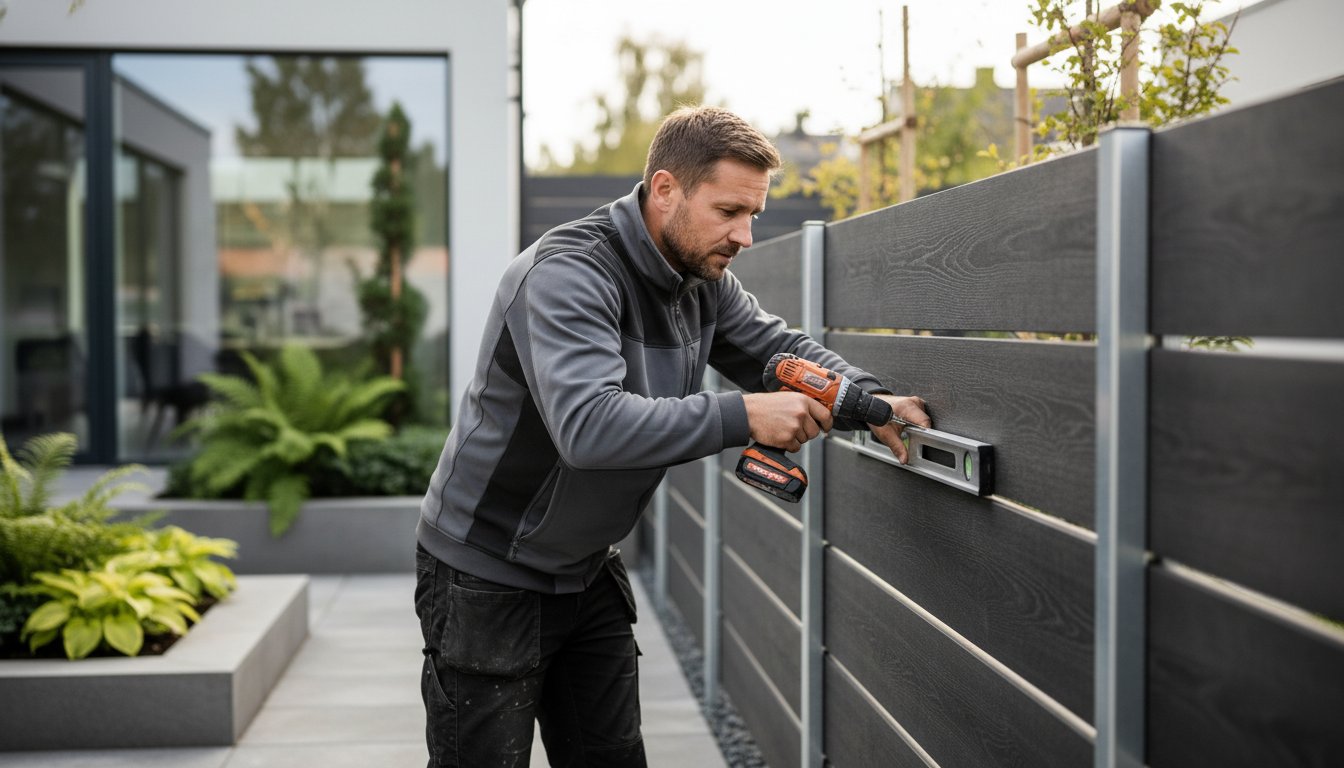
A fence isn't just a boundary; it's an engineered legacy that must withstand the 50-degree temperature swings of the Swedish climate without a single millimetre of compromise. Achieving a professional composite fence installation requires more than just manual labour; it demands an understanding of how high-performance materials interact with the environment. You likely appreciate the warmth of natural textures but worry about the environmental cost of materials or the frustration of boards warping after a single season. It's a valid concern when traditional timber often fails to meet the rigorous demands of modern, sustainable architecture.
This guide delivers the technical blueprint for mastering these challenges, moving beyond basic assembly to master the thermal dynamics of natural-fiber composites. We'll show you how to achieve a flawless finish using hidden fastening systems that allow for essential material expansion while maintaining absolute structural integrity. You'll learn the precise post-setting methods and engineering principles needed to ensure your boundary is built to last and designed for life, providing a maintenance-free solution that respects both your time and the planet.
Key Takeaways
- Understand the engineering differences between natural-fiber composites and traditional timber to ensure long-term structural integrity and prevent common installation failures.
- Master site assessment protocols for soil density and wind loads to guarantee your project withstands the demanding Swedish climate and environmental conditions.
- Learn the precision techniques required for a professional composite fence installation, from establishing a level foundation to managing the interlocking tongue-and-groove interface.
- Implement high-performance maintenance and "Cradle to Cradle" ownership strategies to protect your investment for a service life exceeding 50 years.
- Identify the essential professional toolset and engineering principles needed to deliver a refined Nordic aesthetic that balances premium quality with eco-conscious responsibility.
The Architecture of Longevity: Why Composite Fence Installation Differs from Wood
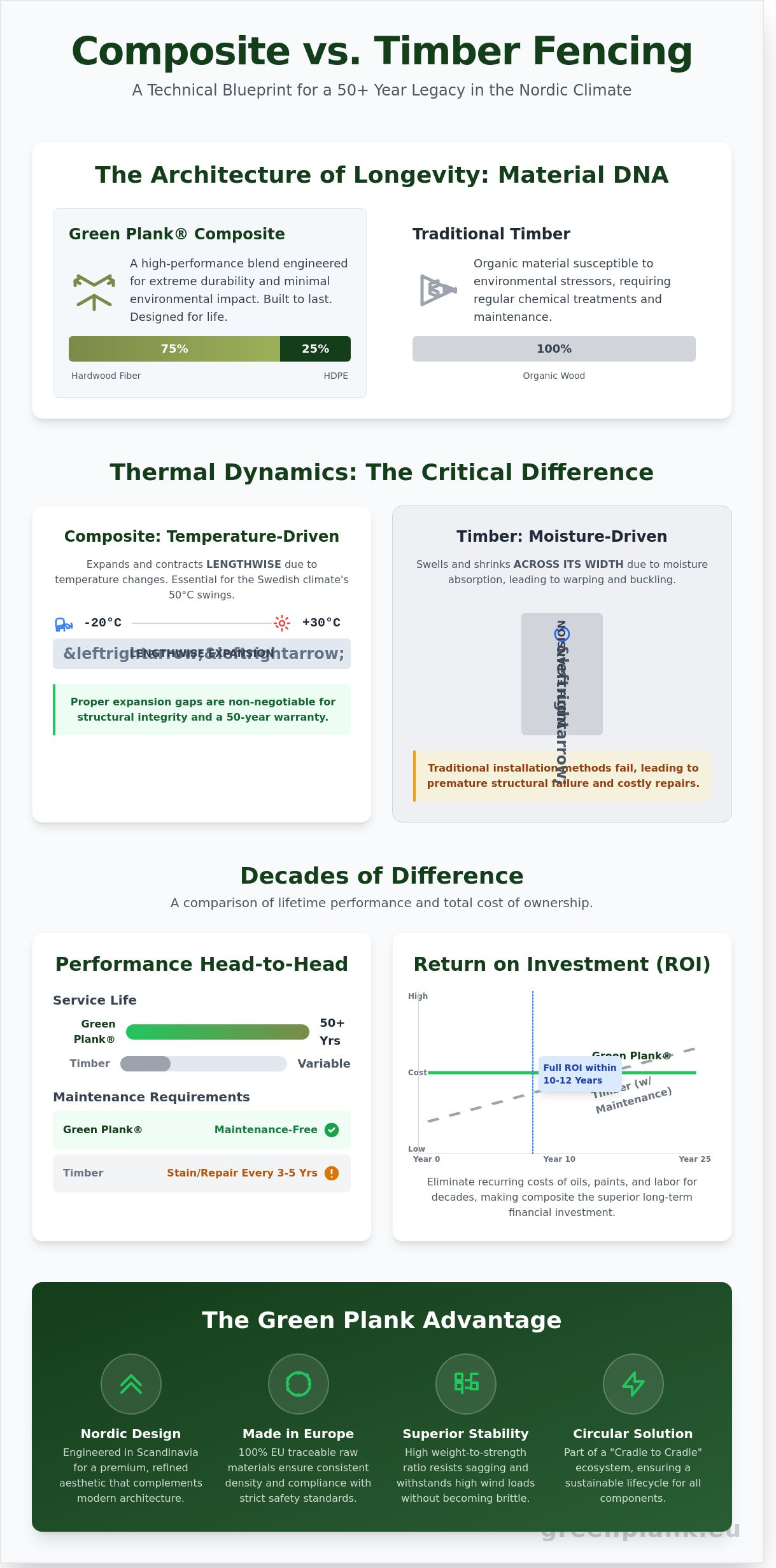
Successful composite fence installation requires a fundamental shift in technical approach. You can't treat high-performance engineered boards like standard pressure-treated timber. Green Plank products are defined by a specific structural DNA: 75% hardwood fiber and 25% High-Density Polyethylene (HDPE). This precise ratio creates Wood-plastic composites (WPCs) that deliver the warmth of natural timber with the resilience of advanced polymers. Built to last. Designed for life.
Traditional timber installation methods often fail when applied to WPC because they overlook the material's unique thermal profile. While organic wood expands primarily across its width due to moisture, composite materials expand and contract along their length based on temperature. Ignoring these specific tolerances leads to structural tension and buckling. In the Swedish climate, where temperatures fluctuate from -20°C to +30°C, these expansion gaps aren't optional; they're the difference between a lifetime boundary and a failed investment. A "Built to Last" philosophy means respecting these physics. Correct execution is the only way to safeguard a 50-year warranty. Beyond durability, professional installation integrates your project into a wider ecosystem of sustainable building materials, ensuring every component remains part of a circular construction cycle.
Material Stability and European Standards
Green Plank utilizes 100% EU traceable raw materials to maintain consistent board density. This traceability ensures that every plank meets strict European safety and environmental regulations. Low-density composites, frequently found in budget imports, lack internal rigidity and require support intervals as tight as 30 cm to prevent sagging. In contrast, Green Plank systems offer a superior weight-to-strength ratio compared to lightweight PVC alternatives. Our boards provide the density required for high-wind areas across Sweden without the brittle nature of unreinforced plastics. Designed in Scandinavia. Produced in Europe.
The ROI of Professional-Grade Installation
The financial logic of a composite fence installation centers on the total cost of ownership. While a timber fence requires staining and repairs every 3 to 5 years, a Green Plank boundary remains maintenance-free for decades. Homeowners in Sweden often see a full return on investment within 10 to 12 years by eliminating the recurring costs of oils, paints, and labor. Precision leveling is a critical part of this value; it prevents structural stress that can compromise the fence over 30 or 40 years. This engineering precision, combined with our refined Nordic design, ensures your landscape reflects a premium aesthetic that respects the surrounding environment while providing a maintenance-free lifestyle.
Preparation and Planning: Mastering the WPC Environment
A successful composite fence installation begins long before the first post hole is dug. It requires a meticulous approach to the environment, respecting both the engineering of the natural-fiber composite and the specific conditions of the Swedish landscape. Proper planning ensures your boundary remains stable against Baltic winds and shifting frost cycles. It's about precision, not guesswork. Our products are designed in Scandinavia and produced in Europe to meet these exact rigors. They provide a circular solution for those who value both aesthetics and environmental ethics.
Before ordering materials, verify local Swedish municipality (kommun) regulations regarding "bygglov" or building permits. While many regions allow fences up to 110 cm without a permit, height restrictions and boundary line offsets vary significantly between Stockholm and Kiruna. Site assessment must also account for wind loads, which often exceed 25 m/s in coastal regions like Halland. High-performance boundaries require deep post footings to resist these lateral forces. Drainage is another non-negotiable factor; stagnant water around post bases can compromise the stability of the soil, even if the engineered boards remain unaffected.
Protecting the Nordic character of your materials during the staging phase is critical. Store all boards flat on a level surface and keep them covered until the moment of assembly. This prevents bowing and ensures the traceable raw materials maintain their structural integrity. Handling these premium components with care reflects the quality of the final build.
The Essential Tool Kit for WPC
High-performance composite requires professional-grade tools to achieve a clean finish. You'll need fine-toothed carbide-tipped blades with at least 60 teeth to ensure melt-free, crisp edges on every cut. Accuracy is a hallmark of Scandinavian craftsmanship. While string lines are useful for basic layouts, using a self-leveling laser level provides the multi-directional accuracy needed for complex elevations. Safety gear is mandatory; always wear P2-rated respiratory protection to manage natural-fiber composite dust. We recommend the following checklist:
- Carbide-tipped circular saw: For clean, professional-grade edges.
- Impact driver: To secure fasteners without stripping the composite.
- Laser level: For maintaining perfect horizontal alignment across uneven terrain.
- P2/P3 Dust mask: To ensure a safe working environment during cutting.
The Science of Thermal Expansion
High-density polyethylene (HDPE) components naturally expand and contract as ambient temperatures shift throughout the Swedish seasons. This physical reality must be managed through calculated expansion gaps. If you're performing a composite fence installation during a 25°C summer, your gaps will be smaller than during a 5°C autumn install. We require acclimatising boards on-site for at least 48 hours. This allows the material to reach equilibrium with the local microclimate, ensuring the final structure is built to last and designed for life. Ignoring this step can lead to buckling, whereas proper gapping results in a maintenance-free finish that lasts for 30 years.
Structural Foundations: In-Ground Posts vs. Surface Mounting
The longevity of a professional composite fence installation depends entirely on the stability of its foundation. Swedish ground conditions, characterized by intense seasonal freeze-thaw cycles, require specific engineering approaches to prevent shifting. Whether you're securing posts in deep soil or onto existing stone, the structural integrity determines the 30-year lifecycle of your sustainable boundary. We prioritize Nordic reliability by ensuring every post remains immovable against the elements.
Setting Posts for Maximum Wind Resistance
Sweden's coastal and open plains often face wind speeds exceeding 25 meters per second. To counter these forces, we utilize the bell-shaped footing technique. This involves widening the bottom of the post hole to create a heavy, flared anchor that resists both lateral wind pressure and frost heave. In Swedish climates, frost-line protection is mandatory for stability. Posts should be set at a minimum depth of 900mm in southern regions like Skåne, while northern provinces may require depths exceeding 1.5 meters. Alignment precision is critical. You must ensure 100% vertical plumb, as tongue-and-groove systems require perfectly parallel channels to allow for the natural thermal expansion of the boards. Designed for life. Built to last.
Surface Mounting and Infrastructure Profiles
When working with existing concrete patios or balconies, we utilize commercial-grade infrastructure profiles. These engineered base plates provide a rigid, high-strength connection to solid substrates without the need for excavation. We only recommend heavy-duty expansion anchors or chemical fixings for these applications. It's a significant engineering risk to install base plates on hollow breeze blocks or thin decorative paving stones. These materials lack the density to withstand the leverage exerted by high-wind gusts on a solid fence surface. To maintain our premium aesthetic, we use color-matched post caps and skirting to hide the structural hardware. This delivers a clean, architectural finish that conceals the heavy-duty engineering beneath.
Effective drainage strategies are the final component of a successful composite fence installation. To prevent moisture buildup at the post base, follow these professional standards:
- Gravel Bases: Place a 100mm layer of drainage gravel at the bottom of the post hole before pouring concrete to allow water to escape.
- Concrete Shedding: Finish the concrete pour with a slight outward slope, roughly 5 degrees, to direct surface water away from the post profile.
- Substrate Integrity: Ensure the mounting surface is a solid, reinforced concrete slab with a minimum thickness of 100mm for surface-mounted plates.
By combining European-made materials with these precise installation methods, we ensure your boundary remains a permanent fixture of your landscape. Our natural-fiber composite technology is engineered for the harsh Scandinavian climate, providing a circular and low-maintenance solution that respects both your property and the planet. This logical approach to construction ensures that the aesthetic beauty of the wood is supported by unwavering structural strength.
Step-by-Step Assembly: Building the Composite Barrier
The transition from site preparation to physical assembly requires engineering precision. A successful composite fence installation relies on the exact alignment of the bottom rail. This component acts as the load-bearing foundation for the entire span. It's vital to ensure it's perfectly level to prevent cumulative alignment errors. If the first rail is off by even 2mm, the discrepancy will magnify as you stack the panels, leading to visible gaps or structural tension.
Once the bottom rail is secured, the interlocking process begins. Green Plank panels are engineered with a sophisticated tongue-and-groove interface. This design creates a solid, wind-resistant barrier while maintaining the clean lines characteristic of Nordic design. Each board must be seated firmly into the one below it, ensuring the tongue is fully engaged without using excessive force that might damage the composite fibers.
The Board-by-Board Assembly Process
Seat each board to allow for natural vertical movement. Because our natural-fiber composites are produced in Europe to withstand harsh climates, they're designed to handle thermal expansion. In Sweden, where temperatures vary significantly between seasons, leaving a 3mm to 5mm gap at the post channel is a professional requirement. When you're managing a slope, use a stepped installation method. This maintains the structural integrity of the WPC panels better than racking. For the final board in a run, use a fine-tooth saw blade. This ensures a clean, burr-free edge that preserves the symmetrical aesthetic of the boundary.
Utilizing Hidden Fastening Technology
Traditional face-screwing often compromises the surface integrity and visual harmony of the material. Professional installers choose hidden deck fasteners and specialized fencing clips to maintain a pristine finish. The HidLoc™ system is a "Responsible Innovator" in the field; it secures the panels while allowing for silent material movement. This technology eliminates the friction-based creaking sounds sometimes found in inferior products during temperature shifts. By removing visible hardware, you achieve a seamless "Scandinavian" look that emphasizes the material's natural texture.
The final stage involves installing the top rail and post caps. The top rail provides the necessary structural rigidity, locking the entire assembly into a single, durable unit. Post caps serve a dual purpose: they provide a refined finish and protect the internal post structure from moisture ingress. Conduct a final inspection to verify that all expansion gaps are clear and every cap is secure. This attention to detail ensures the installation meets our high standards for longevity and performance.
Ready to upgrade your property with a sustainable, low-maintenance solution? Explore our range of professional-grade composite fencing systems designed for life.
Post-Installation: Ensuring 50 Years of Service Life
A professional composite fence installation represents a long-term investment in your property's infrastructure. Once the final panel is secured, the focus shifts to preservation through minimal effort. Start by removing construction dust and pencil marks using a soft brush and mild soapy water. This initial step ensures the natural-fiber composite surface can weather evenly under the Swedish sun. Green Plank products follow a "Cradle to Cradle" ownership model. This means our materials are engineered for a circular economy, intended to be recycled into new high-performance products at the end of their decades-long service life.
Unlike traditional timber, Green Plank composites never require staining, oiling, or painting. The color is deeply embedded within the natural fibers and polymer matrix during the European manufacturing process. This eliminates the recurring costs of wood preservatives, which can average 1,500 kr to 3,500 kr every few years for standard residential boundaries. To maintain peak performance, follow this annual inspection checklist:
- Check post caps and trim for secure attachment after heavy winter snow loads.
- Clear organic debris from the base of the fence to ensure proper drainage.
- Inspect expansion gaps to confirm they remain unobstructed by dirt or stones.
- Verify that gate hardware operates smoothly and remains aligned with the latch.
Maintenance and Care Protocols
Cleaning your fence requires nothing more than a garden hose and a soft sponge. High-pressure washers can be used with caution, but they risk raising the wood fibers if the nozzle is held closer than 30 cm or if the pressure exceeds 1,500 PSI. For minor scuffs or scratches, a light sanding with fine-grit sandpaper in the direction of the grain is often sufficient. In shaded areas prone to moisture, remove leaves and grass clippings promptly. This prevents organic matter from breaking down and creating a breeding ground for surface mold. It's a simple way to protect the engineered integrity of the panels.
The Green Plank Warranty and Support
Validating your warranty requires simple documentation of your composite fence installation. Save your original purchase receipts and take high-resolution photos of the finished project to confirm correct spacing and post-depth. For large-scale commercial infrastructure projects in Sweden, our technical support team provides detailed engineering specifications and load-bearing data. European-made quality is a primary driver of long-term property appreciation. Our products are designed in Scandinavia and produced in Europe to ensure they withstand the rigors of Northern climates. Built to last. Designed for life.
Secure Your Landscape with Nordic Engineering
Successful composite fence installation requires a shift from traditional woodworking mindsets toward engineering precision. By prioritizing structural foundations and understanding the thermal expansion of WPC materials, you ensure a boundary that remains stable through harsh Swedish winters. Choosing a professional-grade system means you aren't just building a barrier; you're implementing a circular solution designed for the long term. Every component reflects a commitment to durability and environmental ethics.
Green Plank systems are manufactured in the EU using 100% traceable materials, adhering to a Cradle to Cradle circular design philosophy. These products carry a 50-year service life warranty, providing a level of security that standard timber cannot provide. It's an investment in Nordic reliability and a maintenance-free future for your outdoor space. Whether you're securing a private residence or a commercial perimeter, the result is a sophisticated, sustainable landscape that respects nature. For property owners coordinating a complete exterior renovation, finding a reliable European supplier for other essentials—such as evaluating plieninė stogo danga kaina—ensures that every aspect of the build meets these high standards. Built to last. Designed for life.
Explore Green Plank's Professional Fencing Systems to find the perfect balance of engineering and aesthetics for your property. It's time to build a boundary that stands the test of time.
Frequently Asked Questions
How much expansion gap should I leave between composite fence boards?
You should leave a 3mm to 6mm expansion gap at the ends of each board to accommodate thermal movement. Composite materials expand and contract based on temperature fluctuations, so this space prevents buckling. In Sweden, where temperatures swing from -20°C in winter to +30°C in summer, precise spacing ensures your composite fence installation remains structurally sound. This engineered approach maintains the fence's integrity throughout the Nordic seasons.
Can I install a composite fence on top of an existing concrete wall?
You can install a composite fence on an existing concrete wall by using specialized galvanized steel post feet. These plates are secured into the concrete using M10 expansion bolts to provide a rigid foundation. This method eliminates the need for 80cm deep ground excavations while maintaining a premium aesthetic. It's a professional-grade solution for Swedish residential projects where stone or concrete boundaries are already established and stable.
Do composite fence posts need to be reinforced with steel or timber?
Green Plank composite fence posts require internal reinforcement with galvanized steel or aluminum inserts for any installation exceeding 120cm in height. This internal core provides the lateral strength needed to resist bending under heavy pressure. By combining a natural-fiber composite exterior with a metallic core, the system achieves a 25 year service life. It delivers the durability of modern engineering without the rot issues of timber.
Is it possible to cut Green Plank composite boards with standard woodworking tools?
You can cut Green Plank boards using standard woodworking tools equipped with fine-toothed, carbide-tipped saw blades. A miter saw with an 80-tooth blade delivers the cleanest finish for professional results. Since our natural-fiber composite is engineered for precision, it doesn't splinter or crack like traditional softwoods. This allows installers to achieve exact measurements and clean lines during the composite fence installation process for a refined finish.
How does wind load affect the spacing of composite fence posts?
High wind loads require you to reduce post spacing from the standard 180cm to 120cm to ensure structural integrity. In coastal regions of Sweden, wind speeds often reach 25 meters per second, exerting significant pressure on solid fence surfaces. Shorter spans between posts distribute this force more effectively. This prevents the fence from leaning during autumn storms, protecting your investment with a design that is built to last.
What is the best way to clean my composite fence after installation?
The best way to clean your fence is with warm water, mild household detergent, and a soft-bristled brush. You should avoid high-pressure washers exceeding 1,500 PSI, as excessive force can damage the protective surface of the natural-fiber composite. Annual cleaning prevents the buildup of organic matter and pollutants. This simple maintenance routine preserves the Nordic character of the material for decades without the need for staining or oiling.
Can composite fencing be installed on a sloped or uneven landscape?
You can install composite fencing on uneven terrain by using the stepping method, where each panel is set at a different height. This creates a series of horizontal levels that follow the natural contour of the land. Because our tongue-and-groove boards slide into vertical post channels, you can easily adjust the height of each section. This ensures a clean, professional finish even on garden gradients exceeding 15 degrees.
Why is a tongue-and-groove system better than traditional overlap fencing?
A tongue-and-groove system is superior because it creates a seamless, interlocking barrier that offers 100 percent privacy and 30 percent better acoustic insulation. Traditional overlap fencing often develops gaps as timber shrinks or warps over time. Our engineered boards lock together to form a solid wall that remains dimensionally stable. This design provides a more sophisticated, high-end appearance that is produced in Europe for demanding environments.
Specifikér produktet
Brug denne guide i en Green Plank-specifikation
Tekniske WPC-artikler skal understøtte de kommercielle sider — ikke konkurrere med dem. Fortsæt til kompositterrasse, TerraTuff, Nordeka eller de tekniske downloads.