



The most expensive part of a decking project isn't the material you walk on; it's the premium composite you throw in the skip. Professional installers and homeowners often find themselves caught in the confusing gap between square meter estimates and the reality of linear board lengths. It's a common frustration that leads to over-ordering, unnecessary costs, and a larger environmental footprint than intended. Using 6 LM boards requires a shift toward engineering precision, ensuring that every centimeter of your high-quality, EU-sourced material serves a purpose.
You'll likely agree that sustainability shouldn't be a secondary thought, but a fundamental part of the design process. This article promises to help you master the technical specifications of 6-meter profiles to ensure precise ordering and a waste-free installation. We'll provide a clear formula for converting m2 to linear meters, discuss the structural benefits of longer profiles for joist spacing, and demonstrate how minimizing off-cuts protects both your budget and the planet. By the end, you'll have the confidence to execute a project that reflects the longevity and ecological ethics of the materials themselves.
Key Takeaways
- Define the distinction between square meters and linear meters to eliminate ordering confusion and prevent material shortages.
- Learn the precise calculation formula that accounts for drainage gaps to ensure your material order matches your structural reality.
- Discover how utilizing 6 LM profiles creates a seamless architectural aesthetic while significantly reducing installation time and physical joints.
- Reduce your project's carbon footprint by prioritizing unit precision, which minimizes off-cut waste and optimizes shipping logistics.
- Understand the long-term value of engineering-grade composite decking, backed by 100% European raw materials and a 50-year warranty.
Table of Contents
- What Does 6 LM Mean in Composite Decking and Construction?
- How to Calculate Linear Meters (LM) for Your Project
- Linear Meters vs. Square Meters: Why Units Matter for Sustainability
- Maximizing Efficiency with 6-Meter Composite Profiles
- Sustainable Sourcing: Why Green Plank Optimizes for Professional Specs
What Does 6 LM Mean in Composite Decking and Construction?
Precision in engineering begins with the correct unit of measurement. In the European building industry, LM stands for Linear Meters, often referred to as Löpmetrar in Nordic regions. It's the standard metric for quantifying the total length of materials like decking, cladding, or fencing. When we refer to 6 LM, we are specifically discussing a single 6-meter profile, a length that offers distinct advantages for both structural integrity and aesthetic continuity. Professional specifiers rely on this unit because it translates directly to the physical reality of the construction site. It moves beyond abstract area calculations to provide a blueprint for exact material requirements.
Integrating wood-plastic composite decking into a large-scale project requires a deep understanding of these dimensions. While a DIY enthusiast might think in terms of total area, a master craftsman thinks in terms of board runs. This shift in perspective is the first step toward a waste-free installation. For professional specifiers, the LM unit is the language of efficiency. It allows for the alignment of joist spacing with board length, ensuring that every piece of material is utilized to its full potential without unnecessary cuts.
LM vs. M2: Clearing the Confusion
Square meters (m2) define the surface area of your deck, but linear meters (LM) define the actual material you'll handle. The two units are linked by the width of the board and the necessary spacing between them. Common ordering mistakes often stem from failing to account for these variables:
- Board width: Narrower boards require more linear meters to cover the same square meter area.
- Gap factors: Essential drainage and expansion gaps reduce the total length of material needed across a large surface.
- Waste margins: Ordering by area alone often leads to a surplus of off-cuts that end up as landfill.
By focusing on the total LM required, you ensure that every euro spent contributes to the final structure rather than the waste bin. This precision is the foundation of a sustainable construction ethic.
Why 6-Meter Profiles are the Industry Standard
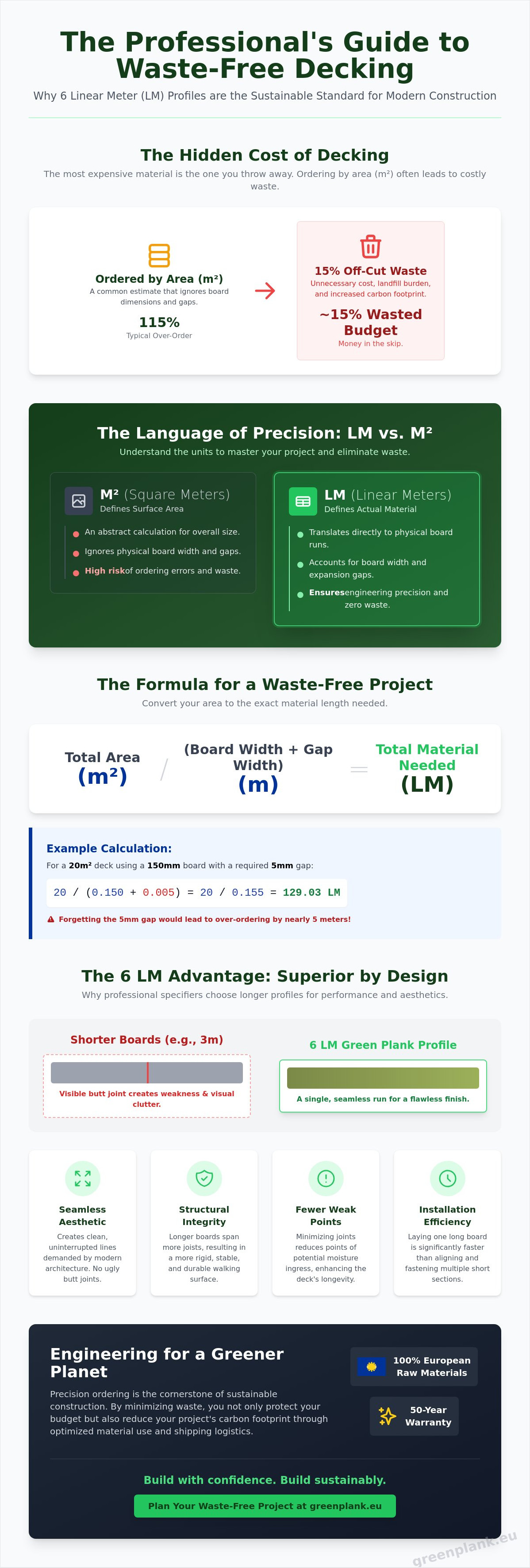
Modern architecture demands clean lines and minimal interruptions. A 6-meter profile provides a seamless run that shorter, 3-meter boards simply cannot match. The benefits of choosing a 6 LM profile extend beyond the visual:
- Structural integrity: Longer boards span more joists, creating a more rigid and stable walking surface.
- Joint reduction: Fewer butt joints mean fewer points of potential moisture ingress and a more uniform surface.
- Installation efficiency: Laying one long board is significantly faster than aligning and fastening multiple short sections.
While the logistics of transporting 6-meter lengths require professional coordination, the long-term performance benefits are undeniable. It's a choice that prioritizes the longevity of the deck over the convenience of the delivery truck.
How to Calculate Linear Meters (LM) for Your Project
Precision in ordering is the most effective way to uphold a commitment to sustainability. While square meter measurements provide a general sense of scale, they don't account for the physical reality of board placement. To achieve a waste-free installation, you must translate your two-dimensional area into a specific total length of material. This process moves beyond estimation and into the realm of professional engineering, ensuring that your project remains both ecologically responsible and financially sound.
The Standard Calculation Formula
Calculating your requirements starts with a simple but vital equation. To find your total linear meters, you must divide the total area by the combined width of the board and the expansion gap. You can determine the total linear meters required for your project by using the formula: Total Area / (Board Width + Gap Width).
Consider a standard 20m2 deck using a 150mm wide composite board. If you factor in a 5mm drainage and expansion gap, the calculation becomes 20 / 0.155. This results in approximately 129 LM of material. Failing to include that 5mm gap might lead to ordering nearly 5 extra meters of board that you simply don't need. This level of accuracy aligns with international sustainable sourcing guidelines by preventing the manufacturing and transport of redundant materials. We generally recommend adding a 5-10% waste margin to this total to account for end-cuts or complex perimeter angles.
Planning Joist Spacing for 6 LM Boards
The substructure of your deck must be designed to complement the length of your surface boards. For private residential projects, we recommend a 600 cc (center-to-center) joist spacing. This specific interval provides the necessary support for our high-density wood-plastic profiles while optimizing the use of structural timber. Utilizing 6 LM boards offers a distinct advantage in this phase of construction:
- Perfect alignment: A 6-meter board spans exactly eleven 600mm joist intervals.
- Support security: Every board end lands precisely on the center of a joist, eliminating the need for complex blocking.
- Structural stability: Fewer butt joints across the deck surface increase the overall lateral rigidity of the system.
When you use 6 LM profiles, you also simplify the creation of staggered patterns. While long boards allow for vast, uninterrupted runs, strategically offsetting the joints ensures the deck remains stable under load. This approach reflects a "Responsible Innovator" mindset, where technical planning enhances the final aesthetic. If you're ready to begin your technical layout, you can view the detailed profile dimensions at greenplank.eu to ensure your calculations are exact.
Linear Meters vs. Square Meters: Why Units Matter for Sustainability
True sustainability isn't just about the material you choose; it's about the precision with which you order it. When you buy by the square meter, you're buying a surface area. When you buy by the linear meter, you're buying a structural component. This distinction is vital for those aiming to reduce their project's environmental impact. Ordering 6 LM profiles allows for a direct correlation between the manufacturing output and the final installation. It eliminates the surplus that often plagues construction sites. It's a more disciplined way to build.
Professional contractors prioritize linear meter measurements for accurate site-level material management. It allows them to account for every joint and every support. Green Plank supports this level of technical rigor by providing exact lengths for large-scale infrastructure projects. This ensures that the material arrives ready for installation, which minimizes the energy spent on site-cutting and disposal. It's a system designed for professionals who value both time and resource efficiency.
The Environmental Cost of Over-Ordering
Every discarded off-cut represents wasted energy, raw materials, and transport emissions. By utilizing precise LM calculations, you support our Cradle to Cradle ownership model. This circular approach ensures that resources remain within the production loop rather than ending up in a skip. Our commitment to 100% EU raw materials further lowers the carbon footprint by reducing the distance materials travel before reaching your site. High-quality manufacturing doesn't just happen; it's the result of ethical sourcing and engineering precision.
Precision ordering also has a significant financial impact. You pay for what you actually install. In large-scale developments, the difference between a square-meter estimate and a linear-meter reality can represent a substantial portion of the budget. Choosing 6-meter profiles reduces the total number of boards required, which simplifies logistics and lowers shipping costs. It's a practical choice that rewards careful planning.
Unit Comparison Table
The width of your chosen profile dictates the total length of material needed to cover your deck area. Wider profiles cover more ground per linear meter, reducing the total length required for the same surface area. This comparison assumes a standard 5mm expansion gap.
| Board Width | Area to Cover | Total Linear Meters (approx.) |
|---|---|---|
| 140 mm | 20 m2 | 138 LM |
| 150 mm | 20 m2 | 129 LM |
| 180 mm | 20 m2 | 108 LM |
Selecting the right profile width is essential for optimizing your 6 LM requirements. Wider boards, such as our commercial infrastructure profiles, offer a faster installation and a more robust aesthetic. They require fewer fasteners and fewer joist connections, which further enhances the sustainability of the build. It's a logical progression: wider boards lead to fewer linear meters, which leads to a more efficient use of resources.
Maximizing Efficiency with 6-Meter Composite Profiles
Efficiency in construction is often measured by the speed of installation and the longevity of the result. When you specify a 6 LM profile, you're choosing a material that excels in both categories. These longer boards allow for vast, uninterrupted runs that define modern architectural aesthetics. By eliminating the frequent breaks required by shorter boards, you create a seamless visual flow that enhances the premium feel of any outdoor space. It's a design choice that prioritizes elegance through simplicity.
The practical advantages of these long profiles are just as compelling. Laying a single 6-meter board is significantly faster than aligning and securing three 2-meter sections. This reduction in labor doesn't just save time; it reduces the margin for human error. To maintain this clean aesthetic, we recommend using our HidLoc™ hidden fastening systems. These clips secure the boards from the side, ensuring a screw-free surface that's safe for bare feet and visually flawless. This combination of long profiles and hidden fasteners represents the pinnacle of contemporary decking technology.
Structural integrity is another key benefit of the 6 LM board. Because a longer board spans more joists, it distributes weight and lateral loads more effectively across the entire substructure. This creates a more rigid deck surface that resists the "bouncing" sensation sometimes found in inferior installations. It's an engineering-first approach that ensures the deck remains stable and secure for decades.
Installation Best Practices for Long Boards
Working with 6-meter WPC boards requires an understanding of material science. All composite materials experience thermal expansion and contraction. When installing these long profiles, it's essential to leave adequate gaps at the ends to allow the boards to breathe. We also emphasize the importance of double-joisting at any butt joints. This provides a dedicated support surface for each board end, preventing sagging and ensuring long-term alignment. For a comprehensive look at framing rules, please consult our Professional Deck Installation Guide.
Commercial Infrastructure and Infrastructure Profiles
In public spaces like piers and boardwalks, durability is non-negotiable. Our Commercial Infrastructure Profiles are engineered with a 75% hardwood fiber and 25% HDPE blend to withstand heavy foot traffic and harsh environmental conditions. Despite their strength, these boards utilize low-density engineering to remain manageable on-site. This makes 6m boards easier for professional teams to handle without specialized heavy lifting equipment. You can explore our full range of high-performance Commercial Infrastructure Profiles to find the right fit for your next large-scale project.
Sustainable Sourcing: Why Green Plank Optimizes for Professional Specs
Professional specifications demand more than just dimensional accuracy. They require a commitment to the entire lifecycle of the material. Green Plank's dedication to 100% EU raw materials ensures that every 6 LM profile meets the highest environmental and manufacturing standards. By sourcing materials within the region, we reduce transport-related CO2 emissions while maintaining total control over the purity of our wood-plastic composite. This ethical foundation provides the reliability that project partners expect from a premium European brand.
Engineering confidence is best expressed through longevity. Our 50-year warranty on residential profiles is a direct result of our material science. Longer profiles face unique physical challenges, including potential thermal movement and structural load distribution. We utilize high-performance HDPE to bind our hardwood fibers, creating a high-density core that resists warping even in 6-meter lengths. This stability is why architects and commercial developers choose our profiles for infrastructure projects that must endure for decades without failure.
Cradle to Cradle: Circular Design in Every Meter
Our "Responsible Innovator" personality is rooted in a Cradle to Cradle ownership model. We don't just sell a product; we manage a resource. This circular design philosophy prioritizes long service life and eventual recyclability. Precise ordering of 6 LM boards aligns perfectly with this goal by ensuring that manufacturing output matches the physical requirements of the site. This level of technical precision is often a prerequisite for modern sustainable building certifications. For a deeper look into our circularity principles, you can explore our Sustainable Building Materials Guide.
Engineered for the European Climate
The European climate presents extreme temperature fluctuations that can compromise inferior materials. We rigorously test our Terra Tuff Composte Decking and Smart System wpc composite decking lines for dimensional stability under these varying conditions. Our proprietary 75/25 hardwood-to-HDPE ratio is the optimal blend for maintaining a straight, true profile over a 6-meter span. This engineering precision prevents the bowing or "snaking" that can occur with lower-quality composites.
While our standard 6-meter lengths satisfy most professional requirements, we also support our commercial project partners with specialized solutions. For large-scale infrastructure developments, we can coordinate custom length requirements to further minimize site waste. This flexibility, combined with our regional manufacturing heritage, makes us the preferred partner for those who refuse to compromise on quality or environmental ethics. It's a partnership based on shared values and engineering excellence.
Precision Planning for a Lifetime of Performance
Mastering the technical nuances of linear meters is more than a simple calculation exercise; it's a commitment to professional craftsmanship. By shifting your focus from vague area estimates to precise 6 LM specifications, you eliminate the environmental and financial costs of over-ordering. This disciplined approach ensures that every profile serves a defined structural purpose. You now have the tools to align joist spacing with board lengths, creating a deck that is as stable as it is beautiful.
Our engineering-led approach provides the necessary foundation for your project's success. We utilize 100% EU raw materials to ensure regional quality and reduced transport emissions. This dedication to material science is backed by our Cradle to Cradle circular ownership model and a warranty of up to 50 years on premium profiles. You're ready to transform your vision into a durable, sustainable reality. Explore our range of high-performance WPC decking profiles to find the perfect match for your next architectural masterpiece. Your investment in quality today secures a maintenance-free outdoor space for the next half-century.
Frequently Asked Questions
What does 6 LM stand for in a decking quote?
6 LM stands for 6 Linear Meters, which indicates the physical length of a single decking profile. In a professional quote, this unit ensures you are ordering the exact length required for your structural layout rather than a generic area estimate. It's the standard metric for builders who prioritize precision and waste reduction in high-end construction. This unit helps align material procurement with the actual board runs on your site plan.
How many linear meters of decking do I need for a 10m2 area?
For a 10m2 area using a 150mm wide board with a 5mm expansion gap, you would need approximately 64.5 linear meters. This calculation is derived by dividing the total area by the effective width of the board including the gap. Always factor in a 5-10% waste margin to account for end-cuts and perimeter detailing. This methodical approach prevents material shortages and ensures your project remains on schedule.
Why is it better to buy 6-meter boards instead of shorter lengths?
Buying 6-meter boards is superior because it minimizes the number of butt joints, creating a seamless and premium aesthetic. Longer profiles also distribute weight more effectively across joists and significantly reduce installation time. By using a single 6 LM board instead of multiple short sections, you improve the structural integrity of the entire deck surface. It's a choice that reflects an engineering-first mindset.
Does board width change the number of linear meters I need to order?
Yes, board width directly impacts your total linear meter requirements. A wider profile covers more surface area per meter, meaning you'll need fewer linear meters to complete the project. For example, switching from a 140mm board to an 180mm board can reduce your total LM requirement by over 20% for the same square meter area. This technical detail is crucial for accurately budgeting materials and managing shipping logistics.
How do I calculate the gap between boards when measuring LM?
You calculate the gap by adding the required expansion distance, typically 5mm, to the physical width of the board before dividing your total area. This effective width ensures your LM order accounts for the space used by drainage and thermal movement. Ignoring this gap often leads to over-ordering material, which contradicts a sustainable, zero-waste building philosophy. Precision here is the hallmark of a responsible craftsman.
Can Green Plank provide custom linear meter lengths for large projects?
Yes, Green Plank coordinates with large-scale commercial infrastructure partners to provide custom linear meter lengths. This bespoke service is designed to minimize site waste and optimize logistics for significant public works like piers or boardwalks. For residential projects, our standard 6-meter profiles typically offer the most efficient balance of performance and handling. We prioritize these specialized solutions for partners who share our commitment to ethical manufacturing.
Is there more waste when working with 6 LM boards?
Working with 6-meter boards actually reduces waste when the joist layout is engineered to match the board length. Because these profiles span more supports, you encounter fewer end-cuts compared to using multiple shorter boards. Precise planning ensures that your 6 LM profiles arrive ready for a near-zero-waste installation, supporting our Cradle to Cradle circularity goals. It's about paying for what you install, not what you throw away.
How do I transport 6-meter composite decking boards safely?
Transporting 6-meter boards requires a professional delivery service with a flatbed vehicle capable of supporting the entire profile length. It's essential to keep the boards flat and evenly supported to prevent temporary bowing or surface damage during transit. Our logistics partners are experienced in handling these long-profile shipments to ensure they arrive in pristine, install-ready condition. Proper handling is the first step in maintaining the material's long-term performance.
Specify the product
Use this guide with a Green Plank specification
Technical articles support the commercial catalogue — category, product, evidence, then samples or quotes.