



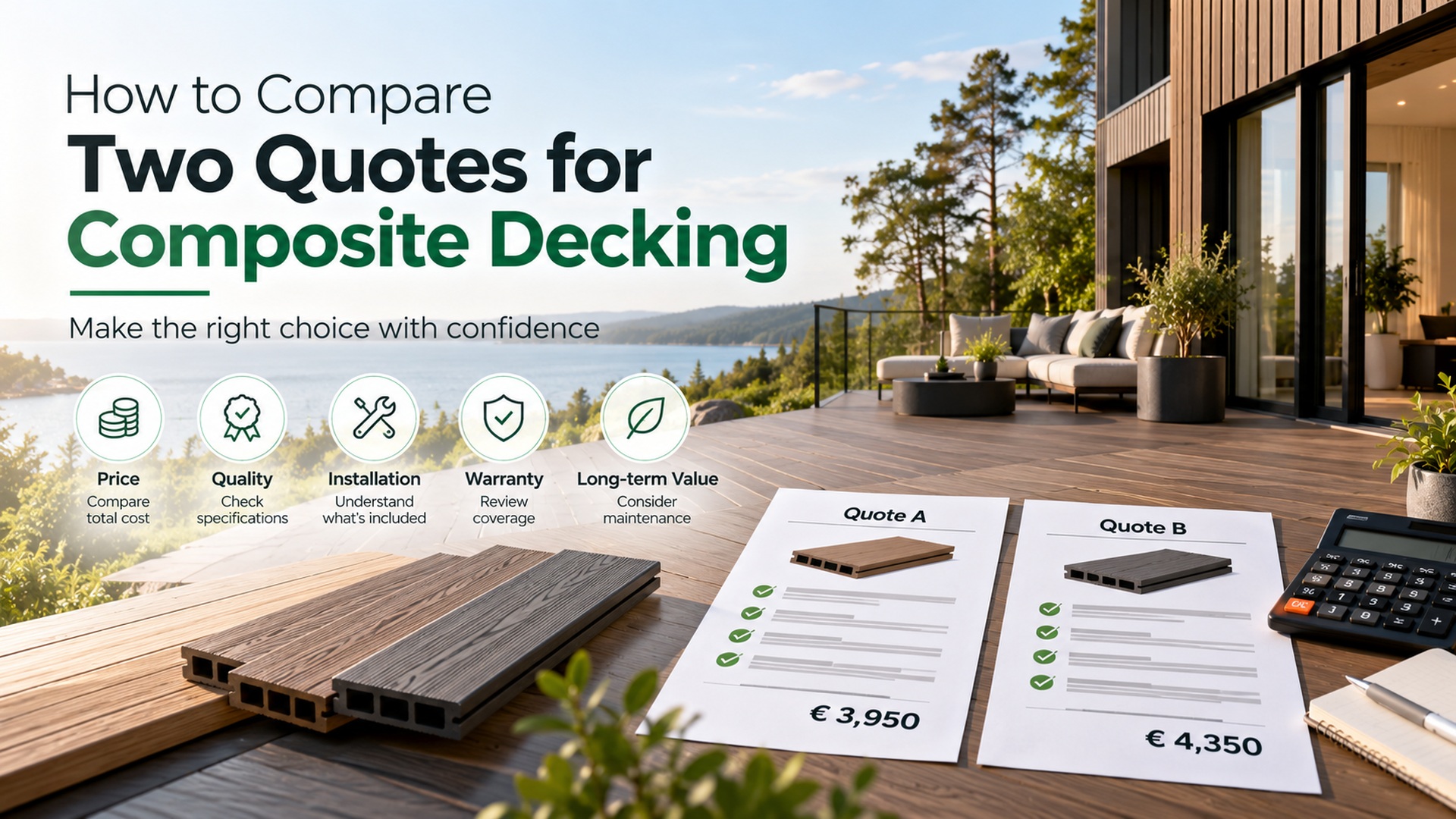
How to Compare Two Quotes for Composite Decking
Two composite decking quotes can look similar at first glance, yet represent very different products, quantities and long-term value. One supplier may quote only the decking boards, while another includes clips, joists, finishing profiles, delivery and installation. Even when both quotations show a price per square metre, the specification behind that number may be completely different.
The best way to compare composite decking quotes is therefore not to ask simply, Which quote is cheaper? Instead ask, What exactly am I receiving for the total price, and how suitable is the complete system for my project?
A lower price per m² does not automatically mean a lower project cost. Compare the complete installed decking system, specification, warranty and expected maintenance before making a decision.
1. Start by Making Both Quotes Comparable
Before comparing prices, confirm that both suppliers are quoting for exactly the same deck area and scope. A 40 m² terrace can require more than 40 m² of boards because cuts, layout, board direction and waste must be considered.
Ask each supplier to clearly state:
- Total deck area in m²
- Board dimensions and lengths
- Total linear metres of decking supplied
- Number of boards
- Recommended board spacing
- Expected cutting or installation waste
- Substructure included or excluded
- Clips, screws and accessories included or excluded
- Delivery included or charged separately
- Installation included or material-only quotation
Once these points are standardised, the quotations become much easier to compare.
2. Do Not Compare Price per m² Alone
Price per square metre is useful, but only when the products and scope are genuinely comparable. Board width, required spacing, profile design and installation system can all affect how much material is required to cover one square metre.
| Comparison point | Quote A | Quote B |
|---|---|---|
| Decking area | Same project area? | Same project area? |
| Board dimensions | Check width, thickness and length | Check width, thickness and length |
| Profile type | Solid, hollow or capped? | Solid, hollow or capped? |
| Accessories | Included? | Included? |
| Substructure | Included? | Included? |
| Delivery | Included? | Included? |
| Installation | Included? | Included? |
| Warranty | What is actually covered? | What is actually covered? |
3. Compare the Decking Board – Not Just the Brand Name
Composite decking is a broad product category. Two boards described as WPC decking may differ considerably in formulation, profile construction, surface technology, weight, dimensions and intended application.
Important questions include:
- What percentage of the board is wood or natural fibre?
- Which polymer is used?
- Is the board capped or uncapped?
- Is the profile solid or hollow?
- Where are the raw materials sourced?
- Where is the decking manufactured?
- Is technical documentation available?
- What joist spacing does the manufacturer permit?
For example, Green Plank offers different decking families for different applications. Premium TerraTuff™ uses a co-extruded protective FortiShield™ surface system, while other Green Plank ranges provide different constructions and price positions. Comparing equivalent product categories is therefore essential.
4. Check What Is Included Under the Deck
The visible boards are only one part of a decking system. The substructure beneath the deck can represent a significant part of both material and installation cost.
A quotation should make clear what type of joists or supporting structure is proposed, the spacing between supports and whether pedestals, rubber pads, foundations or other components are required.
Important comparison
If Quote A includes decking boards, joists, clips, screws and finishing profiles while Quote B includes only boards and clips, comparing the two headline totals gives a misleading result. Add the missing components before deciding which quotation offers better value.
5. Compare the Number of Joists, Clips and Fasteners
Installation requirements can directly influence project cost. A decking system requiring closer joist centres may need more substructure material and potentially more installation time than a system approved for wider spacing in the same application.
Ask suppliers to provide the recommended joist spacing for your intended use rather than assuming that all composite boards use the same installation distances.
The same applies to clips and fasteners. Confirm how many are required per square metre and whether starter clips, end clips, screws and replacement pieces are included.
6. Examine Origin, Traceability and Technical Documentation
For a meaningful product comparison, look beyond colour samples. Ask where the decking is manufactured, where its principal raw materials originate and what technical information supports the product.
Green Plank focuses on European production, European-origin raw materials and material traceability. For customers who value supply-chain transparency and European technical support, these factors can form part of the purchasing decision alongside price and appearance.
Production location alone, however, should never be treated as proof of performance. Products should be evaluated using their actual technical specifications, installation requirements, documentation and warranty conditions.
7. Read the Warranty – Not Just the Number of Years
A large warranty number can attract attention, but the number alone tells only part of the story. Different warranties may cover different defects, applications and periods, and exclusions can vary.
When comparing two quotes, check:
- Whether the warranty applies to residential or commercial use.
- Which defects or performance characteristics are covered.
- Whether coverage changes over time.
- Which installation requirements must be followed.
- Whether labour, replacement material or consequential costs are covered or excluded.
- What documentation must be retained if a claim is made.
Green Plank warranty periods vary by product family, so the current warranty document for the specific product should always be checked rather than assuming that every board carries the same coverage.
8. Compare Maintenance and Life-Cycle Cost
The purchase price is paid once, but maintenance continues throughout the period of ownership. This is why a useful comparison should consider life-cycle cost rather than initial material price alone.
ISO 15686-5 provides guidance on life-cycle costing for buildings and constructed assets. In practical terms, a decking comparison can consider initial materials, installation, routine maintenance, repairs, potential replacement and other relevant costs over the chosen evaluation period.
| Cost category | Questions to ask |
|---|---|
| Initial materials | What is included in the quoted price? |
| Installation | Labour, preparation and substructure included? |
| Maintenance | Cleaning, oiling, staining or painting required? |
| Repairs | How easily can individual boards be replaced? |
| Replacement | What service period is being assumed? |
| Delivery | Transport and unloading included? |
Composite decking generally reduces the need for the recurring painting, staining or oiling associated with maintaining the appearance of many traditional timber decks. It still requires cleaning and appropriate care.
9. Look for Hidden Costs
A quotation that initially appears inexpensive can become less competitive once missing items are added. Before accepting an offer, check for costs that may appear later.
- Freight and unloading
- Extra boards for cutting and waste
- Substructure materials
- Clips and stainless-steel screws
- Starter and finishing accessories
- Edge or fascia boards
- Ground preparation
- Steps and complex detailing
- Removal of an existing deck
- Additional labour for special patterns
10. Compare Samples in Real Conditions
Online photographs are useful for inspiration, but physical samples provide a better impression of colour, surface texture, profile construction and overall feel.
Place samples outdoors and inspect them in daylight, shade and evening light. Consider how the colour works with the house façade, doors, windows and surrounding landscape. A terrace is a large visual surface, so a small difference in colour can have a significant effect on the completed project.
A Simple Composite Decking Quote Scorecard
Before making the final decision, score each quotation using the same criteria. This prevents the lowest headline price from dominating the comparison.
| Criterion | Suggested check |
|---|---|
| Complete project price | Compare like-for-like scope |
| Board specification | Profile, dimensions, formulation and surface |
| Installation system | Joists, spacing, clips and accessories |
| Origin and traceability | Manufacturing and raw-material information |
| Technical documentation | Installation and product data available |
| Warranty | Duration, coverage and exclusions |
| Maintenance | Expected ongoing care |
| Supplier support | Technical and after-sales assistance |
The best-value decking quote is not necessarily the cheapest. It is the quotation that provides the right product, complete system, clear documentation and appropriate long-term performance for the project at a competitive total cost.
Make the Final Decision on Total Value
When two composite decking quotations arrive, first make them comparable. Standardise the area, quantities and scope; compare the actual board specification; identify missing accessories; examine installation requirements; read the warranty; and consider maintenance over time.
A professional quote should make it easy to understand what you are buying, how much material is supplied, how it should be installed and what support stands behind the product.
For Green Plank projects, compare the available decking families according to your application, design requirements and budget before selecting the final system.
Explore Green Plank European composite decking: www.greenplank.eu
Sources
Specify the product
Use this guide with a Green Plank specification
Technical articles support the commercial catalogue — category, product, evidence, then samples or quotes.