



European Composite Cladding & WPC Fencing for Modern Outdoor Architecture
Facades and fencing are no longer simply functional elements. They help define the architecture of a building, create privacy and connect homes, gardens, terraces and commercial outdoor spaces. For these reasons, architects, contractors, retailers and homeowners are increasingly considering composite cladding and WPC fencing alongside traditional materials.
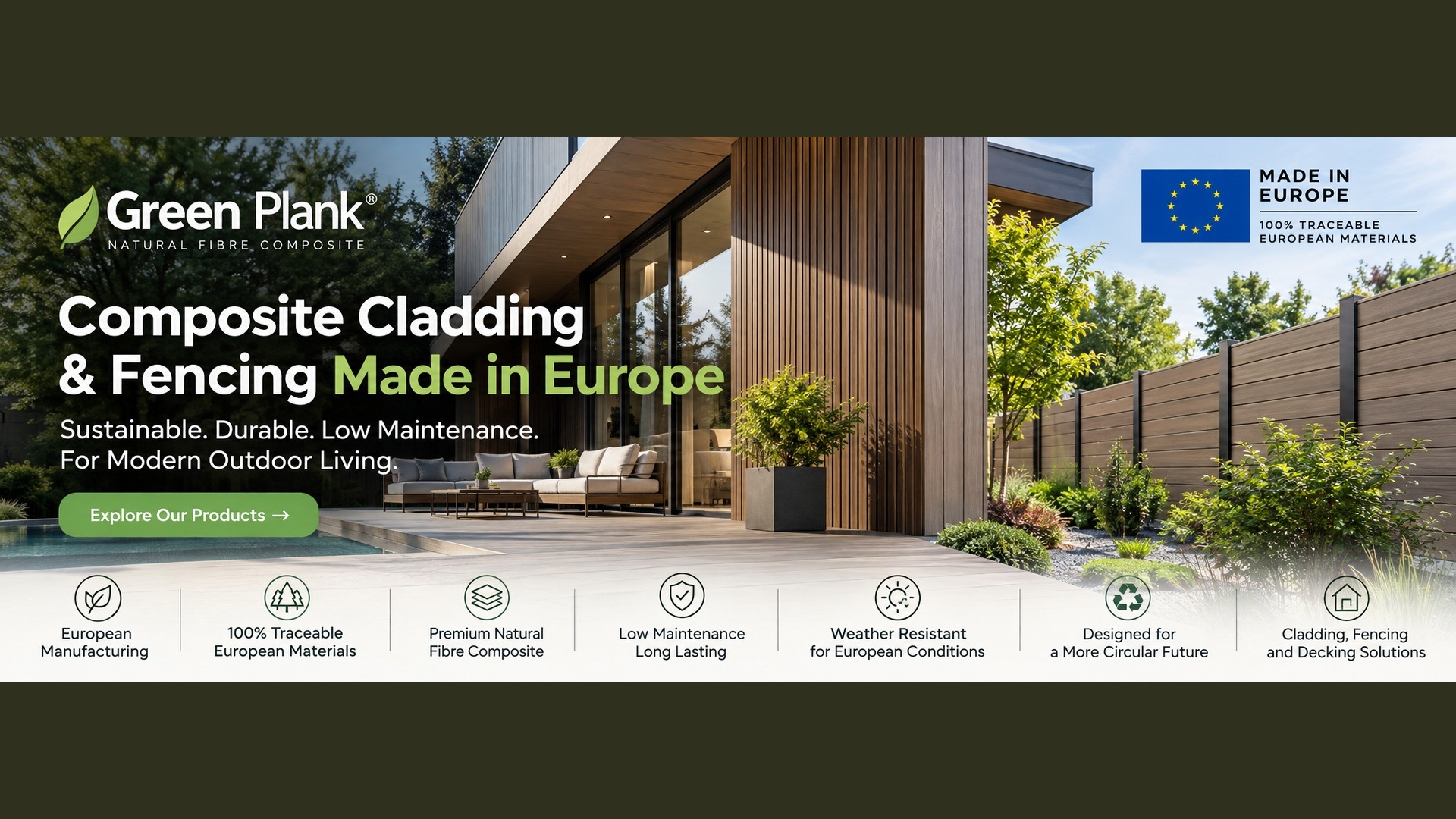
Green Plank is a Swedish brand with European production in Klaipėda, Lithuania. Its product range includes composite solutions for cladding, fencing and decking, with an emphasis on European raw materials, traceability and complete system planning.
A successful composite project starts with more than colour and appearance. Profile design, raw materials, substructure, ventilation, fastening, documentation and installation should be evaluated as one complete system.
What is WPC composite?
WPC stands for Wood Plastic Composite. It is a category of materials combining wood or natural fibres with a thermoplastic polymer and functional additives. There is no single universal WPC formulation: fibre type, polymer, additives, proportions, profile geometry and manufacturing methods can differ considerably between products.
Selected Green Plank products use a high proportion of European hardwood fibres, including beech and oak, combined with HDPE and functional additives. The exact formulation and technical specification should always be checked for the individual product range.
Composite cladding for contemporary facades
Composite facade cladding can create clean architectural lines while introducing a timber-inspired appearance. Ribbed and fluted profiles can add depth, shadow and rhythm to residential and commercial buildings and may be used vertically or horizontally where the specific system permits.
Green Plank offers composite profiles designed for modern facade applications. Their appearance can be combined with render, brick, stone, metal or glass, allowing composite cladding to function as either a primary visual element or an architectural accent.
Think beyond the visible cladding board
A facade is a construction system rather than simply a decorative profile. Substructure, ventilation, moisture management, fastening, corners, joints and finishing details need to be considered for the specific building and intended application.
- Check profile dimensions and construction.
- Specify an appropriate supporting structure.
- Follow product requirements for ventilation and moisture management.
- Use compatible fastening components.
- Plan corners, transitions and finishing profiles in advance.
- Follow the current product-specific installation instructions.
WPC fencing: privacy meets architectural design
Composite fencing can define gardens, terraces, residential developments and commercial outdoor areas. Depending on the system, it can provide substantial visual screening or create a more open architectural boundary.
Green Plank Haven™ is designed as a composite privacy fencing system, while other configurations can support a more open appearance. When comparing fencing solutions, however, the price of the infill boards should never be considered in isolation.
| System component | What should be evaluated? |
|---|---|
| WPC profiles | Profile type, dimensions, surface and system compatibility |
| Posts | Material, dimensions and required spacing |
| Foundation | Ground conditions, fixing method and system requirements |
| Wind exposure | Particularly important for closed privacy fencing |
| Accessories | Rails, connectors, trims and other required components |
| Future supply | Availability of matching profiles and replacement components |
Composite cladding vs. WPC fencing
Although facade cladding and fencing may use related composite technologies, they perform different functions. A cladding profile should not automatically be used as fencing, or vice versa, unless the product is specified for that particular application.
| Factor | Composite cladding | WPC fencing |
|---|---|---|
| Primary purpose | Facade and architectural covering | Boundary and privacy |
| Supporting system | Facade substructure | Posts and foundations |
| Key considerations | Ventilation, moisture and fastening | Wind, post spacing and foundations |
| Design approach | Ribbed, fluted or timber-inspired appearance | Closed privacy or more open configurations |
Why does raw-material origin matter?
For professional buyers, traceability can help establish material origin, product identity and supply-chain information. Green Plank works with European raw materials and manufactures in Europe, creating a regional supply chain for the relevant products.
European origin alone, however, is not proof of higher quality or lower environmental impact. Those conclusions require product-specific technical information and, where environmental comparisons are made, suitable environmental data.
Green Plank in Europe
Swedish brand • Production in Klaipėda, Lithuania • European raw materials • Focus on traceability
For professional specifications, these characteristics should be considered together with current technical documentation for the selected product.
Low maintenance does not mean maintenance-free
Many composite products do not require the same recurring surface treatments with paint, stain or oil associated with many traditional exterior timber applications. This can simplify routine care, but it does not make a composite facade or fence maintenance-free.
Outdoor surfaces can accumulate dirt, pollen and organic deposits. Fasteners, joints, drainage areas and structural components should also be inspected according to the manufacturer's recommendations.
Temperature movement must be considered
Composite profiles respond to changes in temperature. The amount of movement depends on factors including material formulation, profile construction, board length, installation temperature and site conditions.
There is therefore no universal expansion gap that is correct for every WPC product. The same principle applies to supporting distances and fixing details. Current product-specific installation instructions should always take priority over generic rules.
Documentation matters in professional projects
Architects, contractors, merchants and professional buyers should assess more than design and purchase price. Product identification, intended use, technical data, installation instructions and relevant documentation should be reviewed before specification and installation.
The EU Construction Products Regulation provides the European regulatory framework for construction products within its scope. The documentation and regulatory requirements applicable to a particular product depend on its intended use and relevant technical specifications.
Compare the cost of the complete system
The price of a cladding or fencing profile does not necessarily represent the cost of the finished project. A meaningful quotation should include the components and work required to create the complete installed system.
| Cost area | Cladding | Fencing |
|---|---|---|
| Main product | Cladding profiles | Fence boards or panels |
| Supporting structure | Facade substructure | Posts and foundations |
| Accessories | Fasteners, corners and trims | Rails, connectors and trims |
| Installation | Facade installation | Foundation and fence installation |
| Over time | Inspection, cleaning and repairs | Inspection, cleaning and replacement parts |
ISO 15686-5 sets out principles for life-cycle costing of buildings and constructed assets. For buyers, this provides a useful framework for looking beyond the initial purchase price and considering relevant costs over a defined analysis period.
Warranty: compare the conditions, not only the years
Composite product warranties vary by product family, application and warranty terms. Haven™ fencing, for example, may carry a limited residential warranty of up to 25 years depending on the current product and applicable conditions. Professional or commercial applications may be subject to different terms.
A warranty period should not be interpreted as a guaranteed technical service life. Always review the current warranty document and installation requirements for the specific product.
10 questions to ask before selecting cladding or fencing
- What raw materials are used?
- Where is the product manufactured?
- Can the origin of the materials be traced?
- Is the profile intended for the proposed application?
- What substructure or post system is required?
- How should ventilation, moisture or wind loads be addressed?
- How is thermal movement accommodated?
- What technical documentation is available?
- What exactly does the warranty cover?
- Can matching profiles and system components be reordered later?
European production with Scandinavian design thinking
Composite cladding and WPC fencing provide architects, retailers, installers and homeowners with additional ways to create coordinated outdoor environments. Appearance is important, but the profile is only one part of the finished result. Material composition, system design, documentation and correct installation are equally important.
Green Plank combines a Swedish brand background with European manufacturing, European raw materials and traceability across solutions for cladding, fencing and decking. The appropriate product should always be selected according to the technical, architectural and commercial requirements of the individual project.
Conclusion
When selecting European composite cladding and WPC fencing, compare the complete system rather than focusing only on appearance or price per metre. Raw materials, profile construction, substructure, ventilation, foundations, fastening, documentation and warranty all contribute to an informed specification.
This system-based approach provides a stronger basis for selecting Green Plank solutions for homes, gardens, terraces, residential developments and professional building projects.
Sources
- Green Plank – European production and product information
- Green Plank – composite fencing systems
- ISO 15686-5 – Life-cycle costing
- EUR-Lex – Regulation (EU) 2024/3110 on construction products
Specify the product
Use this guide with a Green Plank specification
Technical articles support the commercial catalogue — category, product, evidence, then samples or quotes.