



Modern Composite Cladding and Fencing in Scandinavian Design
Scandinavian architecture is recognised for clean lines, balanced proportions, natural colours and a strong connection between buildings and their surroundings. Today, that design philosophy extends beyond the interior. Façades, terraces, fencing and privacy screens increasingly form one coordinated architectural concept.
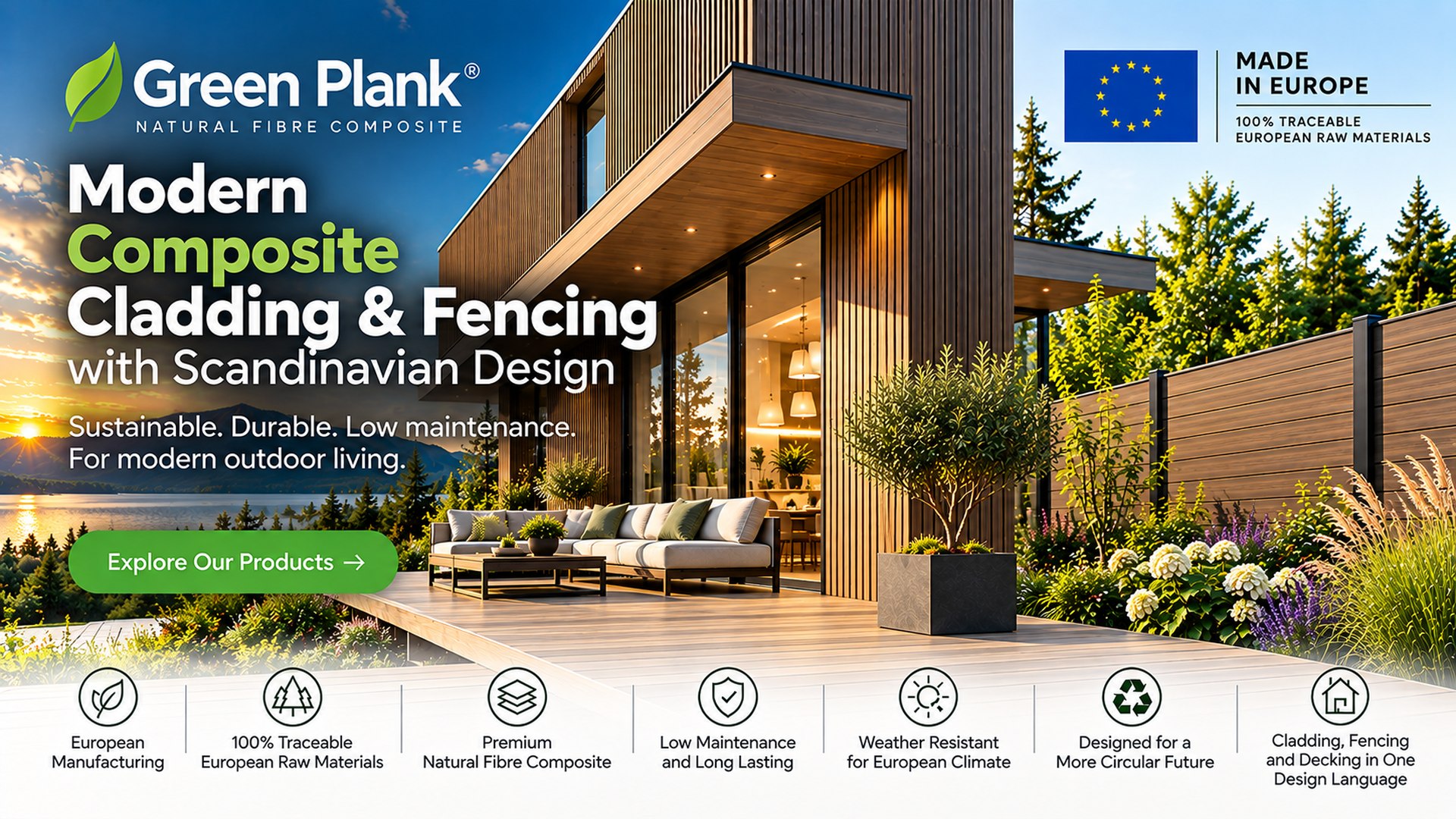
Green Plank® composite cladding and fencing combine this Scandinavian approach with modern WPC technology, European production and a strong focus on material origin and traceability. The result is a contemporary solution for homes and professional projects where appearance, practicality and reduced maintenance are equally important.
Scandinavian design is not simply minimalism. It is about creating harmony between form, function, materials and the surrounding environment.
Creating One Architectural Language from Façade to Garden
A modern building is experienced as a complete composition. The façade, windows, terrace, fencing and landscaping all contribute to its character. Selecting materials that work together can therefore create a more considered and visually coherent property.
Composite materials are particularly interesting for contemporary architecture because profiles can be produced with different textures, dimensions and colours. Designers can create everything from warm timber-inspired façades to sophisticated grey, brown and dark architectural surfaces.
- Clean lines for contemporary architecture
- Natural-looking wood textures and modern colours
- Coordinated cladding, decking and fencing concepts
- Solutions for residential and professional projects
- Reduced need for traditional surface treatments
- European production and traceable material sourcing
What Is Composite Cladding?
Composite cladding is an exterior covering manufactured from composite materials, commonly combining wood fibre with a thermoplastic polymer and functional additives. WPC stands for Wood Plastic Composite.
Not all WPC products are identical. Performance depends on factors including raw-material quality, formulation, profile engineering, manufacturing control and correct installation. These aspects should be considered alongside appearance and purchase price.
Green Plank focuses on a high proportion of European wood fibre in its composite products, together with European-origin raw materials, traceability and manufacturing within the EU.
Why Choose Composite for a Modern Façade?
Natural timber remains an attractive architectural material, but maintaining a particular appearance may require periodic surface treatment depending on timber species, exposure and design requirements.
Modern composite cladding provides an alternative for projects seeking a timber-inspired appearance with less dependence on regular painting, staining or oiling. Routine cleaning and inspection are still important, but ongoing surface treatment requirements can be reduced.
| Design factor | Composite cladding | Traditional timber cladding |
|---|---|---|
| Appearance | Consistent profiles and controlled finishes | Natural variation in grain and colour |
| Surface treatment | Generally no regular painting or oiling | May require treatment depending on timber and desired finish |
| Colour options | Controlled contemporary and timber-inspired colours | Determined by species, ageing and treatment |
| Design flexibility | Ribbed, linear and wood-effect profiles | Traditional natural timber appearance |
| Routine care | Cleaning and periodic inspection | Varies according to timber, coating and exposure |
Scandinavian Design: Simplicity, Rhythm and Natural Colour
A visually strong façade does not need to be complicated. Many successful Scandinavian buildings use repetition, proportion and a carefully limited palette of materials to create architectural character.
Vertical Cladding for Height and Definition
Vertical composite profiles can emphasise the height of a building while creating a clean contemporary appearance. Narrow ribs and shadow lines can add depth as daylight moves across the façade.
Horizontal Lines for a Calm Architectural Expression
Horizontal cladding can visually extend a building and reinforce its proportions. This approach works particularly well on low-profile modern homes where strong horizontal lines are already part of the architecture.
Natural Colours Connect Building and Landscape
Grey, charcoal, brown and warm timber-inspired shades combine naturally with glass, stone, concrete, metal and rendered façades. Repeating related colours across cladding, decking and fencing can create a unified outdoor environment.
A Simple Scandinavian Design Principle
Start with the primary material and colour of the building. Then use cladding, decking and fencing to create either a calm tone-on-tone palette or one controlled contrast. A smaller number of carefully coordinated materials often creates a stronger architectural identity.
Composite Fencing as Part of the Architecture
Fencing is no longer simply a boundary around a property. In modern landscape design, fencing and privacy screens can define outdoor rooms, provide privacy and visually connect the house with the garden.
Green Plank Haven™ composite fencing is designed for contemporary screening applications and can complement composite decking and modern exterior materials.
- Contemporary privacy screening for gardens and terraces
- Clean lines suited to Scandinavian architecture
- Coordinated appearance with composite decking and cladding
- Reduced need for traditional painting or oiling
- Suitable for new-build and renovation projects
Three Ideas for a Coordinated Scandinavian Exterior
- Nordic minimalism: Combine grey composite cladding with dark window frames, a slightly warmer grey terrace and matching fencing for a calm, contemporary exterior.
- Warm timber character: Pair brown or oak-inspired composite profiles with black metal and large glazed areas. The contrast between warm and cool materials creates architectural depth.
- Modern contrast: Use a light primary façade with dark composite cladding on selected sections, then repeat the darker tone in fencing or privacy screens.
European Production and Material Traceability
Design is only one part of choosing an exterior building product. For architects, contractors, distributors and increasingly homeowners, understanding where a product is manufactured and where its raw materials originate can also influence specification decisions.
Green Plank positions its composite solutions around EU manufacturing, European-origin raw materials and traceability. This provides greater transparency for customers who want to understand the supply chain behind the finished product.
| Question to Ask | Why It Matters |
|---|---|
| Where is the product manufactured? | Provides greater supply-chain transparency |
| Where do the raw materials originate? | Clarifies material sourcing |
| Are the materials traceable? | Supports documentation and quality control |
| Is technical documentation available? | Supports specification and correct application |
| What installation system is required? | Helps plan ventilation, fixing and movement allowances |
European Composite vs Overseas Alternatives
Manufacturing location alone does not determine product quality. High-quality composite products can be produced in different parts of the world. A professional comparison should therefore go beyond country of origin or the initial price per square metre.
Consider the complete specification: material formulation, raw-material origin, profile construction, traceability, technical documentation, manufacturing quality control, warranty conditions and access to support.
For European projects, regional manufacturing can additionally offer practical advantages such as a closer connection between manufacturer and market and a more transparent European supply chain.
Low Maintenance Does Not Mean No Maintenance
Composite cladding and fencing are frequently selected because they can reduce the need for traditional surface treatments. However, every exterior building material remains exposed to dust, pollen, organic deposits and changing weather conditions.
Periodic cleaning and inspection are therefore recommended. Drainage and ventilation should remain unobstructed, and any project-specific maintenance instructions should be followed.
Good exterior design considers the whole life of the building. Appearance, maintenance, installation, documentation and material origin should all be evaluated before specification.
Correct Installation Is Essential
Even a premium composite profile requires correct installation. Substructure design, ventilation, drainage, fixing points and expansion allowances must follow the requirements of the specific cladding or fencing system.
For fencing, posts, foundations, local conditions and expected wind loads must also be considered. The current installation instructions for the selected Green Plank system should always be consulted before construction begins.
Traceability and Digital Product Information
European construction policy is moving toward more structured and digital product information. The EU Construction Products Regulation, Regulation (EU) 2024/3110, provides a framework that includes the digitalisation of construction-product information and digital product passports.
This direction makes product documentation, material information and traceability increasingly relevant to manufacturers, architects, contractors, distributors and professional purchasers across Europe.
Scandinavian Design Meets Modern Composite Technology
Green Plank composite cladding and fencing offer architects, homeowners and developers an opportunity to create contemporary outdoor environments where façades, terraces and screening work together as one architectural concept.
By combining Scandinavian design with European manufacturing, European-origin raw materials, traceability and modern composite technology, Green Plank provides an alternative for projects where both appearance and practical long-term ownership matter.
Explore Green Plank composite solutions for modern architecture: www.greenplank.eu
Sources
Specify the product
Use this guide with a Green Plank specification
Technical articles support the commercial catalogue — category, product, evidence, then samples or quotes.