



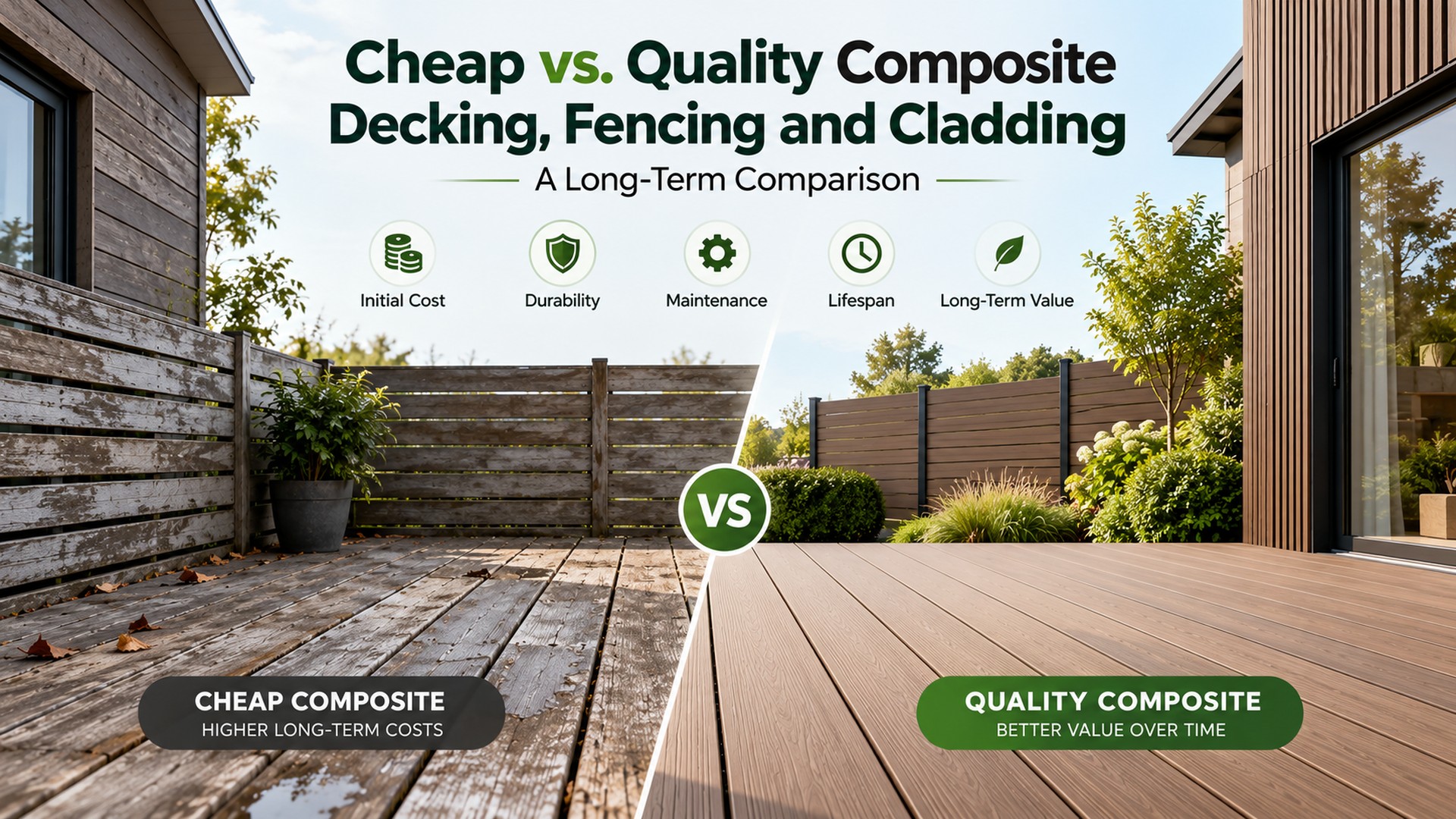
Cheap vs Quality Composite Decking, Fencing and Cladding: A Long-Term Comparison
At first glance, two composite products can look remarkably similar. The colour may be almost identical, the surface may imitate timber, and both may be marketed as WPC. Yet the differences behind the visible surface can be substantial. Raw materials, formulation, profile engineering, surface construction, manufacturing control, installation requirements, documentation and warranty all influence what you are actually buying.
This is particularly important when comparing composite decking, fencing and facade cladding. The lowest purchase price may be appropriate for some projects, while a more fully specified product may offer advantages where documentation, traceability, system compatibility and long-term planning matter.
Price is only the starting point. A meaningful comparison looks at the complete installed system and the costs, requirements and risks associated with using it over the intended analysis period.
Why Do Composite Product Prices Vary So Much?
WPC, or Wood Plastic Composite, is a category rather than a single material recipe. Products can contain different natural fibres, polymers and additives, while manufacturers can use very different profile geometries and production technologies.
A lower price does not automatically indicate poor quality, just as a premium price does not prove superior performance. Buyers should instead investigate what creates the price difference.
| Comparison point | Budget-focused product | More fully specified product |
|---|---|---|
| Raw materials | Origin or composition may be less detailed | Composition and sourcing may be documented |
| Profile design | Often selected primarily around price | Selected around application and system requirements |
| Surface | Standard composite surface may be used | May include advanced or co-extruded surfaces |
| Documentation | Check availability carefully | Technical and installation information should be clearly available |
| Warranty | May be shorter or more restricted | May offer longer coverage subject to conditions |
1. Start with the Raw Materials
One of the first questions should be simple: what is the product actually made from? Composite quality cannot be judged from wood-fibre percentage alone. Fibre type, polymer quality, additives, formulation consistency and manufacturing control all contribute to the finished product.
Selected Green Plank products use a high proportion of European hardwood fibres, including beech and oak, combined with HDPE and functional additives. Green Plank also works with European raw materials and traceability across its supply chain. Exact formulations should always be confirmed for the individual product.
A practical purchasing rule
Do not compare samples only by colour and texture. Ask for material composition, profile dimensions, raw-material origin, technical information, installation instructions, warranty conditions and compatible system components.
2. Decking: Compare More Than the Board Price
Composite decking is often advertised by linear metre, but this can make products with different widths difficult to compare. A better starting point is the amount of material required for one finished square metre.
For illustration, a 150 mm board installed with an assumed 5 mm joint has an effective coverage width of 155 mm. Approximately 6.45 linear metres are therefore required per square metre. This is a calculation example only; actual installation gaps must follow the product-specific instructions.
The complete decking cost can include:
- Decking boards and cutting waste.
- Substructure and supports.
- Clips, screws and starting fasteners.
- Edge and finishing profiles.
- Transport and handling.
- Installation labour.
- Cleaning and planned maintenance.
3. Hollow, Solid and Capped Decking Are Not the Same
Profile construction is another reason for significant price differences. Hollow, solid and capped or co-extruded boards represent different engineering approaches. None should automatically be labelled superior without considering the intended application.
Hollow profiles
A well-designed hollow profile can be an efficient solution for many residential applications. Wall thickness, internal geometry and support requirements should be checked rather than assuming that all hollow boards perform alike.
Solid profiles
Solid composite boards have a continuous composite core. Their suitability still depends on profile design, installation requirements and the loads associated with the project.
Capped and co-extruded profiles
Co-extruded boards add a separate surface layer around the composite core. Green Plank TerraTuff™ uses this type of construction. When comparing capped products, buyers should examine both the protective layer and the underlying core rather than relying on the word capped alone.
4. Composite Fencing: The Board Is Only Part of the System
With fencing, concentrating only on the price of individual boards can be particularly misleading. Posts, foundations, rails, reinforcement, connectors, finishing components and installation all contribute to the completed fence.
A privacy fence and an open horizontal fence also perform different functions. Green Plank Haven™ is designed around a closed privacy concept, while other systems can create a more open architectural expression.
| Fencing factor | Why it matters |
|---|---|
| Board construction | Affects system design and installation requirements |
| Posts | Provide the primary structural support |
| Foundations | Must suit site conditions and system requirements |
| Wind exposure | Especially important for closed privacy fencing |
| Replacement parts | Relevant when maintaining a consistent system over time |
5. Composite Cladding Requires a System Approach
Facade cladding should never be selected only because the profile looks attractive. Substructure, ventilation, moisture management, fixings, corners, openings and applicable building requirements are fundamental parts of facade design.
Premium-looking and inexpensive cladding can appear similar in a small sample. A professional comparison should therefore consider profile geometry, surface construction, dimensional requirements, technical documentation and installation details.
Green Plank offers composite facade solutions including fluted architectural profiles. These can create strong vertical or horizontal lines and work with materials such as brick, render, glass, metal and stone. The appropriate product should always be selected according to the actual building application.
6. Installation Can Matter More Than the Price Difference
A high-specification composite product can still underperform if it is installed incorrectly. Decking requires suitable support, drainage and ventilation; fencing requires properly designed posts and foundations; cladding requires a correctly designed facade build-up.
Composite materials also respond to temperature changes. There is no single universal expansion gap or support spacing suitable for every WPC product. Profile geometry, board length, installation temperature and intended use all matter.
- Identify the exact product and intended application.
- Read the current technical and installation documentation.
- Design the supporting structure for the selected system.
- Plan drainage and ventilation where required.
- Use compatible fixings and accessories.
- Allow for product-specific thermal movement.
- Check applicable local building and structural requirements.
7. Maintenance: Low Maintenance Is Not No Maintenance
Composite outdoor products can reduce the need for recurring surface treatments such as painting, staining or oiling associated with many traditional timber applications. However, describing WPC as completely maintenance-free can be misleading.
Decking still needs cleaning, drainage channels should remain clear, fencing should be inspected, and facade systems should be maintained according to the manufacturer's instructions. When comparing products, ask for the actual maintenance recommendations rather than relying on a general marketing claim.
8. Warranty: Read the Conditions, Not Just the Number
A 20-, 25- or 50-year headline can look impressive, but warranty periods are meaningful only when the terms are understood. Coverage may differ according to product, installation, residential or commercial application and the type of claim.
Green Plank warranties vary by product family. Selected TerraTuff™ decking products, for example, can carry limited residential warranty coverage of up to 50 years, depending on the product and applicable terms. Haven™ fencing can carry residential coverage of up to 25 years. Other ranges have different conditions.
A warranty period should also not be interpreted as a guaranteed technical service life. Always review the current warranty document for the specific product.
9. Documentation and Traceability Have Long-Term Value
Documentation becomes increasingly important for distributors, architects, contractors and professional projects. Knowing the product identity, material origin, installation method and applicable technical information can simplify specification, project handover and future reordering.
Green Plank combines European manufacturing with European raw materials and traceability. Traceability improves transparency, but it should not be confused with proof of lower environmental impact. Carbon or broader environmental comparisons require appropriate product-specific evidence.
10. Compare Lifecycle Cost, Not Only Purchase Price
The cheapest product on day one is not necessarily the lowest-cost product over the chosen analysis period. Equally, an expensive product is not automatically more economical. A structured lifecycle comparison helps avoid both assumptions.
ISO 15686-5 provides principles for life-cycle costing of buildings and constructed assets. A simplified project comparison can consider:
Purchase + accessories + installation + maintenance + repairs + replacements + relevant end-of-life costs.
| Cost category | Decking | Fencing | Cladding |
|---|---|---|---|
| Main product | Boards | Boards/panels | Profiles/panels |
| Supporting system | Joists/supports | Posts/foundations | Facade substructure |
| Accessories | Clips/screws | Rails/connectors | Fixings/trims |
| Future costs | Care/repairs | Care/parts | Inspection/care |
When Can a Cheaper Composite Product Make Sense?
A budget product can be perfectly rational when it is suitable for the application, properly documented and installed according to its requirements. A small residential project with straightforward specifications may have very different priorities from a commercial facade, public terrace or large fencing development.
The objective should therefore not be to buy the most expensive product. It should be to avoid paying for characteristics you do not need while ensuring that the system meets the requirements you do have.
10 Questions Before Choosing Composite Products
- What is the product made from?
- Where are the main raw materials sourced?
- Where is the product manufactured?
- What profile and surface construction is used?
- What supporting structure is required?
- What does the complete installed system cost?
- What technical documentation is available?
- What maintenance is actually required?
- What exactly does the warranty cover?
- Can matching products and components be reordered later?
Green Plank: European Composite Systems
Green Plank is a Swedish brand with European production in Klaipėda, Lithuania. Its portfolio includes composite decking, facade cladding and fencing manufactured using European raw materials, with traceability as an important part of the product proposition.
European origin alone does not prove better performance. Green Plank products, like competing products, should be evaluated using the same criteria: material composition, profile engineering, documentation, installation requirements, warranty, availability and total system cost.
Conclusion
The real difference between cheap and quality composite decking, fencing and cladding cannot be found on the price tag alone. A better comparison looks beneath the surface at raw materials, construction, system components, documentation, installation, maintenance and warranty.
For homeowners and professional buyers alike, the strongest purchasing decision is usually based on the complete installed system and its cost over the intended period of use rather than the lowest price per board or linear metre.
Sources
- Green Plank – European composite products and company information
- Green Plank – Composite fencing systems
- ISO 15686-5 – Life-cycle costing
- EUR-Lex – Construction Products Regulation (EU) 2024/3110
Specify the product
Use this guide with a Green Plank specification
Technical articles support the commercial catalogue — category, product, evidence, then samples or quotes.