



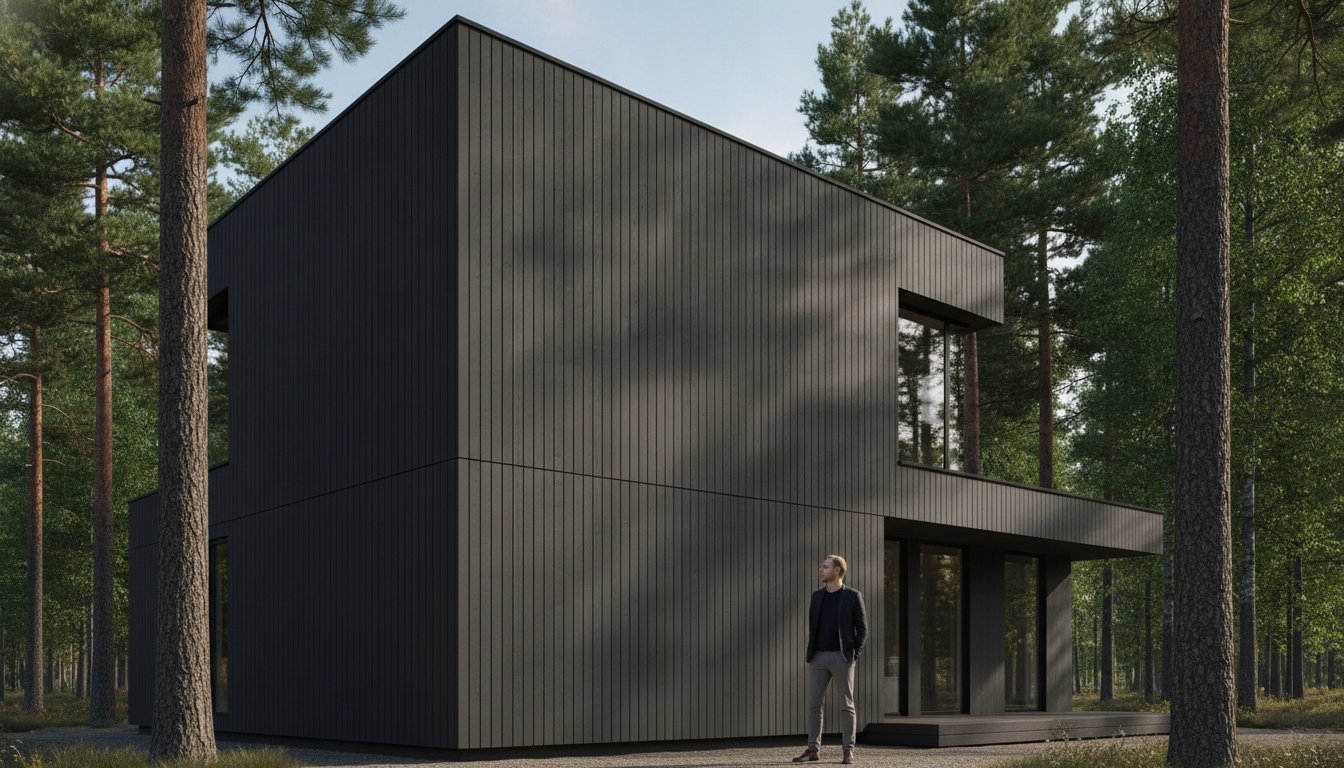
By July 1, 2026, the standard for Swedish facades will no longer be defined by aesthetic charm alone, but by the rigorous performance mandates of the new Boverket building regulations. For architects and developers, the era of repainting rotting timber or replacing warped imports is ending. Choosing a specialized wpc cladding manufacturer Sweden is now a strategic necessity for those who require both architectural elegance and technical compliance. We understand that a facade is a structural investment that must withstand extreme UV fluctuations and moisture without losing its integrity.
In this article, you'll discover why European-engineered WPC cladding is the definitive choice for projects requiring 50-year durability and circular sustainability. We'll detail the material science behind our 75% hardwood fiber composition and explain how these systems align with the 2026 EU Energy Performance of Buildings Directive. From the precision of HidLoc™ hidden fastening systems to the environmental ethics of cradle-to-cradle ownership, we're outlining the future of the Swedish building envelope.
Key Takeaways
- Learn why a composition of 75% hardwood fiber provides the structural stiffness and natural wood aesthetic necessary for the demanding Swedish climate.
- Understand the technical criteria for selecting a reliable wpc cladding manufacturer Sweden to ensure compliance with the upcoming 2026 Boverket building regulations.
- Compare the long-term lifecycle costs of European-engineered composite against traditional timber, focusing on the elimination of painting and fungal decay.
- Discover how the HidLoc™ hidden fastening system achieves a seamless, screw-free finish while accommodating thermal expansion in outdoor wall cladding.
- Explore the commitment to circular sustainability through 100% EU raw materials and a 50-year service life warranty.
Table of Contents
- What Defines a Premium WPC Cladding Manufacturer in Sweden?
- Engineering for Longevity: The Science of 75% Hardwood Fiber
- WPC vs. Traditional Wood: A Lifecycle Comparison for Swedish Projects
- Installation Excellence: HidLoc™ and Smart System Integration
- Partnering with Green Plank: The Future of WPC in Sweden
What Defines a Premium WPC Cladding Manufacturer in Sweden?
Swedish architecture demands resilience. As we move toward the 2026 regulatory updates, the selection of facade materials has become a question of engineering as much as aesthetics. A premium What is WPC (Wood-Plastic Composite)? is not merely a plastic alternative; it's a sophisticated architectural solution. Selecting a specialized wpc cladding manufacturer Sweden allows developers to access products specifically tuned for the high-moisture and low-temperature cycles of the North. These systems provide the warmth of natural timber without the inherent vulnerabilities of organic wood.
We focus on 100% EU raw materials to ensure regional reliability. This local sourcing strategy provides a transparent supply chain and significantly reduces the CO2 footprint of your construction project. Many generic imports use low-density fillers that fail under Swedish snow loads or warp during the spring thaw. In contrast, a premium wpc cladding manufacturer Sweden utilizes high-density HDPE and refined hardwood fibers to create a board that is as heavy and durable as it is beautiful. By functioning as a "Responsible Innovator," we provide solutions that respect the environment while offering the engineering precision required for a 50-year service life.
The Evolution of Exterior Facades in Northern Europe
The shift from traditional timber to advanced composites is driven by necessity. Natural wood facades in Sweden face constant threats from moisture, mould, and fungal decay. By 2026, the industry is prioritizing maintenance-free building envelopes that eliminate the need for toxic paints and stains. High-performance WPC cladding is a key component in securing BREEAM and LEED certifications. It supports circular sustainability through a long service life and cradle-to-cradle ownership, ensuring that the materials used today don't become the waste of tomorrow.
Key Performance Indicators for Swedish WPC
Success in the Scandinavian climate requires meeting specific technical thresholds. Our manufacturing process focuses on three primary indicators:
- Low thermal expansion: Our engineering ensures stability during rapid temperature fluctuations, preventing the buckling seen in low-grade composites.
- Advanced UV stability: Integrated pigments protect against the "grey-out" effect, maintaining the facade's deep, natural tones for decades without treatment.
- High-density structural integrity: Each profile is designed to withstand the physical demands of commercial environments. This density prevents moisture absorption, which is the primary cause of internal rot in traditional materials.
By prioritizing these indicators, we ensure that every facade remains a permanent asset rather than a maintenance liability. The result is a beautiful, sustainable exterior that honors its natural surroundings while outperforming traditional wood in every measurable category.
Engineering for Longevity: The Science of 75% Hardwood Fiber
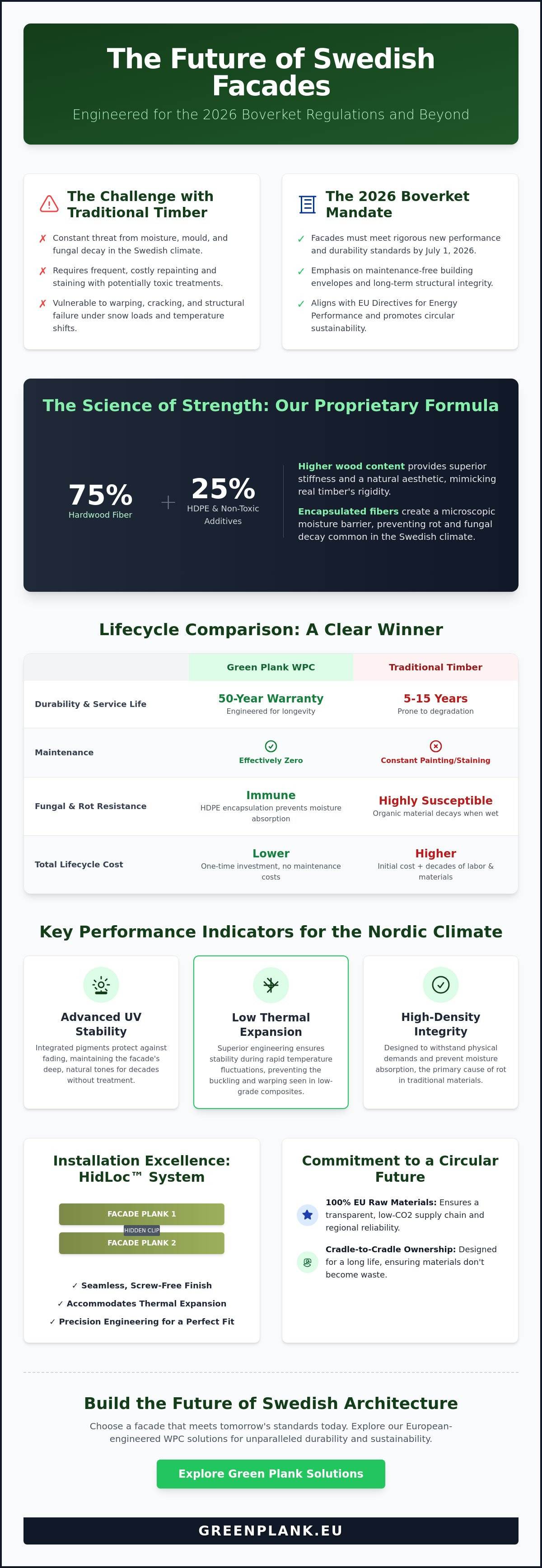
The durability of a facade depends on the precision of its molecular bond. As a leading wpc cladding manufacturer Sweden, we don't settle for the industry-standard wood ratios often found in mass-market imports. Our proprietary formula utilizes 75% hardwood fiber balanced with 25% high-density polyethylene (HDPE) and non-toxic additives. This specific ratio isn't accidental; it's an engineering choice designed to provide the superior stiffness and structural integrity required for large-scale architectural projects. By prioritizing a higher wood content, we achieve a material that behaves more like natural timber in its rigidity but outperforms it in every environmental metric.
While the hardwood fibers deliver the warmth and tactile feel of natural wood, the HDPE component acts as a vital moisture barrier. It encapsulates the wood fibers at a microscopic level, preventing the internal rot and fungal decay that plague traditional cedar or larch facades in the humid Swedish climate. We've mastered the creation of low-density profiles that reduce the load on the building's sub-structure without sacrificing structural strength. This engineering balance ensures that the material remains lightweight for installers while providing a service life of up to 50 years.
Material Composition and Environmental Impact
Quality begins with the source. By utilizing 100% EU raw materials, we maintain total control over the purity and performance of our composite. This localized supply chain does more than just ensure quality; it significantly reduces the CO2 footprint of every square meter produced. Our Cradle to Cradle ownership model represents the definitive future of circular construction by treating our products as technical nutrients that can be recaptured and reused. It's a commitment to a waste-free building cycle that respects our regional heritage.
Aesthetic Versatility: From Natural Wood Grain to Modern Slat Walls
Architecture is a visual language. Our manufacturing process allows for immense versatility, ranging from deep, embossed wood grains to the sharp, clean lines of modern slat walls. For commercial facades, consistency is paramount. We use advanced batch-blending technology to ensure that the color and texture stay uniform across thousands of square meters. Whether you're designing a private villa or a sprawling civic center, our profiles offer a premium finish that never requires the high maintenance costs of repainting or oiling. If you're planning a project for the 2026 building cycle, you can explore our architectural composite profiles to find the perfect match for your design vision.
WPC vs. Traditional Wood: A Lifecycle Comparison for Swedish Projects
Choosing between traditional timber and advanced composites is a decision that defines the long-term financial and structural health of a building. While wood has been the historical standard in Scandinavia, its organic nature presents significant challenges in our climate. Selecting a specialized wpc cladding manufacturer Sweden allows developers to move away from materials that begin to degrade the moment they're installed. A 50-year lifecycle analysis reveals that the higher initial investment in premium WPC is quickly offset by the elimination of recurring maintenance costs and the prevention of structural failure.
Engineering for the Swedish environment means addressing the specific threats of moisture and biological decay. Traditional wood facades are highly susceptible to pests, mould, and fungal growth, particularly in humid coastal regions like Gothenburg or the Stockholm archipelago. Our composite profiles are engineered to be inert. They don't provide a food source for insects or fungi, ensuring the facade remains as sound in year fifty as it was on day one. This biological resistance is paired with rigorous fire safety standards. Our products are designed to meet stringent Swedish building codes, providing the necessary flame retardancy for both residential and high-density commercial applications.
The Real Cost of Maintenance
The true expense of a facade is found in its upkeep. Traditional wood requires sanding, staining, and sealing approximately every three years to maintain its appearance and water resistance. Over a 50-year period, this translates to sixteen separate maintenance cycles, each involving significant labor and material costs. Choosing composite wall cladding offers a superior ROI for property managers by effectively eliminating these expenses. It's a "fit and forget" solution that's particularly valuable for public infrastructure, where ongoing maintenance budgets are often constrained.
Durability in Extreme Weather
Sweden's climate demands materials that can handle rapid transitions between freezing and thawing. Our manufacturing process ensures that the cladding remains stable in sub-zero temperatures, avoiding the brittle failure common in low-grade plastic alternatives. We also prioritize environmental resilience in several key areas:
- Saltwater resistance: Ideal for coastal developments and public piers where salt spray would quickly corrode or rot traditional materials.
- Impact resistance: High-density profiles protect facades from mechanical damage in high-traffic urban areas.
- UV protection: Advanced pigments ensure the color doesn't fade under the intense summer sun, maintaining the building's aesthetic value without repainting.
By partnering with a dedicated wpc cladding manufacturer Sweden, you're investing in a building envelope that respects both the environment and the project's bottom line. The result is a facade that requires no toxic chemicals for preservation and remains a permanent, beautiful asset for decades.
Installation Excellence: HidLoc™ and Smart System Integration
The integrity of a building envelope is defined by the precision of its assembly. As a specialized wpc cladding manufacturer Sweden, we recognize that high-performance materials require equally sophisticated installation systems. A facade is a dynamic structure that must breathe, expand, and contract in response to the Scandinavian climate. To facilitate this, we provide dedicated Commercial Infrastructure Profiles that serve as the essential backbone for any professional cladding project. These sub-frame components ensure that the vertical alignment remains perfect over a 50-year service life while providing the necessary structural support for high-rise applications.
Achieving a seamless architectural finish requires moving beyond traditional face-screwing methods. Our HidLoc™ Hidden Fastening Systems eliminate visible fixings, allowing the natural aesthetic of the composite to remain uninterrupted. This system is not merely for visual appeal; it is a critical engineering feature. The clips allow for the natural thermal expansion and contraction of the boards, preventing the buckling and warping that often occur when materials are rigidly fixed. By utilizing this system, developers can significantly reduce installation time on large-scale commercial facades while ensuring a flawless, screw-free result that meets the highest design standards.
The HidLoc™ Advantage
The HidLoc™ system provides a reliable solution for the thermal movement inherent in all composite materials. By securing the boards from the side rather than through the face, the system maintains the integrity of the moisture barrier within the HDPE-encapsulated fibers. This method also creates consistent spacing between boards, which is vital for aesthetic uniformity across expansive wall surfaces. It represents our "Responsible Innovator" approach, where technical efficiency directly supports long-term structural health.
Smart System and Terra Tuff Profiles
Selecting the appropriate profile is essential for meeting specific project demands. Our Smart System wpc composite decking and cladding lines feature interlocking slats that provide a sharp, modern aesthetic ideal for contemporary urban architecture. For projects requiring extreme durability, the Terra Tuff Composte Decking and cladding profiles offer enhanced impact resistance and a more traditional board width. These profiles are engineered with wind load and weight considerations at the forefront, making them suitable for exposed locations where environmental pressure is highest.
Success in vertical cladding depends on proper moisture management. Installers must prioritize a rear-ventilated cavity to ensure that drainage and airflow remain unobstructed. While many of the core principles found in our deck installation guide are applicable here, vertical facades require specific attention to gravity-fed drainage paths. Ensuring a 20mm to 30mm ventilation gap behind the WPC panels prevents moisture buildup against the building's primary insulation layer. If you're planning a complex architectural project, you can download our full technical installation manuals to ensure your facade meets every performance benchmark for the 2026 building cycle.
Partnering with Green Plank: The Future of WPC in Sweden
Leading Swedish developers require more than just a material supplier; they need a partner who understands the local regulatory horizon and the specific demands of the Nordic environment. Choosing a wpc cladding manufacturer Sweden with established roots ensures that your project is backed by regional expertise and a transparent European supply chain. We eliminate the logistical and quality risks associated with distant imports by providing 100% EU raw materials. This localized approach translates to faster delivery times, ethical manufacturing standards, and a significantly reduced CO2 footprint. Our commitment is solidified by a 50-year service life warranty, providing the engineering confidence that vague, short-term guarantees from competitors cannot match.
A partnership with us is an investment in long-term reliability. We don't just deliver boards; we provide a comprehensive facade system designed to outperform traditional timber in every metric. By maintaining a high-end, professional standard in our manufacturing, we ensure that every profile meets the aesthetic expectations of premium architectural designs. Our role as a "Responsible Innovator" means we're constantly refining our material science to meet the shifting needs of the Swedish construction industry, ensuring your projects remain compliant with the 2026 building regulations.
Sustainability as a Core Value
Our approach to circular design is a fundamental pillar of our manufacturing philosophy. We manage technical nutrients through our Cradle to Cradle ownership model, ensuring that every board contributes to a waste-free building cycle. This strategy helps you meet the zero-emission mandates of the upcoming EU Energy Performance of Buildings Directive. We've optimized our material science to reduce density while maintaining structural strength, allowing for a lower environmental impact without compromising on the facade's 50-year longevity.
Commercial Infrastructure and Project Support
Beyond residential applications, we specialize in high-performance Commercial Infrastructure Profiles designed for the most demanding public environments. Our systems are the preferred choice for public piers, coastal boardwalks, and urban facades where durability is non-negotiable. We provide comprehensive technical consultation for architects and specifiers, ensuring that every detail is addressed during the planning phase. Whether you're specifying Smart System wpc composite decking or high-density Terra Tuff profiles, our team provides the documentation required for modern Swedish building permits. To initiate a partnership or request full technical specifications for your next project, contact our Swedish team today.
Securing the Next Fifty Years of Swedish Architecture
The Swedish architectural landscape is undergoing a significant transformation. As the 2026 building regulations approach, the focus shifts from short-term aesthetics to long-term structural integrity and circular ethics. The integration of 75% hardwood fiber and 100% EU raw materials creates a facade that resists the harshest Nordic winters without the risk of rot. By selecting a dedicated wpc cladding manufacturer Sweden, developers ensure their projects are backed by engineering precision and a Cradle to Cradle Certified approach that respects the environment.
Sustainable construction isn't just about the materials you choose today; it's about the maintenance you avoid over the next five decades. Our systems eliminate the need for toxic treatments while offering an industry-leading 50-year warranty. This commitment to quality ensures that your building envelope remains a high-performing asset for generations. Whether you're designing a public pier or a modern urban facade, the right technical support makes the difference between a temporary project and a lasting legacy. Request a Technical Consultation for Your Swedish Project to align your next development with the highest standards of European manufacturing. Let's build a maintenance-free future that respects both nature and design.
Frequently Asked Questions
Is WPC cladding suitable for the extreme Swedish winter?
WPC cladding is specifically engineered to withstand the extreme temperatures and moisture levels of a Swedish winter. The material remains stable during the rapid transition between freezing and thawing, which prevents the brittle failure often seen in low-grade plastics. Because the hardwood fibers are encapsulated in high-density polyethylene, they don't absorb moisture. This lack of water penetration eliminates the internal pressure that causes traditional timber to crack or warp when temperatures drop below zero.
How does the 75% hardwood fiber ratio affect the appearance of the cladding?
The 75% hardwood fiber ratio provides a natural, matte aesthetic that closely mimics the warmth and texture of organic timber. Unlike many competitors who use higher plastic ratios, our high wood content eliminates the synthetic shine common in mass-market imports. This composition allows for deep, authentic embossing while maintaining the structural stiffness required for a professional architectural finish. It's the definitive choice for projects where visual quality is as important as durability.
What is the expected lifespan of Green Plank WPC cladding?
Green Plank WPC cladding is designed for a service life of up to 50 years. This longevity is a direct result of our engineering precision and the use of 100% EU raw materials. By protecting the hardwood fibers from environmental degradation, we ensure the facade remains structurally sound without the risk of rot or fungal decay. This long-term performance is backed by our comprehensive warranty, making it a permanent investment for any building envelope.
Does composite cladding require any painting or sealing over time?
Composite cladding is a maintenance-free solution that never requires painting, staining, or sealing. The pigments and UV stabilizers are integrated throughout the board during the extrusion process, which prevents the "grey-out" effect seen in natural wood. Property managers can eliminate the recurring costs of sanding and oiling, as the facade only requires occasional cleaning with water to maintain its premium appearance over its entire service life.
Can Green Plank WPC cladding be used for high-rise commercial buildings?
Our cladding systems are suitable for high-rise commercial applications and meet the necessary structural requirements for wind loads. As a leading wpc cladding manufacturer Sweden, we provide architects with the detailed technical specifications and fire-safety documentation required for complex urban projects. Our Smart System and Terra Tuff profiles are engineered to be lightweight yet structurally robust, making them ideal for modern building envelopes that prioritize both safety and speed of installation.
How does the HidLoc™ system improve the durability of the facade?
The HidLoc™ system improves durability by facilitating natural thermal expansion without compromising the board's integrity. By using hidden fasteners instead of traditional face-screwing, the system prevents the stress fractures and buckling that occur when materials are rigidly fixed. This method also preserves the moisture-resistant surface of the cladding, ensuring that the internal core remains protected from the elements while achieving a flawless, screw-free architectural finish.
What makes Green Plank more sustainable than other WPC manufacturers?
Our sustainability is defined by a Cradle to Cradle ownership model and a commitment to reducing CO2 footprints. We source 100% EU raw materials to ensure ethical manufacturing standards and minimize transportation emissions. While some manufacturers rely on distant supply chains with opaque environmental standards, we focus on circular design as a specialized wpc cladding manufacturer Sweden. This approach ensures that our products function as technical nutrients that can be recaptured and reused at the end of their service life.
Are there specific fire safety certifications for Swedish building projects?
Yes, we provide specific profiles that are engineered to meet the stringent fire safety mandates of the Swedish building regulations. Our fire-rated cladding solutions undergo rigorous testing to ensure they provide the necessary flame retardancy for multi-story residential and commercial developments. We work closely with developers to provide the certification data required by Boverket, ensuring every project remains compliant with the high safety standards expected in the Swedish market.
Spesifiser produktet
Bruk denne guiden i en Green Plank-spesifikasjon
Tekniske WPC-artikler skal støtte de kommersielle sidene — ikke konkurrere med dem. Fortsett til komposittdekke, TerraTuff, Nordeka eller de tekniske nedlastningene.