



What if the most expensive material you buy today actually becomes your most profitable asset by 2030? It's natural to feel concerned about an upfront investment that sits 20% to 30% higher than traditional pressure-treated pine. You want a facade that reflects professional-grade quality without draining your capital reserves on day one. However, the total cost of ownership wpc cladding tells a different story of financial efficiency. By eliminating the $2 to $5 per square meter annual burden of staining and sealing, these engineered natural-fiber composites typically break even in just 3 to 5 years.
We'll show you how to calculate the ROI of sustainable, Scandinavian-engineered materials over a 50-year service life. You'll discover how to navigate the 2026 California Building Standards Code, effective January 1, 2026, by choosing Class A fire-rated solutions that protect both your project and your budget. This analysis provides the technical precision you need to move from high-maintenance timber to a circular, durable future. Built to last. Designed for life.
Key Takeaways
- Shift your procurement strategy from initial purchase price to a comprehensive lifecycle analysis that identifies hidden timber maintenance liabilities.
- Optimize project budgets by utilizing engineered installation systems like HidLoc™ to significantly lower expensive onsite man-hour costs.
- Evaluate the total cost of ownership wpc cladding through detailed financial modeling of Year 10 and Year 25 cumulative expenditure.
- Protect your investment by understanding the technical link between 100% traceable EU raw materials and long-term structural stability.
- Maximize the ROI of your facade by selecting professional-grade solutions backed by an industry-leading 50-year warranty for extreme durability.
Defining the Total Cost of Ownership (TCO) for WPC Cladding
In professional construction procurement, focusing solely on the "Price Per m2" is a strategic error that often leads to inflated long-term liabilities. A facade is not a static purchase; it's a multi-decade performance commitment. The total cost of ownership wpc cladding represents the sum of every financial outlay from the initial acquisition through decades of operation to eventual end-of-life disposal. While traditional timber appears budget-friendly on a Day 1 invoice, it carries a heavy "maintenance debt" that matures quickly in harsh exterior environments.
Understanding TCO requires a shift in perspective. It's built on three distinct pillars: Acquisition (procurement and logistics), Operational (cleaning, inspections, and treatments), and Disposal (replacement labor and material waste). As we move through 2026, rising labor costs for skilled trades make "maintenance avoidance" the most effective way to protect project margins. Choosing a high-performance Wood-plastic composite (WPC) isn't just an aesthetic choice. It's a calculated financial hedge against the escalating costs of manual labor and chemical treatments.
Acquisition Costs vs. Lifetime Value
Professional-grade WPC commands an initial premium because of its engineered complexity. High-density variants typically utilize a precise blend of 75% hardwood fiber and 25% high-density polyethylene (HDPE). This ratio delivers the structural rigidity of timber with the moisture resistance of advanced polymers. By sourcing 100% traceable EU raw materials, we eliminate the volatility of global shipping and ensure supply chain stability. You're paying for engineering precision that prevents the warping, splintering, and fading common in lower-grade alternatives. Quality is an investment; cheap materials are a future invoice for repairs.
The 'Invisible' Costs of Exterior Facades
Traditional timber facades require staining or sealing every 18 to 24 months to maintain structural integrity. These operational costs aren't just about the price of oil or paint. They include the "invisible" expenses of scaffolding hire, specialist cleaning crews, and the opportunity cost of building downtime. In 2026, industry data shows timber maintenance costs between $2 and $5 per square meter annually. Over a 50-year WPC service life, a timber facade would likely require three full replacement cycles, whereas a professional-grade composite remains structural and aesthetic. We define TCO as the total lifecycle expenditure including maintenance and replacement. By choosing materials designed for a half-century of service, you effectively delete decades of recurring line items from your facility's budget. Built to last. Designed for life.
The Financial Anatomy of a WPC Cladding Project
The financial profile of a facade project is determined long before the first board is fixed. To accurately calculate the total cost of ownership wpc cladding, you must look beyond the surface aesthetic to the engineering beneath. A professional-grade project is an assembly of components designed to work in unison. We utilize a precise material composition of 75% hardwood fiber and 25% high-density polyethylene (HDPE) to achieve the optimal balance of rigidity and moisture resistance. This specific ratio ensures the material behaves predictably under environmental stress, protecting the underlying structure for decades.
Calculating the "Total System" cost is essential for financial transparency. A standard budget should allocate an additional 15% to 20% for installation accessories, including keels, clips, and corner guards. While these components represent a smaller portion of the initial invoice, their quality dictates the lifespan of the entire installation. A Life-cycle cost analysis (LCCA) reveals that using high-performance sub-frames and fasteners prevents the premature failure of the cladding system, effectively safeguarding your capital investment. Built to last. Designed for life.
Material Quality and Density Factors
Density is the silent guardian of a facade. Low-density composites often suffer from poor fastener retention; the boards eventually pull away from the sub-frame as they expand and contract. This leads to sagging, rattling, and eventually, the need for a full replacement. Our high-density engineered boards provide superior grip for screws and clips, ensuring the facade remains stable even in high-wind zones. We incorporate UV-stable pigments throughout the board's core to reduce aesthetic depreciation. This engineering choice removes the need for expensive restorative painting or staining, which is a major driver of the total cost of ownership wpc cladding over a 25-year period. You can explore our range of professional-grade cladding profiles to see how density influences design.
Installation Systems and Labor Savings
Labor is often the most volatile variable in a construction budget. Traditional timber cladding requires manual pre-drilling and meticulous spacing, which consumes expensive onsite man-hours. In contrast, our HidLoc™ hidden fastening system is engineered for speed and precision. Research indicates that "Click-Lock" and similar integrated systems can reduce installation labor time by up to 50%. These systems also allow for natural thermal expansion without stressing the boards. By requiring fewer support joists due to the inherent strength of the profile, these systems save on secondary material costs. Choosing commercial-grade composites over "DIY-grade" alternatives mitigates the financial risk of structural failure in large-scale infrastructure projects. Designed in Scandinavia. Produced in Europe.
Financial Comparison: WPC vs. Traditional Timber Cladding
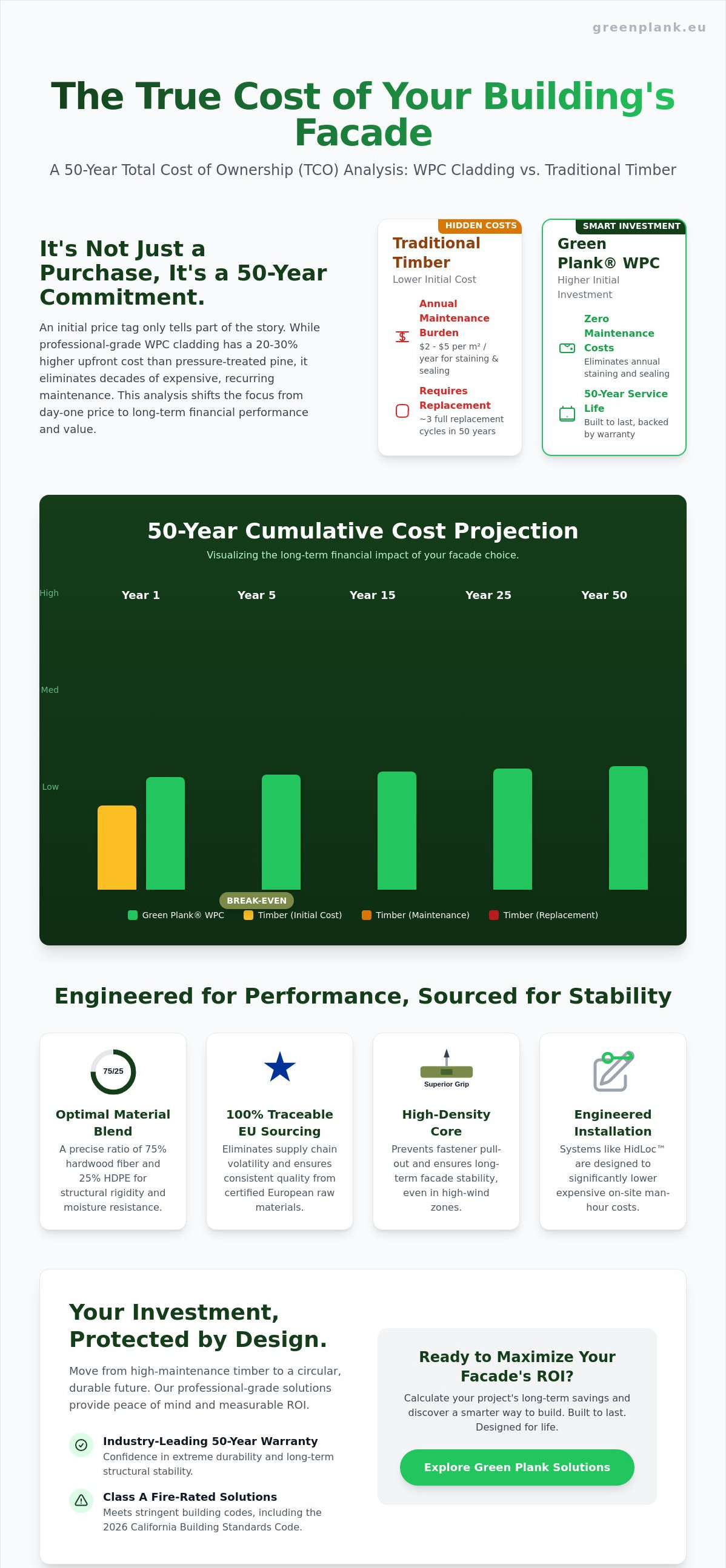
A direct comparison of cumulative costs reveals that the initial price of a material is often the least significant factor in its long-term financial performance. In Year 1, WPC cladding reflects a higher capital expenditure, typically 20% to 30% above pressure-treated pine. However, by Year 10, the total cost of ownership wpc cladding shifts decisively in favor of the composite. By Year 25, the cumulative savings become substantial as the timber alternative requires its fifth or sixth major maintenance cycle. This "Break-Even Point" generally occurs within 3 to 5 years, after which the maintenance avoidance of WPC becomes a pure financial gain for the property owner.
This financial trajectory is supported by a comprehensive Life Cycle Assessment of WPC, which highlights how durability impacts long-term asset value. While timber costs are subject to the inflation-adjusted price of professional labor and chemical treatments, WPC remains stable. Aesthetic ROI also plays a critical role. A WPC facade retains its original Nordic character without the "weathered" or graying look that can devalue a property during an appraisal. It maintains curb appeal and structural integrity simultaneously. Built to last. Designed for life.
The 25-Year Maintenance Ledger
The financial burden of timber is found in its recurring ledger. Softwood and even many hardwoods require sanding, staining, and sealing every 3 to 5 years to prevent moisture ingress and UV degradation. Current 2026 data estimates these costs at $2 to $5 per square meter annually for materials and labor. In contrast, WPC requires only periodic cleaning with soap and water, involving minimal labor and zero expenditure on oils or stains. WPC maintenance costs are typically 90% lower than timber over 20 years. When you factor in the rising cost of skilled trades, the choice to avoid manual treatment cycles becomes a logical economic decision.
Service Life and Warranty Protection
Project risk management relies on predictability. Traditional timber is susceptible to rot, moisture degradation, and insect damage, leading to unpredictable costs for localized board replacements. These repairs often result in a mismatched aesthetic because new wood rarely blends with aged sections. Our professional-grade solutions provide a 50-year service life, backed by significant engineering confidence and long-term warranties. Choosing sustainable building materials also enhances the residual value of the asset. Property appraisals in 2026 increasingly account for the circularity and low-maintenance profile of a building's envelope. High-performance composites protect your capital and the planet. Nordic reliability. European precision.
Risk Mitigation: How Quality Sourcing Protects Your TCO
The lowest procurement price is often a precursor to the highest long-term liability. In the context of total cost of ownership wpc cladding, selecting non-traceable materials creates a significant financial "tail" of risk. While "cheap" imports might save capital in the short term, their high failure rates, often manifesting as delamination or structural warping within the first 5 years, can triple the projected lifecycle cost. We mitigate these risks by using 100% EU raw materials, ensuring that every board meets rigorous European safety and consistency standards. This engineering precision is specifically designed to withstand Nordic climate extremes, where temperature fluctuations can cause inferior composites to buckle or crack.
Our commitment to traceability acts as a financial hedge against future regulatory shifts. As carbon taxes and disposal fees become more stringent in 2026, the value of a circular, low-impact product increases. Every board we produce is a result of engineering confidence. Built to last. Designed for life.
The Cost of Failure in Low-Grade Composites
Low-grade composites typically utilize non-traceable HDPE blends that lack the necessary UV stabilizers for long-term exposure. When these materials fail on a multi-story commercial building, the financial impact is catastrophic. The logistical costs of scaffolding, specialized labor, and waste disposal for a failed facade can exceed the original material cost by 400%. Professional-grade WPC is identified by its high density and a 75% hardwood fiber core, which prevents the internal moisture expansion that causes delamination. Investing in quality today prevents the logistical nightmare of a full-scale replacement in 2031.
Regulatory and Environmental Future-Proofing
Choosing a high-performance composite wall cladding with a low CO2 footprint is a strategic move for project certification. Materials that comply with Cradle to Cradle principles allow owners to avoid future disposal taxes and landfill fees, which are projected to rise significantly by 2030. Sourcing "Made in EU" products simplifies the path to LEED and BREEAM certification, directly impacting the property's market value and tenant appeal. You can view our full range of traceable, European-engineered solutions to secure your project's future. Designed in Scandinavia. Produced in Europe.
Maximizing ROI with Green Plank WPC Solutions
Achieving the lowest total cost of ownership wpc cladding requires a partnership with an innovator that understands the full lifecycle of the building envelope. At Green Plank, we don't just manufacture boards; we engineer systems designed to eliminate the financial volatility of exterior maintenance. Our 50-year service life serves as a definitive guarantee of the lowest possible TCO, providing a level of predictability that traditional timber cannot match. By choosing a system designed in Scandinavia and produced in Europe, you're investing in a legacy of Nordic reliability and ethical manufacturing that protects your capital for decades.
The financial logic of our system is rooted in the "Maintenance Avoidance" model. When a facade requires zero chemical treatments over its half-century lifespan, the initial premium transforms into a significant yield. We utilize the HidLoc™ hidden fastening system to further extend this service life. These clips allow for natural thermal expansion while protecting the structural integrity of the boards, preventing the stress fractures often seen in face-fixed installations. Built to last. Designed for life.
Engineered for Longevity: Smart System & Terra Tuff
Our Smart System and Terra Tuff lines represent the pinnacle of natural-fiber composite engineering. We maintain a precise 75% hardwood fiber and 25% HDPE ratio, a technical attribute that delivers maximum structural stability without the weight of solid timber. This specific engineering allows for high-strength profiles that are lighter than traditional alternatives, directly reducing shipping and handling costs by approximately 15% during the logistics phase. These profiles are specifically designed for high-traffic commercial infrastructure and extreme weather exposure. For projects requiring a unified aesthetic and financial strategy, our wpc composite decking solutions offer cross-project cost synergy, allowing for bulk procurement and simplified maintenance protocols across the entire site.
The Professional Partner Advantage
We provide architects and contractors with the technical precision needed to calculate project-specific ROI. Beyond the immediate durability of our commercial-grade profiles, we incorporate a Cradle to Cradle ownership model that addresses the often-ignored end-of-life costs. This circular approach ensures that the facade maintains residual value, avoiding the rising landfill fees and disposal taxes projected for 2030 and beyond. This is a critical factor in the total cost of ownership wpc cladding that competitors often overlook. Our team is ready to support your next project with detailed technical specifications and financial modeling. We invite you to request a technical consultation to calculate the precise TCO and long-term ROI for your next sustainable project. Designed in Scandinavia. Produced in Europe.
Securing Your Project's Financial Future
Transitioning from high-maintenance timber to an engineered circular model is the most effective way to stabilize long-term facility budgets. By prioritizing the total cost of ownership wpc cladding, you effectively eliminate the recurring labor and chemical expenses that erode property margins. This approach moves beyond the initial invoice to embrace a lifecycle of durability and predictable performance. You aren't just buying a facade; you're securing a maintenance-free future that protects your capital from the hidden debts of traditional wood.
Our commitment to Nordic reliability is anchored in 100% EU-sourced traceable raw materials and a Cradle to Cradle circular design model. These engineering choices, backed by an industry-leading 50-year service life warranty, ensure your investment remains a structural asset well into the mid-century. It's time to choose a professional-grade solution that respects both your financial goals and the environment. Take the next step in sustainable construction and Request a Professional Quote for Your Next Project today. We help you build with the quiet confidence of a brand that knows its value. Designed in Scandinavia. Produced in Europe. Built to last. Designed for life.
Frequently Asked Questions
What is the average break-even point for WPC cladding vs. timber?
WPC cladding generally breaks even with traditional timber within 3 to 5 years of installation. While the initial capital expenditure is 20% to 30% higher than pressure-treated pine, the lack of recurring maintenance costs quickly offsets this premium. By the fifth year, owners have avoided multiple staining and sealing cycles, which industry data estimates cost $2 to $5 per square meter annually. This makes the total cost of ownership wpc cladding far more favorable over the long term.
Does WPC cladding require any specialized tools for installation?
No specialized equipment is necessary for a professional installation. Standard woodworking tools, such as miter saws with carbide-tipped blades and cordless drills, are perfectly suitable for cutting and fixing the boards. Our HidLoc™ hidden fastening system further streamlines the process by providing pre-engineered spacing and attachment points. This compatibility with existing contractor toolsets reduces setup time and ensures a precise, high-end finish without requiring additional equipment investments.
How does the 50-year warranty affect the total cost of ownership?
A 50-year service life warranty significantly lowers the risk profile of a building project. It eliminates the financial burden of a full-scale facade replacement, which typically occurs every 15 years with softwoods. By guaranteeing structural integrity for half a century, the warranty ensures that the total cost of ownership wpc cladding remains flat after the initial installation. This long-term security is a primary signature of our engineering confidence and European manufacturing standards.
Are there hidden costs in WPC cladding maintenance?
There are no hidden chemical or labor-intensive costs associated with maintaining our natural-fiber composites. Unlike timber, which requires periodic sanding, staining, and sealing to prevent rot, WPC only needs a simple wash with soap and water twice a year. This minimal effort removes surface dust and organic debris without the need for specialist cleaning crews or expensive scaffolding hire. You save approximately 90% on maintenance labor compared to wood over a 20-year period.
How does the use of 100% EU raw materials impact the price?
Sourcing 100% traceable raw materials from Europe results in a higher initial material price compared to non-traceable imports. However, this investment protects you from the costs of failure, such as delamination or warping, which are common in low-grade HDPE blends. European production also offers supply chain stability and compliance with strict environmental regulations. This consistency prevents expensive project delays and ensures that every board meets professional-grade performance standards for decades.
Can WPC cladding be recycled at the end of its service life?
Yes, our composite cladding is fully recyclable and designed according to a circular, Cradle to Cradle model. At the end of its 50-year service life, the boards can be ground down and reprocessed into new high-performance products. This circularity helps property owners avoid future disposal taxes and landfill fees, which are projected to increase as carbon regulations tighten. It's a sustainable choice that respects nature while protecting your long-term financial interests.
Does WPC cladding fade over time, affecting its value?
Our engineered boards experience minimal, controlled color maturation during the first few months of exposure, after which they remain UV-stable. We incorporate high-quality pigments throughout the board's core to prevent the drastic graying and aesthetic depreciation seen in natural wood. This color consistency ensures that the property maintains its curb appeal and market value without the need for restorative painting. Your facade stays vibrant and professional-grade for its entire lifespan.
Is WPC cladding suitable for high-traffic commercial facades?
High-density WPC is specifically engineered for the rigors of commercial and public infrastructure. The 75% hardwood fiber and 25% HDPE ratio provides the impact resistance and structural rigidity required for high-traffic areas. Our Terra Tuff and Smart System lines are built to withstand physical stress and extreme weather without splintering or cracking. This durability makes it a reliable choice for architects who prioritize both aesthetic excellence and long-term structural performance.
Spesifiser produktet
Bruk denne guiden i en Green Plank-spesifikasjon
Tekniske WPC-artikler skal støtte de kommersielle sidene — ikke konkurrere med dem. Fortsett til komposittdekke, TerraTuff, Nordeka eller de tekniske nedlastningene.