



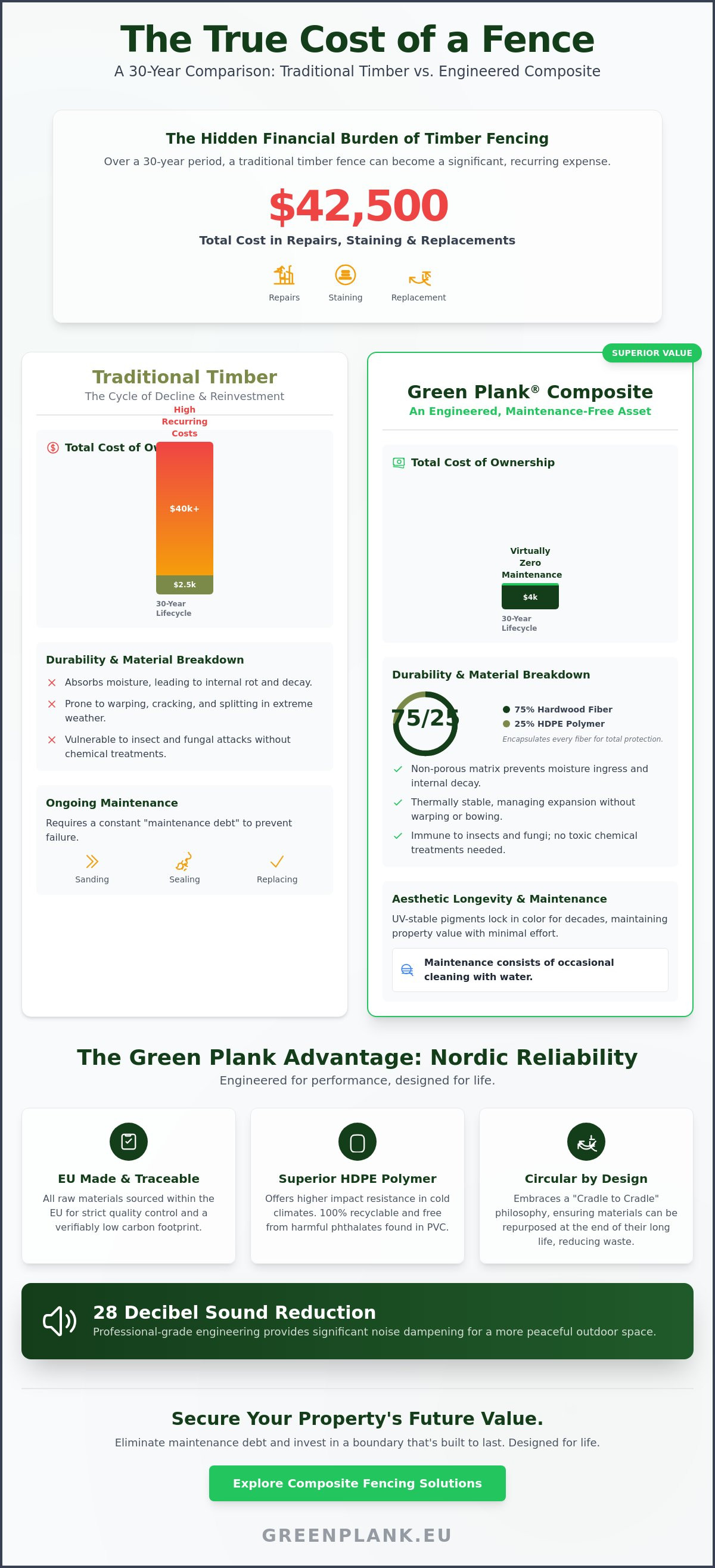
Over a 30 year period, a traditional timber fence can cost a homeowner up to $42,500 in repairs, staining, and total replacements. It's a hidden financial burden that most property owners ignore until the wood begins to rot in the damp European climate. Understanding the long-term value of composite fencing is essential for anyone looking to break this cycle of constant reinvestment. You likely appreciate the natural aesthetic of wood, yet you're tired of the biennial chore of sanding and sealing just to keep it from failing.
This guide demonstrates how professional-grade composite systems deliver superior financial and environmental returns by eliminating these recurring costs. We'll examine the 2026 cost metrics, the engineering behind our 28 decibel sound reduction, and why Nordic reliability means your boundary stays pristine for decades. Discover how an EU-made, traceable product transforms your outdoor space into a maintenance-free asset. Built to last. Designed for life.
Key Takeaways
- Compare initial purchase costs against 20-year maintenance cycles to calculate the true total cost of ownership for your property.
- Understand how high-density manufacturing and a 75% hardwood fiber blend create a permanent barrier against moisture and internal decay.
- Evaluate the long-term value of composite fencing through its circular, "Cradle to Cradle" design and 100% traceable European materials.
- Discover how professional-grade systems like Terra Tuff provide stability in extreme climates while delivering a refined Nordic aesthetic.
- Learn why transitioning to an engineered boundary eliminates maintenance debt and secures your property's future resale value.
Defining the Long-Term Value of Composite Fencing
In the 2026 property market, homeowners and architects are moving away from the "cost per meter" mindset. They're adopting a more sophisticated perspective that prioritizes value over decades. The long-term value of composite fencing isn't just a marketing claim; it's a measurable financial and functional reality. True value is built on three specific pillars: financial return on investment, the reclamation of personal time, and a verifiable reduction in environmental impact. As construction trends shift toward sustainable, circular materials, choosing a boundary that doesn't require replacement every decade has become a hallmark of responsible property management.
Modern Wood-plastic composites (WPCs), often categorized as high-density natural fiber composites (NFC), represent a peak in engineering precision. These materials aren't simple plastic alternatives. They're engineered systems designed to withstand the volatile European climate without the structural degradation common in organic materials. By integrating traceable raw materials with advanced polymers, these systems provide a stable, high-performance solution that outlasts traditional alternatives by a factor of three.
Why Initial Price is a Deceptive Metric
A low upfront price for timber often masks a significant "maintenance debt." Traditional wood fences are a liability. They require constant attention, absorbing moisture during wet seasons and cracking under the summer sun. Over a 30 year lifecycle, the cost of staining, sealing, and eventually replacing a timber fence can reach $42,500. Composite systems eliminate these recurring expenses. Our philosophy at Green Plank is simple: Built to last. Designed for life. By choosing professional-grade materials, you're not just buying a fence; you're securing a maintenance-free future. You're trading a weekend of sanding for a lifetime of leisure.
Aesthetic Longevity and Property Appeal
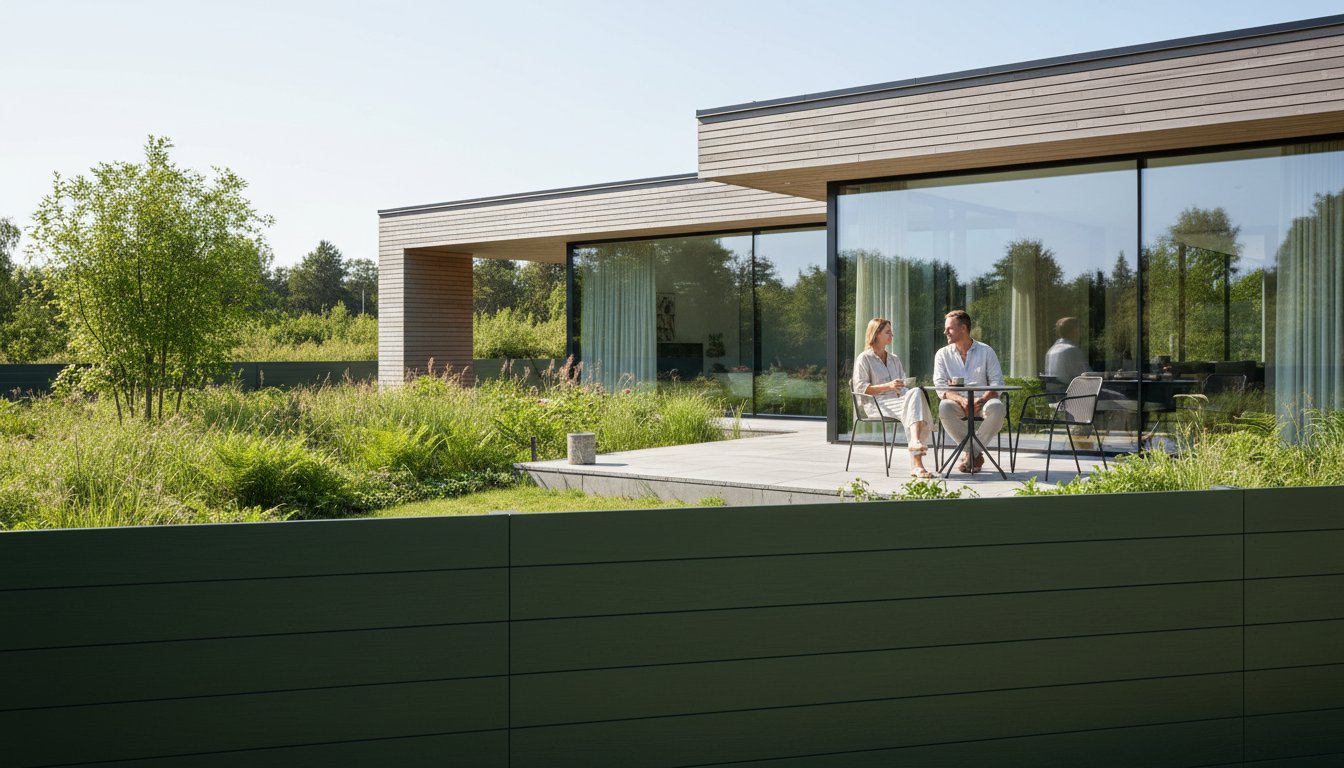
The visual impact of a fence line directly influences property valuation. A grey, sagging timber fence suggests neglect, while a crisp, well-maintained boundary signals quality. High-end composite fencing utilizes UV-stable pigments that are locked into the material during manufacturing. This prevents the aggressive fading seen in cheaper alternatives. Your fence will look as refined in year 20 as it did on the day of installation. This enduring aesthetic is why modern architects favor composite for high-end residential projects. It provides a clean, Nordic character that complements contemporary design while ensuring the property's curb appeal remains an asset rather than a renovation project.
Engineering Durability: Why WPC Outlasts Traditional Materials
The long-term value of composite fencing is rooted in a precise material ratio: 75% hardwood fiber and 25% high-density polyethylene (HDPE). This isn't a random mixture. It's a calculated engineering balance. The high hardwood content provides the structural stiffness and "Nordic character" required for a premium boundary. Meanwhile, the HDPE acts as a high-performance binder that encapsulates every organic fiber. This encapsulation creates a material that is essentially immune to the biological threats that destroy timber. Insects and fungi can't digest the polymer-shielded cellulose, ensuring your fence remains structurally sound without the need for toxic chemical treatments.
Moisture is the primary enemy of any outdoor structure. Traditional wood absorbs water, leading to internal rot, warping, and eventual collapse. Our high-density manufacturing process eliminates this vulnerability. By using extreme pressure to fuse the fibers and polymers, we create a non-porous matrix that prevents water ingress. This stability results in a low-life cycle cost because the core material doesn't degrade over time. In the volatile European climate, where temperatures can swing from freezing to intense heat in a single day, this thermal stability is vital. Our engineered profiles manage expansion and contraction through advanced design, preventing the leaning and bowing seen in lower-grade alternatives.
The Role of HDPE vs. PVC in Fencing
Green Plank utilizes HDPE rather than traditional PVC for several engineering reasons. HDPE offers superior impact resistance, especially in the cold winters of Northern Europe. It doesn't become brittle or crack when the temperature drops. It's also a more sustainable choice; it's 100% recyclable and free from the harmful phthalates often found in PVC products. We source all raw materials within the EU, allowing for rigorous quality control and a verifiably low carbon footprint. This commitment to traceable, professional-grade components ensures that every plank meets our standards for strength and environmental ethics.
Weatherproofing for the Next 50 Years
Coastal properties require a boundary that can withstand salt spray and constant high humidity. Our composite matrix is chemically inert to these corrosive elements, meaning it won't peel, flake, or corrode like painted metal or treated wood. We've also engineered our profiles to handle significant wind loads, maintaining structural integrity during the extreme storm events that are becoming more frequent. While standard industry warranties provide a baseline, our systems are engineered with a 50-year lifecycle in mind. This benchmark of longevity is why discerning homeowners choose Green Plank for their most demanding projects. Built to last. Designed for life.
The Financial Case: Calculating Total Cost of Ownership (TCO)
To accurately assess the long-term value of composite fencing, property owners must look beyond the initial invoice. While a timber fence often presents a lower entry price, it carries an inherent maintenance debt that grows annually. In 2026, professional installation labor costs have stabilized between $15 and $30 per linear foot; however, the recurring costs of wood preservation continue to climb. When you factor in the rising price of high-quality stains, specialized cleaning chemicals, and the professional labor required for biennial applications, the financial narrative shifts. A capped composite system typically reaches a "break-even" point against timber within 8 to 12 years. From that moment forward, every year of ownership represents a direct saving.
The total cost of ownership for a professional-grade composite fence over a 30 year period is estimated between $6,000 and $9,000. In contrast, a traditional wood fence over the same duration can cost between $23,300 and $42,500 when accounting for multiple replacements and consistent upkeep. This massive discrepancy exists because timber is a depreciating asset that requires constant capital injection to remain functional. Composite is an engineered investment that maintains its value through structural permanence. Built to last. Designed for life.
Timber vs. Composite: A 25-Year Cost Breakdown
Maintaining a timber boundary is a relentless cycle of sanding, sealing, and board replacement. By year 15, most wood fences require significant structural repairs due to ground-level rot. Our data indicates that owners of natural-fiber systems avoid these expenses entirely. This financial efficiency mirrors the patterns found in our low maintenance decking guide, where engineered materials outperform organic ones in every ROI metric. Consider these avoided costs over 25 years:
- Elimination of professional staining services, currently costing $50 to $100 per hour.
- Zero expenditure on toxic wood preservatives or fungal treatments.
- Avoidance of material inflation, which often sees timber prices fluctuate by 15% annually.
- No requirement for full-scale replacement at the 15-year mark.
Resale Value and Marketability
A pristine, zero-maintenance fence line serves as a powerful psychological trigger for prospective property buyers. It communicates a message of high-end quality and reduced future responsibility. In real estate transactions, a transferable warranty acts as a signature of engineering confidence, effectively de-risking the purchase for the new owner. This is precisely why commercial developers and modern architects prioritize WPC for high-traffic infrastructure; the material's ability to retain its "day one" aesthetic without additional funding is a critical asset. By installing a professional-grade boundary, you're not just enclosing a space; you're enhancing the liquid value of the entire property.
Environmental Value and Circular Design in 2026
Sustainability in 2026 is no longer defined by a simple label; it's defined by a product's entire lifecycle. The long-term value of composite fencing lies in its ability to break the resource-heavy cycle of extraction and disposal. When a boundary lasts 50 years instead of 10, the environmental demand for timber, transport, and chemical treatments is reduced by 80%. This is the ultimate form of conservation. By utilizing hardwood processing byproducts, our natural-fiber composite prevents the felling of new trees. We repurpose industrial waste into a high-density, high-value asset that respects the forest rather than depleting it.
Longevity is the cornerstone of our environmental ethics. Every replacement cycle avoided is a victory for the planet. Traditional timber fences are often treated with heavy metals or toxic preservatives to delay rot, chemicals that eventually leach into the soil. In contrast, our engineered matrix is chemically stable. It provides a permanent, non-toxic boundary that protects your local ecosystem while delivering a refined Nordic aesthetic. Built to last. Designed for life.
Traceability and Ethical Manufacturing
Manufacturing in Europe allows us to maintain a transparent, ethical supply chain where every component is traceable. We source 100% of our raw materials within the EU to minimize transport-related CO2 emissions and ensure fair labor practices. This proximity ensures we meet the rigorous benchmarks outlined in our sustainable building materials guide. By excluding toxic additives and lead-based stabilizers, we produce a material that's safe for both your garden and the broader ecosystem. It's a clean technology designed for a circular future.
The Circular Economy of WPC
The "Cradle to Cradle" model ensures that a product's value doesn't end at the landfill. Our engineered boards are designed for eventual reclamation. At the end of their multi-decade lifecycle, the composite can be ground down and re-integrated into new production lines without losing structural integrity. This circular design aligns perfectly with 2026 EU green building standards, providing a future-proof investment against potential carbon taxes or disposal fees. Choosing a sustainable boundary isn't just an ethical preference; it's a strategic decision to support a circular economy that respects the limits of our planet. View our sustainable fencing collections to see how engineering precision meets environmental responsibility.
The Green Plank Advantage: 50 Years of Nordic Reliability
The long-term value of composite fencing is best realized through products that bridge the gap between aesthetic aspiration and industrial performance. Green Plank represents this intersection. By combining refined Scandinavian design sensibility with European industrial strength, we've created a lineage of products like the Smart System and Terra Tuff. These aren't just fences; they're engineered boundaries proven in the most extreme climates. From the salt-heavy air of coastal regions to the sub-zero winters of the Arctic circle, our natural-fiber composite maintains its structural integrity without compromise. Designed in Scandinavia. Produced in Europe.
Professional installers and architects specify our systems for high-value projects because they require consistency. They know that a Green Plank boundary won't warp, splinter, or decay, regardless of the environmental pressure. This reliability is the hallmark of a "Sustainable Craftsman" approach. It's a commitment to quality that ensures the property's perimeter remains a maintenance-free asset for a 50-year lifecycle. When you choose an engineered solution, you're investing in a legacy of durability. Built to last. Designed for life.
Engineered for Life: The Smart System Approach
Our Smart System utilizes a modular design that simplifies the construction process, significantly reducing initial labor costs. A primary feature of this approach is the HidLoc™ system. This technology ensures a flawless finish by securing planks without the need for exposed screws or visible fasteners. It results in a clean, modern aesthetic that highlights the refined Nordic character of the material. If you're planning a comprehensive outdoor renovation, you can find similar efficiency in our deck installation guide. Coordinating your fencing and decking with matching engineered systems ensures a cohesive, high-end look for the entire property.
Securing Your Investment
Verifying the authenticity of your materials is the final step in securing long-term value of composite fencing. In a market often saturated with low-grade plastic alternatives, looking for European-made, traceable products is essential. Genuine Green Plank materials are backed by decades of engineering confidence and local European support. This proximity means your project security is never compromised by global supply chain volatility or unverifiable overseas warranties. We invite you to move beyond the cycle of timber repair and embrace a permanent boundary solution. Consult with our specialists to receive professional-grade specifications for your next project. Contact Green Plank today to begin your transition to a maintenance-free perimeter.
Securing Your Property’s Future with Engineered Excellence
Investing in your property's perimeter is a decision that impacts both your financial balance sheet and your daily quality of life. By choosing a high-density natural fiber composite, you eliminate the $42,500 maintenance debt often associated with traditional timber over three decades. You replace a cycle of decay with the verifiable long-term value of composite fencing. This transition ensures your boundary remains a pristine asset, backed by an engineering confidence that supports a 50-year lifecycle. Every plank represents a commitment to 100% EU-sourced, Cradle to Cradle certified materials that respect the environment while enhancing your home's curb appeal.
Professional-grade engineering means your fence is a permanent solution rather than a temporary fix. It's time to reclaim your weekends and protect your property's resale value with a boundary that respects both nature and your investment. Our team is ready to help you specify a solution that meets your exact architectural requirements and climate demands. Request a Professional Quote for Your Composite Fencing Project today and experience the quiet confidence of Nordic reliability. Built to last. Designed for life.
Frequently Asked Questions
How much does composite fencing increase property value?
High-end composite fencing increases property value by providing a permanent, maintenance-free asset that appeals to modern buyers. Most homeowners prioritize boundaries that don't require a "maintenance debt" of biennial staining or repairs. A pristine fence line improves curb appeal and signals that the property is managed with high-quality, durable materials. This translates into higher liquid value and faster sales in competitive real estate markets.
Is composite fencing really maintenance-free?
Professional-grade composite is essentially maintenance-free compared to traditional timber. It doesn't require sanding, sealing, or painting to prevent rot or decay. You only need to perform a simple wash with soap and water once or twice a year to remove surface dust or pollen. This reclaimation of personal time is a primary driver for the long-term value of composite fencing for busy property owners.
Can composite fence panels withstand high winds?
Engineered composite systems are designed to withstand significant wind loads when installed according to manufacturer specifications. By using high-density materials and secure aluminum post systems, these fences maintain structural integrity during extreme European storm events. Proper installation, including correct gapping for thermal expansion, ensures the fence remains stable and upright for decades without leaning or warping.
Does composite fencing fade in direct sunlight?
Modern co-extruded composite fences are engineered to limit color change to less than 5% over a 10 year period. While all materials exposed to UV radiation experience some shift, our UV-stable pigments ensure the change is nearly imperceptible. This prevents the aggressive grey, weathered look that affects untreated wood within just 24 months of installation. Your fence maintains its refined Nordic character year after year.
What is the actual lifespan of Green Plank composite fencing?
Our systems are engineered for a 50 year lifecycle. While our official warranty provides 15 years of prorated coverage against rot and insect damage, the high-density matrix ensures structural permanence for 30 or more years. This durability is a core component of the long-term value of composite fencing, as it eliminates the need for full-scale replacements every decade.
How does the cost of composite fencing compare to cedar or pressure-treated wood?
The upfront cost for composite materials ranges from $11 to $45 per linear foot, which is higher than the $15 to $20 typically spent on wood. However, composite becomes the more economical choice within 8 to 12 years. Over a 30 year period, the total cost of ownership for wood can reach $42,500 due to maintenance and replacement, whereas composite remains a one-time investment.
Is composite fencing environmentally friendly compared to natural wood?
Composite is a more sustainable choice due to its circular design and use of recycled materials. Our products utilize 50% to 60% recycled wood fibers and are 100% EU-sourced. This prevents deforestation and eliminates the need for the toxic chemical preservatives used in pressure-treated timber. It's a clean technology designed to protect both your garden and the broader ecosystem.
Can I install composite fencing myself or do I need a professional?
While DIY installation is possible for those with advanced carpentry skills, professional installation is recommended to ensure the warranty remains valid. Proper gapping for thermal expansion and secure post anchoring are critical for long-term performance. Professional labor costs typically range from $15 to $30 per linear foot, providing the security that your engineered boundary is built to last.
Spesifiser produktet
Bruk denne guiden i en Green Plank-spesifikasjon
Tekniske WPC-artikler skal støtte de kommersielle sidene — ikke konkurrere med dem. Fortsett til komposittdekke, TerraTuff, Nordeka eller de tekniske nedlastningene.