



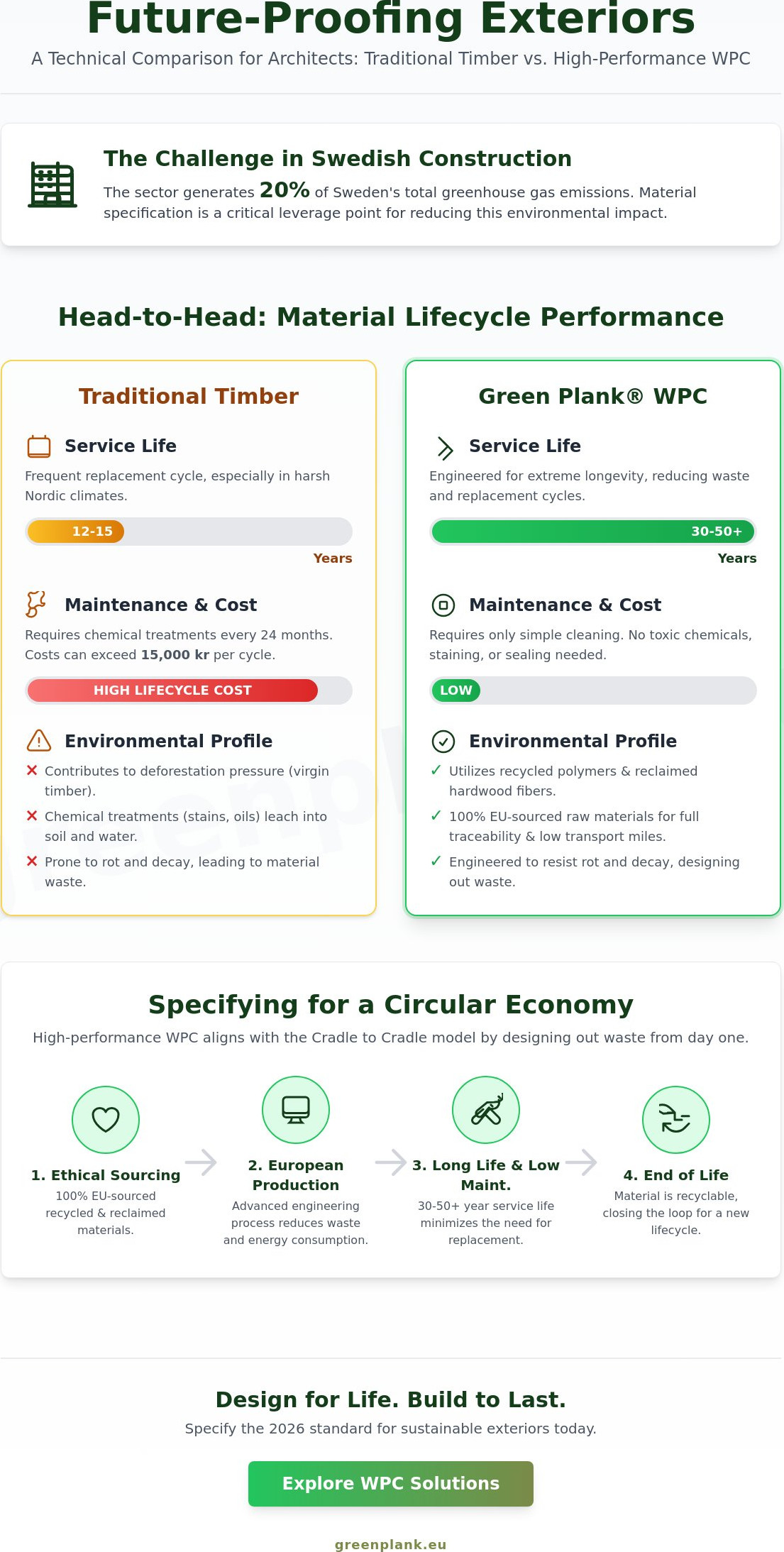
According to Boverket's 2023 climate report, the Swedish construction sector generates approximately 20% of the nation's total greenhouse gas emissions. This reality places a heavy burden on the specification process, as you're often forced to choose between the aesthetic warmth of wood and the harsh reality of material failure in Nordic climates. You've likely seen traditional timber decks or facades grey and rot within five years; this leads to maintenance costs that can exceed 15,000 kr per project cycle. It's a frustrating cycle that compromises both your design vision and the planet's health.
We understand that you need high-performance solutions that don't sacrifice environmental ethics for durability. This guide helps you navigate the evolving landscape of sustainable building materials for architects by focusing on circular, professional-grade solutions. You'll discover how to evaluate and specify engineered natural-fiber composites that offer 30-year service lives while maintaining 100% raw material traceability. We'll examine the technical criteria for 2026 specifications, ensuring your projects are built to last and designed for life. Designed in Scandinavia and produced in Europe, these materials provide the stability and refined character your clients expect.
Key Takeaways
- Define the 2026 standard for sustainable building materials for architects, moving beyond "less harm" toward regenerative design and circularity.
- Compare the life-cycle performance of timber and natural-fiber composites to ensure long-term durability in harsh coastal environments and high-traffic public spaces.
- Understand the engineering and ethical advantages of 100% EU-sourced raw materials, prioritizing traceability and reduced transport miles in your procurement.
- Master a circular specification framework that utilizes the "Cradle to Cradle" model to design out waste from the initial project phase.
- Evaluate the technical benefits of European-engineered WPC systems as high-performance, low-maintenance alternatives for modern commercial architecture.
What are Sustainable Building Materials in the 2026 Context?
In 2026, the definition of sustainable building materials for architects has moved beyond simple energy efficiency. It now centers on materials that minimize environmental impact through low embodied carbon, circular lifecycles, and strictly traceable sourcing. Architecture in Sweden and across Europe is undergoing a fundamental shift from a "do less harm" mindset toward regenerative design. This approach prioritizes materials that contribute to a building's ecosystem rather than just depleting resources. Architects are increasingly rejecting energy-intensive materials like traditional concrete or virgin plastics in favor of solutions that align with sustainable building principles.
Environmental Product Declarations (EPDs) have become the standard for modern material specification. They provide the transparency needed to verify environmental claims with scientific precision. By analyzing EPDs, professionals can ensure that their chosen sustainable building materials for architects meet the rigorous standards of the Swedish Boverket regulations. This data-driven approach ensures every project is built on a foundation of ethical engineering and environmental responsibility.
Embodied Carbon vs. Operational Carbon
The construction phase alone accounts for 10% of global CO2 emissions. While operational carbon focuses on the energy used during a building's life, the material choice made early in the design phase dictates the total footprint. Embodied carbon is the total greenhouse gas emissions generated from resource extraction to disposal. By selecting low-carbon materials at the outset, architects can reduce a project's impact before the first stone is laid. In Sweden, the 2022 climate declaration law for new buildings has accelerated this focus. It requires developers to calculate and report the climate impact of the construction stage to ensure compliance with national CO2 reduction targets.
The Rise of Natural Fiber Composites (NFC)
Natural Fiber Composites (NFC) have emerged as a high-performance alternative to traditional timber. These materials blend hardwood fiber with recycled polymers to create a superior climate-resistant product. This engineering process results in a material that resists rot and decay without the need for toxic chemical treatments. For a deep dive into the material science behind these innovations, read our guide on What is WPC Composite Decking?.
NFC materials provide a circular solution by utilizing waste streams from the timber industry and transforming them into professional-grade building components. This reduces the reliance on virgin timber and minimizes deforestation pressures. Designed in Scandinavia. Produced in Europe. These composites offer the aesthetic of wood with the durability of modern engineering. Built to last. Designed for life.
Comparing External Materials: Timber vs. High-Performance WPC
Architects specifying sustainable building materials for architects in Sweden often face a choice between traditional timber and high-performance Wood Plastic Composite (WPC). While wood offers immediate carbon sequestration, its performance in public infrastructure tells a different story. In coastal regions like Gothenburg or Malmö, saltwater and high humidity accelerate rot in softwoods. This leads to a replacement cycle every 12 to 15 years. High-performance WPC, engineered for these environments, extends this cycle to 30 or even 50 years. This longevity is the foundation of true circularity.
The "hidden cost" of timber isn't just financial; it's environmental. Maintaining a wooden deck requires chemical oils and stains every 24 months. These treatments can cost upwards of 8,000 kr per maintenance cycle for a mid-sized public space. More importantly, these chemicals leach into the soil, impacting local biodiversity and groundwater. Research into Sustainable Building Technologies highlights how material longevity and reduced chemical dependency are vital for modern infrastructure. Green Plank composites use 100% traceable recycled HDPE, ensuring a circular manufacturing process that rivals the carbon benefits of wood when measured over a full 50-year service life. Designed in Scandinavia and produced in Europe, these materials provide a stable, carbon-neutral alternative to treated timber.
Durability as a Sustainability Metric
A 50-year warranty material is inherently more sustainable than a 10-year material, regardless of the initial carbon footprint. Replacing a deck five times in half a century creates five times the transport emissions and installation waste. Our low-density engineering reduces weight without sacrificing structural integrity, which cuts transport-related CO2 and speeds up the installation process. We're committed to transitioning from a "replacement culture" to "built to last" engineering. This approach ensures that sustainable building materials for architects deliver long-term value for both the client and the planet.
Maintenance-Free Architecture
HDPE-based composites eliminate the need for oils, stains, and toxic sealants. You get a refined Nordic character without the inevitable decay associated with natural fibers. The aesthetic evolution of WPC means architects no longer have to sacrifice beauty for performance. Our surfaces achieve high slip resistance ratings, ensuring safety in Swedish public squares during wet autumn months. They remain safe, stable, and beautiful for decades without intervention. If you're planning a project that requires this level of resilience, you can explore our professional-grade decking solutions to see how engineering meets Scandinavian design. Built to last. Designed for life.
The Engineering of Traceability: Why EU Raw Materials Matter
Traceability isn't just a marketing buzzword; it's a fundamental technical requirement for modern Green Building Principles. When architects specify sustainable building materials for architects from opaque global supply chains, they inherit significant risks. These risks include illegal logging, unethical labor practices, and inconsistent material purity that can compromise structural integrity. Sourcing 100% of raw materials from within the European Union eliminates these variables. It ensures every cubic meter of fiber meets strict EU environmental standards. Local sourcing also slashes transport emissions, which helps Swedish firms meet their net-zero targets by drastically reducing long-distance freight miles.
The choice of polymer is equally vital for long-term performance. Green Plank utilizes high-density polyethylene (HDPE) because it ensures stability in extreme temperature fluctuations. In Sweden, where seasonal changes are drastic, HDPE prevents the warping and cracking common in cheaper PVC-based composites. This engineering choice reflects a commitment to circularity, as HDPE is more readily recyclable than many alternative binders.
Scandinavian Design Meets European Manufacturing
Local manufacturing allows for rigorous quality control that overseas production simply can't match. Green Plank utilizes 75% hardwood fiber to achieve a natural look and superior strength. This specific ratio is critical for performance. While many competitors use bamboo or softwood fillers that absorb moisture and swell, hardwood fiber offers the density required for high-traffic commercial zones. Our commitment to sustainable building materials for architects means using materials that last decades, not years. You can learn more about how EU standards impact project longevity in our European Raw Materials guide.
HidLoc™ and Structural Innovation
Engineered profiles must withstand the harsh Nordic environment. To protect the material's integrity, the fastening system must be as advanced as the plank itself. HidLoc™ is a stainless steel hidden fastening system that allows for natural thermal expansion without compromising deck integrity. By using this system, architects can prevent water ingress and rot, as it eliminates the need for surface-penetrating screws that often create entry points for moisture.
This structural innovation provides several key benefits for large-scale projects:
- Enhanced Aesthetics: A clean, fastener-free surface that highlights the natural wood grain.
- Increased Longevity: Reduced risk of board splitting or fastener corrosion.
- Maintenance Efficiency: Individual boards can be replaced without dismantling the entire system.
Designed for life. Built to last. This approach ensures that the architectural vision remains intact for a 30-year lifecycle, providing a maintenance-free solution that respects both the user and the planet.
Specifying for the Circular Economy: An Architect's Framework
Circular design shifts the focus from initial construction costs to long-term material value. For 2026 specifications, choosing sustainable building materials for architects requires a deep understanding of how products behave at the end of their service life. The goal is to design out waste from the project's inception; ensuring that every component can be recovered, reused, or safely returned to the biosphere. Architects in Sweden are increasingly prioritizing these closed-loop systems to meet stringent climate declaration requirements.
Cradle to Cradle Ownership Model
The Cradle to Cradle model treats building components as technical nutrients. Green Plank implements this circularity by maintaining strict control over the entire supply chain. We use 100% EU-sourced raw materials to ensure every plank is traceable and compliant with European safety standards. This geographical proximity reduces transport emissions and supports the regional economy. Our engineered composites are designed as low-density materials. This technical attribute reduces the dead load on building structures by approximately 15% to 22% compared to traditional hardwoods. Lower structural loads mean smaller foundation requirements; which saves significant volumes of concrete and reduces the overall carbon footprint of Swedish infrastructure projects. Designed in Scandinavia. Produced in Europe.
The Architect's Selection Checklist
To ensure a project meets circularity benchmarks, architects should evaluate every manufacturer against a rigorous set of criteria. This checklist simplifies the procurement process while guaranteeing long-term performance.
- Recycled Content: Is the material manufactured from recycled or rapidly renewable fibers rather than virgin old-growth timber?
- Warranty Longevity: Does the product carry a 25-50 year commercial warranty to ensure it stays in the "use" phase as long as possible?
- Traceability: Are all raw materials 100% traceable to the European Union to avoid high-risk or unethical supply chains?
- End-of-Life: Can the manufacturer demonstrate a functional take-back program where the material is fully recycled into new products?
Safety is a non-negotiable aspect of specifying sustainable building materials for architects. You must verify that materials are free from toxic additives such as formaldehyde, volatile organic compounds (VOCs), or heavy metal stabilizers. Green Plank products are engineered to be inert; making them safe for public parks, schools, and residential balconies across Sweden. These materials integrate seamlessly into modular infrastructure profiles. Such profiles allow external spaces to be adaptable; providing the flexibility to reconfigure or upgrade urban environments without total demolition. Built to last. Designed for life.
Green Plank: Setting the Standard for Sustainable Exteriors
Green Plank defines the intersection of engineering precision and environmental ethics. For professionals sourcing sustainable building materials for architects, our Terra Tuff and Smart System lines provide the durability required for 2026 commercial specifications. We manufacture in Europe using 100% traceable raw materials. This ensures every profile meets the rigorous standards of the Swedish construction market while supporting a circular economy. Our products stand as the leading Trex decking alternative for European projects. They offer significantly reduced transport emissions and superior resistance to the volatile Nordic climate.
The "Designed in Scandinavia" ethos informs every product we manufacture. Functionality, minimalism, and longevity remain our core priorities. Customisable solutions for cladding, fencing, and infrastructure profiles allow architects to maintain design integrity without compromising on performance. These profiles are engineered to withstand the extreme thermal expansion and contraction cycles typical of Northern European winters. We provide a professional-grade alternative to tropical hardwoods, protecting global biodiversity while delivering a refined aesthetic.
High-Performance Decking and Cladding
Terra Tuff is engineered specifically for high-traffic commercial zones like public boardwalks, school playgrounds, or restaurant terraces. It features a high-density, solid core that eliminates moisture absorption and resists heavy impact. Our Smart System wall cladding extends this performance to the building envelope. These natural-fiber composite solutions provide a maintenance-free facade for both interior and exterior applications. Architects benefit from consistent colour and texture across large-scale developments. This eliminates the aesthetic unpredictability and high maintenance costs associated with traditional timber. Every board is designed for life and built to last.
Partnering for Sustainable Success
We support the architectural community with comprehensive technical documentation and precision CAD details. This streamlines the integration of our sustainable building materials for architects into complex BIM workflows. Our commitment to sustainability means we focus on reducing the CO2 footprint of every project we supply. By choosing European-made composites, specifiers lower their project's carbon intensity and avoid the ethical complexities of overseas shipping. We provide warranties of up to 30 years, reflecting our confidence in Scandinavian engineering. Our team assists with material selection to ensure compliance with Swedish building regulations and environmental certifications like Miljöbyggnad.
Specifying Excellence for the 2026 Circular Economy
The shift toward 2026 standards demands a rigorous approach to material selection. Architects in Sweden must now prioritize 100% traceable, EU-sourced raw materials to meet evolving environmental benchmarks. We've seen how engineered natural-fiber composites provide a superior alternative to timber by offering high-performance durability without intensive maintenance. These choices aren't just about aesthetics; they're about long-term structural integrity and carbon accountability. Specifying sustainable building materials for architects involves looking beyond the initial installation to the entire lifecycle of the building.
Green Plank sets the standard with professional-grade solutions that bridge the gap between Scandinavian design and industrial precision. Our Red Dot Design Award-winning products ensure your projects stand out for their beauty and their ethics. With an industry-leading warranty of up to 50 years for commercial projects, we provide the technical confidence needed for Sweden's most ambitious developments. It's time to embrace a framework where quality and responsibility coexist. Designed in Scandinavia. Produced in Europe. Built to last. Designed for life.
Explore Green Plank's range of sustainable architectural solutions
Your next project deserves the reliability of Nordic engineering and the promise of a greener future.
Frequently Asked Questions
What makes a building material truly sustainable for architects?
A material is truly sustainable when it adheres to circular economy principles and maintains a low embodied carbon footprint throughout its entire life cycle. For professionals specifying sustainable building materials for architects, this means selecting products with a verified Environmental Product Declaration (EPD) that confirms at least 90% recycled content. In Sweden, these materials must also comply with Boverket’s climate declaration requirements to ensure long-term environmental accountability and transparency.
How does WPC compare to mass timber in terms of sustainability?
Wood Plastic Composite (WPC) serves as a durable partner to mass timber by offering superior moisture resistance and lower maintenance requirements in exposed areas. While mass timber excels in structural carbon sequestration, Green Plank WPC utilizes 90% recycled fibers and polymers to prevent unnecessary deforestation. It's engineered to resist rot and fungal decay without the toxic chemical treatments often required for raw wood, ensuring a cleaner life cycle for external facades.
What is the typical service life of Green Plank composite materials?
Green Plank composite materials are engineered for a service life exceeding 25 years in harsh Scandinavian climates. This longevity is backed by rigorous testing against UV radiation and moisture absorption, which often limits traditional timber to a 10 year aesthetic peak. By choosing materials that last three decades, architects reduce the frequency of replacement cycles and minimize the total carbon debt of the building project.
Can WPC cladding be used for both interior and exterior applications?
Our WPC cladding is designed for both interior and exterior use, providing a seamless aesthetic transition for modern architectural projects. The material maintains its dimensional stability in temperatures ranging from -30°C to +60°C, making it ideal for the Swedish climate. Its moisture resistant properties make it particularly effective for high traffic indoor areas or exposed coastal facades where traditional wood requires annual staining and oiling.
How does using 100% EU raw materials impact the CO2 footprint of a project?
Sourcing 100% EU raw materials reduces transport related CO2 emissions by up to 60% compared to products imported from Asia. This regional supply chain ensures all components meet strict EU environmental regulations and ECHA standards. For architects, this translates to higher LEED or BREEAM scores and a transparent, traceable path from raw material extraction to the final installation on a Swedish construction site.
Is composite decking recyclable at the end of its life?
Green Plank composite decking is 100% recyclable and can be processed into new high performance profiles at the end of its life cycle. We operate a closed loop manufacturing process where production offcuts are immediately reintroduced into the extrusion line. This circular approach ensures that sustainable building materials for architects don't end up in Swedish landfills, supporting the national goal of a fossil free construction industry by 2045.
Does Green Plank offer warranties for commercial infrastructure projects?
We provide comprehensive limited warranties ranging from 20 to 30 years for commercial infrastructure and public space projects. These warranties cover structural integrity, splintering, and rot, giving developers confidence in their long term investment. This professional grade assurance reflects our commitment to Nordic reliability and the proven durability of our European made composite formulations.
What is the difference between HDPE and PVC in composite manufacturing?
High Density Polyethylene (HDPE) is a more sustainable and flexible polymer compared to Polyvinyl Chloride (PVC), which often contains harmful phthalates. HDPE maintains its impact resistance in sub zero Swedish winters, whereas PVC can become brittle and crack. We utilize recycled HDPE to create a more stable, eco conscious product that delivers a natural wood feel without the environmental baggage associated with chlorine based plastics.
Spesifiser produktet
Bruk denne guiden i en Green Plank-spesifikasjon
Tekniske WPC-artikler skal støtte de kommersielle sidene — ikke konkurrere med dem. Fortsett til komposittdekke, TerraTuff, Nordeka eller de tekniske nedlastningene.