



Over-ordering high-quality composite decking isn't just a budget error; it's a failure of sustainability that contradicts the core values of eco-conscious construction. Many professionals find themselves confused when transitioning from square meter estimates to the actual linear meters required for a purchase. For instance, a project utilizing narrower boards might require exactly 8 LM per square meter, yet this figure shifts the moment you change your profile width. Precision in these technical calculations is the essential foundation of a waste-free procurement process.
You likely understand that every wasted offcut represents both a financial loss and an unnecessary environmental footprint. We're here to help you eliminate that uncertainty. This guide provides a clear framework for converting your deck's surface area into precise linear measurements. You'll learn how plank dimensions dictate your total requirements and how to optimize your order for maximum efficiency. We'll examine the relationship between material science and installation logic, ensuring your outdoor space reflects both premium quality and responsible craftsmanship.
Key Takeaways
- Understand the fundamental distinction between surface area and linear meters to ensure ordering precision and technical accuracy.
- Apply the standard conversion formula to determine exactly how many linear meters are required based on your chosen plank width and gap spacing, whether your project calls for 8 LM or a different specification.
- Align your procurement with the Cradle to Cradle ownership model by eliminating material waste and reducing the carbon footprint of manufacturing and transport.
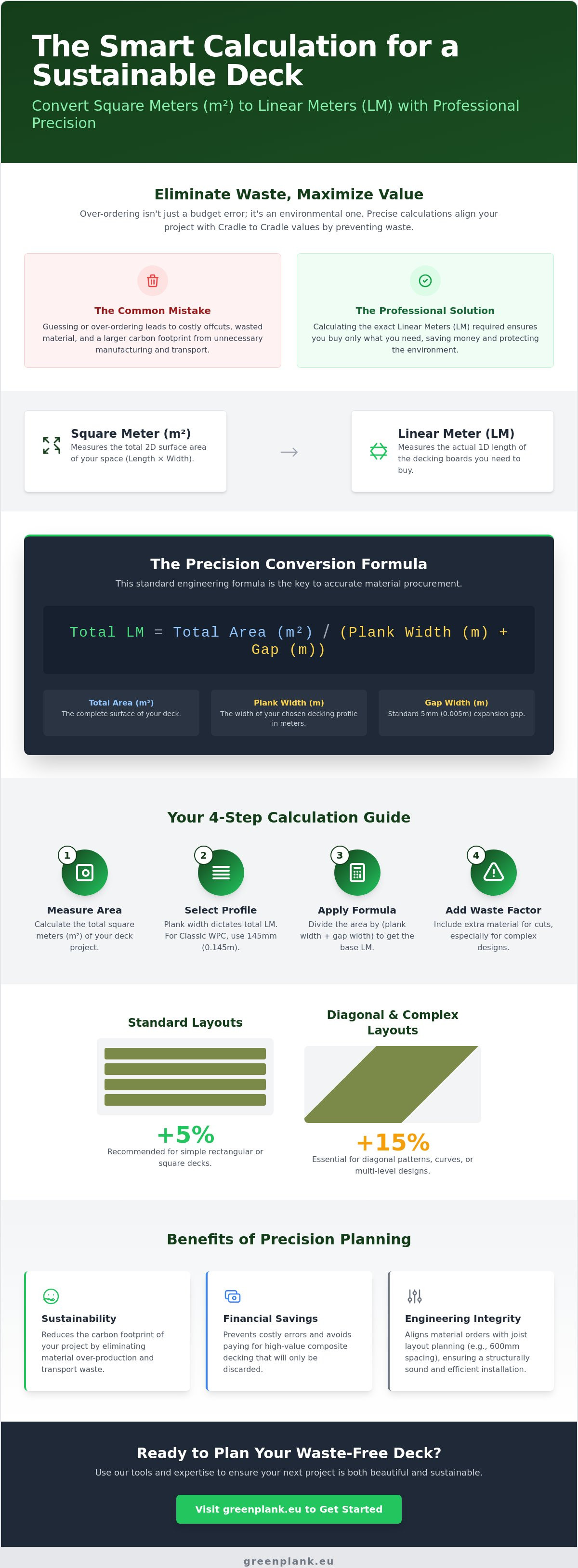
- Account for installation variables such as joist spacing and layout orientation, noting that diagonal patterns typically require a 15% increase in total material.
- Select specialized WPC solutions like Terra Tuff for high-traffic commercial zones or Smart System for residential projects to ensure engineering longevity and material efficiency.
What is a Linear Meter (LM) in Composite Decking?
In the technical language of European construction, a linear meter (LM) signifies a single meter of material length. It describes the physical extent of a decking board without factoring in its surface width or profile thickness. While consumers often think in square meters, professionals rely on linear meters to ensure engineering precision. This distinction is vital for maintaining our commitment to sustainability. By calculating exactly how many meters of a profile are needed, we eliminate the over-production that inflates a project's carbon footprint.
Our EU-based manufacturing facility utilizes linear meters to track raw material efficiency. Since Wood-plastic composites (WPCs) are produced through a continuous extrusion process, length is the most accurate metric for production control. Whether a project requires exactly 8 LM or 800, the focus remains on material integrity and waste reduction. In Sweden and across the EU, you might hear this referred to as a "running meter," but the technical goal remains the same: 100% material utility.
Linear Meter vs. Square Meter: The Specifiers Distinction
Square meters measure the total footprint of your outdoor space. Linear meters measure the actual planks you must purchase to cover that footprint. This difference is critical because plank width dictates your total order. A narrower board requires more linear meters to cover the same area than a wider one. For example, a standard 1 square meter area might require approximately 7 to 8 LM of decking depending on the specific profile and the necessary expansion gaps. Precision here prevents costly errors.
- Width impact: Narrower boards increase the total LM required for the same area.
- Expansion gaps: Standard 5mm joints must be factored into the plank's coverage width.
- Waste reduction: Precise LM ordering prevents the disposal of high-value composite offcuts.
Standard Units in WPC Manufacturing
We manufacture profiles like Terra Tuff and Smart System in optimized lengths to streamline project logistics. Standardizing these units allows for more efficient shipping across Sweden and the wider Nordic region. Professional contractors prefer linear meter calculations because they align perfectly with joist layout planning. When you know the exact LM required, you can map out your framing with 600 cc spacing for private decks with absolute confidence. This systematic approach ensures every centimeter of material serves a functional purpose.
- Logistics: LM units determine the weight and volume for transport efficiency.
- Framing: Joist spacing is calculated based on the span capability of the linear profile.
- Durability: Continuous lengths reduce the number of butt joints, improving long-term moisture resistance.
Calculating Material Needs: Converting Area to Linear Meters
Accuracy in material procurement is the hallmark of a professional installer. Converting square meters (m2) into linear meters (LM) requires a specific engineering formula rather than a simple estimate. The standard calculation is: Total Area (m2) / (Plank Width + Gap Width) = Total Linear Meters. This equation ensures that the physical dimensions of the board and the necessary expansion joints are both represented. Understanding the technical properties of wood plastic composite explains why these gaps are vital for maintaining dimensional stability over a long service life.
Profile selection dictates the final order volume. Our Smart System decking and Nordeka profiles have different widths, meaning they require different LM totals for the same square meterage. For example, a project that utilizes exactly 8 LM of material might only cover a small balcony if the planks are wide, or a very narrow commercial walkway if the profile is slim. Precision at this stage prevents over-ordering and aligns with our goal to reduce the CO2 footprint of every installation. We recommend adding a waste factor of 5% for standard rectangular decks, while complex shapes with many angles may require a 10% buffer.
Step-by-Step Conversion Framework
Begin by measuring the total footprint of your outdoor space with care. Once you have the square meterage, select your profile width. For our Classic WPC range, the width is 145mm. You must then factor in the 5mm gap provided by the HidLoc™ hidden fastening system. This brings your effective width to 150mm (0.15m). Divide your total area by this effective width to find your base LM. This methodical approach ensures you don't purchase unnecessary planks that would otherwise end up as waste.
Example Calculation for an 8 LM Requirement
Small measurements often carry the most weight in finishing work. If you have 8 LM of a 150mm wide plank, you are covering approximately 1.2 square meters of surface. In a residential context, this might represent the skirting for a small terrace or the material needed for a single stair tread. In a commercial setting, this length could be the exact amount needed for a specialized trim or a narrow transition strip. Focusing on these small-scale requirements ensures 100% material efficiency. You can explore our full range of profiles to find the exact width that suits your architectural vision and minimizes offcut waste.
- Smart System: Optimized for residential efficiency with specific width-to-LM ratios.
- Nordeka: A premium wider profile that reduces the total LM needed for large areas.
- Waste Management: Calculating to the nearest decimeter supports our Cradle to Cradle ownership model.
The Engineering Logic: Why LM Precision Drives Sustainability
Engineering precision serves as the primary tool for environmental stewardship. Precision in linear meter (LM) ordering is a direct application of the Cradle to Cradle ownership model, ensuring that every resource remains productive within the circular economy. When a project is calculated with technical exactness, we eliminate the CO2 footprint associated with the excess manufacturing and transport of unneeded material. Our low-density WPC profiles are engineered for high-performance efficiency. They provide structural strength without the environmental weight of traditional, high-density alternatives.
We source 100% EU raw materials to maintain absolute consistency across every linear meter produced. This regional reliability allows us to guarantee that a specific length, whether it's 8 LM for a custom trim or 800 LM for a commercial deck, meets the same high engineering standards. By utilizing 75% hardwood fiber and 25% HDPE, we create a material that is both durable and ecologically responsible. This blend ensures that your project doesn't just look beautiful; it respects the natural world that inspired it.
Circular Design and Material Efficiency
The environmental cost of waste in the construction supply chain is often overlooked. Every discarded offcut represents wasted energy and lost potential. We mitigate this by offering custom length options and promoting precision planning. This approach allows builders to minimize offcuts, ensuring the 75% hardwood fiber blend is utilized to its fullest extent. It's a commitment to material science that prioritizes longevity over short-term convenience. Precision planning isn't just about saving money; it's about honoring the materials we use.
Long-Term Performance and LM Integrity
A 50-year warranty is a testament to our engineering confidence. However, this longevity depends on correct installation and spacing. Technical precision at the LM level is essential for managing thermal expansion, a natural characteristic of composite materials. Utilizing the HidLoc™ hidden fastening system ensures structural integrity over long LM runs. These fasteners allow for the necessary movement while maintaining a seamless aesthetic. When you plan your layout with precision, you prevent the buckling or warping that occurs from improper spacing. This level of detail ensures your deck remains maintenance-free for decades.
- Thermal Management: Precise LM calculations allow for accurate expansion gap placement.
- Structural Support: Correct measurements ensure boards are properly supported by the joist framework.
- System Integration: HidLoc™ fasteners work in tandem with our profiles to maintain a secure, hidden bond.
Project Planning: Calculating LM for Commercial and Residential Decks
Technical precision starts below the surface. For residential projects, we recommend a joist spacing of 600 cc. This standard ensures the structural integrity of every linear meter of decking, providing a stable foundation for years of use. If you choose a diagonal layout, you must account for a 15% increase in your total LM count due to complex angle cuts. This foresight prevents the waste of high-quality material and ensures you have enough planks to complete the pattern without interruption. Proper planning at this stage reflects the craftsmanship of a responsible innovator.
Don't overlook the periphery of your project. Calculating skirting and trim in linear meters is essential for a cohesive aesthetic. These finishing profiles, like our WPC skirting, are often ordered in smaller quantities to frame specific sections or transitions. For example, exactly 8 LM of trim might be just enough to finish the edge of a small terrace or frame a feature planter. Including these details in your initial calculation ensures a seamless visual flow from the main deck to the surrounding landscape. Accuracy in these small measurements is what separates a standard installation from a premium outdoor space.
Commercial Infrastructure vs. Residential Layouts
Commercial infrastructure requires a different engineering mindset than a private backyard. Public spaces face higher foot traffic and heavier loads, necessitating increased material density through tighter joist spacing or specialized Commercial Infrastructure Profiles. Consider a staircase as a technical case study. Exactly 8 LM of material used for steps experiences significantly higher mechanical stress than 8 LM of flat decking. For these high-impact zones, we utilize profiles like Terra Tuff. This ensures long-term performance and safety in demanding environments, protecting both the user and the investment.
The Role of Hidden Fastening Systems
The installation method directly influences your final procurement list. Integrating HidLoc™ hidden fastening systems ensures a clean, screw-free surface while maintaining precise expansion gaps. You must calculate the number of clips required per linear meter based on your specific joist spacing. Following these strict LM guidelines prevents thermal movement issues and preserves the validity of our 50-year warranty. It's a system designed for longevity and aesthetic perfection. You can view our technical installation specifications to refine your material list and ensure 100% material efficiency.
- Stair Transitions: Account for both the tread and the riser in your total linear meter count.
- Multi-Level Decks: Track LM requirements for each level separately to avoid logistics errors.
- Layout Logic: Horizontal patterns are the most material-efficient, while diagonal designs require a 15% buffer.
Green Plank Solutions: Maximizing Value per Linear Meter
Selecting the appropriate profile is an exercise in both aesthetic vision and engineering efficiency. Every linear meter of decking we produce represents a commitment to long-term performance and environmental stewardship. For high-scale commercial projects where durability is non-negotiable, Terra Tuff serves as the definitive choice. It is engineered to withstand extreme mechanical stress across extensive linear runs. Residential projects benefit from the Smart System, an innovative WPC solution designed for streamlined installation and high material value in private outdoor spaces.
Our Nordeka and Entra profiles offer specialized technical attributes for diverse architectural needs. Whether you require the wide-plank elegance of Nordeka or the versatile application of Entra, the foundation remains the same. We utilize 100% EU raw materials to ensure that every linear meter meets rigorous safety and quality standards. This regional manufacturing approach allows us to maintain a low CO2 footprint while delivering a product that carries a 50-year warranty. A small repair might only necessitate 8 LM of material, but the structural integrity of those planks must match the standard of a multi-thousand meter installation.
Choosing the Right Profile for Your LM Needs
Profile width significantly impacts your total linear meter requirements and installation speed. Wider profiles often provide a more efficient LM-to-square-meter ratio, reducing the number of fasteners and joist connections needed. Selecting sustainable building materials from our range ensures your project aligns with the principles of circular construction. Unlike traditional timber, our WPC does not require annual staining or sealing. This maintenance-free nature ensures that your investment retains its value and beauty over decades of exposure to the elements.
- Terra Tuff: Engineered for maximum load-bearing capacity in public infrastructure.
- Smart System: Optimized for residential balconies and terraces with high efficiency.
- Nordeka: A premium wide profile that minimizes the total LM needed for large areas.
- Entra: A versatile solution for diverse decking and cladding applications.
Next Steps for Your Project
Precision in calculation is the first step toward a successful installation. If your project involves complex geometries where a standard 8 LM buffer might not be sufficient, our engineers are available to assist with technical calculations. We provide expert guidance to help you refine your specifications and eliminate material waste. Once your measurements are finalized, you can request a detailed quote based on your exact linear meter requirements. To ensure your project meets our high standards for safety and longevity, we recommend adhering to our professional deck installation framework. This systematic approach guarantees a maintenance-free outdoor space that respects both your budget and the natural world.
Building Your Sustainable Outdoor Legacy
Precision in measurement is more than a technical requirement; it's a commitment to the circular economy. By mastering the conversion from area to linear meters, you ensure that every plank serves a functional purpose without contributing to unnecessary waste. Whether your project requires a precise 8 LM for a finishing trim or a substantial volume for a commercial boardwalk, the goal remains 100% material utility. This technical rigor, combined with the right profile selection, ensures your outdoor space remains beautiful and structurally sound for decades.
Our profiles are manufactured using 100% EU-sourced raw materials, ensuring regional reliability and lower transportation emissions. This engineering excellence allows us to offer a 50-year warranty, grounded in the principles of Cradle to Cradle circular manufacturing. It's time to transition from planning to action. We're ready to help you build an outdoor space that honors both your design and the environment.
Request a Technical Quote for Your WPC Project and secure a sustainable foundation for your next outdoor build.
Frequently Asked Questions
What is the difference between linear meters (LM) and square meters (m2)?
A square meter measures the total surface area of your project footprint, while a linear meter measures the physical length of the decking boards required. You purchase WPC by the linear meter to ensure the total length of the planks covers your calculated area. This distinction is vital for engineering precision and helps prevent the over-ordering of high-quality materials.
How many linear meters of decking do I need for a 20m2 deck?
For a 20m2 deck using a profile with a 150mm effective width, which includes a 145mm board and a 5mm expansion gap, you'll need approximately 134 LM. This calculation is reached by dividing the total area by the effective width of the plank. Always confirm the specific width of your chosen Green Plank profile to ensure your material order is technically accurate.
Does the plank width affect the total linear meters (LM) I need to order?
Yes, the width of the plank is the primary variable that determines your total linear meter requirement. Narrower boards require more meters to cover the same square meterage than wider profiles. For example, a specialized trim or a small stair tread might only require 8 LM if using a wide profile, but would need more length if a narrower board was selected.
How do I calculate LM for deck skirting and trim?
Measure the total perimeter of your deck's exposed edges to determine the linear meters required for skirting. You must also account for the vertical faces of any stairs and the perimeter of multi-level transitions. Calculating these finishing touches in precise linear meters ensures a cohesive aesthetic and a professional, screw-free finish across the entire installation.
Why is it important to factor in gaps when calculating LM?
Factoring in gaps is essential because the expansion joint defines the "effective width" of each plank. Our HidLoc™ hidden fastening system creates a consistent 5mm gap that must be added to the board's physical width in your formula. Ignoring these gaps leads to ordering more material than necessary, which contradicts the goals of sustainable, waste-free construction.
Can I order custom lengths of Green Plank WPC to reduce LM waste?
We provide custom length options for our WPC profiles to help minimize offcuts and reduce material waste. This flexibility allows you to tailor your order to the specific dimensions of your project layout. By utilizing custom lengths, you support our Cradle to Cradle ownership model and significantly lower the CO2 footprint of your building project.
How much waste should I add to my total linear meter calculation?
We recommend adding a 5% waste factor for standard rectangular deck designs to account for minor trimming. If your project features diagonal layouts or complex architectural angles, you should increase this buffer to 10% or 15%. Precise planning ensures you have sufficient material to maintain the structural integrity of the installation without creating unnecessary environmental waste.
Are Green Plank warranty terms based on the number of linear meters installed?
Our 50-year warranty applies to the long-term performance and material integrity of our WPC profiles regardless of the total linear meters installed. The warranty remains valid as long as the installation adheres to our professional guidelines, including proper joist spacing and the use of HidLoc™ fasteners. This guarantee reflects our engineering confidence in every meter of material we produce.
Spesifiser produktet
Bruk denne guiden i en Green Plank-spesifikasjon
Tekniske WPC-artikler skal støtte de kommersielle sidene — ikke konkurrere med dem. Fortsett til komposittdekke, TerraTuff, Nordeka eller de tekniske nedlastningene.