



The lowest price per square meter on a decking quote is often a deceptive figure that masks a ticking clock of structural failure. When you conduct a comparison with cheap Chinese and non-traceable raw materials with European 100% sourceable and traceable materials, the difference isn't just aesthetic; it's chemical. You likely want an outdoor space that withstands the harsh Nordic climate without warping or leaching toxins into your garden soil. It's understandable to seek value when Swedish construction costs remain high, but a deck that splits after 60 months isn't a bargain.
This article demonstrates why 100% traceable European WPC serves as a superior long-term investment that aligns with Sweden's circular economy goals. You'll discover how our professional-grade composite provides the stability and safety required for modern Scandinavian architecture. We will break down the durability metrics of engineered fibers, the safety of certified polymers, and how choosing local manufacturing reduces your project’s CO2 footprint. Designed in Scandinavia and produced in Europe, these materials are built to last and designed for life.
Key Takeaways
- Understand why 100% material traceability is essential for avoiding hazardous "mixed-stream" recycled plastics and unknown waste often found in non-traceable global imports.
- Discover the engineering difference between premium European hardwood fibers and the low-grade agricultural waste that causes budget boards to warp, fade, and crumble.
- Learn why the initial price tag is misleading by calculating the Total Cost of Ownership (TCO) and the significant cost in SEK of replacing failed decking within just five years.
- Examine our hi write comparison with cheap chines and non traceable raw materials with European 100 % source able and traceable materials to understand the long-term value of Nordic reliability.
- Master the specifier’s checklist to verify Technical Data Sheets and REACH compliance, ensuring your project meets the highest Swedish environmental and safety standards.
Traceability in WPC: Why Origin Matters for Composite Decking
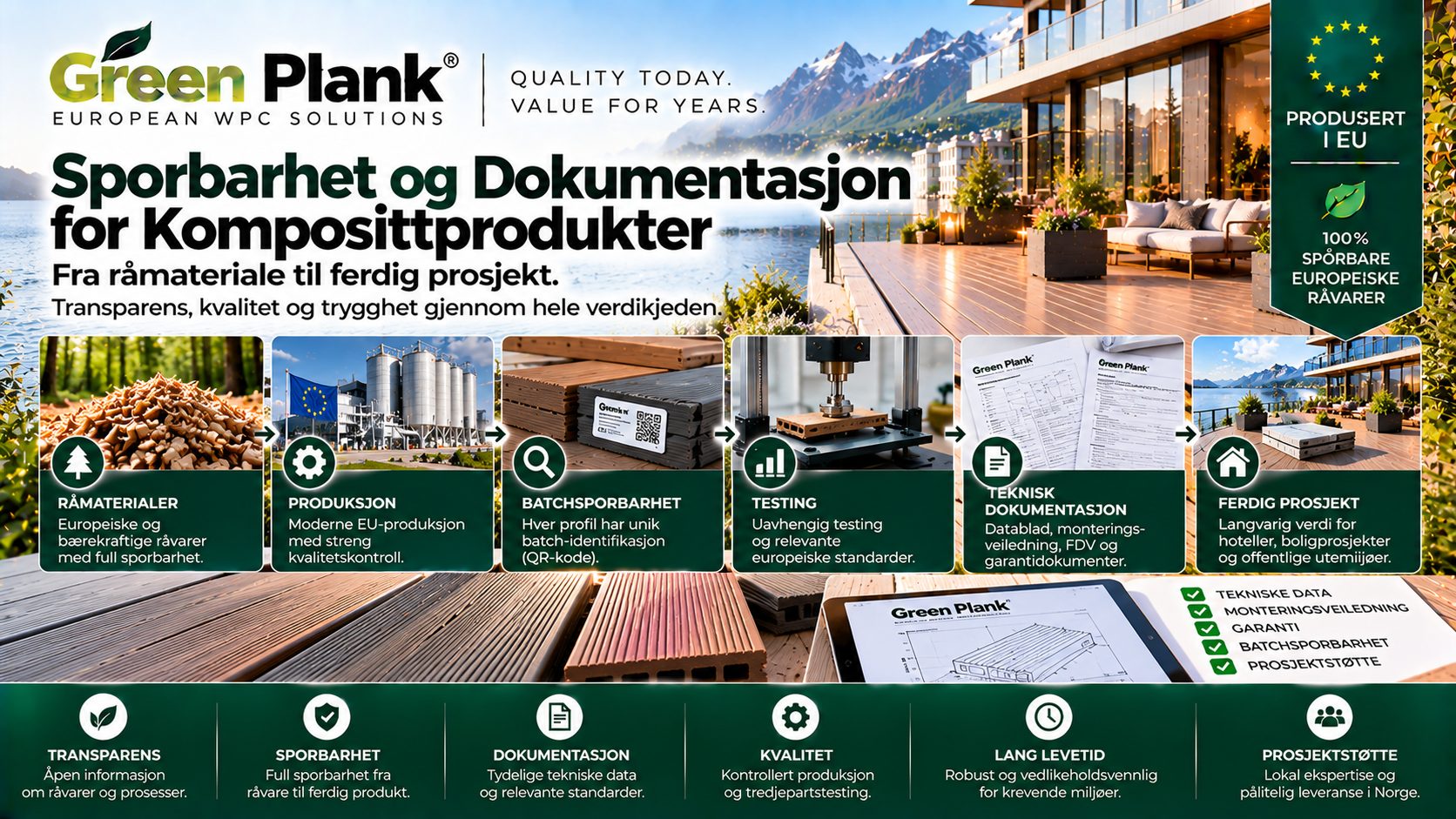
Traceability is the rigorous ability to track every raw material from its primary source to the finished board installed on a terrace. In the Swedish construction sector, where climate extremes demand high performance, knowing exactly what is inside a product is vital. Wood-plastic composites (WPCs) combine natural fibers and polymers, but the quality of these components varies based on their origin. While European manufacturers adhere to strict sourcing protocols, many global imports operate within a transparency gap. These non-traceable products often contain unknown recycled waste, including contaminated plastics or wood fibers from unidentified species that haven't been treated for moisture resistance.
The regulatory landscape in Sweden is changing rapidly. The EU's focus on circularity and the European Green Deal are making traceability a mandatory project requirement rather than an optional feature. For architects and developers, documenting the lifecycle of materials is now a standard part of the procurement process. European-made products offer a higher baseline of trust because they operate under these localized legal frameworks. When professionals perform a Hi write comparison with cheap chines and non traceable raw materials with European 100 % source able and traceable materials, the technical and ethical differences become undeniable. Nordic reliability is built on this foundation of verified data and local accountability.
The Hidden Risks of Non-Traceable Supply Chains
Materials marketed as "cheap" often bypass the strict environmental and labor standards enforced within the EU. These non-traceable supply chains are highly vulnerable to geopolitical restrictions and price volatility, which can lead to sudden cost increases or delivery delays. In the Swedish market, non-traceable materials are the primary cause of early-stage product failure. Without a verified chain of custody, there is no guarantee that the bonding agents or UV stabilizers can withstand the intense Scandinavian freeze-thaw cycles. This often results in boards that warp, crack, or fade within just 3 to 5 years of installation.
Traceability as a Quality Benchmark
There is a direct link between 100% EU raw materials and consistent manufacturing tolerances. By sourcing fibers and polymers locally, manufacturers maintain tight control over the density and moisture content of the raw ingredients. Knowing the specific wood fiber species, such as FSC-certified hardwood, ensures better thermal stability and reduces the risk of linear expansion. This engineering precision allows for tighter gaps between boards and a more refined aesthetic. Material traceability is the cornerstone of sustainable building materials. Choosing products backed by a Hi write comparison with cheap chines and non traceable raw materials with European 100 % source able and traceable materials ensures that your outdoor space is designed for life and built to last.
The Chemistry of Composite: Traceable EU Materials vs. Non-Traceable Imports
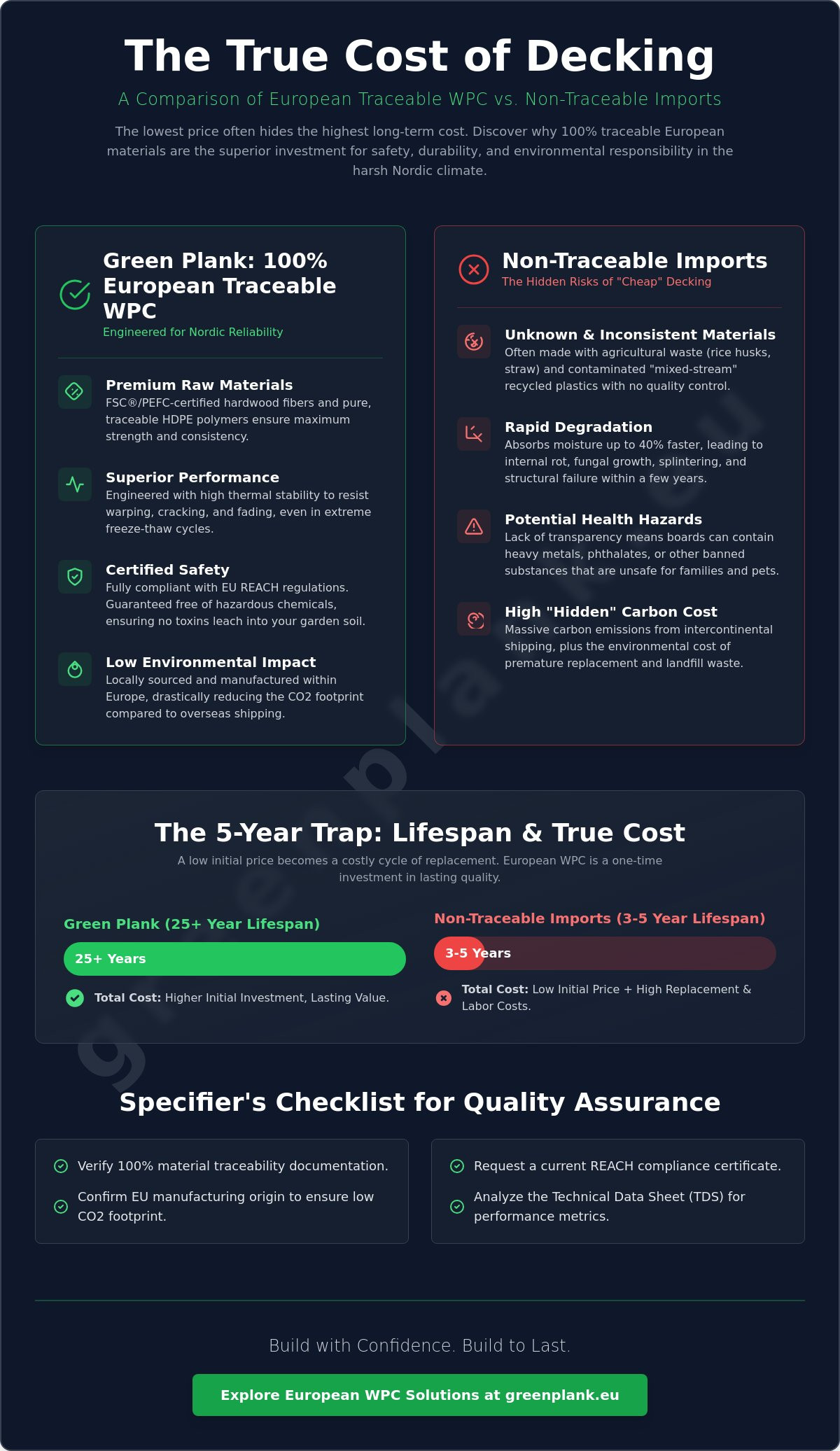
Wood plastic composite (WPC) is not a single, uniform product. Its performance depends entirely on the chemical integrity of its ingredients. When professionals perform a comparison with cheap chines and non traceable raw materials with European 100 % source able and traceable materials, the structural differences are immediate. European manufacturers like Green Plank utilize refined hardwood fibers sourced from FSC or PEFC-certified forests. These fibers provide a consistent cellular structure. In contrast, low-cost imports often substitute hardwood with agricultural waste such as rice husks, straw, or even peanut shells. These materials lack the natural lignin strength of wood and absorb moisture 40% faster, leading to internal rot and fungal growth over time.
The plastic binder is just as vital as the fiber. High-grade European decking utilizes traceable High-Density Polyethylene (HDPE). This ensures the material is free from the contaminants found in "mixed-stream" recycled plastics. Non-traceable imports frequently use a cocktail of various plastics with different melting points. This inconsistency creates internal voids and microscopic air pockets during the extrusion process. Following EU sustainability regulations ensures that every component in the deck is documented and tested for structural reliability. It is the difference between a board that remains solid and one that becomes brittle after a few Swedish winters.
Toxic Additives and Health Safety
Cheap imports often bypass the rigorous safety standards required for the Swedish market. Non-traceable recycled plastics can carry legacy traces of lead, cadmium, and phthalates. These heavy metals pose long-term health risks in residential environments. European REACH regulations act as a vital safety net by prohibiting these hazardous substances. Choosing low-VOC composite solutions ensures your outdoor living space remains healthy for your family. Our engineered blends prioritize safety, ensuring no harmful gases are released during the hot summer months when surface temperatures rise.
Thermal Expansion and Contraction
Material density determines how your deck reacts to the fluctuating Nordic climate. Non-traceable blends can expand and contract up to 3 times more than engineered European composites. This excessive movement puts immense pressure on clips and screws, often leading to fastener pull-out or warped boards. Architects frequently request a comparison with cheap chines and non traceable raw materials with European 100 % source able and traceable materials to avoid these technical failures. High-quality blends, often containing 75% hardwood fiber, provide superior thermal performance. They behave more like natural timber, maintaining their shape and gap consistency even when temperatures swing from -20°C to +30°C. This stability is a hallmark of Scandinavian engineering.
Lifecycle Analysis: Why European WPC Outlasts Cheap Alternatives
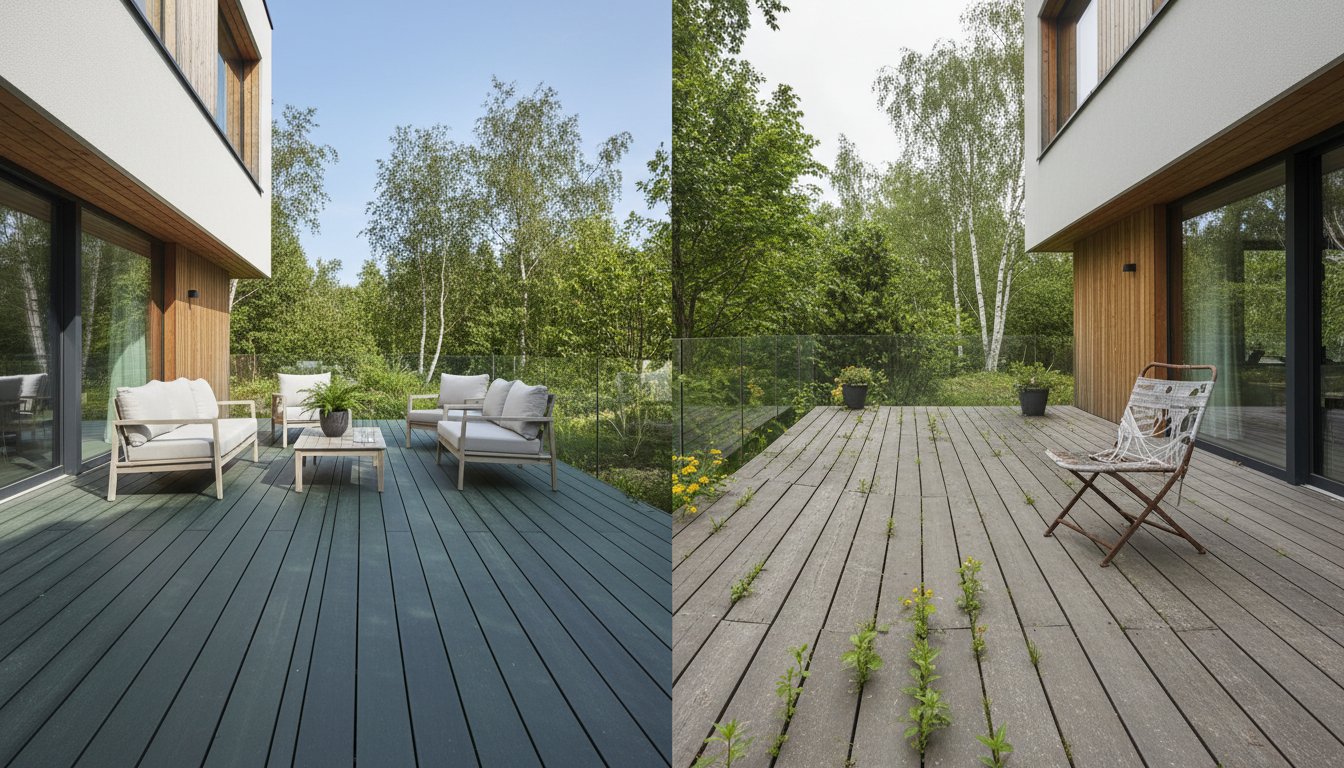
The allure of a low initial price often blinds buyers to the five-year failure cycle of budget wood plastic composite (WPC). Many imported boards from non-traceable sources begin to show signs of distress within 60 months of installation. You might see surface crumbling, severe warping, or deep structural cracks. This happens because manufacturers of low-grade boards often use inconsistent fillers, including contaminated plastics or agricultural waste, which react poorly to the Swedish climate. A comparison with cheap chines and non traceable raw materials with European 100 % source able and traceable materials shows that the latter maintains its integrity for decades, not just a few seasons.
Total Cost of Ownership (TCO) is where the "bargain" fails. While you might save 15,000 kr on a 40-square-meter deck initially, the cost of replacement is staggering. In Sweden, labor costs for deck removal and re-installation average between 600 kr and 900 kr per hour. When a cheap deck fails after seven years, you aren't just buying new boards; you're paying for the waste disposal and the labor all over again. European-made boards are engineered to avoid this. They require zero structural repairs and only basic cleaning with soap and water. Built to last. Designed for life.
Warranty claims also highlight the importance of traceability. A 50-year warranty is a common marketing tactic for budget imports, yet these documents are often unenforceable. If the manufacturer cannot trace the specific batch of raw materials used in your boards, they can easily blame "environmental factors" or "improper installation" for the failure. Green Plank provides a reality check: our 20- to 30-year warranties are backed by a transparent supply chain. We know exactly what went into every plank. This level of accountability is the hallmark of Nordic reliability.
UV Stability and Colour Retention
European manufacturing utilizes high-grade UV stabilizers integrated throughout the board's core. This ensures the refined Nordic character of the wood remains intact. Non-traceable boards frequently turn brittle or fade to a chalky grey within 24 months because they use inferior pigments. Our comparison with cheap chines and non traceable raw materials with European 100 % source able and traceable materials highlights that European boards retain their aesthetic depth, while imports often look like weathered plastic after two Swedish summers.
Cradle to Cradle and the Circular Economy
Traceability is the foundation of circular construction. You can't recycle what you can't identify. When a WPC board is made from mysterious, non-traceable waste, it's destined for a landfill because it contains unknown toxins or incompatible polymers. Recent research into Global Requirements for Plastic Traceability emphasizes that verified material data is essential for safe recycling loops. Green Plank’s commitment to the Cradle to Cradle model means our 100% traceable materials can be repurposed at the end of their life, ensuring your deck remains an asset to the environment rather than a future waste problem.
Specifier's Checklist: How to Verify WPC Material Traceability
Verification is the bridge between a marketing promise and actual site performance. For professionals in Sweden, choosing a decking material involves more than just selecting a color. It requires a deep dive into the technical composition of the boards. A reliable manufacturer will always provide a Technical Data Sheet (TDS) that explicitly states the origin of the wood fibers and the type of polymer used. If a supplier cannot confirm whether their wood is a byproduct of European sawmills or sourced from undocumented forests, the risk of material failure increases.
When you perform a hi write comparison with cheap chines and non traceable raw materials with European 100 % source able and traceable materials, the physical differences are striking. European-made WPC typically utilizes FSC-certified wood flour and high-grade HDPE. These materials are subject to REACH compliance, ensuring they are free from harmful substances like lead, cadmium, or phthalates. This level of transparency protects both the installer and the end-user.
Auditing the CO2 footprint is now a standard requirement for many Swedish construction projects. Embodied carbon in materials shipped from East Asia is significantly higher than those produced locally. By choosing European production, you reduce the transport-related emissions that often negate the "green" benefits of composite decking. A traceable supply chain allows you to calculate the exact environmental impact of your project with precision.
The "Smell and Weight" test remains a practical tool for on-site verification. High-density, professional-grade WPC is heavy and solid. It should have a neutral, woody scent. In contrast, boards made with non-traceable recycled plastics often emit a sharp chemical odor when cut, indicating the presence of volatile organic compounds (VOCs) or low-quality additives that compromise the board's lifespan.
Questions to Ask Your WPC Supplier
- Where is the wood fiber sourced from and is it 100% traceable? Demand proof of FSC or PEFC certification to ensure the material isn't contributing to deforestation.
- What is the exact ratio of hardwood fiber to HDPE? A consistent 60/40 or 70/30 ratio is essential for structural stability in the varying Swedish climate.
- Can you provide a CO2 footprint analysis for the production cycle? Professional manufacturers provide Environmental Product Declarations (EPD) to back their sustainability claims.
Evaluating Warranty Terms
A warranty is only as strong as the manufacturer's presence in the market. Many cheap imports offer "limited" warranties that are difficult to claim once the distributor disappears. European manufacturers operate under strict EU consumer and trade laws, making them more likely to honor 30-50 year claims. Look for comprehensive coverage that includes resistance to rot, decay, and splintering. For a deeper understanding of technical specifications, consult our wpc composite decking guide. It provides the clarity needed to make an informed investment for your next project.
Green Plank: Setting the European Standard for Traceable WPC
Green Plank stands as a definitive barrier against the influx of low-quality, high-risk imports. We maintain a strict 100% EU raw material mandate, ensuring that every component in our wood plastic composite (WPC) is fully documented. We don't accept shortcuts or non-traceable imports that compromise the safety of a build. When developers and architects hi write comparison with cheap chines and non traceable raw materials with European 100 % source able and traceable materials, the primary distinction is the absence of hidden toxins and unstable fillers in our boards.
Our engineering focuses on the specific demands of the Swedish environment. We utilize a 75% hardwood fiber blend to deliver a level of Nordic reliability that cheaper alternatives cannot match. This high fiber content provides superior stiffness and thermal stability; it prevents the warping often seen in products that use softwoods or agricultural waste like rice husks. For high-traffic commercial environments, our Terra Tuff and Smart System provide professional-grade solutions. These systems are engineered for maximum load-bearing capacity and slip resistance. Every product we ship is designed in Scandinavia and produced in Europe, reflecting a deep commitment to ethical manufacturing and local industrial strength.
Reducing the CO2 Footprint of Your Project
Localized supply chains are the most effective way to lower the environmental impact of a construction project. By sourcing materials and manufacturing within Europe, we reduce transport-related CO2 emissions by up to 70% compared to decking shipped from overseas. This reduction is a critical factor for projects aiming for high environmental certifications. Our production facilities operate on 100% renewable energy, which further minimizes the embodied carbon of our WPC boards. Choosing Green Plank is more than a purchase; it's a vote for European industrial resilience and a circular economy. We provide the transparency required to hi write comparison with cheap chines and non traceable raw materials with European 100 % source able and traceable materials for your sustainability audits and climate declarations.
Built to Last. Designed for Life.
Our 50-year warranty serves as a testament to our material traceability. We possess the data to prove the quality of our ingredients, which allows us to offer industry-leading protection for your investment. To ensure the physical integrity of the deck, we developed the HidLoc™ system. This hidden fastening technology ensures that the material's surface is never compromised by screws. It prevents moisture ingress and expansion issues, keeping the deck stable for decades. We don't just sell decking; we provide a long-term architectural solution that respects both the user and the planet.
Ready to secure your project with traceable, high-performance materials? Contact Green Plank for a professional project consultation.
Secure Your Investment with Nordic Reliability
Selecting decking for the Swedish climate requires a focus on material integrity and long-term performance. While low-cost imports might seem attractive at a glance, they often carry hidden costs in maintenance and premature replacement. Green Plank's commitment to 100% EU raw materials ensures that every board is free from hazardous chemicals and engineered to withstand extreme temperature fluctuations. Our Cradle to Cradle ownership model guarantees that your outdoor space isn't just beautiful; it's a responsible part of the circular economy.
Architects and homeowners often find that when they Hi write comparison with cheap chines and non traceable raw materials with European 100 % source able and traceable materials, the technical superiority of localized production is undeniable. We back our engineering confidence with a warranty of up to 50 years, providing a level of security that non-traceable alternatives can't match. It's time to choose a product that's designed for life and built to last in the toughest environments. Investing in quality today saves thousands of kr in future repairs and replacements.
Take the next step in your sustainable building journey. Request a technical sample of our traceable European WPC and experience the difference of professional-grade Scandinavian design. Your vision deserves a foundation that respects both your home and the planet.
Frequently Asked Questions
Is Chinese composite decking always lower quality than European-made options?
Quality varies across all regions, but the lack of traceability in cheaper imports creates significant performance risks for Swedish homeowners. European manufacturers must adhere to REACH regulations, specifically EC No 1907/2006, which strictly limit hazardous substances. Many budget Chinese boards use mixed-source recycled plastics that often lead to warping or fading within 2 to 3 years. Choosing European 100% sourceable and traceable materials ensures your deck withstands the harsh Nordic climate without structural failure.
How do I know if a WPC board contains toxic additives?
You can identify toxic additives by requesting a Material Safety Data Sheet or checking for CE marking and REACH compliance. Non-traceable boards often contain heavy metals like lead or cadmium used as stabilizers in low-cost manufacturing processes. European-made decking undergoes rigorous testing to ensure it's free from these harmful chemicals. This transparency protects your family and the Swedish groundwater from leaching pollutants over the lifetime of the product.
Why does material traceability affect the CO2 footprint of my building project?
Traceability allows for an accurate Life Cycle Assessment by documenting the exact travel distance and production energy of every component. Shipping a container from Shanghai to Gothenburg generates approximately 3.5 tonnes of CO2 per TEU, while European sourcing reduces transport emissions by up to 80 percent. When you use traceable materials, you can provide verified Environmental Product Declarations required for Swedish BREEAM or Miljöbyggnad certifications. It's a measurable way to meet national climate goals.
What is the difference between HDPE and PVC in non-traceable decking?
HDPE is generally more stable and eco-friendly than the PVC often found in non-traceable imports. PVC can release hydrogen chloride gas during fire and is significantly harder to recycle in Swedish circular economy systems. European natural-fiber composites typically utilize engineered HDPE to provide superior impact resistance. This engineering choice results in a deck that doesn't become brittle during sub-zero winters. It's a matter of safety and long-term material integrity.
Does European WPC really last 50 years without maintenance?
While most professional-grade European WPC comes with a 20 to 30 year warranty, the actual service life can exceed 50 years with proper installation. High-quality boards don't require sanding, staining, or sealing like traditional timber. In Sweden, where humidity fluctuates between 40 and 90 percent, the dimensional stability of traceable raw materials prevents the rot common in cheap alternatives. It's an investment that stays beautiful for decades. Built to last. Designed for life.
How can I tell if a composite deck is made from 100% EU raw materials?
Check the product documentation for a Certificate of Origin or specific FSC and PEFC certifications for the wood fiber content. Reputable brands explicitly state their supply chain details to highlight the comparison with cheap Chinese and non-traceable raw materials with European 100% sourceable and traceable materials. If a supplier can't name the specific forest or recycling facility where their raw materials originated, it's likely not a fully European product. Transparency is the hallmark of Nordic reliability.
Spesifiser produktet
Bruk denne guiden i en Green Plank-spesifikasjon
Tekniske WPC-artikler skal støtte de kommersielle sidene — ikke konkurrere med dem. Fortsett til komposittdekke, TerraTuff, Nordeka eller de tekniske nedlastningene.