



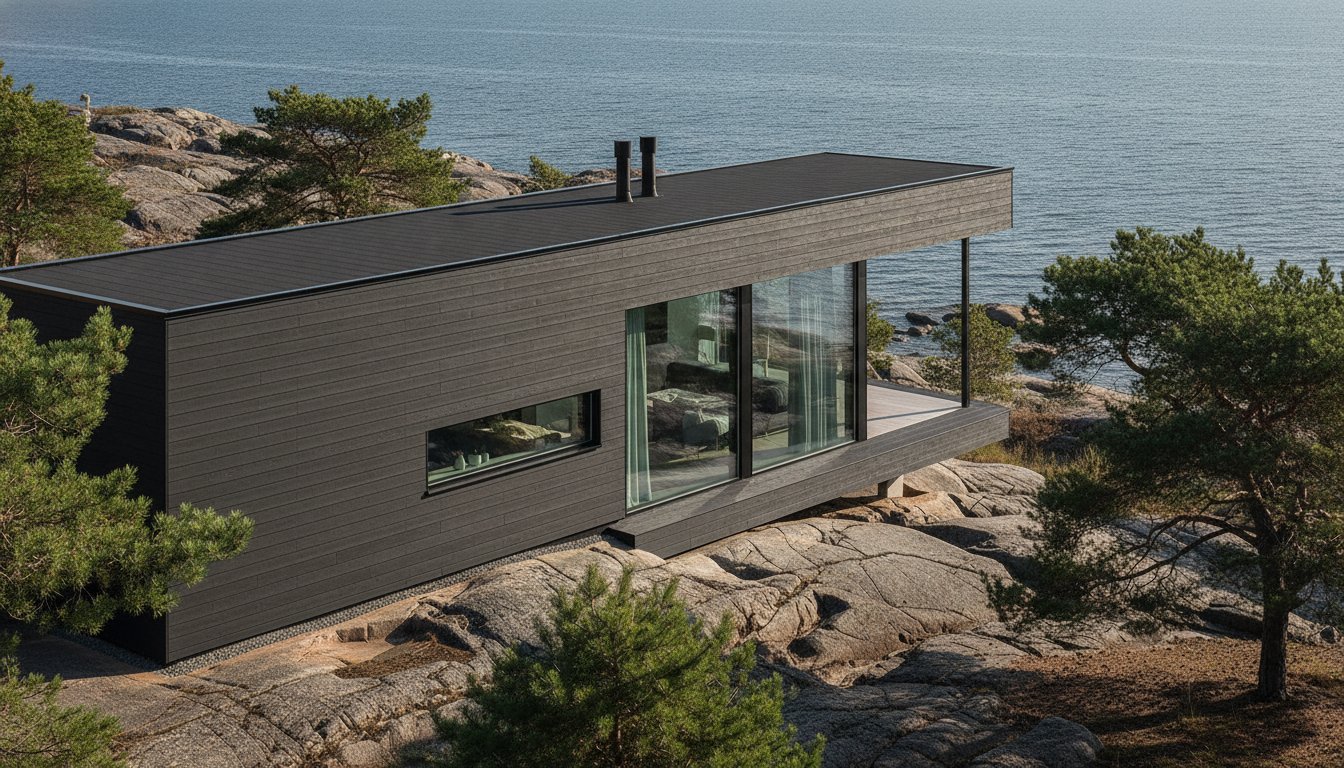
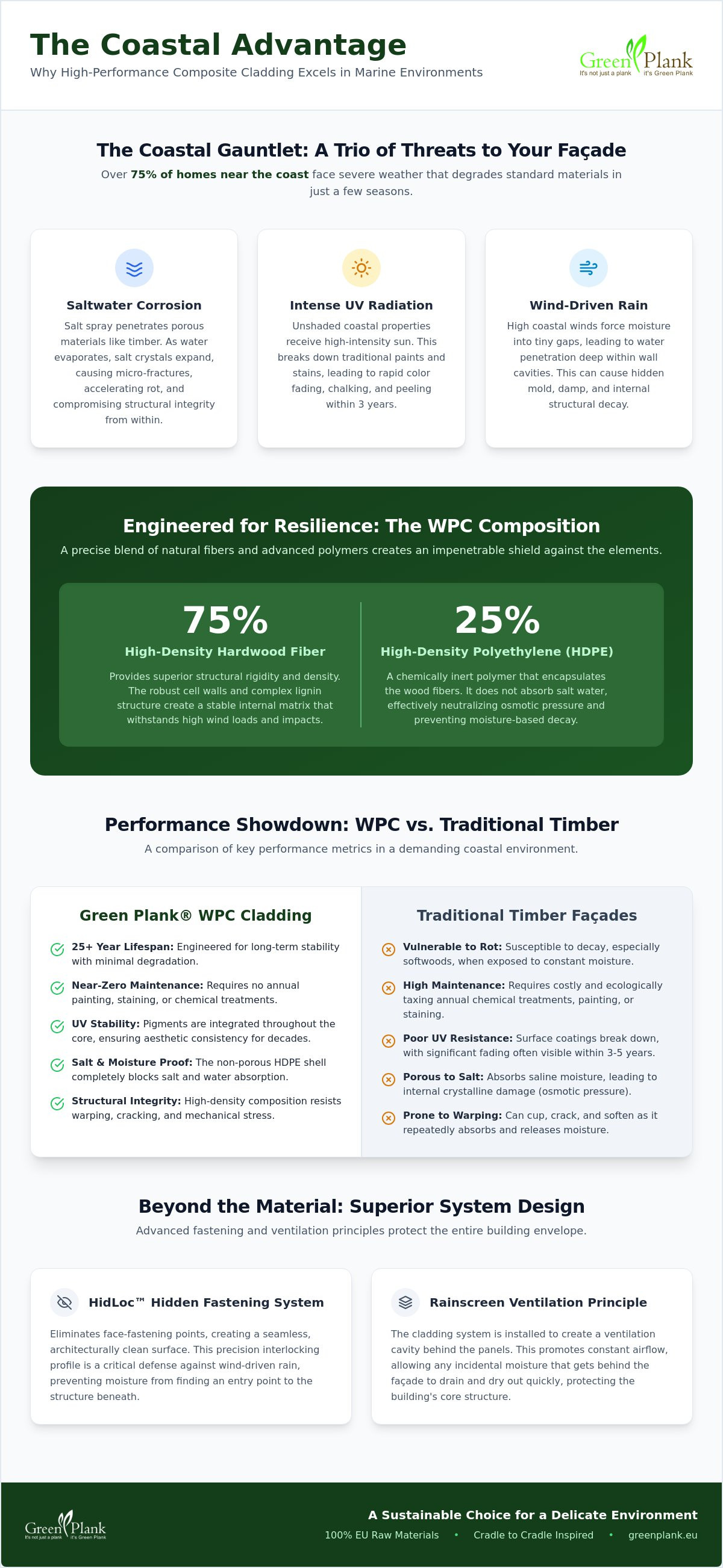
Over 75% of homes situated near the coast face severe weather conditions that can degrade standard building materials in just a few seasons. If you've ever watched your timber facade bleach under the sun or seen metal fasteners bleed rust into your paintwork, you know the relentless nature of the marine environment. Protecting your investment requires more than just a surface-level solution. High-performance composite cladding for seaside properties offers a sophisticated engineering response to salt spray, high winds, and the intense UV exposure typical of coastal zones. It's a material choice that respects both the architecture and the delicate environment it inhabits.
You'll discover why modern WPC technology is now the definitive choice for designers who prioritize a maintenance-free facade for 25 years or more. This guide explores the 2026 engineering standards, including the latest wind speed maps from ASCE 7-22 and the updated fire safety classifications of BS EN 13501-1. We'll examine how 75% hardwood fiber and advanced HDPE resins create a shell that resists warping while maintaining aesthetic consistency. From the precision of HidLoc™ hidden fastening systems to the carbon-saving benefits of 100% EU raw materials, we're detailing the science of coastal resilience.
Key Takeaways
- Identify the specific material vulnerabilities in marine zones to prevent the accelerated rot and corrosion common in traditional seaside facades.
- Discover how high-density hardwood fibers provide the superior structural rigidity needed to withstand the mechanical stresses of high-wind coastal environments.
- Learn how to specify composite cladding for seaside properties that maintains its aesthetic integrity under intense UV exposure without the need for frequent painting or staining.
- Evaluate the technical benefits of the HidLoc™ hidden fastening system and rainscreen ventilation principles for protecting the building envelope.
- Align your project with ecological standards by choosing materials engineered with 100% EU raw materials and a commitment to Cradle to Cradle circularity.
The Challenges of Coastal Architecture: Why Facades Fail
The "Marine Zone" is a rigorous testing ground for any building envelope. Generally defined as the area within five kilometers of the shoreline, this zone subjects facades to a relentless battery of environmental stressors. While the view is aspirational, the reality for building materials is one of constant chemical and mechanical attack. Traditional materials often struggle to maintain their structural integrity here. High-performance composite cladding for seaside properties is engineered specifically to address these localized failures before they begin.
Wind-driven rain represents a significant hidden threat in these locations. Coastal wind speeds are significantly higher than inland averages, which forces rain into the smallest gaps in a facade. This pressure pushes moisture deep into structural wall cavities. If a cladding system isn't designed to shed this water quickly, the resulting damp leads to mold and internal structural decay. Choosing a material that offers precise interlocking profiles is essential for maintaining a dry, healthy building interior.
Saltwater Corrosion and Osmotic Pressure
Salt spray isn't just a surface contaminant; it's a catalyst for cellular destruction. When saline moisture penetrates the pores of natural timber, the water eventually evaporates, leaving behind salt crystals. These crystals grow and expand within the wood fibers, a process known as osmotic pressure. This internal expansion causes micro-fractures that accelerate rot and structural softening. Traditional softwoods are particularly vulnerable, often requiring annual chemical treatments that are both costly and ecologically taxing. In contrast, the HDPE used in Wood-Plastic Composites (WPCs) is chemically inert. It doesn't absorb the brine, effectively neutralizing the risk of osmotic breakdown and ensuring the material remains structurally sound despite constant salt exposure.
UV Stability in Unshaded Marine Environments
Coastal properties frequently lack the natural shade provided by inland forests or urban canyons. This leaves facades exposed to direct, high-intensity solar radiation for the majority of the day. Traditional paints and stains rely on organic binders that break down under UV light, leading to chalking, peeling, and rapid color loss. Modern manufacturing solves this through the integration of UV-stabilized pigments throughout the material core. While painted timber might show significant fading within three years, composite cladding for seaside properties maintains its aesthetic consistency for decades. This longevity ensures that the visual appeal of a seaside home remains intact without the environmental burden of repeated chemical refinishing. It's a solution that balances premium aesthetics with a grounded, eco-conscious responsibility.
Engineering WPC for the Sea: Hardwood Fiber and HDPE
The structural integrity of composite cladding for seaside properties depends entirely on its internal composition. While many market alternatives utilize generic softwood "flour," high-performance engineering favors a precise ratio of 75% hardwood fiber and 25% High-Density Polyethylene (HDPE). This specific blend isn't arbitrary. It's designed to provide the mechanical strength required to resist the intense wind loads and atmospheric pressures found at the water's edge. This ratio ensures the material remains heavy enough to provide structural substance yet flexible enough to handle thermal expansion.
Density plays a critical role in how a facade responds to physical stress. Low-density composites often lack the internal "skeleton" needed to remain stable during extreme weather events. In contrast, high-density WPC profiles offer superior impact resistance and structural rigidity. Research featured in the Journal of Composites for Construction highlights how fiber-reinforced polymers behave under mechanical load, confirming that the quality of the organic filler directly dictates the longevity of the final assembly. For seaside applications, this density is the difference between a facade that rattles in the wind and one that remains silent and secure.
The Hardwood Advantage in Composite Density
Hardwood fibers are inherently more robust than their softwood counterparts. They possess thicker cell walls and a more complex lignin structure, which creates a stable internal matrix when fused with polymer resins. High fiber density prevents the material from warping or expanding unevenly when subjected to the high humidity levels typical of coastal environments. This structural stability ensures that the cladding panels remain flush and secure over decades of service. Because hardwood fibers are more resistant to compression, they also provide a higher level of impact resistance against wind-borne debris during winter storms.
HDPE as a Moisture Barrier
The 25% HDPE component acts as a high-performance binder that completely encapsulates every individual hardwood fiber. This encapsulation process creates a nearly impenetrable moisture barrier. By utilizing 100% EU raw materials, the manufacturing process maintains a level of polymer purity that ensures consistent performance across every plank. This is vital for coastal builds where moisture is constant. It's a standard that ensures the material won't swell or delaminate when the salt air is at its thickest.
This composite matrix effectively prevents the internal fungal growth and "black spot" mold that often plagues traditional timber in seaside humidity. It's a system designed for those who value long-term reliability. If you're planning a project in a sensitive marine area, you can explore our engineered cladding range to see how these material standards translate into architectural beauty. By combining engineering precision with environmental ethics, these composites provide a facade that respects both the structure and the sea.
Performance Comparison: WPC vs. Traditional Coastal Cladding
Selecting a facade for a coastal home is a decision that impacts the property's value for decades. While traditional materials like timber, metal, or fiber cement are common, they often fail to meet the specific mechanical demands of the marine environment over a 50-year service life. High-performance composite cladding for seaside properties provides a more resilient alternative by combining organic strength with synthetic durability. This engineering approach eliminates the most common failure points found in single-source materials.
Weight is a critical factor for seaside renovations and retrofits. Traditional masonry or thick fiber cement boards add significant dead load to a structure, which may require additional reinforcement of the existing wall studs. WPC profiles are engineered with a lower density than stone or cement, making them easier to handle on-site and safer for older coastal buildings. This reduced weight doesn't compromise strength; instead, it allows for a more efficient installation process that respects the structural limits of the original architecture.
Maintenance Cycles and Long-Term Value
The "hidden cost" of timber is its relentless demand for human intervention. In salt-heavy air, natural wood requires sanding, sealing, or repainting every 24 months to prevent the fibers from silvering and splitting. Over a 30-year period, the cumulative expense of these treatments often exceeds the initial cost of the cladding itself. WPC removes this burden. It requires only basic cleaning with soap and water to maintain its appearance. This shift from active maintenance to passive durability ensures a lower Total Cost of Ownership (TCO) and provides aesthetic consistency despite constant UV exposure.
Environmental Resistance: Salt, Wind, and Impact
Direct comparisons reveal significant vulnerabilities in other popular materials. Fiber cement, while fire-resistant, can become brittle in high-wind zones, leading to cracks when struck by wind-borne debris. Metal cladding often suffers from galvanic corrosion near the shore, where salt acts as an electrolyte that accelerates rust. Recent sustainable wood-plastic composite research confirms that HDPE-based composites maintain superior mechanical stability under these conditions. These findings support the use of composite wall cladding as a primary defense against the unique chemical and physical pressures of the coastline. By choosing a material that is naturally resistant to both oxidation and impact, architects can ensure a facade that remains secure for 25 years or more.
Specifying and Installing Cladding in Coastal Zones
Coastal construction demands a shift from standard building practices to high-precision engineering. For composite cladding for seaside properties, the installation method is just as critical as the material composition itself. A poorly executed install can create micro-environments where salt and moisture thrive, leading to premature failure of the substructure. By prioritizing mechanical fastening and airflow, architects can ensure the facade performs as intended for its full 50-year service life. This approach respects the structural integrity of the home while maintaining its premium aesthetic.
Specifying composite cladding for seaside properties also requires a deep understanding of local wind load requirements. Properties situated on exposed cliffs face significantly higher mechanical pressures than those in sheltered bays. Ensuring your project meets the 160 mph impact-resistant envelope requirements found in modern 2026 building codes is essential. It's a standard that provides both peace of mind and a durable architectural finish that doesn't rattle or flex under pressure.
HidLoc™ and Structural Integrity
Hidden fastening systems like HidLoc™ are the 2026 standard for high-wind zones. Traditional face-fixing creates thousands of tiny entry points where screw heads break the board surface. In a marine environment, these small depressions become collection points for salt-water pooling. This concentrated brine accelerates the degradation of the fastener and the surrounding composite material. HidLoc™ eliminates these vulnerabilities by securing the boards from the side. This results in a screw-free, clean facade finish that removes the threat of "rust bleeding" down the wall. It's a cleaner look that offers better protection.
Ventilation and Moisture Management
Designing for effective ventilation follows the rainscreen principle. This involves creating a minimum 20mm airflow gap between the cladding and the building's weather barrier. This cavity allows for pressure equalization, which prevents wind-driven rain from being sucked into the wall assembly. Proper batten spacing is essential to maintain this gap without compromising the structural support of the WPC panels. These same structural principles are explored in our deck installation guide, where airflow is equally vital for long-term performance.
Managing thermal expansion in long-run seaside facades requires precise gap calculations at the joints. Coastal facades experience extreme temperature swings between morning mist and direct afternoon sun. Builders should utilize specialized sealing gaskets or trims at edges to prevent salt ingress into the cut ends of the boards. This attention to detail ensures the expansion doesn't lead to buckling over time. You can view our technical installation specifications to ensure your next coastal project meets these rigorous engineering standards.
Sustainable Coastal Solutions with Green Plank WPC
Building at the water's edge is a privilege that carries an inherent ecological responsibility. Modern coastal developments must balance the desire for premium aesthetics with the urgent need to reduce environmental impact. High-performance composite cladding for seaside properties provides a pathway to achieve this balance. By selecting materials engineered for longevity and circularity, designers can protect the coastline's natural beauty while ensuring the structural durability of the building. It's a commitment to quality that extends beyond the facade to the very ecosystem it inhabits.
Reducing the CO2 footprint of a project begins with the supply chain. Choosing materials manufactured within the region ensures that transportation emissions are kept to a minimum. This regional reliability is a core tenet of the Responsible Innovator mindset. When a facade is built to last for half a century, the need for replacement materials is eliminated, further lowering the lifetime environmental cost of the property. It's a strategy that prioritizes long-term performance over short-term convenience.
European Quality and Circular Design
The Green Plank commitment relies on 100% EU raw materials and local manufacturing standards. Sourcing within the European Union ensures that every component meets rigorous environmental and labor regulations. This localized approach significantly reduces the carbon intensity of premium seaside developments. Our 75% hardwood blend utilizes recycled resources diverted from industrial waste streams, creating a high-density matrix without the need for virgin timber harvesting.
Adopting a Cradle to Cradle ownership model is essential for future-proofing coastal architecture. This circular approach ensures that materials are designed for a continuous life cycle, rather than a linear path to a landfill. By prioritizing circularity, we ensure that:
- Resource consumption is minimized through the use of recycled hardwood fibers.
- Product longevity is maximized with a long service life of up to 50 years.
- Material health is maintained through the exclusion of toxic additives.
- Waste is eliminated by designing profiles that can be repurposed at the end of their functional life.
Professional Specifier Support
Engineering a resilient coastal facade requires precise data and reliable technical support. We provide architects and industry professionals with comprehensive technical data sheets and BIM objects to streamline the planning process. These tools allow for accurate wind load calculations and thermal expansion modeling, ensuring that the composite cladding for seaside properties performs flawlessly in situ. For commercial coastal projects, our custom infrastructure profiles offer the same high-density durability found in residential systems.
Our specific long-term performance guarantees, including warranties up to 50 years, serve as a primary signature of our engineering confidence. This assurance allows specifiers to design with certainty, knowing the facade will resist the harshest marine conditions without failing. To start your next project with a foundation of durability and ethics, you can Explore Green Plank Composite Cladding Systems and discover the standard of sustainable craftsmanship.
Designing for Coastal Resilience and Circularity
Protecting a shoreline facade requires a shift away from the frequent maintenance cycles of traditional timber. By integrating high-density hardwood fibers with chemically inert HDPE, composite cladding for seaside properties provides a definitive barrier against salt crystallization and UV degradation. The engineering doesn't stop at the material level; the HidLoc™ hidden fastening system ensures superior wind resistance while maintaining a clean, screw-free aesthetic that prevents rust bleeding. These technical choices provide the foundation for a home that remains beautiful and structurally secure for decades.
Choosing a sustainable path doesn't mean compromising on durability. Our commitment to 100% EU-sourced materials significantly reduces the CO2 footprint of your development, while our 50-year warranty offers long-term confidence in your investment. This circular approach to construction respects both the architectural vision and the sensitive marine environment. To see how these engineering standards translate into your specific design, you can Request a Professional Sample Pack for Your Coastal Project. We look forward to helping you build a maintenance-free future that honors the sea.
Frequently Asked Questions
Is composite cladding really salt-resistant?
Yes, high-performance composite cladding for seaside properties is inherently salt-resistant because the HDPE resin completely encapsulates the wood fibers. This prevents the brine from penetrating the material, which avoids the osmotic pressure and cellular breakdown that typically destroys natural timber. It's a chemically inert solution that maintains its structural integrity despite constant exposure to sea spray. This protection ensures the material doesn't soften or lose its density over time.
How does coastal wind affect composite wall panels?
Coastal winds exert significant mechanical pressure on facades, but high-density WPC panels are designed to withstand these loads when properly installed. Utilizing the HidLoc™ hidden fastening system ensures that each plank is secured without creating vulnerable entry points for wind-driven rain. This mechanical security is essential for properties on exposed cliffs where gusts can exceed standard inland averages. It's a system built for structural peace of mind.
Does composite cladding fade in direct seaside sunlight?
While all materials experience some solar impact, UV-stabilized pigments ensure that high-end WPC maintains its aesthetic consistency for decades. These pigments are integrated throughout the material core rather than sitting on the surface like paint or stain. This prevents the rapid fading, chalking, and peeling common in traditional seaside facades. It ensures your home keeps its premium look without the need for constant refinishing or repainting.
Can I install WPC cladding myself on a beach house?
While DIY installation is possible, we recommend professional installation for coastal properties to ensure compliance with wind-load and ventilation standards. Precise calculations are needed for expansion gaps and the critical 20mm airflow cavity. A professional install guarantees the system performs as a true rainscreen, protecting your building's structural wall cavities from moisture. This expertise is vital for maintaining the long-term performance and warranty of the cladding system.
How do you clean salt spray off composite cladding?
Cleaning salt spray off your facade requires only a simple solution of soap and warm water. Because the material is non-porous, salt crystals sit on the surface rather than embedding deep in the fibers. Regular rinsing prevents the build-up of abrasive grime and maintains the premium finish without the need for harsh chemicals. It's a straightforward maintenance routine that respects the surrounding marine environment while keeping the facade pristine.
What is the lifespan of WPC cladding in a marine environment?
High-quality WPC cladding is engineered for a service life of up to 50 years in marine environments. This longevity is backed by specific performance guarantees that reflect the material's resistance to rot, decay, and corrosion. It's a long-term investment that provides regional reliability and peace of mind for property owners. By choosing a material that doesn't degrade, you're investing in a permanent solution that avoids the waste of frequent replacements.
Is WPC more expensive than timber for seaside homes?
Composite cladding for seaside properties typically has a higher upfront cost, but it provides significantly better value over its lifespan. You'll avoid the recurring expenses of sanding, sealing, and repainting that timber requires every two years in salt air. When you calculate the Total Cost of Ownership over 25 years, WPC is the more economical and sustainable choice. It's a premium investment that pays for itself through reduced labor and material costs.
Does composite cladding expand and contract more in coastal heat?
WPC does experience thermal expansion, but the 75% hardwood fiber content provides the structural rigidity needed to manage these movements effectively. Proper installation spacing allows the boards to expand and contract without buckling or warping. This stability is vital in coastal zones where temperatures shift rapidly between cool morning mist and direct afternoon sun. It's an engineering standard that ensures the facade remains flush and secure throughout the seasons.
Spesifiser produktet
Bruk denne guiden i en Green Plank-spesifikasjon
Tekniske WPC-artikler skal støtte de kommersielle sidene — ikke konkurrere med dem. Fortsett til komposittdekke, TerraTuff, Nordeka eller de tekniske nedlastningene.