



If your commercial perimeter requires a maintenance crew every spring, it isn't an asset; it's a liability. For projects commissioned in 2026, selecting the right commercial composite fencing supplier is no longer just about aesthetics. It is a strategic decision that impacts your carbon footprint and your bottom line for the next five decades. You've likely seen the failure of timber in high-traffic public spaces or the rapid warping of cheap imports that lack material transparency. It's a costly cycle that drains resources and compromises the visual integrity of professional landscapes.
We believe that infrastructure should be built to last. This article details the technical specifications and sustainability benchmarks required to achieve a 50-year service life. We'll examine the essential shift toward Cradle to Cradle ownership, the necessity of 100% EU raw material sourcing, and how to navigate the new Digital Product Passport requirements. You'll discover how to secure a boundary that delivers zero-maintenance consistency while meeting the highest ecological standards of the modern circular economy.
Key Takeaways
- Learn why the 75/25 hardwood-to-HDPE ratio is the engineering standard for commercial rigidity and impact resistance in public spaces.
- Identify the criteria for selecting a commercial composite fencing supplier that guarantees 100% EU raw material transparency and supply chain security.
- Compare initial capital expenditure against long-term operational savings by eliminating the costly and labor-intensive traditional staining and painting cycles.
- Understand how high-recycled-content WPC systems contribute to LEED and BREEAM certifications while providing critical acoustic insulation for urban developments.
- Explore the Cradle to Cradle ownership model and how 50-year service life warranties redefine boundary infrastructure as a permanent, circular asset.
Table of Contents
- Defining the Commercial Composite Fencing Supplier in 2026
- Engineering for High-Traffic Infrastructure: Material Science and Durability
- Calculating the Long-Term ROI of Composite vs. Traditional Fencing
- Specifying Sustainable Fencing for Public and Commercial Projects
- Green Plank: Europe’s Leading Partner for Circular Fencing Solutions
Defining the Commercial Composite Fencing Supplier in 2026
The 2026 construction market demands more than just a boundary. As urban developments face stricter environmental scrutiny, the role of a commercial composite fencing supplier has evolved from providing simple barriers to delivering high-performance infrastructure assets. It's no longer enough to offer a product that looks like wood. Today's specifiers require verified technical data, carbon footprint transparency, and a commitment to circularity. A professional supplier distinguishes itself by moving beyond retail aesthetics to focus on long-term engineering and material ethics.
Infrastructure Profiles vs. Residential Panels
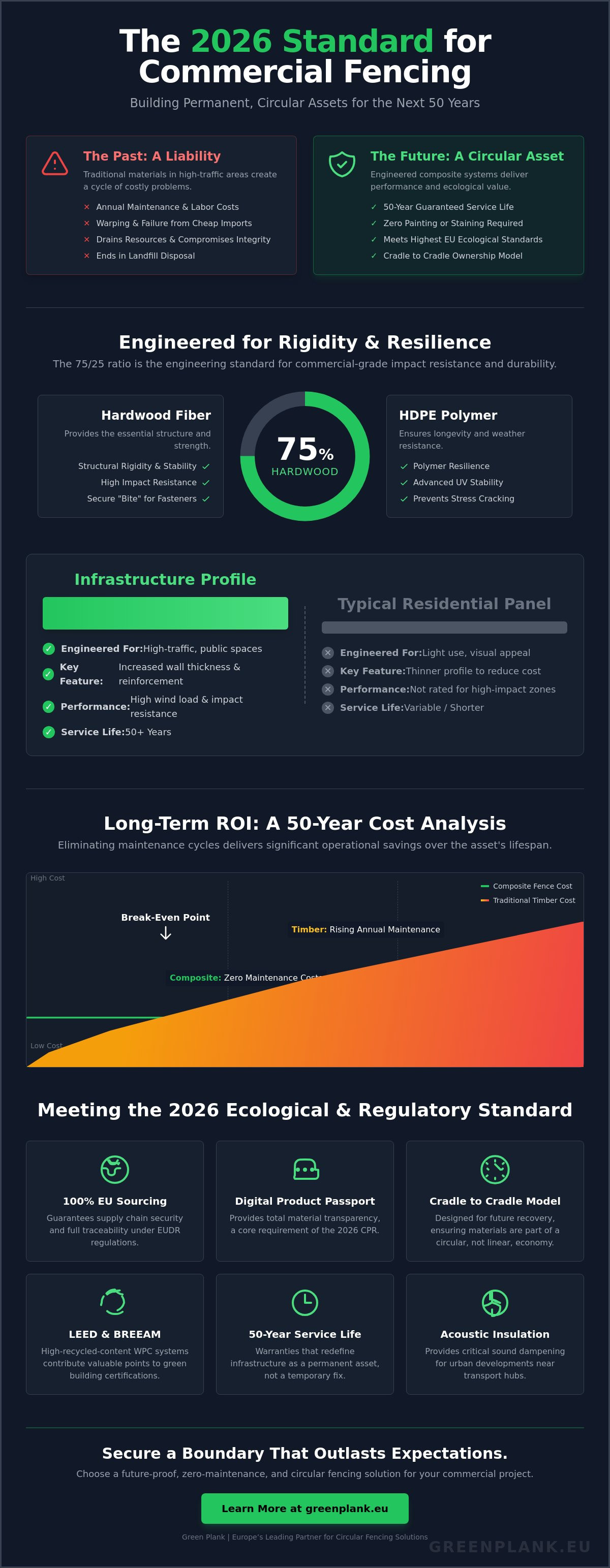
Residential fencing is often designed for light use and visual appeal. In contrast, infrastructure profiles are engineered for survival in public spaces. Commercial projects involve higher wind loads and greater physical impact risks, necessitating specific structural differences. High-performance wood-plastic composites (WPCs) utilize advanced HDPE to prevent environmental stress cracking. This ensures the material doesn't become brittle over its 50-year service life. Increased wall thickness and internal reinforcement are standard in commercial profiles, providing the rigidity required for long-term stability that thin, residential panels simply can't match.
The Importance of Regional Manufacturing
Supply chain security is a primary concern for modern projects. By utilizing 100% EU raw materials, a commercial composite fencing supplier eliminates the risks associated with volatile global logistics and opaque material origins. Under the EU Deforestation Regulation (EUDR) taking full effect in late 2026, every wood fiber must be traceable to its forest of origin. This level of transparency is only possible through regional oversight. It's a vital part of choosing Sustainable Building Materials that align with the latest Construction Products Regulation (CPR). Regional manufacturing doesn't just reduce the carbon footprint; it ensures compliance with the Digital Product Passport requirements enacted in early 2026.
A world-class supplier focuses on the entire lifecycle through a Cradle to Cradle ownership model. This approach ensures that every profile is designed for future recovery rather than landfill disposal. To meet 2026 standards, infrastructure must satisfy three core technical requirements:
- UV Stability: Advanced pigments maintain aesthetic consistency and prevent surface degradation under intense solar exposure.
- Wind Load Resistance: Engineered profiles provide the structural rigidity needed for open-span installations in exposed commercial sites.
- Low-Density Engineering: Proprietary manufacturing techniques reduce material weight without sacrificing strength, which lowers transportation emissions and simplifies site handling.
Engineering for High-Traffic Infrastructure: Material Science and Durability
Commercial perimeters in 2026 demand a level of material science that far exceeds traditional residential standards. When a commercial composite fencing supplier specifies products for public infrastructure, the focus shifts from simple privacy to structural integrity and impact resistance. High-traffic areas, such as transport hubs or municipal parks, require materials that can withstand physical stress without sacrificing their aesthetic or ecological profile. Engineering these boundaries involves a precise balance of polymer science and natural fiber reinforcement.
The foundation of this durability lies in the 75/25 formula. By utilizing 75% hardwood fiber and 25% high-density polyethylene (HDPE) with specific additives, we create a profile that possesses the rigidity of timber and the resilience of advanced polymers. This specific ratio is critical for maintaining structural "bite" for fasteners, ensuring that screws and brackets remain secure even under constant vibration or wind pressure. Scientific analysis, including a comprehensive Life Cycle Assessment (LCA), confirms that the choice of feedstock significantly impacts both the environmental footprint and the mechanical performance of the final installation.
Hardwood Fiber vs. Softwood Fillers
Many suppliers rely on softwood fillers because they're cheaper to process. However, hardwood fiber provides superior moisture resistance and a higher density that prevents internal decay. The length of the fiber is equally important; longer fibers create a more robust internal matrix, which increases the overall tensile strength of the fencing profile. This engineering choice prevents the material from becoming brittle over time. The 75/25 blend is the optimal ratio for preventing long-term bowing in 1.8m+ panels.
UV Inhibitors and Colour Longevity
Aesthetic consistency is a primary requirement for large-scale commercial developments. To achieve this, commercial-grade WPC must feature imbued UV inhibitors that are chemically bonded within the material core. This technology ensures that the colour doesn't just sit on the surface but remains consistent throughout the board. For high-traffic areas prone to staining or graffiti, second-generation co-extruded (capped) surfaces offer an additional protective layer. This polymer shield provides an impermeable barrier against oils, dirt, and moisture, maintaining a zero-maintenance finish for decades.
Engineering for the European climate also requires meticulous thermal expansion management. Our profiles are designed with internal cavities that allow for natural airflow, reducing the heat absorption that causes lesser materials to expand and contract excessively. This low-density engineering also reduces the dead load on elevated commercial structures, such as rooftop gardens or bridges. If you're planning a project that requires these rigorous standards, you can view our commercial infrastructure profiles to see how we balance performance with circularity.
Calculating the Long-Term ROI of Composite vs. Traditional Fencing
Financial directors often prioritize initial capital expenditure (Capex), yet the true measure of a project's success lies in its Total Cost of Ownership (TCO). While traditional timber fencing offers a lower upfront price point, it carries an inherent and escalating maintenance burden. Choosing a professional commercial composite fencing supplier allows for a strategic shift in budgeting. By investing in high-performance materials, organizations transform a recurring expense into a long-term infrastructure asset. A 50-year service life ensures that the cost of the installation is amortized over decades, providing a level of fiscal responsibility that public works and large-scale commercial developments require.
Biological threats represent the primary cause of timber failure in damp European climates. Traditional wood is susceptible to rot, fungal decay, and insect infestations that compromise structural integrity within years, not decades. Composite systems are engineered to be inert. They don't absorb moisture, which eliminates the risk of internal degradation. This resistance ensures the perimeter remains secure and aesthetically consistent without the need for periodic board replacements or structural reinforcements.
Maintenance Lifecycle Analysis
Quantifying the man-hours saved on fence maintenance is essential for accurate commercial budgeting. In a typical commercial complex, a timber perimeter requires cleaning, sanding, and re-staining every three to five years to prevent weather damage. These labor costs add up quickly. Over a 25-year period, the cumulative expense of maintaining wood often exceeds the original purchase price of the fence itself. Transitioning to a zero-maintenance solution eliminates this cycle entirely. It's a benefit similar to that found in Low Maintenance Decking, where the focus remains on performance rather than preservation. Furthermore, eliminating chemical stains and sealants reduces the environmental impact of the facility's ongoing operations.
Warranty as a Financial Safeguard
A 50-year warranty serves as a primary signature of engineering confidence. It isn't just a marketing claim; it's a legal and financial safeguard for commercial insurers and property managers. This long-term guarantee covers structural performance in demanding environments, ensuring that the supplier stands behind the material's durability. In public spaces, vandalism and graffiti are constant concerns. High-density composite surfaces are significantly easier to clean than porous wood. Most paints and markers don't bond deeply with the polymer-rich surface, allowing for rapid removal without damaging the underlying profile. This resilience protects the visual integrity of the site and reduces the costs associated with property restoration.
Specifying Sustainable Fencing for Public and Commercial Projects
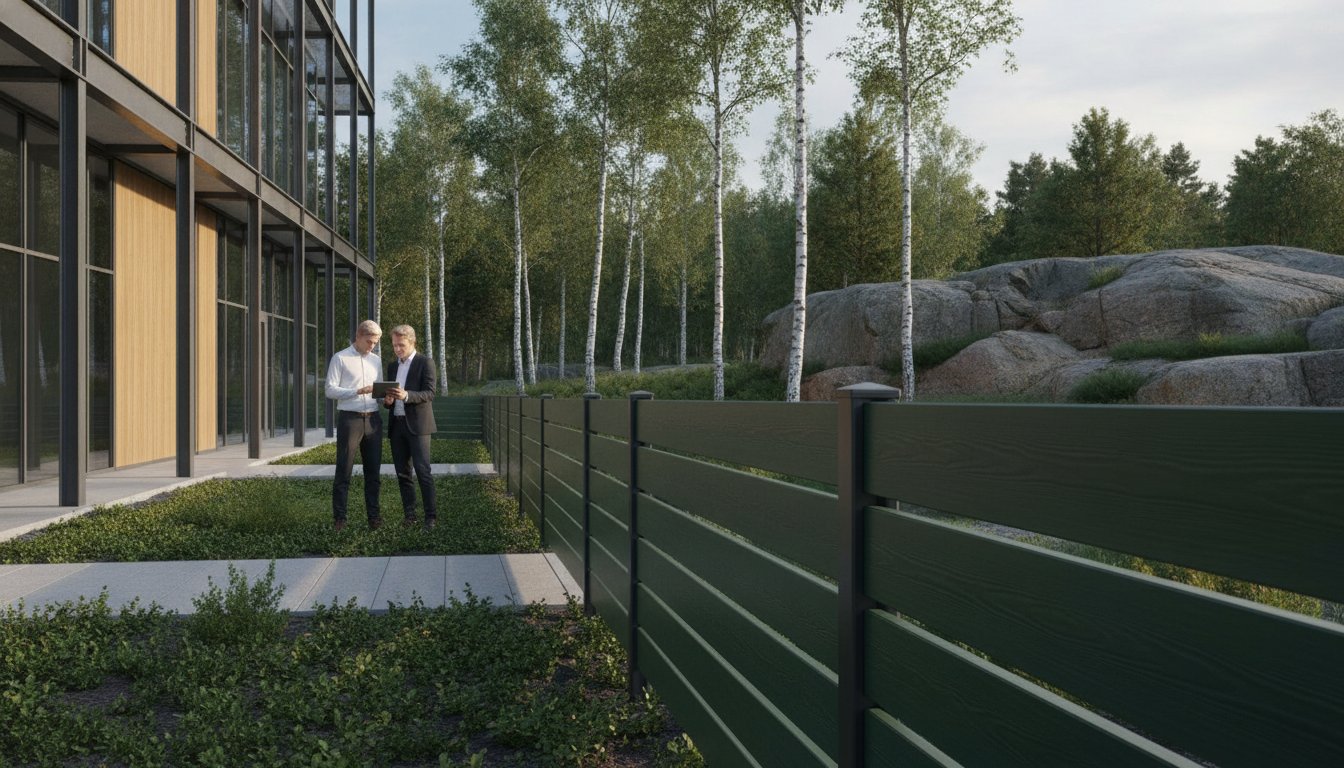
Specifying materials for the public realm requires a rigorous approach to compliance and environmental impact. A reputable commercial composite fencing supplier provides the technical documentation necessary to satisfy LEED and BREEAM certification requirements. These international frameworks reward the use of high-recycled-content WPC, as it directly reduces the embodied carbon of new developments. Beyond ecological metrics, professional projects demand superior security features. Interlocking profiles are a primary engineering requirement for these sites. They create a 'no-gap' perimeter that enhances both privacy and visual security for sensitive commercial installations.
Safety in high-traffic environments is further enhanced through the integration of the HidLoc™ hidden fastening system. This proprietary technology allows for a completely fastener-free surface. It eliminates exposed screws or nails that could cause injury or be subject to tampering in public spaces. The resulting clean aesthetic respects the architectural vision of the project while ensuring a durable, safe boundary that remains stable over decades of use.
Acoustic Performance in Urban Planning
Urban developments situated near highways or industrial zones face significant noise pollution challenges. High-density composite serves as a sustainable and effective sound barrier in these demanding environments. While standard timber fencing often allows sound leakage through natural gaps and low-density fibers, composite systems offer superior sound attenuation. The high material density of Green Plank profiles creates a substantial physical barrier that effectively dampens ambient noise and improves the acoustic comfort of urban spaces. This performance makes it a preferred choice for city planners who need to mitigate environmental noise without resorting to industrial-looking concrete barriers.
Safety and Compliance
Safety in schools, healthcare facilities, and public parks is non-negotiable. Composite surfaces are naturally splinter-free and provide excellent slip resistance, which is essential for pedestrian areas. For projects requiring vertical transitions or integrated building envelopes, architects often specify Composite Wall Cladding to ensure a unified, fire-rated exterior facade. Meeting fire classification standards, such as EN 13501 Class B or C, is a growing requirement for commercial fencing installed in close proximity to buildings. You can browse our full range of composite fencing systems to find the precise specifications required for your next infrastructure project.
Green Plank: Europe’s Leading Partner for Circular Fencing Solutions
Selecting a commercial composite fencing supplier involves more than comparing material samples. It requires a partner with a verifiable legacy of engineering excellence and ethical manufacturing. Green Plank has operated for over 20 years as an independent, family-owned European manufacturer. We've dedicated two decades to refining the balance between material science and ecological responsibility. By maintaining complete control over our production facilities, we ensure that every profile meets the rigorous demands of large-scale infrastructure projects while staying true to our regional heritage.
Our commitment to sustainability is defined by the Cradle to Cradle ownership model. Unlike generic "eco-friendly" claims that focus only on recycled content, our circular approach ensures that products never become waste. We design our fencing systems for future recovery and reprocessing. This accountability protects the environment and provides project owners with a transparent path toward carbon neutrality. It's a high-end, responsible solution for architects who prioritize long-term performance and environmental ethics in equal measure.
The Green Plank Manufacturing Edge
We believe that supply chain transparency is the foundation of quality. By utilizing 100% EU raw materials, we provide a verifiable low CO2 footprint that helps projects comply with the latest European environmental regulations. Our technical support team works directly with specifiers to ensure every installation is successful. We provide comprehensive assistance, including:
- CAD Drawings: Detailed technical illustrations to streamline the planning and approval phases.
- Site-Specific Engineering: Guidance on tailoring infrastructure profiles to meet specific project wind loads and structural requirements.
- Proprietary Technology: Integration of high-performance solutions like Terra Tuff and the Smart System for maximum durability in commercial applications.
Bypassing the traditional retail model allows us to focus exclusively on the needs of industry professionals. This direct-to-professional supply chain ensures that our partners receive specialized technical attention and consistent material availability for large-scale rollouts. For those looking for a reliable online supplier for trade and public projects, you can discover Romford Fencing Ltd.
Partnering for the Future
A successful infrastructure project relies on a robust logistics network. Our national supply network supports seamless delivery for high-traffic commercial installations across Europe. We've successfully delivered boundaries for transport hubs, municipal parks, and industrial complexes where durability is non-negotiable. These case studies demonstrate our ability to handle complex requirements while maintaining the aesthetic consistency that premium developments demand. We invite you to move beyond temporary solutions and invest in a boundary that respects both nature and your budget. Partner with Green Plank for your next commercial fencing project and secure a circular future for your infrastructure.
Securing the Infrastructure of Tomorrow
Engineering a commercial perimeter in 2026 requires a commitment to both material science and the circular economy. The shift toward 100% EU-sourced raw materials and the 75/25 hardwood-to-polymer ratio creates a foundation for structural longevity. By moving away from the costly maintenance cycles of traditional timber, projects achieve a superior total cost of ownership while meeting the highest environmental standards. This transition ensures that boundaries remain consistent in appearance and performance for decades.
Choosing the right commercial composite fencing supplier is the first step in transforming a simple boundary into a high-performance infrastructure asset. Your choice impacts not just the project's aesthetics but also its long-term compliance with evolving European regulations. With a 50-year service life warranty and a dedicated Cradle to Cradle ownership model, your investment remains secure and sustainable. It's time to build boundaries that respect nature and prioritize engineering precision. You can Request a Technical Specification Pack for Your Commercial Project to see how our infrastructure profiles align with your site requirements. Let's create a maintenance-free future together.
Frequently Asked Questions
What makes a composite fence 'commercial grade'?
Commercial-grade fencing is defined by its structural reinforcement and higher material density compared to standard residential alternatives. These systems are engineered to withstand the specific wind loads and physical impacts common in public infrastructure. A reputable commercial composite fencing supplier provides profiles with thicker walls and internal cavities designed for long-term stability in high-traffic urban environments where durability is a primary requirement.
How does the 75% hardwood fiber content affect fence durability?
The 75% hardwood fiber content provides the essential rigidity and tensile strength required to prevent bowing in tall panels. Hardwood fibers are naturally denser and more moisture-resistant than softwood fillers, creating a more robust matrix when combined with HDPE. This specific ratio ensures that the fencing maintains its structural integrity and mechanical "bite" for fasteners over a 50-year service life in demanding climates.
Can Green Plank fencing contribute to LEED or BREEAM certification?
Yes, Green Plank products directly support LEED and BREEAM certifications by utilizing high-recycled-content WPC and 100% EU-sourced raw materials. Our Cradle to Cradle ownership model ensures that materials are managed responsibly throughout their entire lifecycle. Specifiers can use our technical data and environmental performance declarations to satisfy the rigorous material transparency and carbon reduction requirements of these global sustainability frameworks.
What is the expected service life of a commercial WPC fence?
A commercial-grade WPC fence is engineered for a service life of up to 50 years. This longevity is achieved through advanced material science that resists rot, fungal decay, and UV degradation. Unlike traditional timber, which often requires replacement every 10 to 15 years, our composite systems provide a permanent infrastructure solution that remains stable and aesthetically consistent without the need for recurring maintenance costs.
How does the HidLoc™ system work with fencing profiles?
The HidLoc™ hidden fastening system utilizes specialized clips that secure the fencing profiles from within the groove, creating a completely fastener-free surface. This technology eliminates exposed screws or nails, which significantly improves the safety and aesthetic of public spaces. It also allows for the natural thermal expansion and contraction of the material without compromising the structural security or visual alignment of the perimeter.
Is composite fencing suitable for high-wind coastal environments?
Composite fencing is highly suitable for coastal environments due to its inherent resistance to salt spray and high humidity. Our infrastructure profiles are engineered with internal reinforcement to meet specific wind load requirements for exposed sites. The dense material matrix doesn't absorb moisture or corrode, ensuring that the fence remains secure and structurally sound even when exposed to extreme maritime weather conditions.
Does the 50-year warranty apply to commercial installations?
Yes, our 50-year service life warranty is specifically designed to cover the rigorous demands of commercial and public infrastructure installations. This guarantee reflects our confidence in the engineering and material quality of our products. It provides property managers and commercial insurers with a long-term financial safeguard against structural failure, ensuring that the boundary remains a reliable asset for its entire intended lifespan.
How do I clean graffiti from Green Plank composite fencing?
Graffiti can be removed from our high-density composite surfaces using standard eco-friendly cleaning agents or specialized graffiti removers. Because the material is non-porous and features a protective polymer cap, paints and markers don't bond deeply with the core. This allows for rapid restoration of the surface without damaging the profile or requiring the aggressive sanding and repainting necessary for traditional timber.
Spesifiser produktet
Bruk denne guiden i en Green Plank-spesifikasjon
Tekniske WPC-artikler skal støtte de kommersielle sidene — ikke konkurrere med dem. Fortsett til komposittdekke, TerraTuff, Nordeka eller de tekniske nedlastningene.