



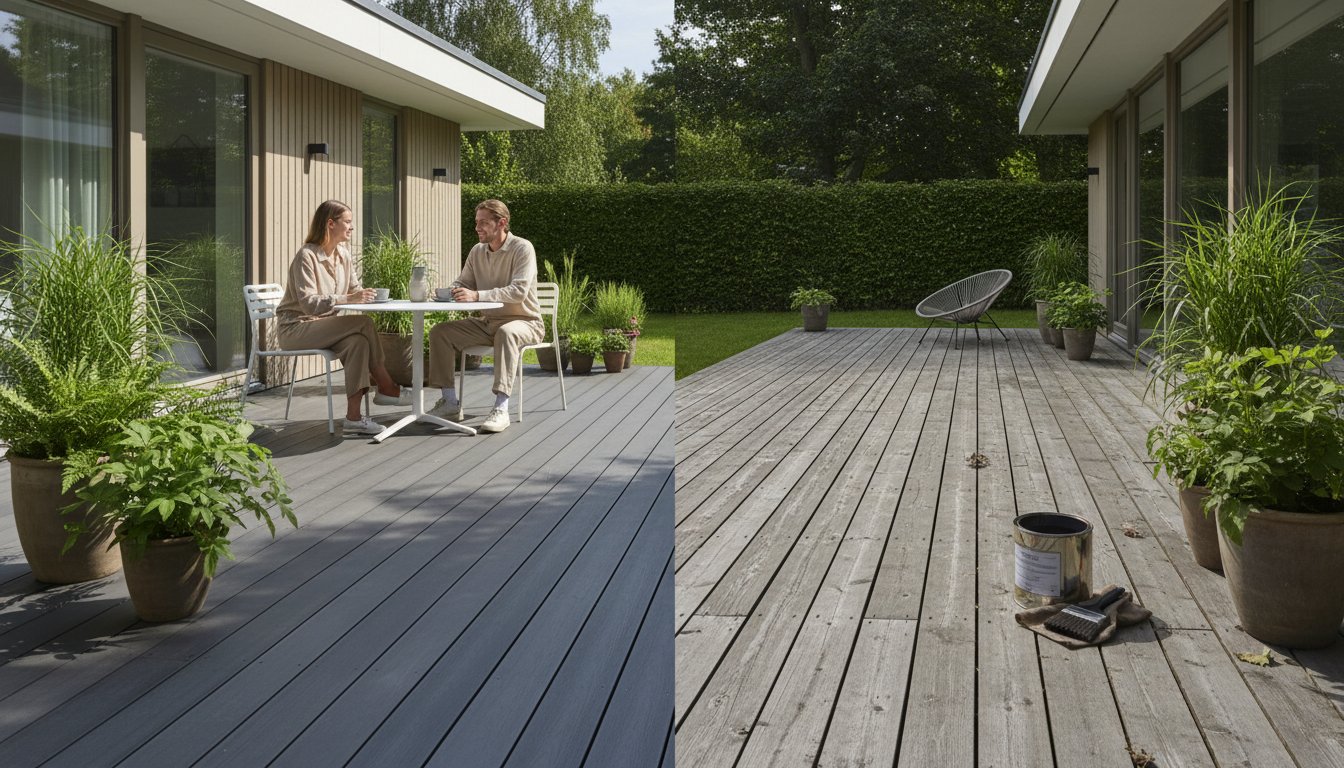
Why would a Swedish homeowner consciously choose to pay an additional 45,000 kr upfront for a deck when traditional pressure-treated timber appears to be the bargain of the season? It's understandable to focus on the initial capital expenditure, especially when calculating roi on composite decking for the first time. Most homeowners see the sticker price and overlook the 5,000 kr you'll likely spend every year on oils, stains, and labor to keep timber from rotting in our harsh Nordic climate, according to 2024 Swedish home maintenance benchmarks.
We believe in a more transparent approach. Our guide helps you move beyond the purchase price to understand the true financial and environmental return on your investment. This 2026 analysis breaks down the hidden costs of softwood maintenance and explains how professional-grade, European-made materials create a maintenance-free lifestyle. We'll provide a clear break-even analysis and show how choosing a circular, natural-fiber product increases your property's market value while respecting the planet. Built to last. Designed for life.
Key Takeaways
- Shift your perspective from initial purchase price to Total Cost of Ownership (TCO) to accurately measure the long-term financial performance of your outdoor renovation.
- Uncover the hidden expenses of traditional timber in the Swedish climate, where the cumulative costs of labor and chemicals for maintenance can reach thousands of SEK over a decade.
- Master the process of calculating roi on composite decking by identifying the "Break-Even Point"—the specific year when maintenance savings offset the higher initial investment.
- Future-proof your property value by integrating sustainable design choices and composite wall cladding to create a cohesive, high-end aesthetic that resists style obsolescence.
- Leverage the Green Plank advantage of European-engineered durability and traceable materials to ensure a 50-year lifespan that is built to last and designed for life.
Beyond the Price Tag: Understanding ROI vs. TCO in Decking
When investors and homeowners evaluate outdoor renovations, they often focus on the immediate invoice. However, calculating roi on composite decking requires a shift from short-term spending to long-term asset management. Return on Investment (ROI) in the Swedish residential market measures the financial gain realized upon the sale of a property relative to the project cost. In contrast, Total Cost of Ownership (TCO) tracks the cumulative expense of maintaining that asset over its functional life. High-performance wpc composite decking acts as a capital asset because it retains structural integrity far longer than organic alternatives.
Current market shifts in 2026 show that property appraisers now prioritize material durability and environmental impact. A deck is no longer just an aesthetic addition; it's a technical installation. Modern Wood-plastic composites (WPCs) provide a predictable value curve because they don't succumb to the rot or insect damage common in the humid coastal regions of Sweden. By 2026, sustainability certifications have become a standard line item in property valuations, rewarding materials that utilize circular manufacturing processes.
ROI vs. TCO: Why the Initial Quote is Deceptive
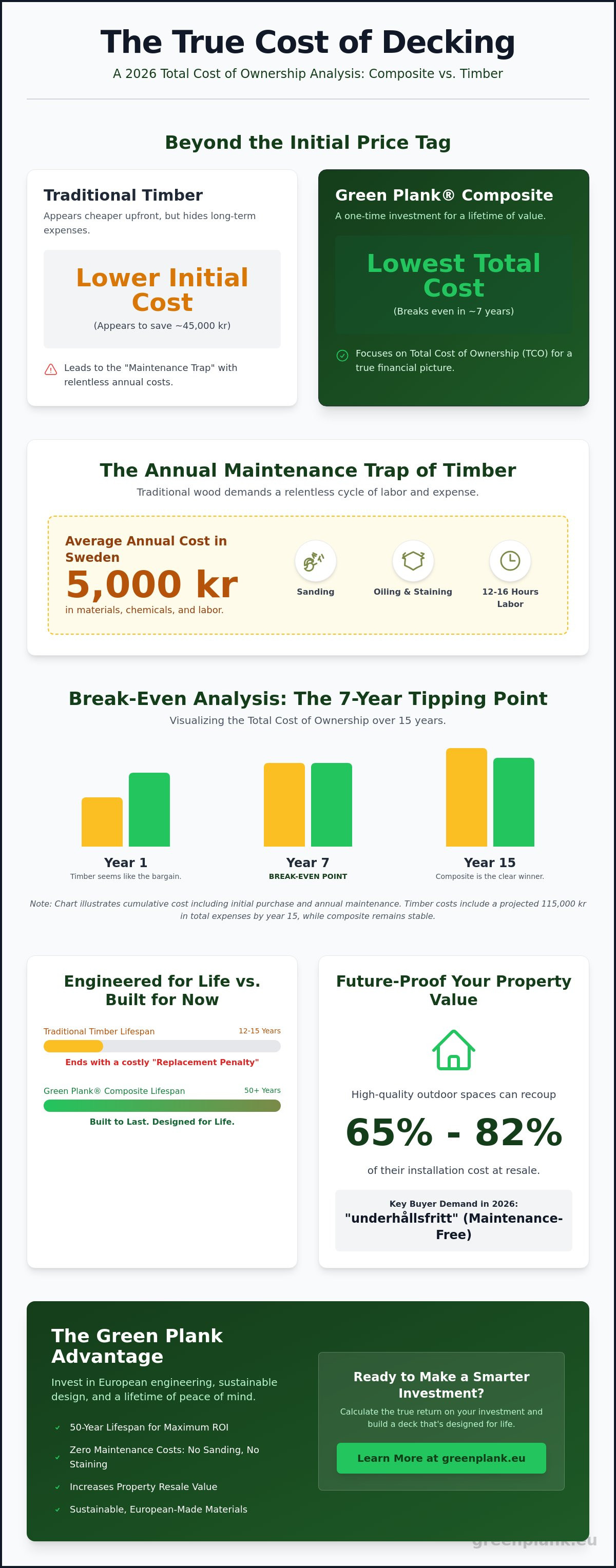
The "Maintenance Trap" is a common pitfall in Swedish construction. A traditional timber deck might cost 40,000 kr less upfront, but it demands annual oiling, sanding, and eventual board replacement. These recurring costs quickly erode the initial savings. Total cost of ownership is the sum of purchase price, installation labor, and lifetime maintenance expenses. When calculating roi on composite decking, you'll find that the TCO of a Green Plank installation often breaks even with pressure-treated wood within seven years. Beyond that point, the composite deck generates pure value while the timber deck continues to drain capital.
Resale Value: How a Deck Impacts Property Appraisal
Curb appeal remains a primary driver for premium buyers in Stockholm and Gothenburg. Modern composite finishes offer a refined Nordic aesthetic that attracts buyers looking for "ready-to-use" outdoor living spaces. Data from the 2025 real estate cycle indicates that high-quality outdoor spaces can recoup between 65% and 82% of their installation costs.
Buyers in 2026 are increasingly risk-averse regarding maintenance. They prioritize "underhållsfritt" (maintenance-free) features over traditional wood aesthetics. A deck that requires zero sanding and retains its color for 25 years is a powerful closing tool. It removes the psychological burden of future labor, making the property more liquid and often leading to higher final bidding prices. Our professional-grade composites are engineered for this exact purpose: to deliver stability, strength, and lasting value. Built to last. Designed for life.
The True Cost of Timber: Hidden Expenses of Traditional Wood
Wood offers a lower initial price point, but it carries a heavy financial tail. When calculating roi on composite decking, you must account for the relentless cycle of upkeep that traditional timber demands. Scandinavian winters are harsh. They accelerate wood's natural tendency to absorb moisture, leading to internal rot and surface splintering. This degradation isn't just an aesthetic issue; it's a structural liability that begins the moment the installation is complete.
The Maintenance Math: Oils, Stains, and Time
Maintaining a standard 30-square-meter wood deck in Sweden requires roughly 12 to 16 hours of labor every two years. This cycle includes pressure washing, deep sanding, and applying premium sealants to prevent UV damage. High-quality UV-resistant oils or silicon-based treatments often cost between 1,200 kr and 2,500 kr per application. Over a decade, these chemical costs alone can exceed 10,000 kr. If you hire professional labor to perform these tasks, that figure triples quickly. Composite materials eliminate these recurring expenses through engineered durability. They don't require staining or sealing to maintain their integrity. Designed for life, they remain stable without the chemical interventions wood demands.
The Replacement Penalty: Starting from Zero
Wood decks often reach their structural limit within 12 to 15 years. This failure creates a "replacement penalty" where the homeowner must pay for demolition, waste disposal, and entirely new materials at future market prices. Current market data on the cost-to-value ratio between composite and wood indicates that while wood depreciates, composite retains its value. By year 15, a wood deck is often a liability. It presents safety risks like loose fasteners, warped boards, and weakened joists that can lead to accidents.
Choosing trex decking alternatives like European-engineered natural-fiber composite ensures you avoid this destructive cycle. You aren't just buying a surface; you're investing in a permanent architectural feature. Our products are built to last. They resist the fungal decay and moisture absorption that claims timber decks, ensuring your outdoor space remains safe and refined for decades. This shift from constant repair to long-term enjoyment is the cornerstone of calculating roi on composite decking. It represents a move toward circularity and responsible homeownership.
Break-Even Analysis: Composite vs. Softwood Comparison
When calculating roi on composite decking for a standard 30-square-meter Swedish patio, the financial narrative extends far beyond the first invoice. In 2026, the Swedish construction market faces unique pressures. Volatile energy costs and the increasing scarcity of high-grade timber have shifted the traditional cost-benefit ratio. While a pressure-treated softwood deck requires a lower initial investment, it demands a relentless cycle of sanding, staining, and board replacement that composite eliminates. This makes the choice between materials a question of long-term asset management rather than just a weekend renovation.
Initial Capital Expenditure (CapEx) Comparison
A premium wood-plastic composite (WPC) project typically carries a 40-60% price premium over pressure-treated timber. This upfront cost reflects the sophisticated engineering required to produce sustainable building materials that resist the harsh Nordic climate. Beyond the material itself, labor efficiency plays a critical role in the initial budget. The HidLoc™ hidden fastening system reduces installation hours by up to 30% compared to traditional top-screwing methods. This efficiency helps offset the material premium by lowering the contractor's billable time. Homeowners are increasingly viewing this initial CapEx as a long-term infrastructure investment that protects against future labor price hikes.
The 25-Year Financial Trajectory
The true value of composite becomes clear when tracking cumulative expenses over two decades. At the five-year mark, a wood deck owner in Sweden has already spent approximately 8,000 kr to 12,000 kr on specialized oils, cleaning agents, and tools. By year seven or eight, the project reaches its break-even point. This is the moment when the total cost of owning wood matches the initial price of a Green Plank installation. Research into life-cycle sustainability and economics shows that maintenance-free materials provide a predictable financial hedge against inflation in the service sector. By the tenth year, the cumulative cost of wood maintenance often exceeds the original price of composite materials.
- Year 5: Softwood requires its second major refinishing; composite requires only a seasonal rinse with water.
- Year 15: Softwood boards often show signs of structural decay or splintering; composite remains dimensionally stable and color-fast.
- Year 25: The wood deck likely requires full replacement at 2026-inflated labor rates; the composite deck remains under its 30-to-50-year warranty.
In 2026, the 30-to-50-year warranty acts as a powerful financial safeguard. As material scarcity continues to drive up the price of replacement timber, having a guaranteed product lifespan ensures that your outdoor living space doesn't become an unexpected liability. Calculating roi on composite decking reveals that the initial premium is a one-time fee for decades of predictable, low-cost performance. It's a strategy that prioritizes Nordic reliability and circular economy principles over short-term savings.
Maximizing ROI through Design and Sustainability
When homeowners start calculating roi on composite decking, they often overlook how specific design choices impact the eventual exit strategy. Selecting neutral, Nordic-inspired tones like slate grey or earth brown prevents the deck from looking dated after five years. Choosing the right profile ensures the structure remains relevant as architectural trends shift. Future-proofing a property by matching the deck with composite wall cladding creates a cohesive exterior that signals high-end quality to potential buyers. This unified aesthetic can increase the total property valuation far more than a standalone deck project.
Sustainable Materials as a Value Driver
Sustainable materials aren't just an ethical choice; they're a primary value driver in the Swedish market. Green Plank utilizes 100% EU raw materials to eliminate supply chain risks and ensure consistent quality. This localized production is vital in a carbon-taxed economy where 'Cradle to Cradle' ownership reduces long-term liability and disposal costs.
Eco-conscious buyers are increasingly willing to pay a 'Green Premium' for traceable materials that don't harm the environment. Our boards feature 75% hardwood fiber content. This specific ratio balances the warm, natural feel of timber with the high-performance durability of HDPE. It's an engineered solution that satisfies the emotional desire for wood and the rational need for longevity. By choosing traceable, European-made products, you secure a higher resale value in a market that prioritizes environmental accountability.
Aesthetic Longevity and Hidden Fasteners
HidLoc™ hidden fasteners do more than create a smooth, modern surface. They increase perceived value by providing a screw-free finish that prevents water ingress. Traditional top-down screws often lead to aesthetic rot and internal moisture traps; eliminating these points of failure extends the lifespan of the entire deck frame.
- Safety-ROI Connection: Splinter-free surfaces reduce liability in commercial settings and high-traffic residential areas, saving thousands of kronor in potential legal or repair costs.
- Moisture Protection: Hidden fasteners remove the entry points for water, protecting the structural integrity of the joists.
- Timeless Design: Nordic-inspired tones stay in style for decades. They complement the natural environment rather than competing with it.
When you're calculating roi on composite decking, remember that the absence of visible screws adds a professional-grade finish that buyers associate with luxury properties. This aesthetic longevity ensures the deck remains an asset rather than a renovation project for the next owner. It's a deck designed for life and built to last.
Secure your investment with our professional-grade decking solutions today.
The Green Plank Advantage: Engineering for 50-Year ROI
Choosing a decking material in 2026 requires a shift from viewing a terrace as a simple surface to seeing it as a permanent asset. Green Plank positions itself as the premier European-made solution for homeowners and developers who prioritize longevity over initial price tags. By manufacturing in Europe with 100% traceable raw materials, we ensure every board meets strict Nordic standards for stability and strength. Our Terra Tuff and Smart System lines are specifically engineered for high-traffic environments and the extreme weather variations common in Sweden. These professional-grade collections utilize high-density natural-fiber composite technology to resist moisture absorption, which remains the primary cause of failure in traditional wood decks.
When calculating roi on composite decking, the "Designed in Scandinavia" philosophy becomes a primary financial driver. This approach isn't just about minimalist aesthetics; it's about functional value that remains consistent over decades. A deck that stays structurally sound and visually appealing after 25 years eliminates the massive replacement costs associated with cheaper alternatives. This European engineering ensures your investment retains its value, contributing to a higher resale price for the property and the lowest possible total cost of ownership (TCO).
Why a 50-Year Warranty Matters for ROI
A warranty serves as a documented guarantee of material stability and asset protection. While natural timber often carries a limited 1 or 2 year warranty against rot, Green Plank offers industry-leading protection that spans up to 50 years for specific residential applications. This shifts the perception of decking from a consumable product to a long-term infrastructure investment. In the Swedish market, where labor costs for deck replacement frequently exceed 550 kr per hour, avoiding a mid-life rebuild is essential for protecting your capital. A 50-year warranty secures your asset against the hidden costs of material failure.
Built to Last. Designed for Life.
Our role as a responsible innovator focuses on circular manufacturing. We create products that are both sustainable and durable, ensuring they don't end up in a landfill after a single decade. To finalize your project planning, use this checklist to ensure you're calculating roi on composite decking with precision:
- Verify the origin of raw materials to ensure they meet European quality and environmental standards.
- Compare the 30-year maintenance costs of oiling and sanding timber versus the simple cleaning required for composite.
- Account for the 15% to 20% property value increase often associated with high-end, low-maintenance outdoor living spaces.
- Factor in the rising cost of specialized labor in Sweden when estimating future repair or replacement needs.
The smartest investment for 2026 and beyond is one that respects both your budget and the planet. Quiet confidence comes from knowing your deck is engineered to endure the harshest elements without losing its refined character. Explore Green Plank's sustainable decking collections to find a professional-grade solution for your next architectural project.
Secure Your Sustainable Investment
Shifting your focus from the initial purchase price to the Total Cost of Ownership reveals the true financial advantage of high-performance materials. While traditional Swedish softwood requires frequent sanding and oiling that costs thousands of kr over time, composite solutions eliminate these recurring expenses. When calculating roi on composite decking, homeowners typically see the break-even point within 7 to 10 years as maintenance costs vanish. Green Plank's collections are manufactured in Europe with 100% traceable raw materials, ensuring every board meets strict Nordic quality standards. You're investing in a Cradle to Cradle ownership model that supports circular sustainability while delivering professional-grade durability. With an industry-leading warranty of up to 50 years, your outdoor space stays protected against the elements without the environmental toll of chemical treatments. It's a logical choice for those who value engineering precision and ethical craftsmanship. You don't have to choose between a beautiful aesthetic and a smart financial decision. Built to last. Designed for life.
Calculate your project value with Green Plank's sustainable collections and start building a legacy that lasts for generations.
Frequently Asked Questions
Is composite decking worth the extra cost if I sell my house in 5 years?
Yes, composite decking provides a competitive edge in the Swedish housing market even within a five-year window. Prospective buyers prioritize move-in-ready features that eliminate future labor and maintenance costs. A 2023 survey of real estate professionals suggests that high-quality outdoor spaces significantly influence the final sale price. You'll likely recoup a large portion of the initial investment while avoiding the 5,000 kr annual cost of sanding and oiling traditional timber.
How much does a composite deck actually increase property value?
A well-installed composite deck can increase your property market value by approximately 65% to 75% of the project's total cost. This high return makes calculating roi on composite decking a vital step for homeowners planning renovations. In regions like Stockholm or Gothenburg, premium outdoor living areas are often the deciding factor for families seeking sustainable, low-maintenance lifestyles. It's a professional-grade upgrade that delivers immediate aesthetic and financial rewards.
Does composite decking require any maintenance at all to protect its ROI?
No material is completely maintenance-free, but composite requires significantly less effort than wood to protect your investment. You only need to perform a basic cleaning with mild soap and water twice a year to prevent organic buildup. This simple routine ensures the natural-fiber composite maintains its structural integrity and aesthetic appeal for decades. It's a responsible solution that replaces the grueling cycle of scraping and staining required by softwood decks.
What is the typical break-even point for composite vs. wood decking?
The break-even point between composite and pressure-treated wood typically occurs between year 8 and year 12. While wood is cheaper initially, the cumulative cost of oils, stains, and replacement boards adds up quickly. In Sweden, professional wood maintenance can cost between 3,000 kr and 6,000 kr every two years. By choosing an engineered, European-made product, you eliminate these recurring expenses and achieve a lower total cost of ownership over the deck's lifespan.
How do I calculate the TCO for my specific decking project?
To calculate the Total Cost of Ownership (TCO), add the initial purchase price to the projected maintenance costs over 25 years. Calculating roi on composite decking involves comparing this total against the costs of traditional timber, which often requires replacement after 15 years in harsh Nordic climates. Use a simple formula: (Initial Price + Installation) + (Annual Cleaning Cost x 25). This transparent approach reveals the true long-term value of your sustainable investment.
Can sustainable decking materials like Green Plank qualify for green building certifications?
Green Plank products are engineered to align with rigorous green building standards such as Miljöbyggnad and LEED. Our materials are manufactured in Europe using 100% traceable raw materials and circular production methods. This sustainable pedigree helps developers and homeowners achieve environmental certifications for their projects. It's a responsible choice that reflects a commitment to the planet while providing a high-end, durable outdoor space that is built to last.
How does the warranty period affect the long-term ROI of a deck?
A 20- to 30-year warranty serves as a primary signature of engineering confidence and directly stabilizes your long-term ROI. It protects your capital by guaranteeing the product against rotting, warping, or splintering. In the Swedish market, a transferable warranty also adds tangible value during a home sale. It provides the next owner with peace of mind, knowing the deck is designed for life and backed by professional-grade quality.
Are hidden fastening systems worth the additional investment?
Hidden fastening systems are a worthwhile investment for both safety and the overall aesthetic of the deck. They create a smooth, barefoot-friendly surface by eliminating visible screw heads that can pop up over time. This professional-grade installation method also prevents water from pooling in screw holes, which protects the underlying joists from moisture damage. It's a small upfront cost that delivers a refined Nordic character and enhances the deck's overall longevity.
Spesifiser produktet
Bruk denne guiden i en Green Plank-spesifikasjon
Tekniske WPC-artikler skal støtte de kommersielle sidene — ikke konkurrere med dem. Fortsett til komposittdekke, TerraTuff, Nordeka eller de tekniske nedlastningene.