




Can a sustainable facade material actually outperform traditional timber in blocking the relentless hum of the city? For architects and specifiers, the acoustic properties of composite cladding have often been an afterthought, overshadowed by aesthetic appeal or weather resistance. However, as urban density increases, the ability of a building envelope to dampen sound is no longer a luxury; it's a technical necessity. Modern Wood Plastic Composite (WPC) is engineered with a high-density core that fundamentally changes how sound waves interact with a structure.
You likely recognize that achieving a quiet interior in a minimalist design is increasingly difficult when hard surfaces reflect every vibration. It's a challenge to meet the International Building Code (IBC) 2021 requirement for a Sound Transmission Class (STC) of 50 in residential assemblies while maintaining an eco-conscious profile. This guide will demonstrate how the high-density composition of WPC cladding provides superior sound damping and acoustic insulation for modern architectural facades. We'll examine the technical science of STC and Rw ratings, explain how a 75% hardwood fiber blend absorbs energy, and show you how to specify a quieter, more sustainable building envelope that respects both the environment and the resident's peace.
Key Takeaways
- Learn how the high-density composition of WPC provides the critical mass necessary to block airborne urban noise effectively.
- Understand how the acoustic properties of composite cladding surpass traditional timber by eliminating the sound leaks typically caused by material warping and gaps.
- Identify the performance differences between solid profiles for maximum sound blocking and slatted designs used for acoustic diffusion.
- Discover technical installation strategies, including the use of ventilated air gaps and mineral wool, to decouple sound and enhance the building envelope.
- Explore the advantages of specifying European-manufactured materials that ensure consistent density and long-term performance through a circular ownership model.
Understanding the Physics: How Composite Cladding Dampens Sound
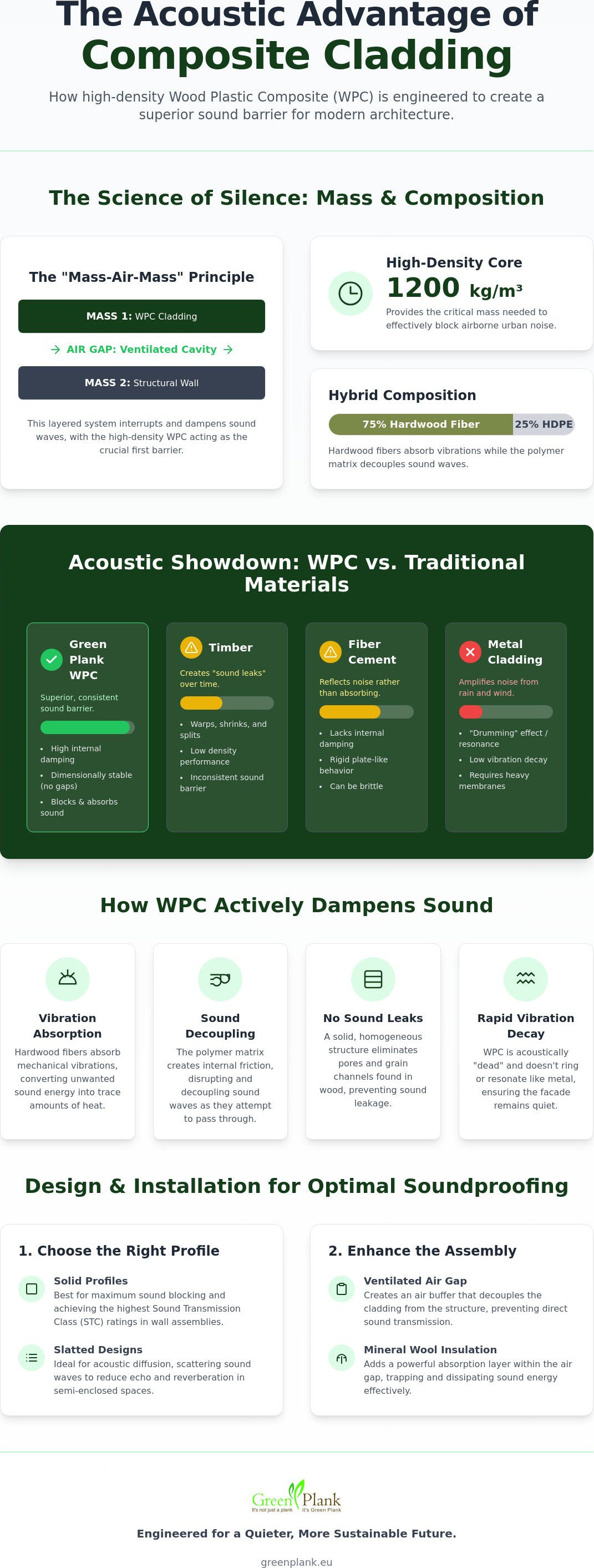
Effective sound insulation within a building facade relies on the fundamental "Mass-Air-Mass" principle. In this system, the exterior cladding acts as the first layer of mass, the ventilated cavity provides the air buffer, and the structural wall serves as the final mass barrier. The acoustic properties of composite cladding are defined by its high-density composition, typically reaching approximately 1200 kg/m³. This density provides the necessary inertia to block airborne noise from entering the building envelope. By increasing the mass of the primary exterior layer, architects can significantly improve the Sound Transmission Class (STC) of the entire wall assembly.
The material's unique hybrid structure plays a critical role in its performance. While traditional materials often rely on thickness alone, Wood Plastic Composite (WPC) utilizes a 75% hardwood fiber and 25% HDPE blend to manage sound waves. The hardwood fibers act as a natural vibration absorber, while the HDPE components provide the elasticity required to decouple sound waves as they pass through the material matrix. This combination ensures that noise isn't just blocked, but actively attenuated.
Mass vs. Porosity in Acoustic Performance
Dense WPC consistently outperforms porous softwoods in blocking sound transmission because it lacks the microscopic air channels found in natural timber. Porous materials allow sound energy to "leak" through the grain, whereas the homogeneous structure of WPC creates a formidable barrier. Increasing the material thickness directly correlates to a higher Weighted Sound Reduction Index (Rw), providing a predictable metric for specifiers. In multi-story developments, this high mass is particularly effective at reducing flanking transmission, which is the noise that travels indirectly through structural joints and wall intersections.
The Damping Effect of Hardwood-HDPE Blends
The specific ratio of 75% hardwood to 25% HDPE creates significant internal friction within the composite matrix. When sound waves strike the surface, this friction converts acoustic energy into trace amounts of heat, a process known as molecular damping. This is a distinct advantage over metallic cladding options. For instance, aluminum cladding has a low vibration decay rate and tends to resonate or "ring" when struck by sound or rain. WPC exhibits a rapid vibration decay, ensuring that the facade remains acoustically "dead." Acoustic damping in WPC is the material’s ability to dissipate sound energy before it reaches the structural wall. This engineered performance ensures that the acoustic properties of composite cladding contribute to a calmer, more controlled indoor environment, even in high-traffic urban settings.
- High material density (1200 kg/m³) blocks airborne noise.
- 75% hardwood fiber content absorbs mechanical vibrations.
- HDPE polymer matrix decouples sound waves to prevent resonance.
- Homogeneous structure eliminates the sound leaks common in natural wood.
Acoustic Comparison: WPC vs. Traditional Building Materials
Selecting the right facade material requires a balance between longevity and technical performance. While timber, fiber cement, and metal are common choices, they each present specific acoustic challenges that Wood Plastic Composite (WPC) is designed to solve. The acoustic properties of composite cladding provide a distinct advantage in maintaining a consistent sound barrier over the lifetime of a building. Understanding these acoustic properties of composite cladding allows specifiers to predict how a facade will behave under real-world noise conditions, long after the initial installation is complete.
Timber is inherently organic. Over time, exposure to moisture and UV radiation causes wood to warp, shrink, and split. These physical changes create "sound leaks" where noise bypasses the material entirely. Fiber cement offers high mass, which is beneficial for blocking sound, but it lacks internal damping. It behaves like a rigid plate, often reflecting noise rather than absorbing it. Metal cladding is perhaps the most problematic acoustically. Without heavy acoustic membranes, metal panels suffer from a "drumming" effect during rain or high winds, often amplifying noise rather than dampening it. WPC, by contrast, provides a stable, high-density matrix that resists the environmental degradation that compromises other materials.
Why Timber "Sound Leaks" Develop Over Time
The acoustic integrity of a timber facade is only as good as its tightest seal. As softwoods lose moisture, they undergo significant dimensional changes. A gap of just 1% in a wall surface can lead to a 10 dB drop in sound insulation. Green Plank’s WPC is engineered for dimensional stability, ensuring the facade remains airtight and acoustically sealed for decades.
- No warping means no structural gaps.
- No splitting means no acoustic vulnerabilities.
- No shrinkage means no loss of transmission loss.
Decibel Reduction Expectations
Research into the acoustic performance of WPC structures shows that composite cladding contributes significantly to the overall Transmission Loss (TL) of a wall assembly. While a standard 2x4 stud wall might only achieve an STC of 35-38, adding a high-density WPC layer helps push the total assembly toward the IBC-mandated STC 50. In practical terms, a well-specified WPC facade can reduce perceived external noise by 10 to 15 decibels compared to an unclad wall. This reduction is vital for high-density residential projects. A quieter facade doesn't just meet building regulations; it improves the psychological well-being of residents by creating a sanctuary from urban stress. It's a technical solution that delivers a tangible lifestyle benefit.
Impact of Profile Design: Slatted vs. Solid Cladding
Geometry dictates how sound waves are reflected, absorbed, or transmitted through a building envelope. While material density is a constant factor, the physical shape of the board significantly alters the acoustic properties of composite cladding by changing the surface area and the path of the sound energy. Solid profiles act as a primary shield against external noise. Slatted profiles function more as a filter for internal reflections. Selecting the correct profile requires a clear understanding of the site's specific noise environment and the desired acoustic outcome.
Solid Cladding for Maximum Transmission Loss
Solid WPC boards are the superior choice for projects facing high-decibel airborne noise, such as ground-floor urban facades or buildings adjacent to transit hubs. These profiles provide the maximum possible mass per square meter, which is essential for stopping low-frequency vibrations. A continuous surface prevents sound bypass. Integrating these boards with hidden fastening systems ensures a tight, seamless assembly that maintains the acoustic seal across the entire facade. Tongue-and-groove joins are particularly effective here; they create a tortuous path for sound waves, trapping energy within the interlocking joint and preventing it from reaching the structural wall.
Slatted Cladding and Sound Diffusion
Open-joint or slatted designs serve a distinct acoustic purpose focused on diffusion rather than total blockage. In enclosed architectural spaces like internal courtyards or narrow residential balconies, flat, hard surfaces often cause unwanted echoes and reverberation. Slatted WPC profiles break up these standing waves. The deep shadow lines and engineered grooves scatter sound in multiple directions, which effectively lowers the perceived noise floor of the immediate area. This "Acoustic Slatted" trend allows architects to achieve the visual warmth of traditional timber while utilizing the acoustic properties of composite cladding to dampen the harshness of the urban environment.
Specifiers should match the profile depth to the primary noise source on site. Heavy traffic produces long, low-frequency waves that demand the sheer mass of solid cladding. High-frequency noise, such as wind whistling or human chatter, is better managed through the irregular surfaces of slatted designs.
- Solid boards block noise. This creates a quieter interior.
- Slatted boards diffuse noise. This reduces courtyard echo.
- Deep grooves trap sound. This disrupts low-frequency rumble.
Optimizing the Installation for Superior Soundproofing
Acoustic performance is rarely the result of a single material. It's the outcome of a carefully engineered system where each component plays a specific role in breaking the path of sound. While the acoustic properties of composite cladding provide a high-density primary shield, the installation method determines whether that potential is realized or lost through structural vibrations. A systemic approach ensures that urban noise is decoupled from the living space, transforming a simple facade into a high-performance acoustic barrier.
The Ventilated Facade as an Acoustic Buffer
The air cavity in a ventilated facade serves a dual purpose. While its primary role is moisture management, it also acts as a secondary insulator. This air gap effectively decouples the exterior cladding from the structural wall, preventing the direct transfer of vibration. For optimal sound damping, the cavity depth must be balanced. Too shallow, and the air can become trapped and transmit sound; too deep, and it may lose its damping effectiveness. Utilizing the HidLoc™ Hidden Fastening System ensures that boards are secured firmly without the risk of "drumming" or rattling during high winds, which is a common failure point in poorly installed metal or timber systems.
Material Synergy: WPC and Insulation
WPC is the ideal "skin" for modern composite wall cladding assemblies that incorporate mineral wool insulation. When high-density WPC is paired with the fibrous structure of mineral wool, the resulting hybrid barrier addresses both airborne noise and structural resonance. Calculating the combined Rw value of such a multi-layer facade reveals a significant improvement over single-layer solutions. We recommend the use of EPDM gaskets to further decouple the WPC from the subframe and prevent vibration transfer. This attention to detail prevents acoustic bridging at the joists, ensuring the building envelope remains as quiet as it is beautiful.
Properly sealing penetrations around windows and doors is the final, critical step. Even the most advanced cladding system will fail if sound can bypass the barrier through unsealed gaps. Maintaining consistent joist spacing is equally vital to control the natural resonance frequency of the boards. If you are ready to specify a high-performance facade for your next project, you can explore our technical cladding profiles to ensure your installation meets the highest acoustic standards.
Sustainability Meets Performance: The Green Plank Advantage
True architectural innovation doesn't force a choice between technical excellence and ecological integrity. The acoustic properties of composite cladding are a direct result of manufacturing precision and material purity. By sourcing 100% EU raw materials, we maintain a level of density consistency that's essential for predictable acoustic modeling. This regional reliability ensures that the performance specified during the design phase is exactly what's delivered on-site, providing a grounded sense of engineering confidence.
Our commitment to a Cradle to Cradle ownership model means that every board is designed with its entire lifecycle in mind. We don't just manufacture a product; we craft a long-term solution for the building envelope. This approach balances a premium, high-end aesthetic with the grounded responsibility of reducing the carbon footprint of modern construction. By choosing a material that respects both nature and the need for tranquility, specifiers create buildings that are as quiet as they are responsible.
European Engineering and Material Consistency
The 75% hardwood fiber ratio is the foundation of our material's acoustic performance. This specific balance ensures the cladding doesn't produce the "hollow sound" or high-frequency resonance typical of low-quality, PVC-heavy composites. High-quality WPC behaves more like solid wood in its damping characteristics, yet it offers the dimensional stability of an engineered product. As urban planners increasingly prioritize sustainable building materials, the focus has shifted toward materials that offer circularity without compromising the building envelope's technical requirements. Our low-density engineering optimizes the internal structure for easier installation, yet it doesn't sacrifice the high-density surface mass required to block airborne noise effectively.
Long-Term Acoustic Reliability
Acoustic insulation is a lifecycle investment. If a material warps, rots, or degrades under UV exposure, its ability to block sound vanishes as gaps emerge. Green Plank’s WPC is engineered to resist these environmental stressors, ensuring the "seal" of the building remains tight for decades. Our 50-year warranty is a primary signature of this engineering confidence. It guarantees that the acoustic properties of composite cladding won't degrade over time, providing a permanent solution for urban noise pollution.
- Material stability prevents sound leaks. This maintains the acoustic seal.
- Engineered durability resists rot and UV. This protects the board's density.
- Maintenance-free surfaces require no sanding or staining. This preserves the material matrix.
Low-maintenance performance means the facade requires no chemical treatments or interventions that could alter its mass or surface density. This stability allows project partners to calculate lifecycle acoustic value with certainty. We encourage our partners to look beyond the initial installation and consider the long-term acoustic health of the structure. A facade that maintains its integrity for half a century is the ultimate expression of sustainable craftsmanship.
Specifying Acoustic Excellence for the Modern Envelope
Achieving a quiet building envelope is a technical challenge that requires a holistic approach to material selection and system design. You've seen how the 75% hardwood fiber composition provides the necessary mass to block noise while the HDPE matrix actively dampens vibrations. These engineered attributes ensure that your facade does more than just shield from the weather; it creates a peaceful interior sanctuary that lasts. By mastering the acoustic properties of composite cladding, architects can meet strict building codes without sacrificing sustainability.
Our Cradle to Cradle certified manufacturing and 50-year service life warranty offer the long-term reliability required for high-end developments. It's a commitment to performance that doesn't come at the cost of the environment. You have the tools to design spaces that are as quiet as they are responsible. Explore our high-performance composite cladding solutions and discover how our European engineering can transform your next architectural project into a sanctuary of sustainable silence.
Frequently Asked Questions
Does composite cladding reduce outside noise?
Yes, composite cladding significantly reduces outside noise by providing a high-density barrier that reflects and absorbs airborne sound waves. The 1200 kg/m³ density of the boards creates the necessary mass to block urban sounds such as traffic or sirens. When installed as part of a ventilated facade system, it helps decouple external vibrations from the building's structural wall to create a quieter interior.
What is the STC rating of composite cladding?
The Sound Transmission Class (STC) rating applies to the entire wall assembly rather than the cladding alone. While a standard stud wall typically achieves an STC of 35 to 38, adding a high-density WPC layer helps the assembly reach the IBC-mandated STC of 50. The acoustic properties of composite cladding contribute roughly 10 to 15 dB of transmission loss to the total system performance.
Is slatted composite cladding better for acoustics than solid boards?
Solid boards are more effective for blocking external noise because they provide greater mass and a continuous seal. Slatted or open-joint designs are better suited for sound diffusion. They break up standing waves and reduce echoes in confined spaces like courtyards or balconies. Your choice should depend on whether you need to stop noise from entering or manage sound reflections within a space.
Can composite cladding help with echoes in urban areas?
Composite cladding helps mitigate urban echoes by disrupting the flat, hard surfaces that usually reflect sound. Profiles with deep grooves or slatted designs scatter sound energy in multiple directions, which prevents the build-up of reverberation. This is especially beneficial in high-density residential areas where narrow streets or internal courtyards can amplify ambient noise through reflection.
Do I need extra insulation behind WPC cladding for soundproofing?
While WPC provides excellent mass, combining it with mineral wool insulation creates a high-performance hybrid barrier. The insulation absorbs sound energy within the cavity, while the cladding blocks airborne noise. This "Mass-Air-Mass" approach is the most effective way to meet modern acoustic standards and ensure a quiet interior environment in noisy city centers.
How does WPC compare to brick in terms of sound insulation?
Brick inherently has higher mass, which is excellent for blocking sound, but it's a rigid material with low internal damping. WPC provides a unique advantage because its 75% hardwood and 25% HDPE blend actively dissipates vibrations through internal friction. This molecular damping ensures that the facade remains acoustically "dead," preventing the resonance that can occur with more rigid, traditional building materials.
Does the thickness of the cladding board affect its acoustic properties?
Yes, the thickness of a board directly impacts the acoustic properties of composite cladding by increasing its total mass. According to the mass law of acoustics, increasing the mass of a partition leads to a higher sound reduction index. Thicker profiles provide a superior Weighted Sound Reduction Index (Rw), making them the preferred choice for projects requiring maximum noise attenuation in high-traffic zones.
Is composite cladding a good choice for sound barriers or fences?
Composite cladding is an exceptional choice for acoustic fencing and sound barriers. Its high density effectively blocks line-of-sight noise from roads or neighbors, while its dimensional stability prevents the sound leaks that develop in timber fences as they warp. Since WPC resists rot and UV degradation, the acoustic seal remains intact for a service life of up to 50 years without any maintenance required.
Spesifiser produktet
Bruk denne guiden i en Green Plank-spesifikasjon
Tekniske WPC-artikler skal støtte de kommersielle sidene — ikke konkurrere med dem. Fortsett til komposittdekke, TerraTuff, Nordeka eller de tekniske nedlastningene.