



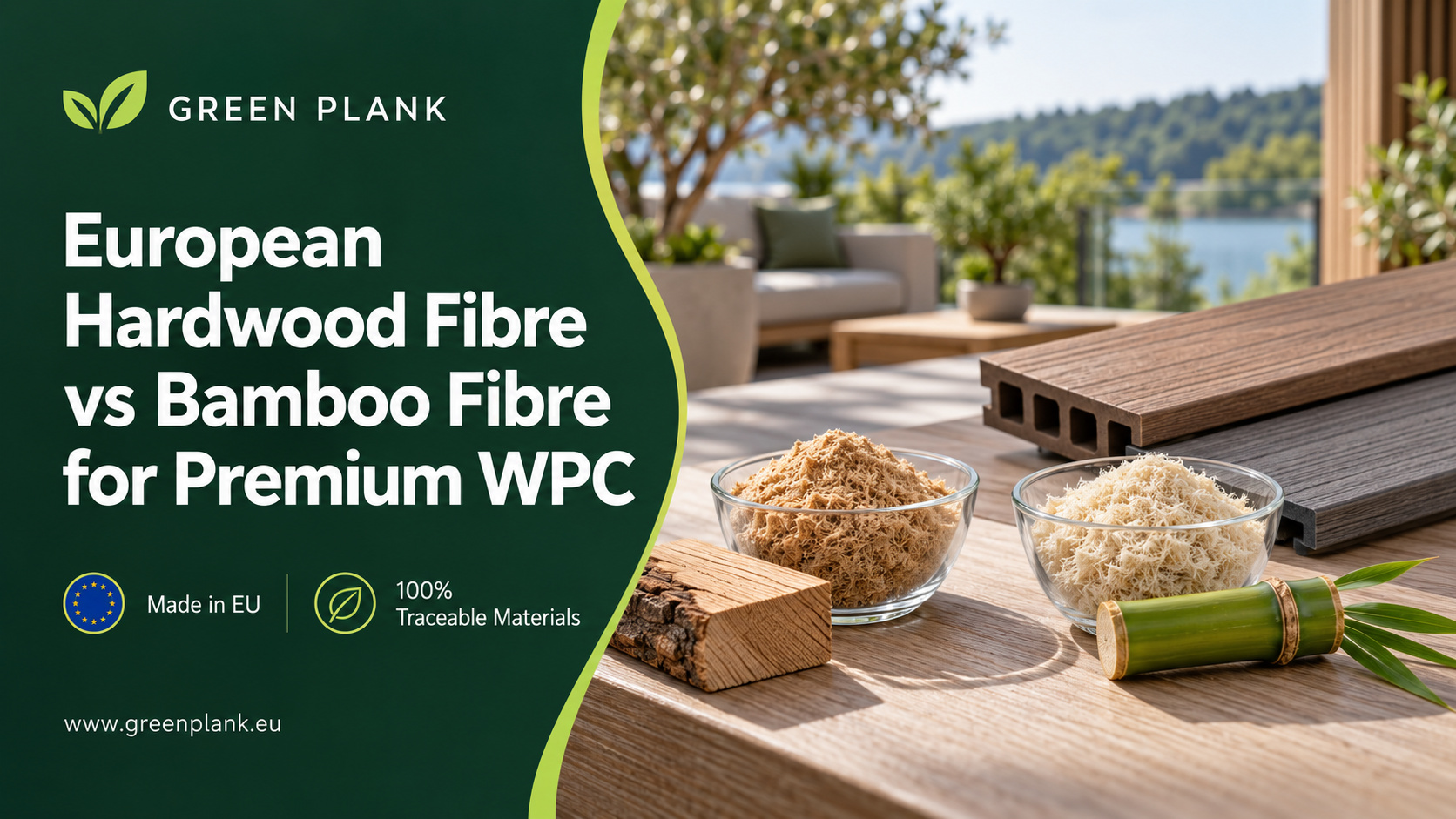
European Hardwood Fibre vs Bamboo Fibre for Premium WPC
Natural fibre is one of the most important components in wood-plastic composite, yet its role is sometimes reduced to a simple percentage on a technical data sheet. In reality, fibre species, moisture, particle geometry, purity, processing and compatibility with the polymer matrix can all influence how a WPC compound processes and how the finished profile performs.
Two options frequently discussed are European hardwood fibre and bamboo fibre. Both are lignocellulosic materials and both can be successfully incorporated into thermoplastic composites. However, they are not automatically interchangeable. Their structure, sourcing, preparation and behaviour during compounding can differ, making careful formulation essential.
Green Plank perspective: Premium WPC should not be judged simply by whether it contains wood or bamboo. The more useful questions are: What is the quality of the fibre? How consistently is it prepared? How well is it bonded to the polymer? And how effectively is the complete formulation processed?
Why fibre quality matters in WPC
In a high-filled WPC formulation, natural fibre is not merely decorative filler. It contributes to the composite structure and can influence stiffness, density, processing behaviour, moisture response, surface appearance and dimensional characteristics.
Important fibre parameters include:
- moisture content before extrusion;
- particle-size distribution and aspect ratio;
- bulk density and feeding consistency;
- purity and contamination control;
- chemical composition and surface characteristics;
- thermal stability during processing;
- compatibility with the polymer and coupling system.
This is why two WPC products with an identical stated fibre percentage can perform differently. Fibre quality and processing discipline matter as much as the headline formulation.
What is European hardwood fibre?
European hardwood fibre used for WPC can be produced from controlled wood-processing streams and prepared to meet defined particle and moisture requirements. Species such as beech and oak are relevant examples of hardwood raw materials available in Europe.
For European manufacturers, regional hardwood sourcing can offer practical advantages including shorter supply chains, improved traceability and closer control over specifications. However, European origin alone does not guarantee premium performance. The fibre still needs appropriate drying, sizing, storage and quality control.
Green Plank's high-wood-fibre WPC approach uses European wood fibres as the main natural-fibre component in a PVC-free HDPE-based composite.
What is bamboo fibre?
Bamboo is a rapidly growing lignocellulosic material used in many engineered products. When appropriately processed, bamboo fibres or bamboo-derived particles can also reinforce thermoplastic composites.
Bamboo's mechanical potential has attracted considerable research interest. At the same time, performance in a WPC profile depends on fibre preparation, chemical composition, particle geometry, moisture control, polymer compatibility and manufacturing conditions. A strong raw plant material does not automatically create a stronger finished decking board.
European hardwood fibre vs bamboo fibre
| Factor | European hardwood fibre | Bamboo fibre |
|---|---|---|
| Material type | Lignocellulosic hardwood fibre | Lignocellulosic grass-derived fibre |
| European sourcing | Can support regional sourcing and shorter supply chains | Often depends on supply from bamboo-growing regions |
| Traceability | Can be strong with controlled European suppliers | Depends heavily on supplier and processing chain |
| Moisture control | Essential | Essential |
| Particle consistency | Can be tightly specified with controlled milling | Requires controlled preparation and grading |
| Polymer bonding | Requires suitable compatibilisation | Requires suitable compatibilisation |
| WPC suitability | Excellent when correctly prepared | Potentially excellent when correctly prepared |
1. Mechanical performance: fibre alone does not decide strength
It is tempting to compare hardwood and bamboo by looking only at the mechanical properties of the original plant material. For WPC, this can be misleading. Once fibre is milled, dried, compounded with polymer and extruded into a profile, performance depends on the entire composite system.
Fibre loading, dispersion, interfacial adhesion, void content, polymer properties and profile geometry all contribute to bending and impact behaviour. A well-engineered hardwood-fibre composite can therefore outperform a poorly processed bamboo composite, and the reverse can also be true.
2. Moisture is a critical production variable
Lignocellulosic fibres are hydrophilic, whereas polymers such as HDPE are comparatively hydrophobic. Moisture control is consequently fundamental for both hardwood and bamboo WPC.
Excess moisture entering the extrusion process can contribute to vapour formation, porosity and surface defects. It can also make processing less stable. Fibre should therefore be dried to a controlled level and protected from moisture pickup before feeding.
A premium fibre needs premium preparation
Species alone cannot compensate for poor drying, inconsistent particle size or contamination. Reliable WPC manufacturing begins with a controlled raw-material specification before the fibre reaches the extruder.
3. Fibre-to-polymer bonding matters
A major technical challenge in WPC is creating an effective interface between polar natural fibres and a non-polar polymer such as polyethylene. Compatibilisers such as maleic-anhydride-grafted polyethylene are commonly studied and used to improve interaction in wood/polyethylene composites.
Good interfacial adhesion can improve stress transfer and help the material behave more like an integrated composite rather than separate wood and plastic phases. The optimum compatibiliser system and dosage must be established for the actual fibre, polymer and additive package.
4. Processing consistency can determine finished quality
For profile extrusion, manufacturers need a compound that feeds, melts and flows predictably. Fibre variation can change bulk density, melt rheology, pressure, torque and surface quality.
A premium production process should therefore control:
- fibre moisture and storage conditions;
- particle-size distribution;
- polymer grade and melt-flow characteristics;
- fibre/polymer/additive dosing accuracy;
- mixing and dispersion;
- extrusion temperature and pressure;
- cooling and calibration;
- finished-profile dimensional tolerances.
5. What about dimensional stability?
Outdoor WPC experiences changing temperature and moisture conditions. The polymer phase responds to temperature, while the natural-fibre phase can interact with moisture. The resulting dimensional behaviour is therefore a property of the complete composite.
Increasing natural-fibre content can modify stiffness and thermal behaviour, but higher fibre content also places greater demands on encapsulation, dispersion and moisture protection. Architects should rely on product-specific technical data and installation instructions rather than assuming that hardwood or bamboo automatically provides lower expansion.
6. Sustainability and sourcing
Bamboo is frequently promoted because it grows rapidly. Growth rate, however, is only one part of environmental assessment. Processing, binders and additives, energy use, transport, manufacturing efficiency, durability and end-of-life considerations also matter.
For a European WPC producer, European hardwood fibre can provide a different sustainability proposition: regional material streams, potentially shorter transportation distances and closer supply-chain traceability. The environmental profile should ultimately be evaluated using documented information for the specific product and supply chain.
Why Green Plank uses European wood fibre
Green Plank's material strategy is built around producing PVC-free WPC in Europe with a high proportion of European wood fibre. A representative formulation is approximately 75% European wood fibres, 15% HDPE and 10% functional additives, with the exact formulation depending on the product and performance requirements.
This approach is intended to combine a high natural-fibre content with controlled polymer and additive technology. Key priorities include:
- traceable European raw materials;
- controlled fibre quality;
- high wood-fibre content;
- HDPE-based, PVC-free technology;
- consistent European manufacturing;
- quality control throughout production;
- products engineered for European outdoor conditions.
Which fibre is better for premium WPC?
There is no scientifically responsible answer that bamboo is always better than hardwood, or that hardwood is always better than bamboo. Both can produce technically successful composites when properly formulated and processed.
For Green Plank, high-quality European hardwood fibre offers a strong combination of regional availability, traceability, controlled preparation and compatibility with its European manufacturing strategy. This makes it particularly suitable for the company's high-wood-fibre HDPE WPC approach.
For architects, distributors and professional buyers, the best comparison is therefore not simply hardwood versus bamboo. It is complete composite system versus complete composite system.
What professional buyers should ask
| Question | Why it matters |
|---|---|
| Where does the fibre come from? | Helps evaluate sourcing and traceability. |
| How is fibre moisture controlled? | Important for stable extrusion and low porosity. |
| Is particle size specified? | Affects feeding, dispersion and surface quality. |
| Which polymer is used? | Influences processing and finished properties. |
| Is a compatibiliser used? | Important for fibre-polymer interaction. |
| What testing supports performance? | Allows objective comparison between products. |
| Where is the WPC manufactured? | Relevant to logistics, traceability and quality control. |
Conclusion
European hardwood fibre and bamboo fibre can both be valuable reinforcements for WPC, but fibre identity alone does not define a premium product. Moisture, particle consistency, polymer selection, coupling technology, additives, extrusion control and profile engineering ultimately work together to determine performance.
For Green Plank, carefully selected European wood fibre supports a high-wood-content, PVC-free WPC strategy focused on traceability, controlled European manufacturing and long-term outdoor performance. For specifiers, the most reliable approach is to evaluate the complete material system rather than choosing a product because of one raw-material claim.
Sources
- https://greenplank.eu/">Green Plank – European composite decking and building products
- https://www.sciencedirect.com/topics/materials-science/wood-plastic-composite">ScienceDirect Topics – Wood Plastic Composites
- https://www.fao.org/forestry/">FAO – Forestry and sustainable forest resources
- https://www.inbar.int/">International Bamboo and Rattan Organisation – Bamboo resources and research
Specify the product
Use this guide with a Green Plank specification
Technical articles support the commercial catalogue — category, product, evidence, then samples or quotes.