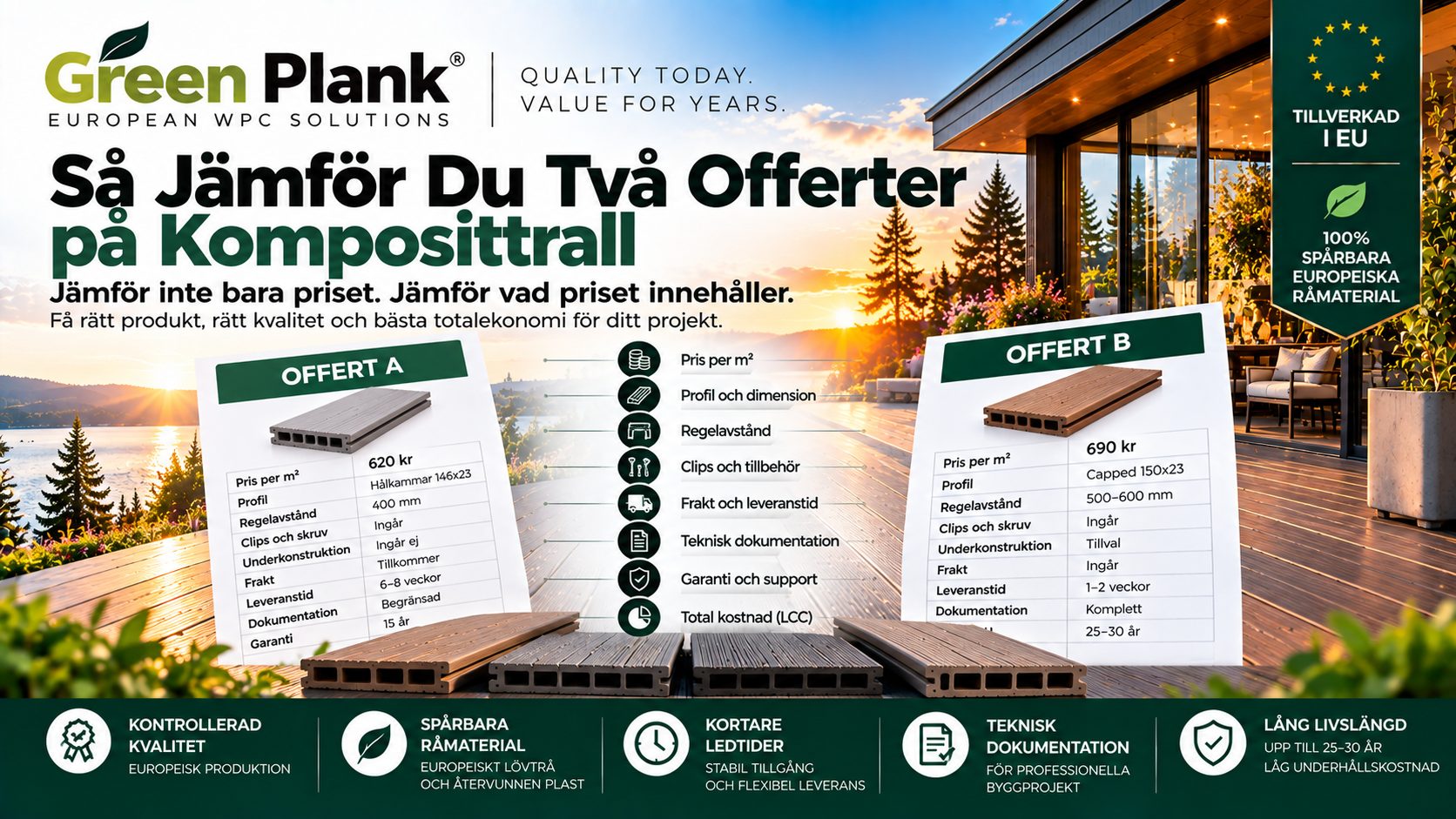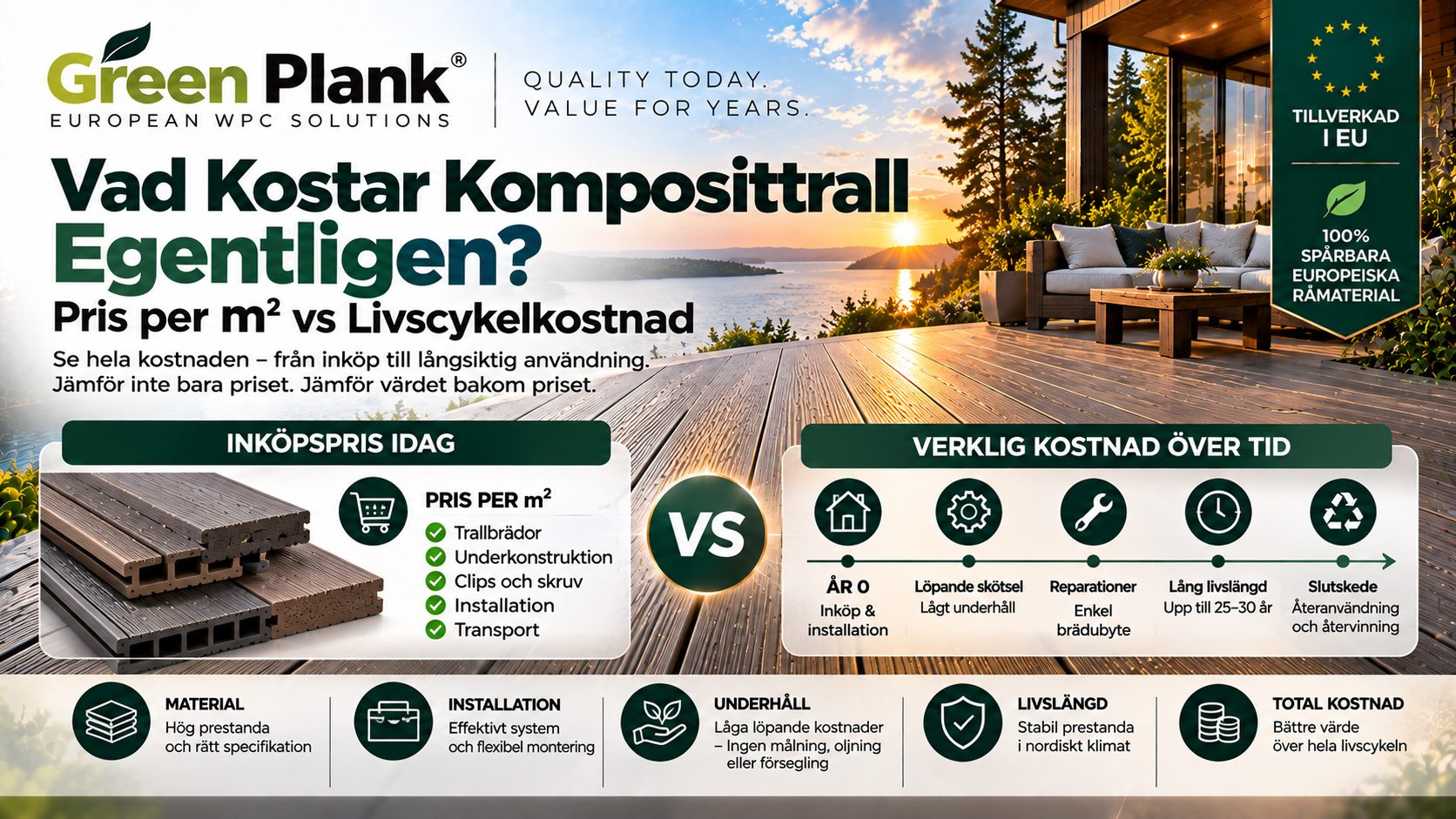




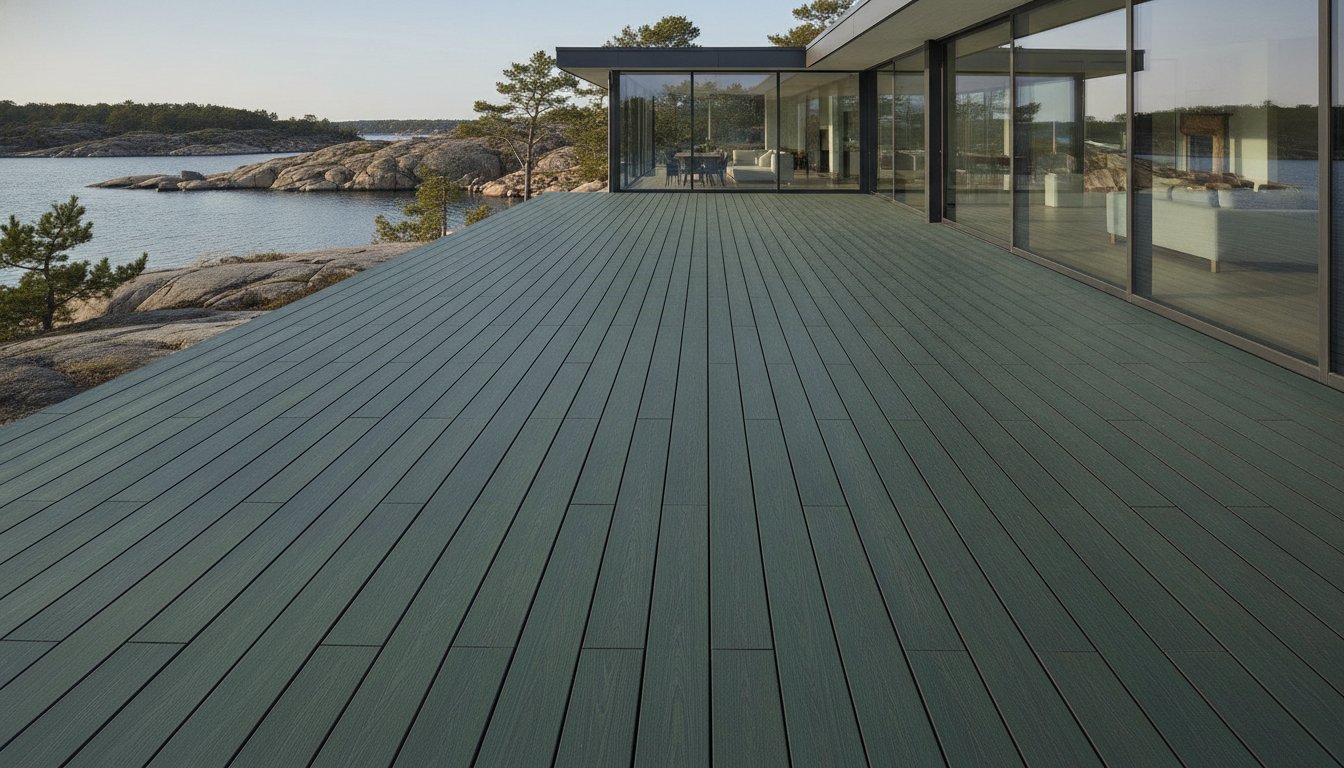
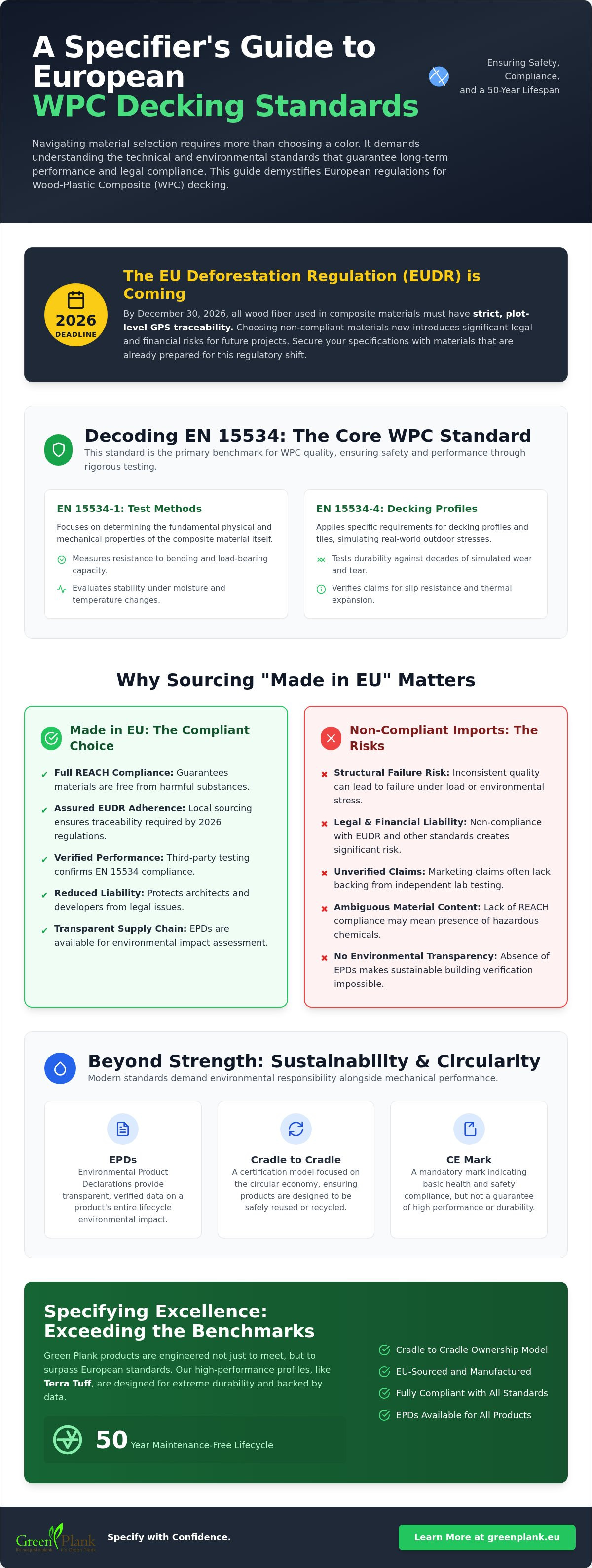
By December 30, 2026, the European landscape for composite materials changes forever as the EU Deforestation Regulation (EUDR) mandates strict, plot-level GPS traceability for every wood fiber used. Choosing a material today isn't just about selecting a color; it's about navigating the complex european wpc decking standards to avoid the structural failure and legal risks of non-compliant imports. You recognize that a premium outdoor space is a long-term investment, yet the technical jargon of EN 15534 and various DIN codes can make it difficult to verify true quality.
We believe that engineering precision and ecological responsibility should go hand in hand. This guide will help you master the technical and environmental standards governing European WPC decking so you can ensure your project meets the highest benchmarks for safety. We'll provide a clear checklist for your specifications, explain how to verify compliance with the latest EU regulations, and show you how to secure a product lifespan of up to 50 years. By the end, you'll have the confidence to specify materials that respect both your design vision and the planet.
Key Takeaways
- Understand why unified regulations are essential for ensuring structural safety in both high-traffic public spaces and private residential zones.
- Decode the technical requirements of EN 15534, the primary benchmark for european wpc decking standards, to verify mechanical strength and material stability.
- Learn how sourcing European-made materials ensures full REACH compliance and eliminates the structural risks associated with non-compliant imports.
- Identify the specific sustainability credentials, including EPDs and Cradle to Cradle certification, required to meet strict EU environmental and circularity regulations.
- Discover how specifying high-performance profiles like Terra Tuff provides the engineering confidence required for a 50-year maintenance-free lifecycle.
Table of Contents
- Understanding the Framework of European WPC Decking Standards
- The EN 15534 Standard: Decoding Technical Performance Requirements
- Why Sourcing "Made in EU" Matters for Compliance and Longevity
- Beyond Mechanical Testing: Sustainability and Circularity Standards
- Specifying Excellence: How Green Plank Exceeds European Industry Benchmarks
Understanding the Framework of European WPC Decking Standards
The transition of Wood-plastic composites (WPCs) from a niche landscaping alternative to a primary construction component has been driven by rigorous technical oversight. In the early 2000s, the market lacked cohesion, which often led to inconsistent performance and material failure. Today, the european wpc decking standards established by the European Committee for Standardization (CEN) provide a unified framework that ensures safety and predictability. These standards aren't just suggestions. They're the benchmark for engineering confidence in high-traffic residential zones and demanding public infrastructure.
Unified standards serve a dual purpose: they protect the end-user and provide a clear roadmap for manufacturers. By harmonizing quality across the EU, CEN eliminates the ambiguity that often plagues non-European imports. This framework distinguishes between basic mandatory safety requirements, such as fire classification, and voluntary quality labels that signal superior durability. It's a system built on engineering precision rather than marketing claims. High-quality manufacturing ensures regulatory adherence; local sourcing minimizes supply chain risk; standardized testing guarantees project longevity.
The Legal Necessity of Compliance in 2026
As of 2026, the legal environment for construction specifiers has become significantly more stringent. Compliance with European standards protects architects and developers from liability issues that arise when sub-standard materials fail under load or environmental stress. There's also a growing shift toward mandatory Environmental Product Declarations (EPDs). These documents provide transparent data on a product's environmental impact, which is now a prerequisite for many large-scale European projects. Sourcing products labeled "Made in EU" acts as an implicit guarantee. It signals that the material adheres to the baseline regulatory requirements of the single market, reducing the risk of project delays or safety audits.
Key Governing Bodies and Certification Logos
Navigating certifications requires an eye for detail. While the CE mark is a mandatory indicator of compliance with EU health and safety requirements, it doesn't always tell the full story of performance. Real assurance comes from third-party laboratory testing. These independent audits verify manufacturer data, ensuring that claims about slip resistance and thermal expansion are grounded in fact. Independent audits provide transparency; transparency builds trust with stakeholders. Standardized metrics allow for direct comparisons; comparisons lead to better material choices.
At Green Plank, we integrate these rigorous benchmarks into our Cradle to Cradle ownership model. This ensures that every profile we manufacture doesn't just meet the current european wpc decking standards but supports a circular economy that respects nature. By prioritizing materials that exceed minimum benchmarks, we provide the regional reliability that industry professionals expect.
The EN 15534 Standard: Decoding Technical Performance Requirements
The EN 15534 Standard is the primary European regulation that defines the technical and safety specifications for wood-plastic composites used in construction. This regulatory framework is divided into several parts to ensure every aspect of a product's lifecycle is scrutinized. EN 15534-1 focuses on the general test methods used to determine physical and mechanical properties. EN 15534-4 provides the specific requirements for decking profiles and tiles, ensuring they can withstand the unique stresses of outdoor flooring. These laboratory tests don't just measure current quality; they simulate decades of wear, moisture exposure, and temperature fluctuations in just a few weeks. This acceleration of time allows engineers to predict how a board will perform in 2050 based on data gathered today.
When you review a Technical Data Sheet (TDS), the presence of these codes indicates a commitment to the european wpc decking standards. It's the difference between a product that looks good on day one and one that maintains its integrity for fifty years. If a manufacturer cannot provide specific test results for these EN benchmarks, the risk of material failure increases significantly. You can explore our technically verified decking ranges to see how these standards are applied to real-world products.
Mechanical Strength: Bending and Impact Resistance
Structural safety depends on two critical metrics: Modulus of Rupture (MOR) and Modulus of Elasticity (MOE). MOR measures the ultimate strength of the board before it breaks, while MOE determines its stiffness. A high MOE is essential because it prevents the decking from sagging between joists over time. Compliance also requires falling mass impact tests. These tests ensure that boards don't shatter or crack when subjected to heavy drops, even in freezing temperatures. We utilize a precise ratio of 75% hardwood fiber and 25% HDPE. This high fiber concentration provides the mechanical stability required for high-traffic zones while the polymer matrix protects the core from the elements.
Durability: Moisture Absorption and UV Stability
Water is the primary enemy of composite materials. EN 15534-4 mandates strict 24-hour immersion and boiling tests to measure swelling and water absorption. Low absorption rates are non-negotiable for wpc composite decking, as they prevent internal rot and fungal growth. UV stability is equally vital and is tested under the EN ISO 4892-2 standard for artificial weathering. This ensures your deck won't fade or become brittle after years of solar radiation. Safety is further reinforced through slip resistance criteria, often classified under DIN 51097. This testing ensures the surface remains safe in wet coastal or poolside environments, providing peace of mind for both residential and commercial specifiers.
Why Sourcing "Made in EU" Matters for Compliance and Longevity
Sourcing is the technical foundation of the european wpc decking standards. While global markets offer numerous composite options, the reliability of a product is directly tied to the transparency of its supply chain. Many non-European imports rely on "ghost" certifications. These are self-declared documents that often lack the rigorous third-party verification required by European law. By choosing materials manufactured within the EU, you ensure that every board adheres to strict REACH regulations. This means your outdoor space remains free from hazardous chemicals like lead or phthalates. Regional manufacturing provides safety; safety provides peace of mind.
Material composition is the next critical factor for long-term performance. We utilize 100% EU-sourced hardwood fibers rather than unknown tropical fillers. Tropical fillers can introduce organic inconsistencies that lead to premature decay or unpredictable expansion. In contrast, high-quality, traceable fibers combined with high-density HDPE ensure that the final profile meets the impact standards defined in the BS EN 15534-4 decking standard. Reliable raw materials result in a stable product; a stable product results in decades of performance. It's a chain of quality that begins at the source.
The Problem with Low-Density Non-Compliant Boards
Many hollow-core imports suffer from internal air pockets that trap moisture. This moisture leads to internal rot and eventual structural failure, often within just a few years of installation. There's a vast difference between 100% EU raw materials and recycled waste of unknown origin. While we focus on low-density profiles to reduce the CO2 footprint, we don't sacrifice performance. Our engineering process ensures that even lighter profiles maintain the mechanical strength required by european wpc decking standards. Engineering precision reduces weight; reduced weight reduces environmental impact. This balance is only possible when you have total control over the manufacturing environment.
Checklist for Verifying WPC Standards
To protect your project and your reputation, you must look beyond the marketing brochure. Always request a Declaration of Performance (DoP) directly from the manufacturer. This document is a legal requirement in the EU and summarizes the product's essential characteristics under standardized conditions. Compare the Technical Data Sheet (TDS) against the minimum thresholds of EN 15534-4 to ensure the product is fit for purpose. Don't take a 50-year warranty at face value without seeing the actual mechanical test results that support such a claim. Verified data proves longevity; longevity proves value. Use this brief checklist for your next specification:
- Verify the origin of both the polymer and the wood fiber.
- Request a recent Declaration of Performance for the specific profile.
- Cross-reference MOR and MOE values with the benchmarks discussed in previous sections.
- Ensure the manufacturer provides a clear REACH compliance statement.
Beyond Mechanical Testing: Sustainability and Circularity Standards
Meeting european wpc decking standards requires more than passing a stress test; it demands a commitment to the entire material lifecycle. The rise of EN 15804 has shifted the focus toward Environmental Product Declarations (EPDs). These documents provide a transparent, third-party verified account of a product’s carbon footprint and resource use. In 2026, an EPD is the primary tool for architects to prove compliance with green building certifications. We prioritize this transparency because it empowers decision-makers. Sustainable manufacturing isn't a trend. It's a technical requirement for the modern built environment.
Circularity is further reinforced through Cradle to Cradle (C2C) certification. This standard ensures that every component is safe for humans and the environment. It also mandates that materials are designed for reuse. To prevent deforestation, we exclusively use PEFC or FSC certified hardwood fibers. This ensures that the wood content is legally sourced and does not contribute to habitat loss. Local sourcing within the EU further reduces the CO2 footprint by eliminating the emissions associated with long-distance shipping. Regional reliability supports ethical goals; ethical goals support long-term project value.
The Role of Recycled HDPE in EU Standards
We utilize a precise blend of 75% hardwood fiber and 25% HDPE. This ratio isn't accidental. It creates a material that's both durable and 100% recyclable. Public tenders across Europe now prioritize these attributes to align with the goals of the EU Green Deal. Choosing sustainable building materials ensures your project meets these evolving requirements. High-quality polymers ensure longevity; longevity ensures a lower lifetime environmental impact. By keeping manufacturing within Europe, we maintain total control over the purity of these recycled components.
Circularity and End-of-Life Standards
Designing for disassembly is a core principle of our engineering philosophy. Our HidLoc™ hidden fastening systems allow for the easy removal of individual boards without damaging the structural integrity of the profile. This facilitates repurposing or recycling at the end of the deck's 50-year service life. A longer lifespan is the most effective way to conserve natural resources. It's a simple logic: products that last longer need to be replaced less often. You can explore our full range of circular decking solutions to start your next sustainable project with confidence.
Specifying Excellence: How Green Plank Exceeds European Industry Benchmarks
Compliance with european wpc decking standards serves as the starting point for our manufacturing process, not the finish line. We recognize that architects and industry professionals require more than just a certificate; they need materials that perform under real-world stress. Our commitment to exceeding the minimum requirements of EN 15534 is what allows us to offer a 50-year service life warranty with absolute confidence. This isn't a marketing claim. It's a signature of engineering precision. By maintaining 100% EU-sourced raw materials, we ensure that every profile leaving our facility possesses the regional reliability your project demands. Technical mastery ensures safety; regional sourcing ensures sustainability.
Partnering with a manufacturer that possesses deep roots in European manufacturing simplifies the specification process. We provide the technical data sheets and legal certifications required to navigate modern building codes without the fear of product failure. Our role as a sustainable craftsman is to provide you with the tools to build outdoor spaces that respect nature and endure for generations. By prioritizing material science and long-term performance, we help you master the european wpc decking standards while delivering an aspirational aesthetic.
Terra Tuff: Engineered for Extreme Commercial Loads
Terra Tuff profiles are specifically engineered for extreme commercial loads and public infrastructure. In environments like public piers or coastal boardwalks, the material must withstand constant foot traffic and environmental salt exposure. Terra Tuff surpasses standard bending strength requirements, providing a rigid surface that doesn't sag over time. Saltwater resistance prevents internal degradation; high-density HDPE ensures impact durability. These profiles also meet the stringent fire safety standards of EN 13501-1, making them a safe choice for commercial facades and high-density residential zones. High-performance engineering protects the investment; fire-rated materials protect the public.
Innovation in Fastening: The HidLoc™ Advantage
Innovation also extends to how our products are assembled. The Smart System wpc composite decking line utilizes our proprietary HidLoc™ hidden fastening systems to address the complexities of thermal expansion. These systems are designed to allow the boards to move slightly without compromising their position. Standardized fastening prevents structural warping; hidden clips preserve the aesthetic beauty of the wood-like finish. This engineering approach ensures that the deck remains as safe and stable in year fifty as it was on day one. Proper installation preserves structural integrity; compliant fastening ensures long-term beauty. You can consult with our technical team for your next large-scale project specification to ensure every detail meets the highest benchmarks for excellence.
Securing Your Project with Engineering Confidence
Adhering to the european wpc decking standards is the only way to ensure that your outdoor space remains safe, stable, and sustainable for decades. By prioritizing the rigorous benchmarks of EN 15534, you eliminate the risks of structural failure and legal liability. Transparency in sourcing ensures compliance; compliance ensures longevity. Our 100% EU raw materials provide the regional reliability required for high-end projects, while the Cradle to Cradle ownership model supports your commitment to a circular economy. A 50-year service life warranty isn't just a promise; it's the verified result of engineering precision.
We invite you to Request Technical Data Sheets for Green Plank WPC Systems to see how our materials exceed these critical benchmarks. Choosing verified quality today prevents the maintenance burdens of tomorrow. You have the power to create a beautiful, maintenance-free environment that respects the planet and stands the test of time. Let's build a future where engineering excellence and environmental ethics coexist perfectly.
Frequently Asked Questions
What is the most important European standard for WPC decking?
EN 15534 is the definitive benchmark for european wpc decking standards, providing a comprehensive framework for mechanical and physical testing. Specifically, Part 4 of this standard dictates the requirements for decking profiles and tiles. By adhering to these rigorous guidelines, manufacturers guarantee that their products withstand the environmental stresses of the European climate. Reliable testing leads to predictable performance; predictable performance leads to long-term project success.
Is EN 15534 compliance mandatory for residential decks?
While individual residential projects may not always face the same legal oversight as public infrastructure, EN 15534 remains the essential benchmark for quality and safety. Compliance ensures that a deck won't warp, crack, or fail prematurely under normal usage. Choosing standardized materials protects your investment and provides a safe environment for your home. Quality engineering reduces maintenance; reduced maintenance increases the enjoyment of your outdoor space.
How does European-made WPC differ from non-EU imports in terms of standards?
European-made products are subject to strict REACH and EUDR regulations that many non-EU imports fail to meet. Local manufacturing guarantees 100% EU raw materials and full traceability of wood fibers used in the production process. Imports often rely on self-declared certifications that lack the third-party verification required by european wpc decking standards. Traceable sourcing ensures safety; local production significantly reduces the CO2 footprint of your project.
What does a "Cradle to Cradle" certification mean for a WPC product?
Cradle to Cradle certification signifies that a product is designed for a circular economy, prioritizing material health and full recyclability. This standard ensures that the WPC contains no hazardous chemicals and utilizes renewable energy during manufacturing. It also mandates a design for disassembly, allowing materials to be repurposed at the end of their life. Circular design respects nature; safe materials protect the end-user throughout the product lifecycle.
Can WPC decking meet European fire safety standards for commercial buildings?
High-performance WPC profiles like Terra Tuff are engineered to meet the stringent EN 13501-1 fire safety standards required for commercial buildings. These materials are typically classified as Class B or C, making them suitable for public boardwalks and commercial facades. Rigorous fire testing provides the necessary documentation for building code approval. Enhanced safety features protect the structure; verified compliance protects the specifier from future liability.
How do I verify the slip resistance of a WPC board for a public project?
You should request the specific test results for DIN 51097 or CEN/TS 15676 from the manufacturer's Technical Data Sheet. These tests measure the coefficient of friction in both wet and dry conditions to ensure the surface is safe for public use. High slip resistance is a technical requirement for poolside and coastal environments. Reliable data proves safety; safe surfaces prevent accidents in high-traffic public zones.
Why is the wood-to-plastic ratio important for meeting EU standards?
A ratio of 75% hardwood fiber to 25% HDPE is critical for achieving the mechanical stability required by European benchmarks. This specific blend provides the structural stiffness of wood with the moisture resistance of high-density polymers. Deviating from this ratio can lead to excessive thermal expansion or brittle boards that fail impact tests. Engineering precision ensures stability; stable materials guarantee a service life of up to 50 years.
What documentation should I ask for to ensure my decking is compliant?
You must request a Declaration of Performance (DoP) and a detailed Technical Data Sheet (TDS) for every specified profile. The DoP is a legal requirement in the EU that summarizes how the product performs against essential safety characteristics. Additionally, ask for a REACH compliance statement to verify the absence of hazardous chemicals like lead or phthalates. Verified documentation proves quality; legal transparency ensures your project meets all regulatory hurdles.
Specificera produkten
Använd den här guiden i en Green Plank-specifikation
Tekniska WPC-artiklar ska stärka de kommersiella sidorna — inte konkurrera med dem. Fortsätt till komposittrall, TerraTuff, Nordeka eller de tekniska nedladdningarna.