



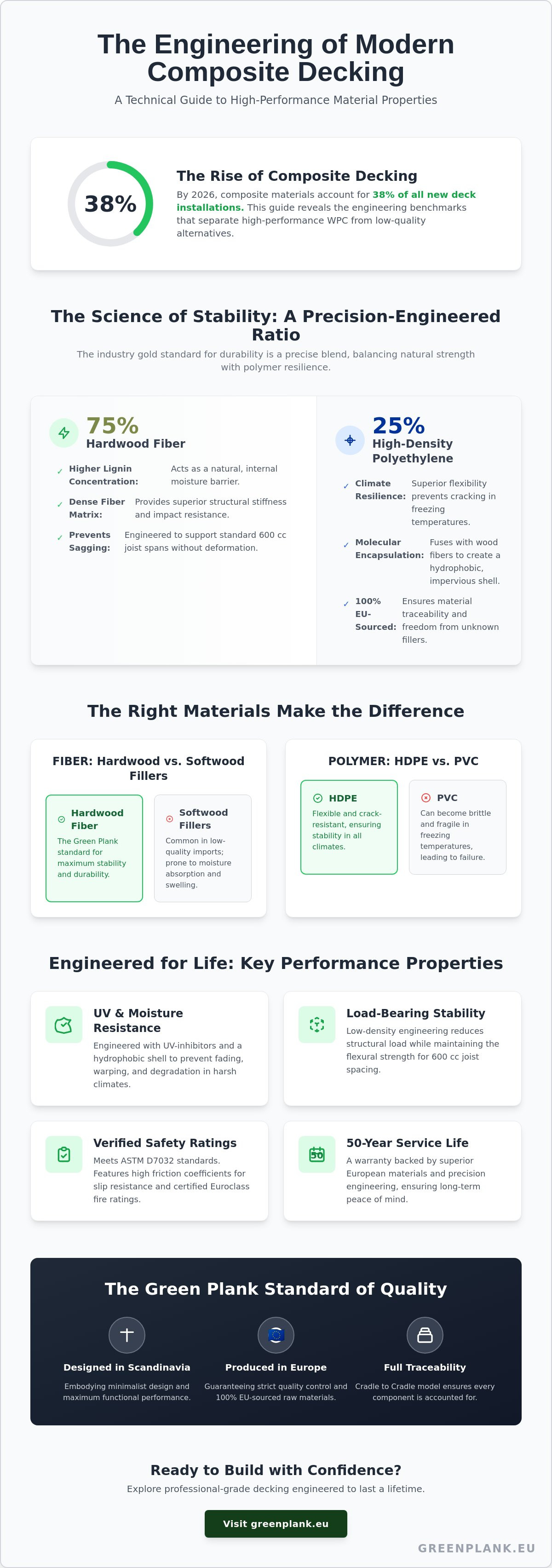
In 2026, composite decking accounts for 38% of all new deck installations, yet many professionals and homeowners still struggle to distinguish between high-performance engineering and low-quality imports. You've likely felt the frustration of choosing between HDPE and PVC, or perhaps you worry that a significant investment might still warp and fade under a harsh climate. It's difficult to trust a product when the raw materials are anonymous. This guide provides a technical deep dive into composite decking material properties to help you identify the engineering benchmarks of the modern era.
We'll explore why a specific 75/25 hardwood-to-HDPE ratio is essential for structural stability and how to verify ASTM D7032 safety and fire ratings. You'll learn how European-made traceability and co-extrusion technology justify a service life backed by a 50 year warranty. Designed in Scandinavia and produced in Europe, our natural-fiber composites are built to last and designed for life. This information ensures your outdoor space remains a maintenance-free sanctuary that respects both nature and engineering precision.
Key Takeaways
- Learn how the precise 75/25 ratio of hardwood fiber to HDPE optimizes composite decking material properties for maximum structural stability.
- Identify how low-density engineering reduces the total structural load on your foundation while maintaining professional-grade impact resistance.
- Understand the hydrophobic nature of molecular-level encapsulation and how engineered UV-inhibitors prevent degradation in harsh climates.
- Verify the specific friction coefficients and Euroclass fire ratings required for safe, compliant commercial and residential installations.
- Discover why 100% European raw materials and the Cradle to Cradle ownership model ensure superior traceability and long-term durability.
Table of Contents
- The Science of Composition: Hardwood Fiber and HDPE Ratios
- Mechanical Properties: Density, Load-Bearing, and Stability
- Environmental Resistance: UV Stability and Hydrophobic Properties
- Safety and Practical Properties: Slip Resistance and Fire Ratings
- The Green Plank Standard: 50-Year Engineering Confidence
The Science of Composition: Hardwood Fiber and HDPE Ratios
Modern engineering has transformed how we perceive outdoor flooring. In 2026, Wood-plastic composites (WPCs) are no longer simple mixtures of waste; they're precision-engineered materials designed to withstand extreme environmental stress. Understanding the specific composite decking material properties starts with the molecular ratio of their core components. At Green Plank, we utilize a rigorous 75% hardwood fiber to 25% High-Density Polyethylene (HDPE) blend. This specific ratio isn't arbitrary. It's the technical threshold where wood's natural strength meets the impervious nature of advanced polymers. It delivers a board that feels like timber but performs with the reliability of a professional-grade building material.
As we move into 2026, the demand for sustainable craftsmanship has never been higher. Homeowners and architects now require materials that don't just look natural but also respect the environment through a reduced CO2 footprint. Green Plank profiles are designed in Scandinavia and produced in Europe to meet these exact standards. By engineering the composition at a microscopic level, we eliminate the weaknesses inherent in traditional timber, such as rot and insect damage. This technical precision allows us to offer a service life backed by a 50-year warranty, providing long-term peace of mind for any residential or commercial project.
Why Hardwood Fiber Trumps Softwood Fillers
Hardwood fibers provide a higher concentration of lignin, a natural organic polymer that acts as a moisture barrier within the wood cell walls. While many competitors use generic softwood fillers, hardwood's denser fibers create a more stable internal matrix. This density reduces the risk of internal swelling and improves the board's overall impact resistance. Shorter, high-quality fiber lengths ensure that the reinforcement agent is thoroughly integrated into the HDPE shell. This 75% hardwood fiber composition is the industry gold standard for durability because it provides the necessary stiffness to prevent sagging over a 600 cc joist span.
HDPE: The Premium Polymer for Outdoor Stability
The choice of polymer determines how a deck responds to thermal expansion and physical impact. We exclusively use EU-sourced HDPE because it offers superior flexibility and crack resistance compared to brittle PVC or low-density alternatives like LDPE. Unlike PVC, which can become fragile in freezing temperatures, HDPE remains stable and resilient. Our manufacturing process incorporates specialized bonding agents and additives that fuse the hardwood and polymer at a molecular level. This creates a circular, Cradle to Cradle lifecycle where materials can eventually be reclaimed and repurposed. Our commitment to 100% European raw materials ensures every board is traceable and free from the unknown fillers often found in low-quality imports.
Mechanical Properties: Density, Load-Bearing, and Stability
Structural integrity is the silent hallmark of premium engineering. While the visual grain might attract the eye, the mechanical composite decking material properties determine whether a project remains level for decades or succumbs to the pressures of use and climate. High-performance WPC relies on a balance between density and flexural strength. Research into the flexural properties of wood-plastic composites shows that the integration of fiber reinforcement is what allows a board to resist deformation under load. For private residential applications, this engineering allows for a standard '600 cc' (center-to-center) joist spacing, providing a stable foundation that feels as solid as traditional hardwood underfoot.
Managing mechanical movement is equally critical for long-term durability. Our HidLoc™ Hidden Fastening Systems aren't just about aesthetics; they're engineered components that allow boards to expand and contract without stressing the fasteners or the joists. This system works in harmony with our low-density profiles to ensure the deck remains a cohesive, durable unit. If you're planning a complex layout, exploring our professional-grade decking collections can help you visualize how these mechanical advantages translate to real-world performance.
Understanding Density vs. Weight-to-Strength Ratios
Density is often confused with quality, but ultra-heavy boards can complicate subframe requirements and increase labor costs. Green Plank utilizes low-density engineering to reduce the dead load on the supporting structure without sacrificing impact resistance. While pressure-treated timber has a density that fluctuates wildly based on moisture content, WPC provides a consistent, predictable range. This consistency ensures every board responds identically to stress, making it easier for contractors to calculate load-bearing capacities for high-traffic commercial zones.
Thermal Expansion and Dimensional Stability
Temperature fluctuations pose a significant challenge to outdoor materials. Plastic-heavy boards often have a high 'plastic memory,' leading to significant warping during Nordic seasonal shifts. Because our boards consist of 75% wood fiber, they exhibit a much lower linear thermal expansion coefficient than standard PVC or low-quality composites. The wood content provides dimensional stability, effectively 'anchoring' the polymer matrix. Proper gapping remains essential; we recommend specific spacing intervals to accommodate the expansion cycles typical of European climates, ensuring your deck stays perfectly aligned through winter freezes and summer heat.
Environmental Resistance: UV Stability and Hydrophobic Properties
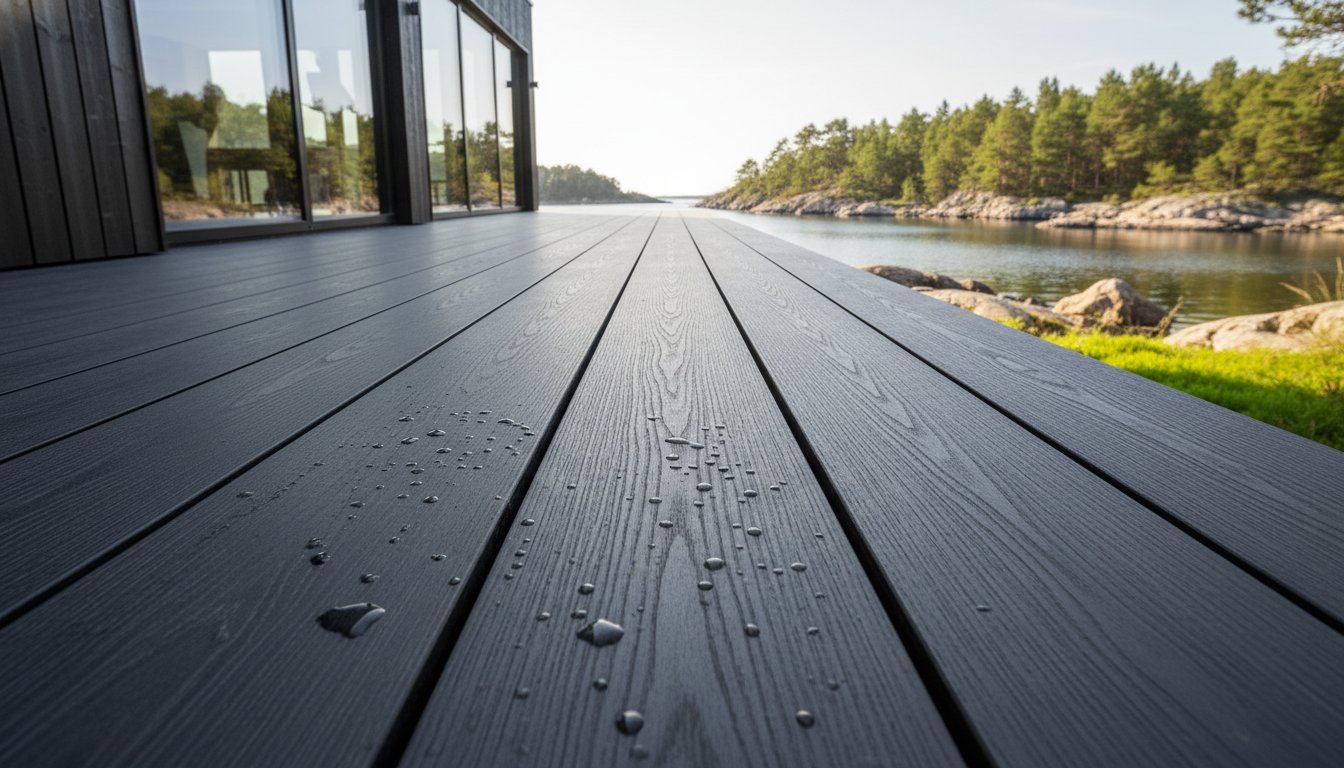
Outdoor longevity depends on how a material interacts with water and light. Unlike timber, which absorbs moisture until it swells and decays, the composite decking material properties of Green Plank profiles are defined by their hydrophobic core. By using high-density polyethylene (HDPE) as a binder, we effectively encapsulate every hardwood fiber in a protective polymer shield. This molecular coating prevents moisture from reaching the organic material, ensuring the board remains stable even in saturated conditions. For a deeper look at this technical process, you can read our guide on how WPC is made.
Sunlight is the primary cause of degradation for outdoor plastics. Without intervention, UV rays break down the molecular bonds of polymers, leading to surface chalking and structural brittleness. We integrate professional-grade UV-inhibitors directly into the matrix during production. These additives act as a molecular shield, absorbing harmful radiation before it can damage the structural integrity of the board. This engineering approach ensures that the deck maintains its strength and flexibility throughout its 50-year service life. Designed in Scandinavia. Produced in Europe. Built to resist the elements.
Moisture Absorption Rates and Rot Prevention
Timber is a sponge. It absorbs water until the cellular structure fails, leading to rot and decay. In contrast, our engineered WPC maintains a moisture absorption rate of less than 1%. This exceptionally low saturation level is critical because it eliminates the conditions required for fungal growth and mold. Whether installed in high-humidity coastal regions or near saltwater pools, the material remains inert. It doesn't rot. It doesn't splinter. It stays stable. This makes it an ideal choice for commercial infrastructure where durability is non-negotiable.
Color Retention and UV-Shielding Technology
Color consistency is achieved through total integration. We don't just coat the surface; pigments are blended through the entire board profile during the extrusion process. For those seeking the highest level of stain resistance, our capped co-extrusion technology adds an extra layer of polymer protection. It's important to understand the natural 'weathering' phase. During the first 12 weeks of exposure, the natural wood fibers undergo a slight color adjustment as they settle into their permanent tone. This is a normal settling process that results in a refined, Nordic character that requires no painting or staining.
Safety and Practical Properties: Slip Resistance and Fire Ratings
User safety is a fundamental pillar of professional-grade engineering. While aesthetic appeal and durability are vital, the composite decking material properties related to physical safety are what make a project viable for public and private use. We evaluate these properties through the lens of the Coefficient of Friction (CoF), a technical measurement of a surface's slip resistance. Our boards undergo rigorous testing to ensure they provide a secure footing in both dry and wet conditions. Unlike traditional timber, which relies on the varying quality of the wood grain, our WPC is manufactured to a consistent safety standard. This controlled production process also ensures a completely splinter-free surface, protecting families and the public from the physical hazards common with aging wood decks.
For architects and contractors managing large-scale projects, the choice of profile is a matter of liability and compliance. Our commercial infrastructure profiles are specifically designed to meet the high-traffic demands of municipal spaces and urban developments. By focusing on the mechanical grip and the internal integrity of the board, we provide a solution that prioritizes human safety without compromising on the refined Nordic aesthetic. These profiles are built to last and designed for life, ensuring that safety remains a permanent feature of the installation, not just an afterthought.
Slip Resistance in Wet and Dry Conditions
The mechanical grip of our decking is achieved through specialized surface treatments, such as deep embossing and wire-brushing. These textures create micro-ridges that significantly enhance traction. Traditional timber often becomes a hazard when wet because it supports the growth of algae, which acts as a lubricant on the surface. Because our WPC is hydrophobic, it resists the organic buildup that makes wood slippery. Maintaining this high level of safety is straightforward. Simple periodic cleaning with a soft brush and water removes the dirt and pollen that can settle in the grooves, ensuring the engineered texture remains effective year-round.
Fire Retardancy and Building Code Compliance
Fire performance is a non-negotiable requirement for modern construction, particularly for multi-story cladding and residential balconies. We integrate advanced fire-retardant additives into the 25% polymer portion of our composite matrix to improve the material's reaction to fire. This engineering ensures our products meet the stringent Euroclass ratings required for commercial building compliance across Europe. By controlling the flame spread and smoke production of the material, we provide a product that meets the highest safety standards for European architectural projects. It's this commitment to engineering precision that defines the Green Plank standard.
If you're ready to secure a material that balances technical safety with sustainable design, explore our full range of professional-grade WPC solutions to find the perfect fit for your next project.
The Green Plank Standard: 50-Year Engineering Confidence
The technical specifications discussed throughout this guide culminate in a material that exceeds standard industry expectations. At Green Plank, we don't view composite decking material properties as static values; we see them as the foundation of a circular economy. Our 'Cradle to Cradle' ownership model ensures every board is designed for a life cycle that respects the planet. This means the product is engineered for extreme longevity, but also for eventual reclamation and reuse. It's a commitment to being a responsible innovator in an industry often plagued by disposable, short-term solutions. By choosing these sustainable building materials, you're participating in a future-proofed construction method that prioritizes both the environment and the end-user.
Our engineering confidence is reflected in our long-term warranties. While standard products might offer 15 or 20 years of coverage, our professional-grade profiles are backed by a service life warranty of up to 50 years. This isn't a marketing claim. It's the result of the 75/25 hardwood-to-HDPE ratio and the molecular-level encapsulation we've detailed in previous sections. Designed in Scandinavia. Produced in Europe. Built to last. Designed for life.
Traceability and EU Manufacturing Quality
Quality begins with the source. By utilizing 100% European raw materials, we eliminate the performance risks associated with the anonymous 'filler' materials often found in low-quality imports. Many non-EU composites contain unknown plastics or recycled waste that can compromise the board's structural integrity over time. Our European-made supply chain ensures total traceability and a significantly lower CO2 footprint due to reduced transport distances. This proximity allows us to maintain the strict Nordic standards for functional material properties that architects and contractors rely on for high-stakes infrastructure projects.
The Long-Term ROI of High-Performance Properties
The financial justification for premium WPC is found in its lifecycle value. A traditional timber deck typically requires replacement every 10 to 15 years and demands annual staining, sealing, and sanding. In contrast, our engineered composite provides a 50-year service life with zero required maintenance beyond simple cleaning. When you calculate the labor and material costs of five wood deck replacements versus one Green Plank installation, the investment pays for itself within the first decade. To achieve a unified, professional-grade exterior, many developers are now pairing their decks with high-performance composite wall cladding. This creates a maintenance-free building envelope that retains its value and aesthetic appeal for generations.
Engineering the Future of Sustainable Outdoor Spaces
The evolution of WPC technology has redefined the benchmarks for modern outdoor construction. We've explored how a precise 75/25 hardwood-to-HDPE ratio and molecular encapsulation create a board that is fundamentally different from generic imports. By prioritizing these specific composite decking material properties, you're choosing a material that resists the structural degradation typical of traditional timber and low-quality plastics. This technical approach ensures your project remains safe, stable, and aesthetically refined for decades.
Green Plank remains committed to the highest standards of Nordic reliability. Every board is manufactured in Europe using 100% EU-sourced raw materials under a Cradle to Cradle ownership model. This ensures total traceability and an industry-leading 50-year warranty. It's an investment in a circular future where performance and environmental responsibility coexist seamlessly. We invite you to see the quality of our sustainable craftsmanship firsthand.
Ready to experience the difference of engineered natural-fiber composites? Request a Professional Sample Pack of our High-Performance WPC today. It's time to build a space that is designed for life and built to last.
Frequently Asked Questions
What are the primary raw materials in composite decking?
High-performance WPC consists of 75% hardwood fiber and 25% High-Density Polyethylene (HDPE) along with specialized additives. We use 100% European raw materials to ensure every board is traceable and free from anonymous fillers. This natural-fiber composite provides the aesthetic of timber with the engineered durability of modern polymers. It's a professional-grade solution designed to withstand the harsh Scandinavian climate while maintaining its structural integrity.
Does composite decking expand and contract like wood?
Composite materials expand and contract primarily due to temperature changes rather than moisture absorption. While traditional wood swells when wet, WPC exhibits linear thermal expansion. Our 75% wood fiber ratio reduces this movement significantly compared to plastic-heavy alternatives. Using the HidLoc™ system allows the boards to move safely within their engineered tolerances. This prevents warping and ensures the deck remains level throughout the year.
Is composite decking fire-resistant for commercial use?
Yes, professional-grade composites are engineered with fire-retardant additives to meet Euroclass safety standards. These composite decking material properties are essential for multi-story cladding and public infrastructure compliance. Unlike untreated timber, these profiles control flame spread and smoke production to protect building occupants. This engineering makes them a reliable choice for commercial balconies and urban developments where building codes are strictly enforced.
How does the density of WPC affect its overall strength?
Material density is a key indicator of impact resistance, but higher weight doesn't always mean superior strength. We utilize low-density engineering to reduce the structural load on subframes while maintaining high flexural strength. This balance allows for a stable 600 cc joist span in private applications without the need for overly heavy, difficult-to-install boards. It delivers a deck that's both easy to handle and exceptionally durable.
What is the difference between HDPE and PVC in composite decking?
HDPE offers superior flexibility and crack resistance compared to the more brittle nature of PVC. While PVC is often used in plastic-only decking, HDPE is the preferred binder for natural-fiber composites because it encapsulates wood fibers more effectively. This choice supports a circular, Cradle to Cradle lifecycle that PVC often lacks. It ensures the boards remain resilient in freezing temperatures, reflecting the reliability of Nordic engineering.
How does moisture absorption affect the lifespan of a composite deck?
Low moisture absorption is the primary factor that extends a composite deck's lifespan to 50 years. Our boards maintain an absorption rate of less than 1%, which prevents the internal rot and fungal growth that destroys timber. By keeping the core dry, the material avoids the structural weakening caused by seasonal freeze-thaw cycles. This hydrophobic property is what makes the material practically maintenance-free and resistant to saltwater.
Can composite decking be recycled at the end of its life?
High-quality WPC is fully recyclable and fits into a circular construction model. Our Cradle to Cradle ownership approach means the materials are designed to be reclaimed and repurposed at the end of their service life. This reduces the environmental footprint of the project and ensures that no 100% EU raw materials go to waste. It's a sustainable choice for those looking to build with the planet's future in mind.
What causes composite decking to fade and can it be prevented?
Fading is caused by UV radiation breaking down polymer bonds, but it's managed through integrated UV-inhibitors and high-quality pigments. You'll notice a slight settling of color during the first 12 weeks as the natural wood fibers weather. This is a controlled process that results in a permanent, refined Nordic character that never requires painting. The composite decking material properties ensure the internal pigments remain vibrant and stable for decades.
Specificera produkten
Använd den här guiden i en Green Plank-specifikation
Tekniska WPC-artiklar ska stärka de kommersiella sidorna — inte konkurrera med dem. Fortsätt till komposittrall, TerraTuff, Nordeka eller de tekniska nedladdningarna.