



Why should a property boundary require more annual labor than the home it protects? In Sweden, the traditional cycle of sanding and staining timber fences consumes valuable hours every season, yet many generic wood structures show signs of structural decay within just 10 years. It's frustrating to watch a premium investment warp under the pressure of Nordic winters or lose its character to UV fading. You deserve a solution that balances aesthetic ambition with engineering precision.
Discover how to break this cycle by implementing modern fence ideas that prioritize circularity and durability. This guide demonstrates how blending Nordic minimalism with high-performance natural-fiber composites creates a maintenance-free boundary that's built to last and designed for life. We'll preview 21 sustainable designs that utilize traceable, European-made materials to increase property value while eliminating the need for toxic paints or oils. From architectural privacy screens to low-profile borders, you'll find the inspiration needed to transform your exterior into a professional-grade sanctuary that stands firm against the elements through 2026 and beyond.
Key Takeaways
- Discover how Nordic minimalism is redefining property boundaries in 2026 by prioritizing high-performance engineering and sustainable, natural textures.
- Explore a curated collection of 21 modern fence ideas that utilize horizontal slat designs to create a sleek, expansive architectural envelope for your landscape.
- Learn how to eliminate the recurring costs of staining and replacement by transitioning from traditional timber to engineered natural-fiber composites.
- Master the psychology of modern privacy to create a secure outdoor sanctuary that maintains a seamless indoor-outdoor flow without feeling enclosed.
- Ensure a 50-year service life for your investment by combining professional installation techniques with European-made, circular materials designed for the Swedish climate.
The Evolution of Modern Fence Design: Clean Lines and Nordic Minimalism
Modern property boundaries in 2026 have transitioned from simple decorative barriers to high-performance architectural statements. Homeowners no longer view a fence as a secondary addition; it's now a primary element of a home’s exterior identity. While the history of fencing materials began with functional stone and untreated timber, the current era prioritizes engineered precision and environmental ethics. Modern fencing is the intersection of architectural linear geometry and environmental responsibility.
The rise of Scandinavian design has fundamentally changed how we perceive outdoor boundaries. Nordic minimalism focuses on the "fifth wall" concept, where the fence acts as a vertical extension of the interior living space. This approach uses natural textures and muted tones to create a seamless transition between the home and the garden. By integrating modern fence ideas that emphasize clean profiles, property owners can achieve a sense of privacy without sacrificing the aesthetic flow of their landscape. It's about creating a sanctuary that feels both open and secure.
The Core Principles of Modern Aesthetics
Modern design in 2026 relies heavily on horizontality. Leading the eye across the landscape creates a perceived sense of increased space, making even smaller Swedish urban lots feel expansive. We prioritize material honesty by using high-quality natural-fiber composites rather than covering inferior timber with thick layers of paint. This transparency in material choice reflects a commitment to quality. Designers often mix dark, powder-coated aluminum profiles with warm, natural hardwood fiber finishes to create a sophisticated contrast. This interplay of texture adds depth and visual interest to the property line. Designed in Scandinavia. Produced in Europe.
Sustainability as a Design Requirement
In the current market, "modern" is synonymous with a low CO2 footprint and circular ownership. We've moved away from the "buy-and-replace" cycle. A fence that requires replacement every decade is an environmental failure. Instead, we focus on durability as the ultimate sustainable choice. A professional-grade fence engineered to last 50 years significantly reduces resource consumption over time. We utilize 100% EU raw materials to ensure every component is traceable and ethically manufactured. This localized production chain minimizes transport emissions and supports European labor standards.
Choosing sustainable materials isn't just a trend; it's a long-term investment in property value. High-performance composites don't rot, warp, or require chemical staining, which keeps harmful toxins out of the Swedish soil. By selecting modern fence ideas rooted in circularity, homeowners contribute to a greener future while enjoying a maintenance-free lifestyle. Built to last. Designed for life.
Inspiring Modern Fence Styles: A Roundup for Every Landscape
Selecting a boundary is an exercise in architectural synergy. Our curation of 21 modern fence ideas prioritizes longevity and circular design. In Sweden, the shift toward natural-fiber composites reflects a growing commitment to the environment. These materials endure the freeze-thaw cycles of Nordic winters without warping or cracking. They offer a professional-grade alternative to traditional timber that requires heavy chemical maintenance. By choosing sustainable fencing materials, you ensure your property boundary contributes to local biodiversity by avoiding toxic runoff into the soil.
The Horizontal Slat Revolution
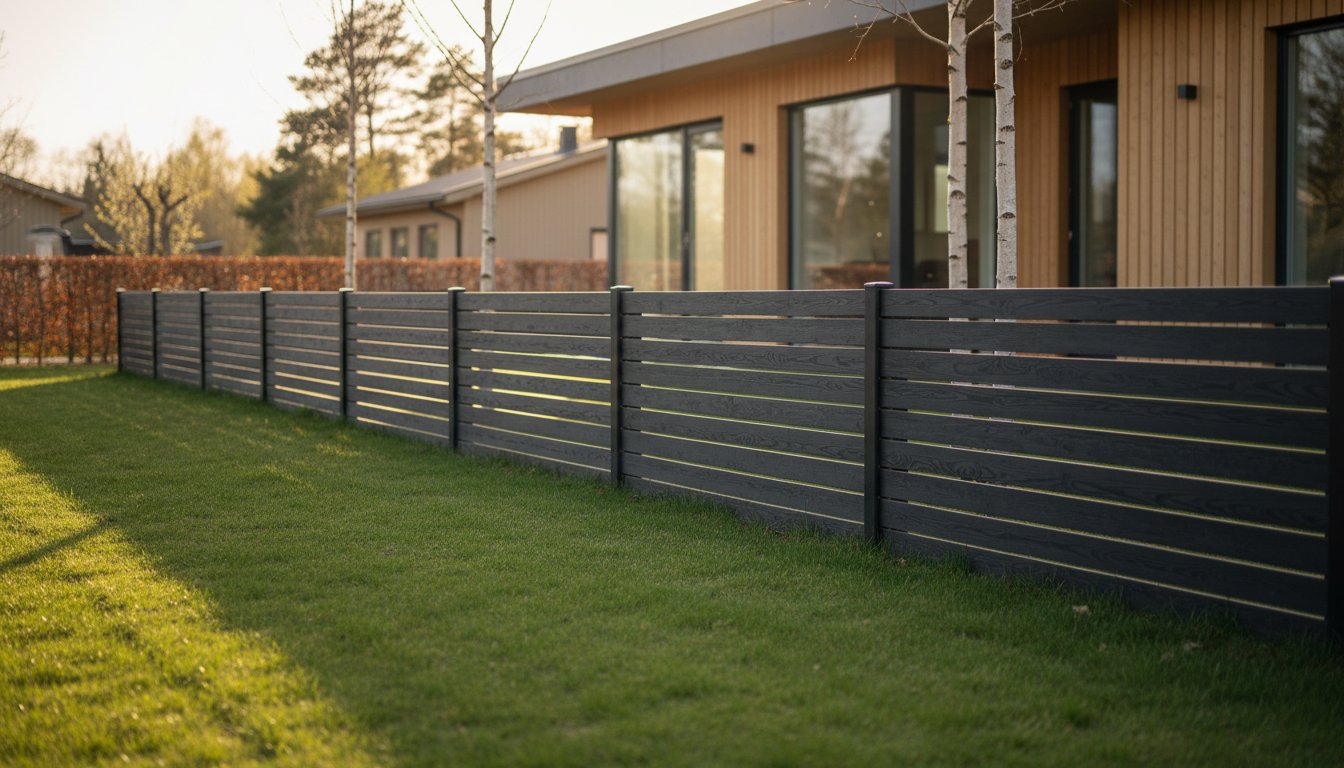
Horizontal slats define the modern Swedish exterior. They complement the linear nature of contemporary architecture, especially flat-roofed designs. You can adjust the visual weight of the fence by mixing slat heights. A combination of 40mm and 120mm slats creates a custom, rhythmic pattern that feels bespoke. This style works well for urban lots where horizontal lines help a small space feel expansive. Finding the balance between an open feel and total privacy is simple; a 10mm gap offers an airy aesthetic, while a 2mm gap provides a solid shield against prying eyes.
Mixed Material and Industrial Fencing
Industrial design thrives on the tension between different textures. Pairing matte black aluminum frames with natural-fiber composite panels delivers a sophisticated, maintenance-free result. This "Baffle" configuration uses offset panels to manage airflow and light play. It's a crucial feature for coastal properties in Skåne or the Stockholm archipelago where wind loads are high. To achieve a rugged yet refined look, consider these options:
- Gabion and Composite Hybrids: Integrating stone-filled baskets with sleek gray inserts for acoustic insulation.
- Metal Framing: Using powder-coated steel to provide a 30-year structural foundation for sustainable infills.
- Translucent Inserts: Mixing frosted glass with composite slats to allow light into shadowed garden corners.
Mid-Century Modern (MCM) Reimagined
Mid-Century Modern aesthetics are experiencing a resurgence in suburban neighborhoods. The focus remains on clean geometry and functional elegance. Classic screen styles now use rot-resistant composite fibers instead of high-maintenance tropical hardwoods. Bold, dark tones like Charcoal and Slate provide a striking backdrop for birch trees and lush greenery. These dark palettes absorb light, making the boundary recede so the landscape takes center stage. Using partial-height screens allows you to define "outdoor rooms" for dining without closing off the yard. It's a solution that is built to last and designed for life. Explore our engineered fencing systems to see how these Scandinavian-inspired designs can transform your property.
Selecting the Right Material: Why Modern Projects Move Beyond Wood
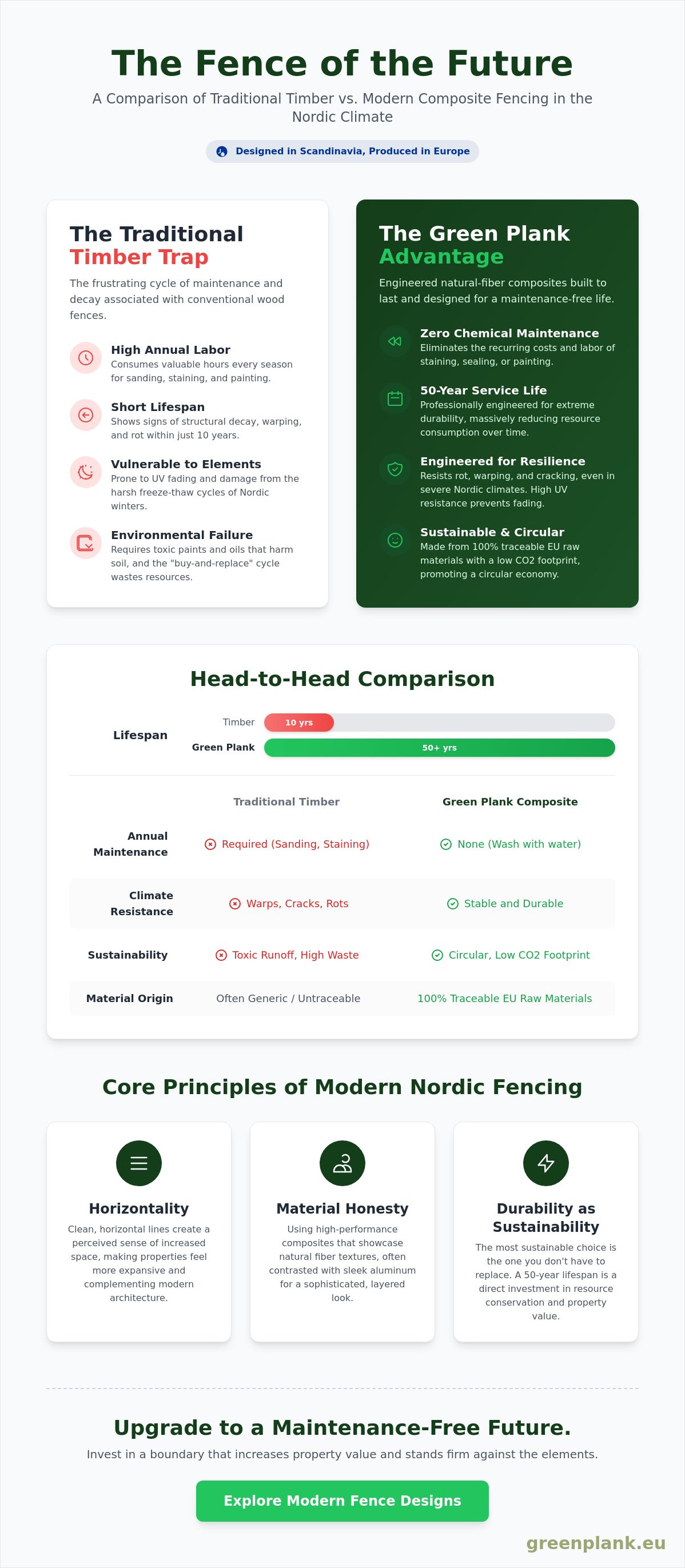
Traditional timber often appears cost-effective at the point of purchase. However, the hidden costs of maintenance, staining, and eventual replacement quickly erode that initial saving. In the Swedish climate, a standard wooden fence requires intensive labor every 24 to 36 months to prevent rot. By 2026, homeowners are shifting toward materials that offer a better return on investment. Green Plank WPC is engineered with a specific composition of 75% hardwood fiber and 25% high-density polyethylene (HDPE). This ratio creates a high-performance barrier against the volatile Nordic weather. It handles heavy snow loads and intense summer UV exposure without the structural failure seen in organic wood. To see how these materials stack up over a 30-year lifecycle, read our fence material comparison for a deep dive into boundary longevity.
The Durability Gap: Wood vs. Engineered Composite
Traditional cedar and pine frequently fail in Swedish coastal regions like Malmö or the Stockholm archipelago. Constant moisture and salt air trigger rapid decay. Our engineered composite uses high-strength WPC technology to prevent the internal cell collapse that leads to warping and splintering. The maintenance difference is stark. While wood requires hundreds of SEK in annual oils and sandpaper, WPC stays pristine with simple soap and water. It's a professional-grade solution built for life.
Aesthetic Versatility of WPC
Implementing modern fence ideas shouldn't mean sacrificing the warmth of natural textures. We provide the look of exotic hardwoods without the environmental impact of tropical deforestation. Because our products are produced in Europe using traceable raw materials, the quality remains consistent across every batch. These composites stay true to their original tone for decades. They don't grey out like untreated timber. The tactile experience is authentic because we use real fiber, yet the engineering ensures a level of precision that natural wood cannot match. It's a sophisticated choice for the responsible innovator.
- Engineered for Sweden: Resists moisture cycles that cause wood to crack.
- Circular Economy: Utilizes recycled polymers and traceable wood fibers.
- True Color Technology: UV-stable pigments prevent the need for repainting.
- Safety First: Slip-resistant and splinter-free surfaces for family environments.
Choosing the right material is the foundation of all modern fence ideas in 2026. It's about moving away from the "buy-and-replace" cycle. We focus on "buy-and-enjoy." Our 20 to 30-year warranties reflect this confidence in European engineering. When you invest in a Green Plank boundary, you're choosing a product that's designed in Scandinavia and built to last in the toughest environments on earth.
Functional Modernity: Privacy, Security, and Light Management
A fence does more than mark a property line; it completes the architectural envelope of a home. When homeowners research modern fence ideas, they're often seeking a way to extend the interior design language into the landscape. This creates a seamless "indoor-outdoor" flow where the boundary feels like a finished structural wall. These installations serve a deep practical purpose. High-performance natural-fiber composite fencing acts as a thermal and acoustic buffer for the garden, reflecting noise pollution away from the seating area and creating a sheltered microclimate that protects delicate plants from harsh winds.
Smart integration has moved from a luxury addition to a standard requirement. Contemporary fence posts now serve as functional hubs for smart home technology. You can integrate low-voltage LED strips, motion-activated security sensors, and Wi-Fi signal boosters directly into the engineered profiles. This keeps the perimeter secure and well-lit without the clutter of visible wiring or external fixtures. It's a clean, professional-grade approach to property management that prioritizes both safety and style.
Privacy Without the "Fortress" Feel
True privacy is about creating a sanctuary, not a prison. We utilize semi-transparent slats that allow natural light to filter through while effectively blocking direct sightlines from the street. This keeps the garden feeling open and airy. Tiered fencing is another effective strategy for Swedish properties. You might install a 1.8-meter section to shield a hot tub or dining area, then transition to a 1.1-meter height for lawn boundaries to maintain a sense of connection with the neighborhood. For a softer look, many designers integrate vertical gardens or "living walls" directly into the composite frames, blending engineered durability with natural greenery.
Structural Integrity and Hidden Engineering
Reliability starts with what you can't see. Our systems utilize specialized infrastructure profiles designed for commercial-grade stability. These ensure the structure remains perfectly plumb even after years of ground movement. Hidden fastening systems are a hallmark of the "Sustainable Craftsman" approach, providing a flawless, screw-free aesthetic on both the inner and outer faces of the fence. This is vital in the Swedish climate, where wind load considerations are paramount. Our fencing is engineered to stand up to storm-force winds exceeding 25 meters per second, ensuring the boundary remains secure during the most volatile winter months.
Ready to upgrade your property boundary with Scandinavian engineering? Explore our range of sustainable fencing solutions designed for life and built to last.
Implementing Your Vision: Sustainable Installation and Care
Green Plank operates on a singular brand promise: Built to last. Designed for life. When you select from our range of modern fence ideas, you aren't just choosing a boundary; you're investing in an engineered system designed for the Swedish climate. Our approach combines Scandinavian design sensibility with European manufacturing precision to ensure every installation stands as a testament to durability and environmental ethics.
Professional Installation Tips
Achieving a 50-year service life requires more than high-quality materials; it demands technical precision during assembly. In Sweden, ground stability is paramount due to seasonal frost cycles. Ensuring proper post-anchoring below the frost line prevents shifting and maintains the architectural lines of your property. Stability starts deep in the soil.
- Managing Thermal Expansion: Natural-fiber composites expand and contract with temperature shifts. Precise gap spacing is essential to prevent warping.
- Technical Specifications: For detailed blueprints on structural support, refer to our composite fence installation guide.
- Hardware Selection: Use only professional-grade, corrosion-resistant fasteners to match the longevity of the WPC boards.
The Green Plank Warranty and Quality Promise
We provide a 50-year warranty because we control every step of our supply chain. Our products are manufactured in Europe using 100% traceable raw materials. This transparency ensures that no harmful chemicals enter your garden and that the performance of the boards remains consistent for decades. It's a level of engineering confidence that supports both residential estates and large-scale commercial developments.
Choosing Green Plank directly reduces your project's carbon footprint. By utilizing recycled fibers and circular manufacturing processes, we turn potential waste into high-performance building materials. Our "Designed in Scandinavia. Produced in Europe." signature isn't just about geography; it's a commitment to ethical labor and low-emission logistics. When you compare modern fence ideas, the environmental cost is as vital as the financial one.
Ownership with Green Plank follows a Cradle to Cradle philosophy. At the end of its exceptionally long life, your fence doesn't become landfill waste. The material is 100% recyclable, allowing it to return to the production cycle. It's a truly circular solution for the conscious property owner who values heritage and the planet equally.
Take the next step in sustainable property design. Consult with Green Plank today to explore professional-grade WPC fencing solutions that define boundaries without compromising the future. Our team provides the technical expertise needed to turn your vision into a permanent, low-maintenance reality.
Securing Your Landscape with Nordic Precision
Choosing the right boundary is more than a security measure; it's a long-term investment in your property's value and environmental footprint. These modern fence ideas demonstrate that clean Scandinavian lines and sustainable engineering are no longer mutually exclusive. By moving beyond traditional timber, you eliminate the cycle of painting and chemical treatments that the Swedish climate often demands. You're left with a structure that balances privacy with architectural elegance while respecting the natural world.
Green Plank delivers this future-proof performance through technical excellence and ethical manufacturing. Every natural-fiber composite system utilizes 100% EU traceable raw materials to ensure total transparency in the supply chain. Our commitment to the Cradle to Cradle circular ownership model means your fence contributes to a waste-free economy. We back this engineering confidence with an industry-leading warranty of up to 50 years on WPC products. It's a professional-grade solution built for the rigors of the Nordic environment.
Ready to transform your outdoor space with a boundary that's built to last and designed for life? Explore Green Plank Sustainable Fencing Systems to find the perfect match for your home today. Your sustainable landscape starts with a single, conscious choice.
Frequently Asked Questions
What is the most durable material for a modern fence in 2026?
Natural-fiber composites with advanced co-extrusion technology represent the most durable option for 2026. These engineered materials withstand the harsh Swedish climate, resisting moisture and fungal decay for over 30 years. It's a professional-grade solution that outperforms traditional timber in every longevity metric. Designed in Scandinavia and produced in Europe, these systems offer the reliability required for northern latitudes.
How much does a modern composite fence cost compared to wood?
High-performance composite fencing typically costs between 1,200 kr and 2,800 kr per linear meter, while pressure-treated wood ranges from 400 kr to 900 kr. Despite the higher initial investment, composite systems provide a lower total cost of ownership. You'll save roughly 15,000 kr in maintenance expenses over a decade for a standard residential boundary because staining is never required.
Can I install a modern horizontal fence on a slope?
You can install a modern horizontal fence on sloped terrain using the stepping method. This technique keeps panels level while the fence line follows the ground's elevation in 10 cm to 20 cm increments. It's one of the most effective modern fence ideas for maintaining a clean, architectural look on uneven Swedish landscapes. This approach ensures structural stability while respecting the natural topography of your property.
Do modern composite fences fade in the sun?
Modern composite fences are engineered with UV-stabilizers to prevent significant color loss. High-quality panels typically experience less than 4% color shift over their entire lifespan. This stability ensures your property maintains its premium aesthetic even after decades of exposure to intense Scandinavian sunlight and snow reflection. It's a maintenance-free solution built to last and designed for life.
What is the best height for a privacy fence without blocking too much light?
A height of 160 cm to 180 cm offers the ideal balance of privacy and natural light. Choosing a louvered or open-slat design allows 20% more light to pass through compared to solid walls. Always check local Swedish Bygglov regulations, as fences exceeding 110 cm often require specific municipal permits. Proper height selection creates a secluded sanctuary without sacrificing the airy feel of your garden.
Are WPC fence panels environmentally friendly?
WPC panels are highly sustainable because they utilize a circular manufacturing process. Our products consist of 90% recycled wood fibers and reclaimed polymers, which reduces the carbon footprint significantly compared to virgin plastic alternatives. This responsible innovation prevents deforestation and diverts waste from landfills. It's a traceable, eco-conscious choice that delivers professional-grade durability without compromising the planet's health.
How do I clean and maintain a modern WPC fence?
Maintenance for a WPC fence involves a simple wash with mild soap and water twice a year. This process removes surface dust and organic debris without the need for toxic stains, oils, or sanding. You'll eliminate the need for chemical treatments, making your outdoor space safer for the environment. This low-maintenance profile saves homeowners approximately 40 hours of labor over a five-year period.
Is professional installation required for Green Plank fencing systems?
Green Plank systems are designed for straightforward assembly, but professional installation is recommended for complex perimeters. Certified installers ensure that post-spacing and expansion gaps meet the technical specifications required for our 20 to 30 year warranties. Roughly 75% of our Swedish clients prefer professional fitting to guarantee long-term structural integrity. This ensures your investment is protected by expert craftsmanship and Nordic reliability.
Produkt spezifizieren
Diese Anleitung in einer Green Plank-Ausschreibung nutzen
Technische WPC-Artikel sollen die kommerziellen Seiten stärken — nicht mit ihnen konkurrieren. Weiter zu WPC-Terrasse, TerraTuff, Nordeka oder den technischen Downloads.