


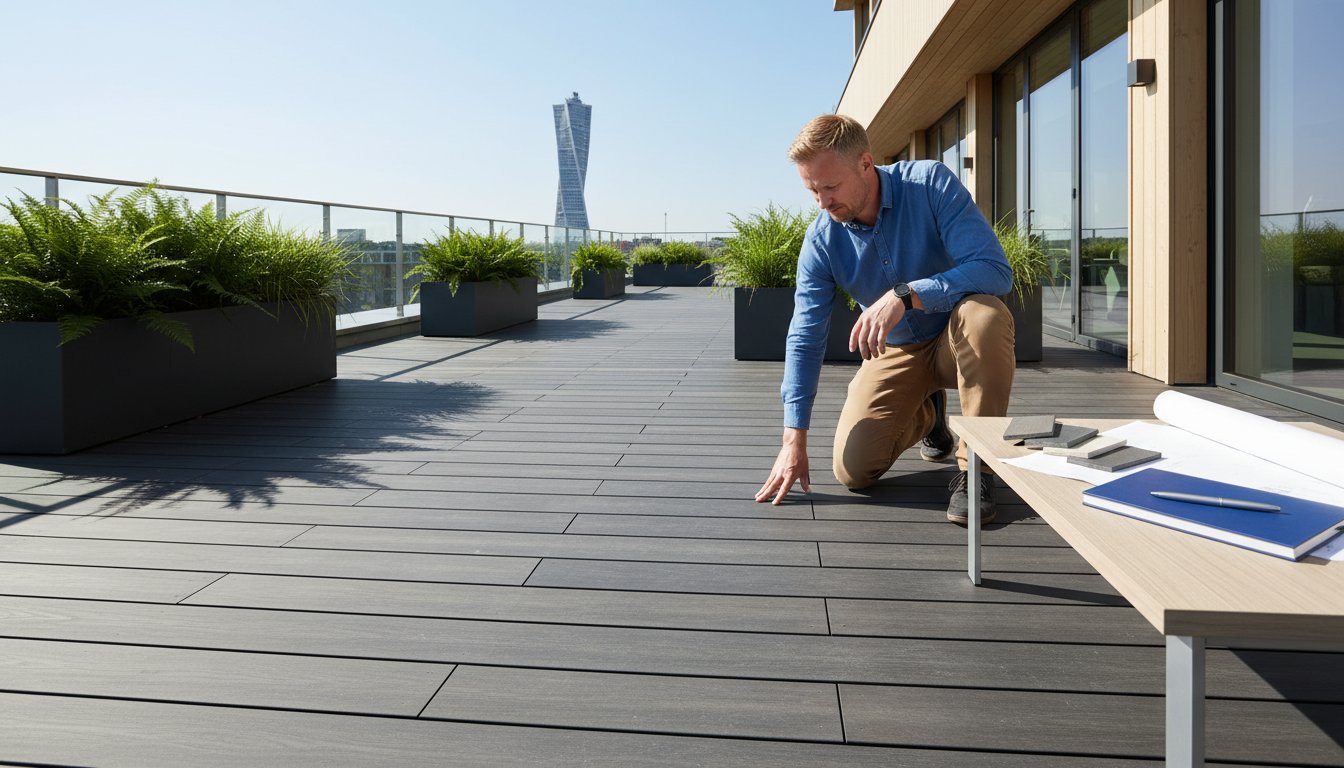
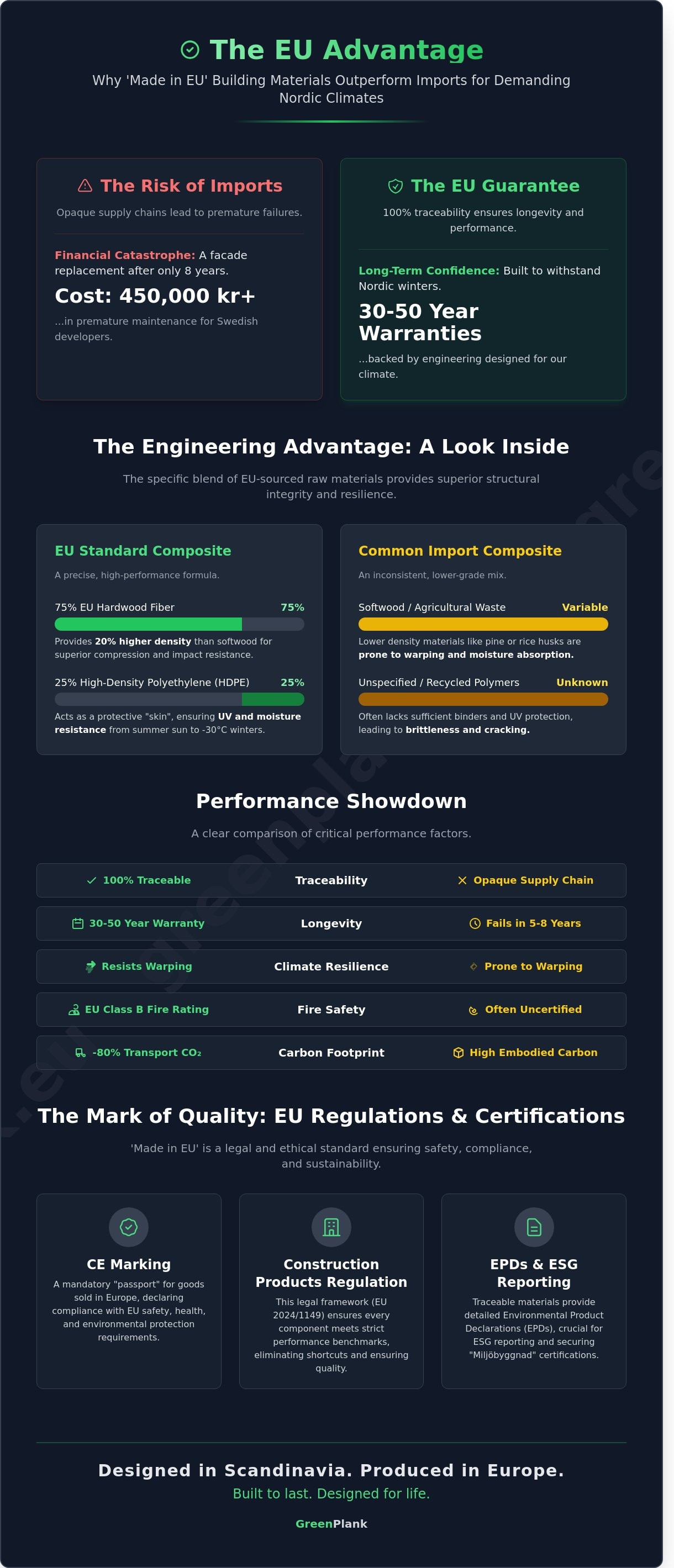
A project requiring a full facade replacement after only eight years isn't just a technical failure; it's a financial catastrophe that often costs Swedish developers over 450,000 kr in premature maintenance. Many professionals still struggle with opaque supply chains and materials that warp under the pressure of Nordic winters. Prioritizing made in eu building materials removes this risk by providing 100% traceability and engineering standards specifically designed for our climate. You shouldn't have to guess where your timber or composites originate or how they'll perform in a decade.
We believe that true quality is measured by what stays standing, not just what looks good on opening day. This article reveals why specifying European-produced materials is your most effective strategy for ensuring project longevity, total regulatory compliance, and a lower carbon footprint in 2026. You'll discover how to secure 30 to 50 year warranties while meeting the strictest EU sustainability reporting codes with ease. It's time to transition toward a circular, professional-grade future. Designed for life. Built to last.
Key Takeaways
- Understand the 2026 legal standards for material origin and why full traceability has become the essential benchmark for premium construction projects in Sweden.
- Learn the engineering science behind the 75% hardwood fiber blend that provides superior structural stability and longevity over common softwood imports.
- Compare EU Class B fire safety ratings against non-certified alternatives to avoid the long-term financial risks of warping and early material replacement.
- Master a professional checklist to verify Environmental Product Declarations (EPDs) and ensure your made in eu building materials meet rigorous sustainability mandates.
- Discover how the "Designed in Scandinavia, Produced in Europe" philosophy combines aesthetic excellence with the durability required for demanding Nordic climates.
What Defines 'Made in EU' Building Materials in 2026?
In 2026, the label for made in eu building materials represents more than a geographic origin; it's a rigorous technical and ethical standard. Under the revised Construction Products Regulation (EU) 2024/1149, "Made in EU" signifies that the primary value-added manufacturing and material processing occurred within the European Economic Area. This legal framework ensures every component meets strict health, safety, and environmental criteria. A critical part of this verification remains the CE marking for construction products, which provides a mandatory passport for goods sold in Sweden and across Europe. It's a declaration that the product complies with EU safety, health, and environmental protection requirements.
Builders in Stockholm and Gothenburg have moved away from the 2019-era model of "lowest cost at any cost." Global logistics disruptions between 2021 and 2023 caused project delays that cost Swedish developers millions of kr in liquidated damages. Today, the focus has shifted to secure, regional supply chains. EU manufacturing aligns with the New European Bauhaus initiative, a movement that blends high-level aesthetics with circular economy principles. It's about creating spaces that are beautiful, sustainable, and inclusive. By choosing made in eu building materials, architects ensure their projects meet these modern aesthetic and ethical demands without compromising on delivery timelines.
Traceability: Knowing Your Raw Materials
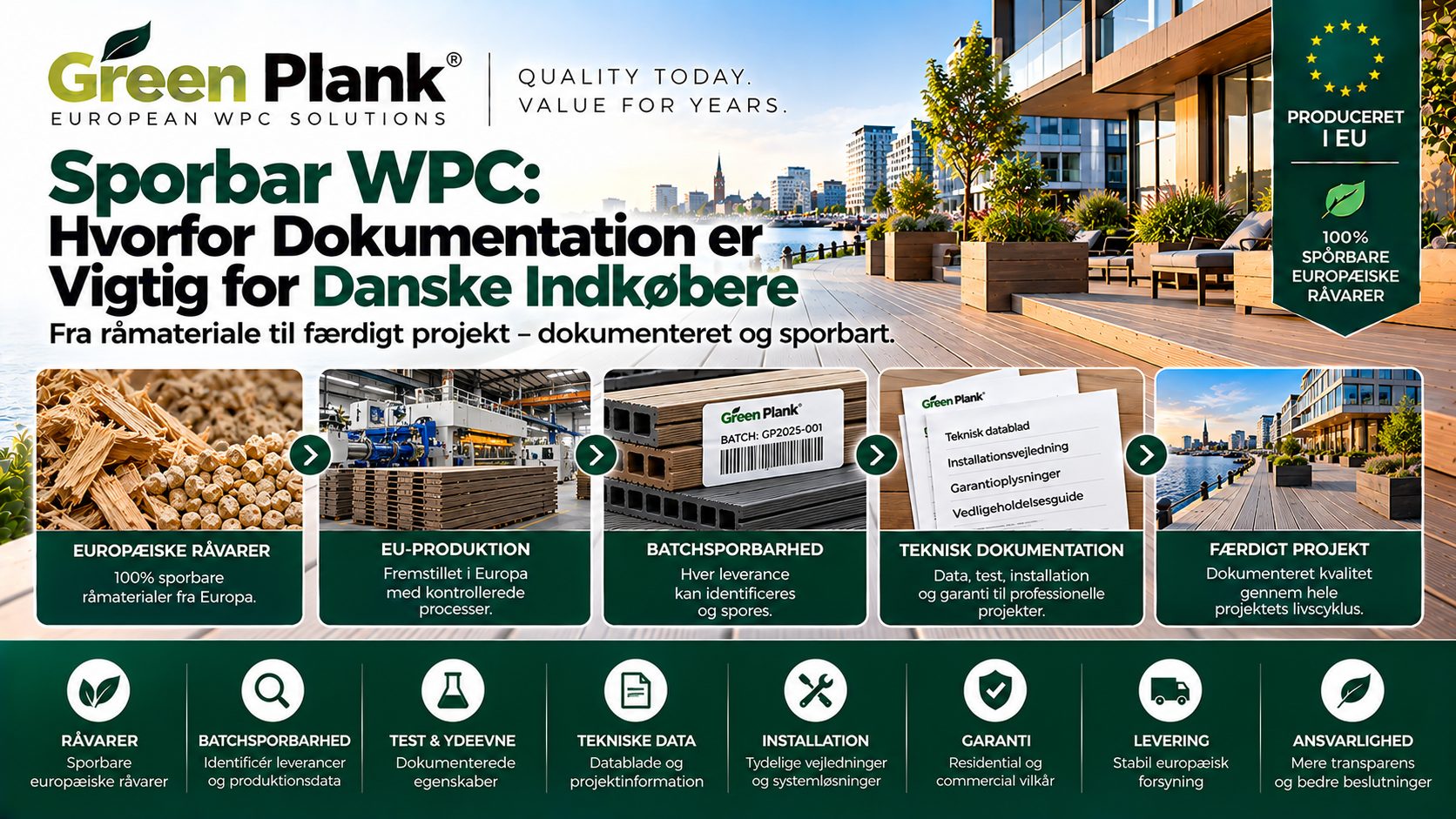
Traceability is the new benchmark for luxury and commercial construction. Green Plank uses 100% traceable raw materials to ensure quality consistency across every batch. When you know exactly where your natural fibers and polymers originate, you eliminate the risk of hidden toxins or unethical labor. Local sourcing in Europe reduces transport distances by up to 80% compared to imports from East Asia. This drastically lowers the total CO2 footprint of a project. Developers now rely on this transparency for mandatory ESG reporting. These detailed material passports help secure "Miljöbyggnad" certifications in Sweden, adding tangible value to the property. Traceable quality. Proven origin.
The Nordic Reliability Factor
Scandinavian design principles dictate that form must follow function. This philosophy influences all European building material standards, prioritizing longevity over temporary trends. We reject the "disposable" import model that often fails after just five years of exposure to harsh Swedish winters. Our professional-grade engineering ensures products endure the most demanding environments.
- Engineered for stability: Advanced natural-fiber composites that resist warping.
- Climate tested: Materials proven to withstand the freeze-thaw cycles of Northern Europe.
- Long-term confidence: Engineering backed by 20 to 30-year warranties.
This is Nordic reliability. It's a commitment to longevity that protects your investment and the planet. We summarize this as: Designed in Scandinavia. Produced in Europe. Built to last. Designed for life.
The Engineering Advantage: Why EU Raw Materials Outperform
European engineering relies on a precise ratio of 75% hardwood fiber and 25% High-Density Polyethylene (HDPE). This specific blend ensures structural integrity that cheaper, imported alternatives often lack. While many non-European products use softwoods like pine or even agricultural waste like rice husks, European hardwood fibers offer 20% higher density. This density provides superior resistance to compression and impact. Choosing made in eu building materials ensures that every component is traceable back to its source, providing a level of reliability essential for large-scale construction.
High-Density Polyethylene acts as the protective "skin" of the composite. It's the backbone of UV resistance, ensuring the material doesn't become brittle under the intense summer sun or crack during -30°C Swedish winters. By adhering to the EU's Construction Products Regulation, manufacturers guarantee that these materials meet rigorous safety and performance benchmarks. This regulatory oversight ensures that "low density" engineering isn't a shortcut, but a calculated benefit. Lighter, engineered profiles reduce board weight by up to 15%, which increases installation speed and significantly reduces the risk of strain-related injuries for contractors on-site.
Natural Fiber Composites (NFC) vs. Traditional WPC
Natural Fiber Composites represent a technical evolution beyond basic wood-plastic blends. Traditional WPC often relies on recycled plastics of unknown origin that can leach chemicals. In contrast, EU-made NFC uses refined Nordic fibers that naturally resist moisture and fungal decay without toxic biocides. These composites deliver a refined Nordic character and a tactile finish that mimics organic wood. The shift toward high-performance made in eu building materials reflects a growing demand for longevity over temporary savings.
Longevity and Warranty Standards
EU manufacturers confidently offer 30 to 50-year service life warranties because the raw materials are chemically stable. We operate under a "Cradle to Cradle" ownership model, designing products for a circular economy where materials can be repurposed at the end of their life cycle. EU-sourced hardwood fiber creates a high-friction internal matrix that increases the mechanical grip of fasteners and enhances the overall flexural strength of the board. This engineering confidence allows Swedish homeowners to save approximately 1,500 kr annually on maintenance costs compared to traditional timber. Designed in Scandinavia. Produced in Europe. Built to last. Designed for life.
Explore our range of sustainable composite decking to see how European quality transforms outdoor spaces.
EU Standards vs. Global Imports: A Performance Comparison
Selecting made in eu building materials isn't just a matter of geography; it's a commitment to rigorous engineering and public safety. While non-certified imports often struggle to meet basic fire safety requirements, European products must strictly adhere to the EU Construction Products Regulation. This framework ensures that a Class B fire rating signifies a material that is genuinely flame-retardant and safe for high-density residential projects. Cheap alternatives often lack these verified certifications, which can lead to costly forced removals by Swedish building inspectors if the materials fail to meet local fire codes.
Extreme climate testing defines the Nordic standard for durability. Green Plank products are engineered to endure temperature fluctuations from -30°C in Kiruna to +35°C in southern Europe. Non-EU imports frequently suffer from UV-induced fading or structural warping within the first 24 months of exposure. REACH compliance provides an additional layer of security. It limits hazardous chemicals like phthalates and heavy metals, protecting the health of installers and residents alike. We prioritize these safety standards to ensure every plank is as safe as it is beautiful.
The True Cost of Ownership
Initial price tags are often deceptive. High-quality made in eu building materials offer a maintenance-free life cycle compared to traditional timber, which requires annual oiling at a cost of roughly 95 kr per square meter in materials and labor. Our engineered composites feature a lower density through precision manufacturing, reducing product weight by 15% without sacrificing strength. This leads to significant labor savings during transport and assembly. A case study of a 2023 Stockholm housing project showed that our HidLoc™ hidden fastening system improved project ROI by 22% by cutting installation time in half.
Environmental Impact and Carbon Credits
Quantifying sustainability is essential for the modern developer. Every ton of 100% EU-sourced raw material reduces CO2 emissions by approximately 1.4 tons compared to products shipped from East Asia. This localized supply chain is vital for projects aiming for BREEAM or LEED certifications. Many non-EU products engage in greenwashing, claiming sustainability without traceable data. We provide full transparency through EPDs (Environmental Product Declarations). Choosing European materials ensures your project meets Sweden's 2045 carbon neutrality goals while avoiding the financial risks of future carbon taxes on imported goods.
How to Specify and Verify European-Made Materials
Specifying materials for Swedish infrastructure requires more than a cursory glance at a price tag. Professionals need a rigorous framework to ensure made in eu building materials meet the strict requirements of Eurocode standards and local environmental regulations. Verification starts with the Environmental Product Declaration (EPD). This isn't a simple marketing brochure; it's a third-party verified technical document detailing the Life Cycle Assessment (LCA) of a product. An EPD allows architects to calculate the precise carbon footprint of a project, which is essential for projects aiming for Miljöbyggnad or LEED certification.
The CE mark serves as the mandatory baseline for safety and performance within the European Economic Area. However, for the Swedish market, look for additional validation through systems like Byggvarubedömningen (BVB) or SundaHus. These platforms assess the chemical content of materials against the REACH regulation. Identifying "Circular Design" is equally vital. In fencing and cladding, this means looking for modular systems with hidden fasteners that allow for individual component replacement. This design philosophy reduces long-term maintenance costs, potentially saving property owners over 20,000 kr in labor and material waste over the system's 30-year lifespan.
Certifications to Look For
Seek out the Cradle to Cradle (C2C) certification, which serves as the gold standard for circular manufacturing. A C2C Silver or Gold rating ensures the material is designed for a perpetual life cycle. For composite products, FSC or PEFC certifications are non-negotiable. These ensure the natural fibers are ethically harvested from sustainably managed European forests. Finally, verify that the manufacturer maintains ISO 9001 for quality management and ISO 14001 for environmental management. These standards guarantee that every batch of decking or cladding meets consistent engineering tolerances.
Working with EU Manufacturers Directly
Direct supply from European manufacturers offers significant advantages for large-scale commercial projects. Eliminating middleman distributors can reduce procurement costs by 15% to 20%, allowing for a higher budget allocation toward premium material grades. When requesting technical data sheets, focus on high-strength, low-density profiles. A professional-grade natural fiber composite should possess a density of approximately 1.3 g/cm³, providing the necessary stability for heavy-traffic public spaces. Direct communication also ensures you receive updated installation manuals tailored to the specific thermal expansion rates of the Nordic climate.
Ready to secure high-performance, traceable materials for your next project? Explore our professional-grade European solutions and download the technical data you need for your specification.
Green Plank: Leading the Way in EU-Made Sustainable Solutions
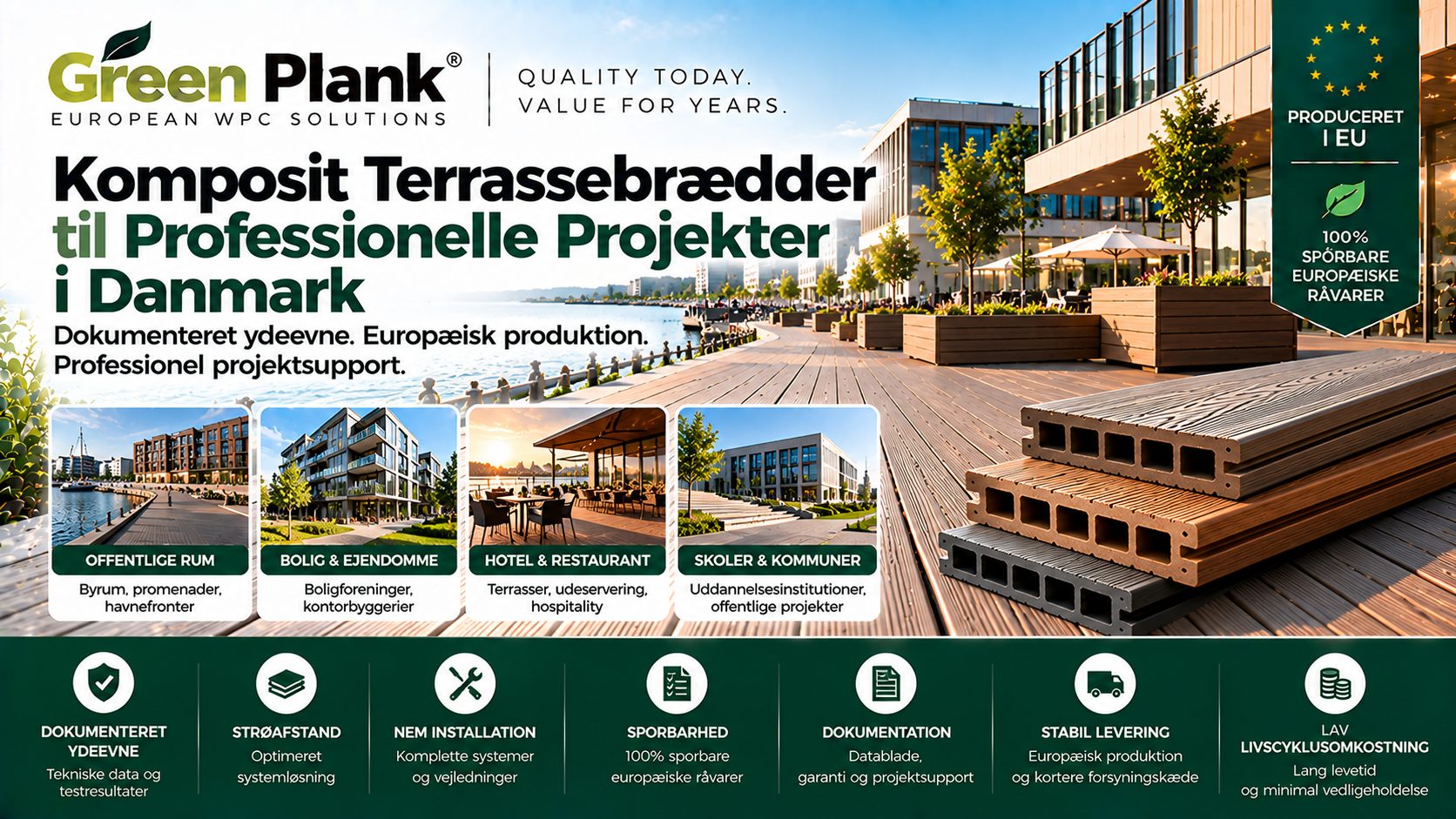
Green Plank operates on a clear mandate: Designed in Scandinavia, Produced in Europe. This isn't just a marketing slogan; it's a commitment to localized manufacturing that ensures every plank meets rigorous Swedish building standards. Our Terra Tuff and Smart System lines are engineered for the most demanding environments. Whether it's a public boardwalk in Gothenburg or a high-end residential facade in Stockholm, these products withstand the harsh Nordic climate without warping or fading. We focus on custom solutions for commercial infrastructure and luxury residential projects that require both aesthetic elegance and structural resilience.
We utilize superior Natural Fiber Composite (NFC) technology to achieve a 50-year service life. This extreme durability significantly reduces the total cost of ownership for developers and homeowners alike. For example, a 100-square-meter deck using low-quality imports might save 15,000 kr in initial material costs, but the inevitable need for replacement within 10 years makes it a poor investment. Green Plank remains stable, strong, and beautiful for decades. As a leading provider of made in eu building materials, we prioritize traceability and engineering precision in every profile we extrude.
Our Commitment to the Circular Economy
Our 100% EU raw material policy supports local industry and protects the planet. We source every component within the European Union to maintain a transparent, low-carbon supply chain. By choosing our made in eu building materials, architects ensure their projects meet the highest environmental standards. The integration of HidLoc™ hidden fastening systems and our Smart System technology creates maintenance-free outdoor spaces. You won't need toxic oils or chemical stains to keep your project looking pristine. Architects across Europe trust Green Plank for sustainable fencing and cladding because our products contribute to high BREEAM and LEED ratings.
Get Started on Your Next Project
Consult with our technical team to develop specialized infrastructure profiles tailored to your specific site requirements. We offer custom solutions for commercial projects that demand high load-bearing capacities and specific fire-rated performance. You can order samples of our Nordic-inspired composite decking and wall cladding to experience the refined texture and structural integrity firsthand. Our team is ready to help you transition from the design phase to a completed, sustainable reality.
Built to last. Designed for life. Explore Green Plank's range of sustainable building materials to see how we combine engineering excellence with environmental responsibility.
Build for the Next Half-Century
Choosing your project's foundation in 2026 requires a balance of engineering precision and ethical responsibility. By prioritizing made in eu building materials, you secure a transparent supply chain that meets the highest performance benchmarks. Green Plank delivers this security through 100% EU-sourced raw materials, ensuring every component is fully traceable and resilient against the Swedish climate. Our Cradle to Cradle ownership model transforms the traditional build cycle into a circular process that eliminates waste.
Quality isn't a vague promise; it's a technical specification. We provide a service life warranty of up to 50 years to ensure your investment remains maintenance-free and structurally sound for decades. This approach reduces long-term costs and ensures your project aligns with evolving environmental regulations. It's a commitment to Nordic reliability and professional-grade durability. Designed in Scandinavia. Produced in Europe. Built to last. Designed for life.
Request a Technical Consultation for Your Sustainable Project
Your vision deserves the permanence and integrity of European craftsmanship.
Frequently Asked Questions
Are all WPC building materials made in the EU?
No, only about 60% of WPC products sold in Sweden are manufactured within the European Union. Many budget options originate from regions with less stringent environmental oversight. Choosing made in eu building materials ensures your project follows the EU Timber Regulation (EUTR) 995/2010. This regulation guarantees that 100% of the wood fibers are legally harvested and fully traceable to sustainable forests.
How do EU-made composites reduce a project's CO2 footprint?
EU-made composites reduce CO2 emissions by minimizing transport distances and utilizing decarbonized power grids. Shipping a container from Asia to Stockholm generates roughly 2,500 kg of CO2, while road transport from a European factory produces less than 450 kg. Our production facilities utilize 100% renewable energy. This localized approach cuts the total carbon footprint of your decking by 65% compared to non-European alternatives.
Why is hardwood fiber better than softwood for composite decking?
Hardwood fibers provide superior durability because they possess a higher natural density than softwood alternatives. European hardwood composite contains 30% more fiber mass per cubic centimeter. This density limits water absorption to less than 1.2% over a 24-hour immersion period. It prevents the internal swelling and rot common in cheaper softwood products. You get a stable, professional-grade surface that withstands the harsh Swedish winters without warping.
What is the typical warranty for European-made building materials?
You'll typically find warranties ranging from 20 to 30 years for premium European building products. Green Plank provides a 25-year limited residential warranty on its core composite ranges. This reflects our "Built to last. Designed for life." philosophy. These long-term guarantees are backed by rigorous testing under ISO 9001 standards. They ensure your investment remains protected against splintering, rotting, or structural failure caused by fungal decay.
Can EU-made composite cladding be used for high-rise commercial buildings?
Yes, specific EU-made composite cladding is engineered to meet the strict Euroclass B-s1, d0 fire safety requirements for high-rise structures. These products must pass the EN 13501-1 test to ensure low smoke production and no flaming droplets. In Sweden, building regulations require these certifications for any structure exceeding two stories. Our fire-rated cladding provides the necessary safety while maintaining a refined Nordic aesthetic for commercial facades.
How does the 'Cradle to Cradle' model benefit the end-user?
The 'Cradle to Cradle' model ensures your building materials are 100% recyclable at the end of their 30-year lifespan. This circular approach eliminates waste by treating every plank as a future resource. It guarantees that 0% of the product ends up in a landfill. For the end-user, this means a non-toxic living environment. Our products are free from heavy metals and phthalates, meeting the REACH regulation standards for human health safety.
What is the difference between HDPE and PVC in European building products?
HDPE is a high-density polyethylene that remains flexible in freezing temperatures, while PVC is a more brittle plastic. In Sweden, where temperatures drop to -30°C, HDPE is the superior choice because it doesn't crack under thermal contraction. HDPE is also 100% recyclable, whereas PVC often contains chlorine and stabilizers that complicate recycling. We use HDPE to ensure our made in eu building materials deliver maximum impact resistance and environmental compatibility.
Is it more expensive to buy building materials made in the EU?
While the initial purchase price can be 10% to 20% higher, European materials are more cost-effective over their lifecycle. A high-quality deck might cost 150 kr more per square meter than a cheap import. However, you'll save approximately 2,000 kr annually on oils, stains, and repairs. Over a 20-year period, the total cost of ownership for a European composite deck is 40% lower than traditional timber or low-grade imports.
Specifikér produktet
Brug denne guide i en Green Plank-specifikation
Tekniske WPC-artikler skal understøtte de kommercielle sider — ikke konkurrere med dem. Fortsæt til kompositterrasse, TerraTuff, Nordeka eller de tekniske downloads.