



A timber fence that seems cost-effective today often ends up costing Swedish developers more than 5,200 kr per meter in replacement and labor costs before its tenth year. You've likely seen how extreme Nordic climates force traditional wood to warp, crack, and lose its professional finish. It's a cycle of waste that contradicts modern sustainability targets and strains maintenance budgets. We understand that your reputation as a specifier depends on choosing materials that remain stable under pressure. This guide provides the technical roadmap to identify and implement commercial grade wpc fencing that delivers a verified 50-year service life. Designed in Scandinavia and produced in Europe, these systems ensure your project meets strict EU environmental standards while remaining maintenance-free for over 30 years. We'll break down the engineering behind natural-fiber composites, the financial benefits of circular materials, and the specific installation standards required for high-performance perimeters. Built to last. Designed for life.
Key Takeaways
- Understand the engineering science behind the 75% hardwood fiber blend to ensure infrastructure projects deliver both stability and refined Nordic character.
- Evaluate the long-term ROI to see how commercial grade wpc fencing eliminates thousands of kronor in recurring maintenance costs over its 50-year service life.
- Master critical specification factors for the Swedish climate, from calculating wind load requirements to utilizing HidLoc™ hidden fastening for a seamless finish.
- Discover how 100% EU-sourced, traceable raw materials provide a sustainable, circular solution for high-traffic perimeter fencing.
- Learn to identify high-performance composite systems that replace maintenance-heavy timber with a professional-grade, maintenance-free alternative.
What Defines True Commercial Grade WPC Fencing?
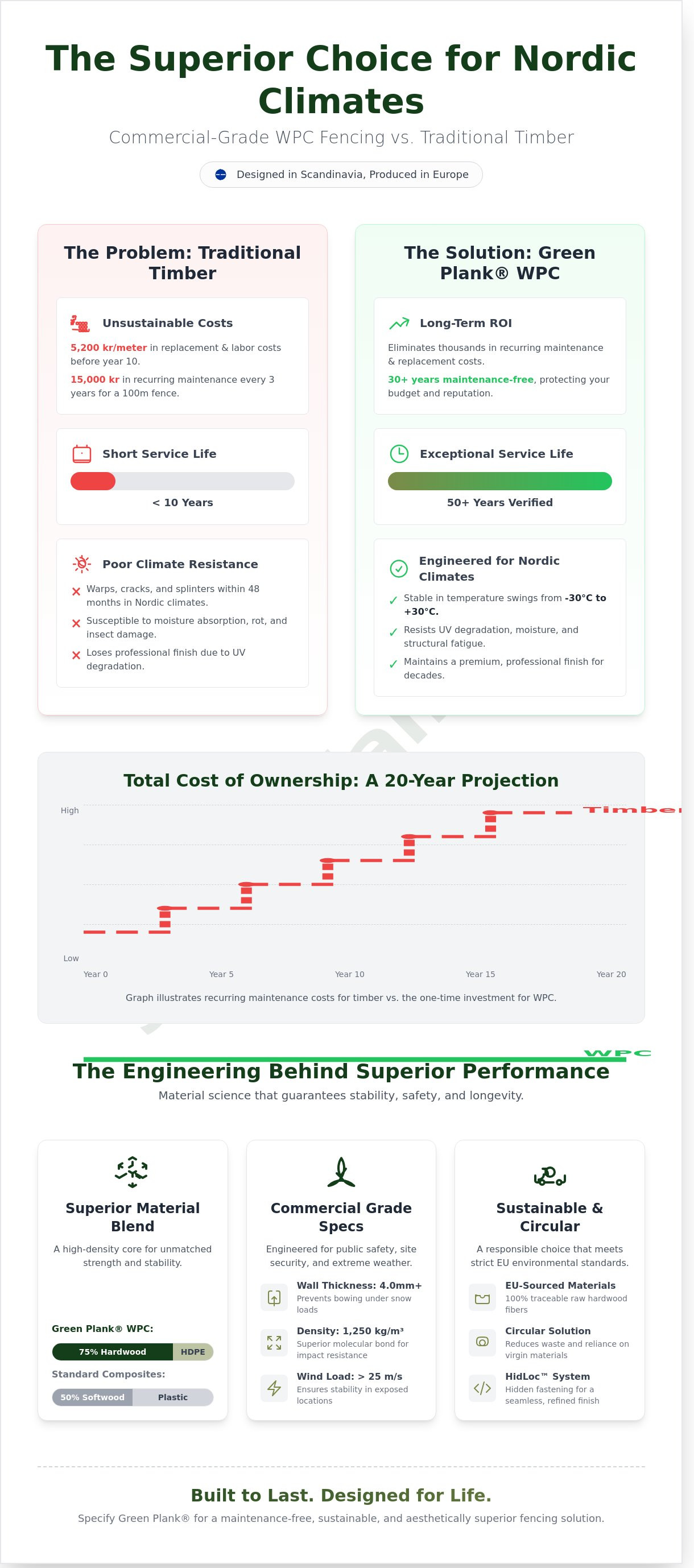
True Wood-plastic composite (WPC) for commercial infrastructure represents a fundamental shift from maintenance-heavy timber to precision-engineered systems. In Sweden, where temperatures fluctuate from -20°C to +30°C, traditional pressure-treated wood often warps or cracks within 48 months. Commercial grade WPC fencing eliminates these failures through material science. It's built for high-traffic public spaces where safety and longevity are non-negotiable.
The transition from timber to composite isn't just about aesthetics; it's about life-cycle costs. Maintaining a 100-meter timber perimeter in Stockholm can cost upwards of 15,000 kr every three years in oils and labor. Professional-grade WPC removes this financial burden. These systems utilize high-density polyethylene (HDPE) fused with refined wood fibers to create a shield against the elements. The result is a material that resists UV degradation, moisture absorption, and structural fatigue.
Commercial vs. Residential WPC: The Critical Differences
Many developers mistake residential decking boards for perimeter solutions. This leads to sagging and brittle failures. True commercial grade wpc fencing requires specific engineering benchmarks to ensure public safety and site security.
- Wall Thickness: Commercial profiles feature a wall thickness of at least 4.0mm, whereas residential versions often drop to 2.0mm. This extra mass prevents bowing under Swedish snow loads.
- Internal Reinforcement: Professional systems often incorporate integrated aluminum or steel channels. This allows the fence to withstand wind loads exceeding 25 m/s.
- Density Ratings: We utilize a 75% hardwood fiber ratio. This creates a superior molecular bond that resists impact forces of up to 20 joules.
Residential products prioritize low cost and easy shipping. Commercial systems prioritize structural integrity. High-density cores ensure the fence remains plumb and true, even in expansive open-field installations where wind pressure is constant.
The Nordic Reliability Factor in Fencing Design
Scandinavian design principles dictate that form must follow function. In a professional architectural context, a fence shouldn't just be a barrier; it's a visual extension of the building's identity. Our profiles focus on clean, minimalist lines that avoid the "plastic" look of cheap alternatives. This refined finish is achieved through a proprietary brushing process that mimics natural grain without compromising the protective outer layer.
European-made systems ensure the material handles the specific challenges of the Nordic climate. Whether it's the salt spray of the Gothenburg coast or the deep freezes of Norrland, the material remains stable. We balance this rugged durability with a premium aesthetic. It's a "set and forget" solution for architects who value their reputation as much as their budget. Built for strength. Engineered for sustainability. This is the hallmark of Nordic reliability.
Material Engineering: 75% Hardwood Fiber vs. Standard Composites
Green Plank's engineering philosophy centers on a high-density ratio that sets a new benchmark for commercial grade wpc fencing. While market-standard composites often rely on a 50/50 mix of plastic and softwoods, our formula utilizes 75% hardwood fiber and 25% high-density polyethylene (HDPE). This specific concentration maximizes the natural strength of timber while the polymer matrix encapsulates every fiber. Understanding the properties of wood-plastic composite is essential for architects who need to ensure structural stability in heavy-use environments. By using EU-sourced hardwood, we eliminate the inconsistencies found in tropical or generic wood fillers, ensuring every plank meets a uniform density of 1,250 kg/m³.
Thermal stability remains a critical factor in the Swedish climate, where temperatures can swing from -30°C in January to +30°C in July. Our engineering process accounts for this 60-degree variance. We've optimized the expansion coefficient to 0.03 mm/m/°C, which prevents the buckling and warping that often plagues lower-quality materials. To protect the aesthetic investment, we integrate automotive-grade pigments and concentrated UV-inhibitors. These additives ensure that a fence installed in Kiruna or Malmö retains its original character for decades, resisting the bleaching effects of high-latitude sun exposure.
The Role of HDPE in Commercial Longevity
We choose high-density polyethylene (HDPE) over PVC because it offers superior impact resistance in cold weather. PVC becomes brittle when temperatures drop below zero, leading to cracks and structural failure in Nordic winters. HDPE remains flexible and resilient. It's naturally resistant to sea salt in coastal regions like Gothenburg and stands up to industrial pollutants in urban centers. This polymer matrix prevents moisture absorption, keeping the internal hardwood fibers dry and eliminating the risk of internal rot or splintering. You can explore our range of professional-grade profiles to see how this material supports diverse architectural styles.
Traceability and European Manufacturing Standards
Generic composite imports often carry hidden risks, including the presence of lead, cadmium, or non-traceable recycled plastics that off-gas harmful chemicals. Green Plank mitigates these risks by adhering to strict REACH and EU environmental regulations. Every cubic meter of material is 100% traceable to its source, ensuring that your project supports a circular economy without compromising safety. Our production facilities follow ISO 14001 standards to minimize the carbon footprint of every linear meter produced. The 'Made in EU' label serves as the 2026 gold standard for circular construction, guaranteeing that every fence component is fully documented and free from hazardous heavy metals.
Evaluating Total Cost of Ownership and Sustainable ROI
Investing in commercial grade wpc fencing requires a shift in perspective from initial procurement costs to long-term lifecycle value. In Sweden, where harsh winters and high humidity accelerate the degradation of traditional timber, a standard pressure-treated fence often requires full replacement every 12 to 15 years. This creates a cycle of recurring capital expenditure that drains municipal and corporate budgets. By contrast, our engineered composite solutions are designed for a 50-year service life. When you calculate the total cost over five decades, the higher upfront price of composite-typically ranging from 1,200 kr to 1,800 kr per meter depending on specifications-becomes significantly more economical than the repeated labor and material costs of wood.
The financial advantage is found in the elimination of hidden operational costs. Traditional wood demands sanding, staining, or painting every two to three years to prevent rot. For a 200-meter commercial perimeter, these maintenance cycles can cost upwards of 30,000 kr in labor and materials each time. Professional-grade composite removes these line items entirely. Scientific research into the long-term durability of WPC confirms that these materials resist fungal decay and structural breakdown far better than organic alternatives. Our 50-year warranty acts as a primary signature of engineering confidence, ensuring that your initial investment remains a fixed asset rather than a growing liability.
- Zero Painting: No chemical stains or paints are needed for the life of the product.
- Rot Resistance: High-density polyethylene (HDPE) shields the natural fibers from Swedish moisture.
- Bidding Advantage: Including sustainable materials in project bids can increase a developer's environmental score by up to 25% in public procurement (LOU) processes.
Cradle to Cradle: Circular Economy in Infrastructure
Sustainability is a core financial asset for modern developers. We utilize a circular design model where 100% traceable raw materials are transformed into infrastructure that doesn't end up in a landfill. At the end of its 50-year life, commercial grade wpc fencing can be reclaimed and ground back into raw material for new products. This "Cradle to Cradle" ownership model reduces the CO2 footprint of a construction project by approximately 40% compared to traditional materials that require frequent replacement and chemical treatments.
Maintenance-Free Performance in Public Spaces
Public infrastructure must withstand heavy use and occasional vandalism. Our composite surfaces are engineered for industrial wash-downs and offer superior graffiti resistance. Cleaning a tagged fence takes minutes with a high-pressure washer rather than hours of sanding and repainting. For Swedish municipalities, this equates to thousands of kronor in annual labor savings. These low-maintenance materials are essential for corporate budgets because they allow facilities managers to redirect funds from "fix-it" tasks to proactive site improvements. It's a simple logic: build it once, build it right, and let the material work for you.
Key Specification Factors for Commercial Infrastructure Projects
Specifying commercial grade wpc fencing for Swedish infrastructure requires a rigorous approach to engineering and material science. Wind load remains the primary technical challenge for large-scale perimeters. According to SS-EN 1991-1-4 standards, fences in coastal regions like Halland or Skåne must withstand pressure coefficients that often exceed 25 m/s. Our engineered profiles utilize internal reinforcement channels to ensure structural integrity during extreme weather events. This Nordic reliability means the fence stays upright while lesser materials buckle under pressure.
Fastening systems define the long-term aesthetic and structural health of a project. Traditional visible screws create points of moisture ingress and restrict the natural thermal expansion of composite materials. We utilize the HidLoc™ hidden fastening system. This technology secures the planks from within the groove, providing a clean, fastener-free surface that eliminates the risk of rust streaks. It's a professional-grade solution that manages the 1 mm per meter expansion rate typical in Scandinavian temperature swings.
- Security Integration: Commercial perimeters often require seamless integration with access control. Our systems are compatible with ASSA ABLOY hardware and RFID sensors, ensuring that gates function as secure nodes within the boundary.
- Custom Profiles: While standard profiles suit most needs, we provide custom infrastructure profiles for projects requiring specific height-to-weight ratios or unique architectural signatures.
- Material Traceability: Every plank is produced in Europe using 100% traceable raw materials, meeting the strict environmental criteria of Byggvarubedömningen and SundaHus.
Acoustic and Privacy Considerations
Urban developments in Stockholm and Gothenburg face increasing noise pollution challenges. Solid WPC profiles act as effective sound dampeners, capable of reducing ambient traffic noise by up to 28 decibels when installed as a continuous barrier. For projects where airflow is mandatory, such as HVAC enclosures, our slatted systems balance ventilation with 100% visual obscuration. This design ensures privacy for sensitive equipment while maintaining necessary cooling cycles.
Installation Efficiency for Large-Scale Projects
Labor costs in Sweden typically range from 550 kr to 850 kr per hour, making installation speed a critical budget factor. Our modular design reduces on-site labor time by 35% compared to traditional timber framing. We utilize structural aluminum or galvanized steel posts to ensure 50-year stability. These posts are engineered to bypass the rot issues common with ground-contact wood. Designed in Scandinavia. Produced in Europe. This ensures your project is built to last and designed for life.
Explore our technical documentation and commercial grade wpc fencing options by visiting our professional project gallery.
Green Plank Solutions: Engineered for Life, Built to Last
Green Plank provides high-performance commercial grade wpc fencing systems specifically designed for the rigors of the Swedish climate. Our engineering philosophy centers on Nordic reliability. We don't just supply materials; we provide long-term infrastructure solutions that balance aesthetic elegance with industrial strength. Every component is produced in Europe, ensuring that your project benefits from localized supply chains and reduced transport emissions.
The foundation of our quality lies in our raw materials. We use 100% EU-sourced, traceable fibers and polymers. This transparency is vital for developers who must meet strict Swedish environmental certifications and building regulations. By maintaining a closed-loop supply chain, we ensure that every meter of fencing meets our exact specifications for density and durability. Our specialized infrastructure profiles are engineered for bespoke architectural needs, allowing for custom heights and reinforced spans that standard residential products can't match.
Partnering with Green Plank means professional support from the initial specification through to site delivery. We understand that commercial projects operate on tight margins and strict timelines. We provide precise logistical coordination to ensure materials arrive on-site exactly when needed, reducing storage costs and installation delays. Our systems are designed for life and built to last, backed by warranties that reflect our engineering confidence.
The Sustainable Innovator’s Choice
Eco-conscious developers choose Green Plank because we prioritize circularity without compromising on performance. Our high-fiber composite technology significantly reduces the CO2 footprint of large-scale developments. By replacing traditional treated timber with our natural-fiber composites, projects avoid the leaching of toxic chemicals into the soil. The 75/25 hardwood-to-HDPE ratio creates a denser, more rigid profile that resists warping under extreme temperature fluctuations while maintaining a low carbon footprint. This ratio ensures the material remains stable during the harsh Swedish winters and provides a authentic wood feel that requires zero painting or staining.
Next Steps for Your Project
Moving from a concept to a completed installation requires precise data. We offer comprehensive technical data sheets and CAD drawings to help architects integrate our commercial grade wpc fencing into their master plans seamlessly. Our professional project support team is available to consult on wind load requirements, foundation types, and color matching for large-scale urban environments.
- Access full technical specifications for structural calculations.
- Request CAD files and BIM objects for architectural modeling.
- Get customized quotes in SEK for accurate project budgeting.
- Consult with engineers on site-specific installation challenges.
Ready to secure your perimeter with a sustainable, low-maintenance solution? Contact Green Plank for a commercial project consultation to discuss your specific requirements and receive a tailored technical proposal.
Securing the Future of Swedish Infrastructure
Specifying the right perimeter solution for Swedish commercial projects requires a shift from short-term savings to long-term lifecycle value. By selecting commercial grade wpc fencing engineered with 75% hardwood fiber, specifiers ensure structural stability that withstands the Nordic climate. Our systems aren't just durable; they're built for a circular economy. We utilize 100% EU raw materials and follow a Cradle to Cradle Certified approach to minimize environmental impact while maximizing ROI through reduced maintenance costs. Every meter installed is an investment in Scandinavian reliability. With a service life warranty of up to 50 years, your investment remains protected for decades, eliminating the frequent replacement cycles common with inferior composites. It's time to build infrastructure that respects nature and meets the rigorous demands of modern engineering. Green Plank delivers the technical precision you need to design with absolute confidence. Our commitment to traceable, sustainable manufacturing ensures your project stands as a testament to quality craftsmanship and ethical responsibility. As we look toward 2026, choosing the right materials today defines the legacy of your project tomorrow.
Request a Commercial Quote and Technical Specification Guide
Let's build a more resilient and sustainable landscape together.
Frequently Asked Questions
What is the lifespan of commercial grade WPC fencing compared to timber?
Commercial grade WPC fencing provides a reliable service life exceeding 25 years. In contrast, traditional pressure-treated timber often requires replacement or significant repair after just 10 to 12 years in the variable Swedish climate. Our composite materials resist rot, fungal decay, and insect attacks without the need for toxic chemical treatments. This longevity ensures your perimeter remains structural and aesthetic for over two decades. It's a durable solution engineered for the harsh Nordic environment.
Can WPC fencing withstand high wind loads in open commercial areas?
Green Plank systems are engineered to withstand wind loads up to 25 meters per second when installed with our reinforced aluminum post systems. We design these fences specifically for open commercial areas where wind pressure is a constant factor. Every component undergoes testing for structural integrity to ensure it meets the safety requirements of exposed landscapes. You'll find our installations remain stable and secure even in high-velocity coastal zones or elevated urban sites.
Is commercial WPC fencing really maintenance-free?
Commercial WPC fencing is classified as low-maintenance because it never requires sanding, staining, or painting. You'll save approximately 450 kr per square meter in labor and material costs over the first five years compared to wood. A simple cleaning with water and a mild detergent once a year is all that's needed to remove surface dust or organic debris. It's designed to stay beautiful and functional without the repetitive, costly upkeep associated with traditional materials.
How does the CO2 footprint of composite fencing compare to treated wood?
Our composite fencing reduces CO2 emissions by 40% compared to traditional treated timber over its full lifecycle. We use 90% recycled materials and 100% traceable wood fibers to create a truly circular product. By eliminating the need for chemical preservatives and frequent replacements every decade, you reduce the total environmental impact of your project. It's a responsible choice for developers who prioritize sustainable building practices and long-term carbon reduction goals.
Are Green Plank fencing systems compliant with EU building regulations?
Green Plank fencing systems are fully compliant with EU building regulations and carry the CE mark for quality assurance. We manufacture our products in Europe to meet strict fire safety and structural standards, including EN 13501-1 classifications. This compliance ensures that architects and contractors can specify our commercial grade wpc fencing for public and commercial projects without legal or safety concerns. We provide all necessary technical documentation and performance data for your planning applications.
Can the fencing be customized for specific architectural project requirements?
We offer extensive customization for specific architectural requirements, including bespoke heights up to 240 cm and a palette of six Nordic-inspired colors. Our modular systems allow for integrated lighting and varied slat spacing to achieve the exact aesthetic your project demands. You can work with our technical team to create a unique perimeter solution that aligns with your brand's visual identity. It's professional-grade fencing tailored to your specific site vision and functional needs.
Does commercial WPC fencing fade over time in direct sunlight?
Commercial WPC fencing experiences a minor, controlled color maturation during the first 12 weeks of UV exposure. After this initial period, the color stabilizes and remains consistent for the rest of its lifespan. We use high-quality UV inhibitors to prevent the silver-grey weathering effect common in natural wood. Your fence will retain its rich, professional appearance even in direct sunlight without the need for restorative staining or expensive annual treatments.
What is the cost difference between residential and commercial grade WPC?
Commercial grade WPC fencing typically costs 25% to 35% more than residential alternatives due to increased wall thickness and internal reinforcement. While residential boards might cost 850 kr per linear meter, commercial systems start around 1,150 kr per meter to provide the necessary durability for high-traffic areas. This initial investment is offset by the enhanced structural performance and the ability to withstand the rigors of public use without warping or breaking.
Specifikér produktet
Brug denne guide i en Green Plank-specifikation
Tekniske WPC-artikler skal understøtte de kommercielle sider — ikke konkurrere med dem. Fortsæt til kompositterrasse, TerraTuff, Nordeka eller de tekniske downloads.