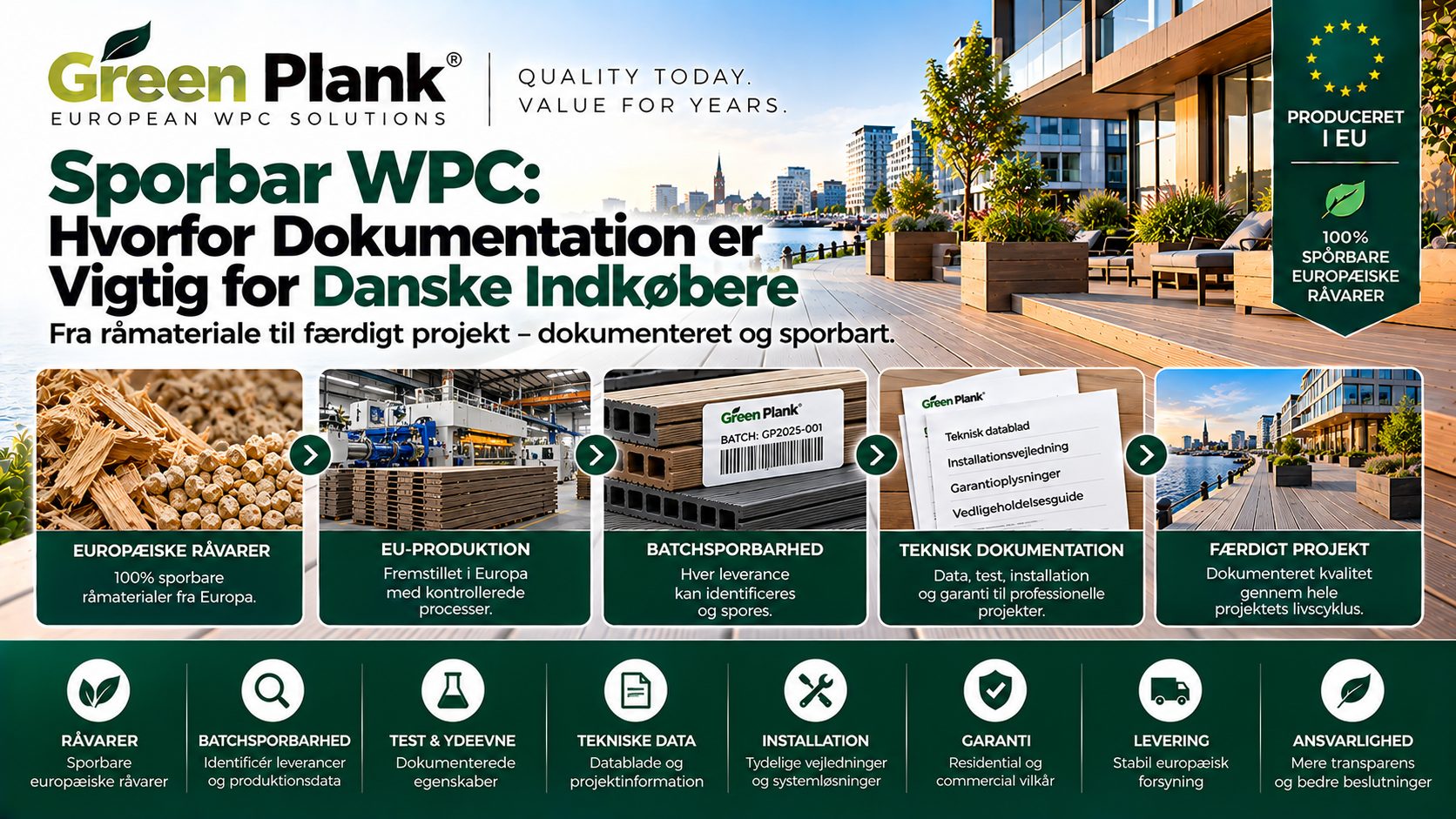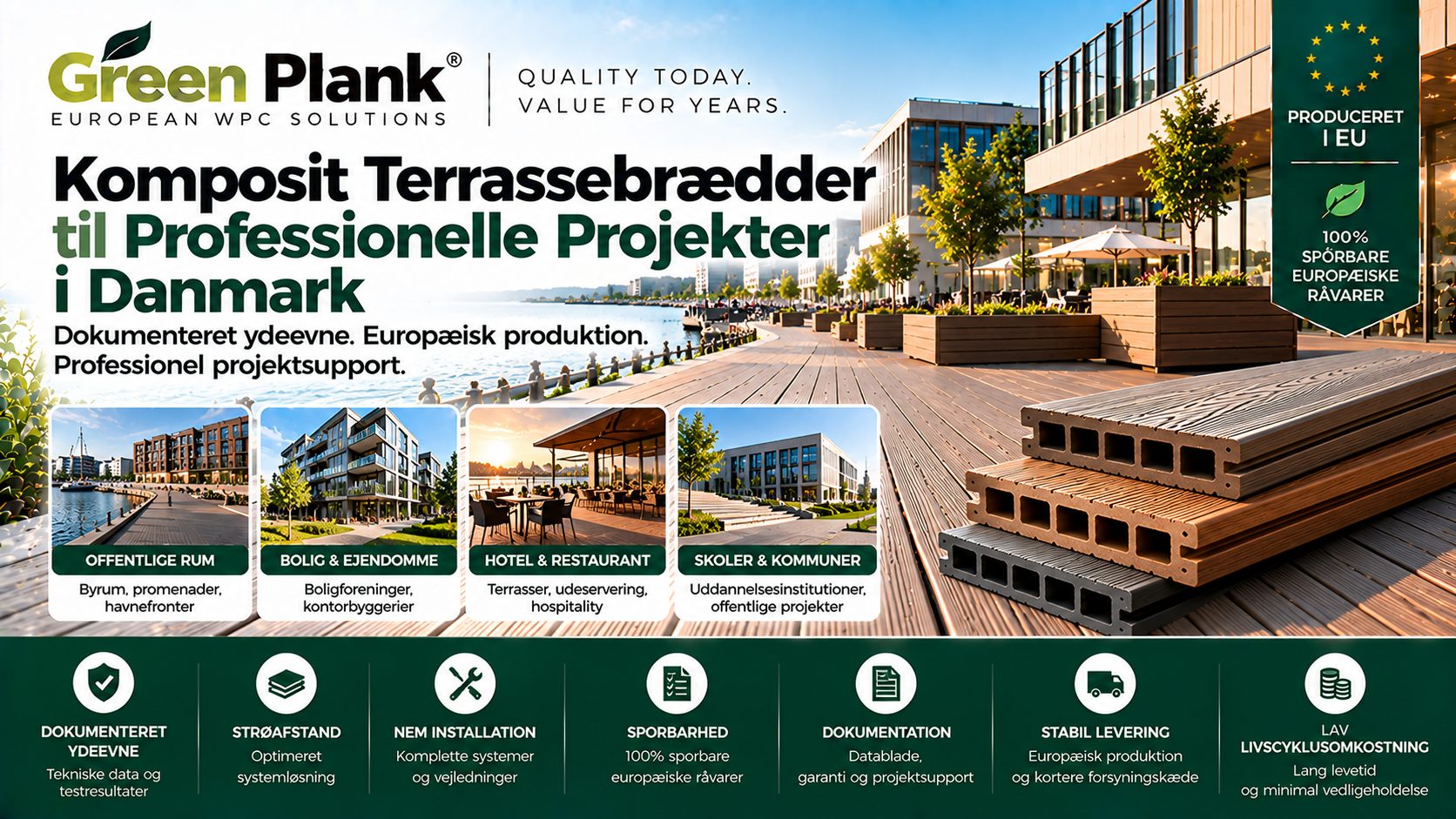




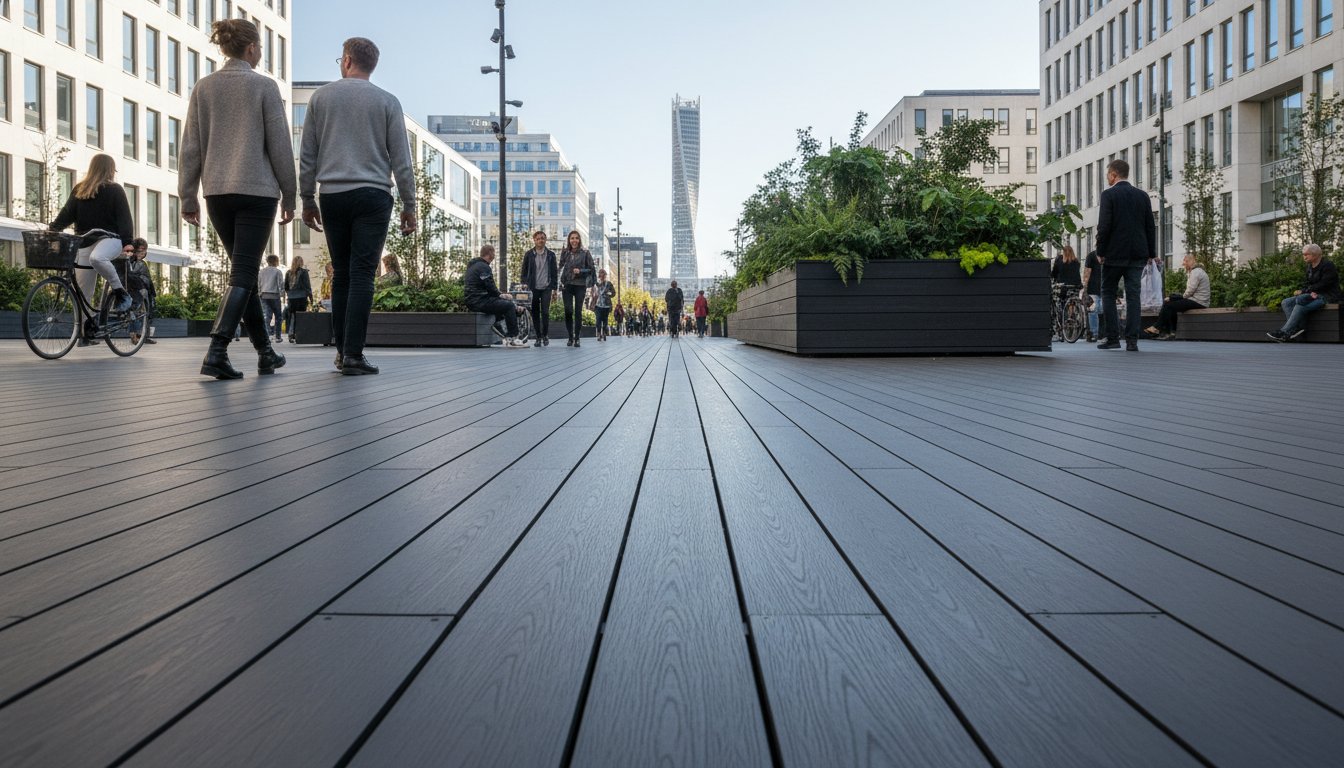
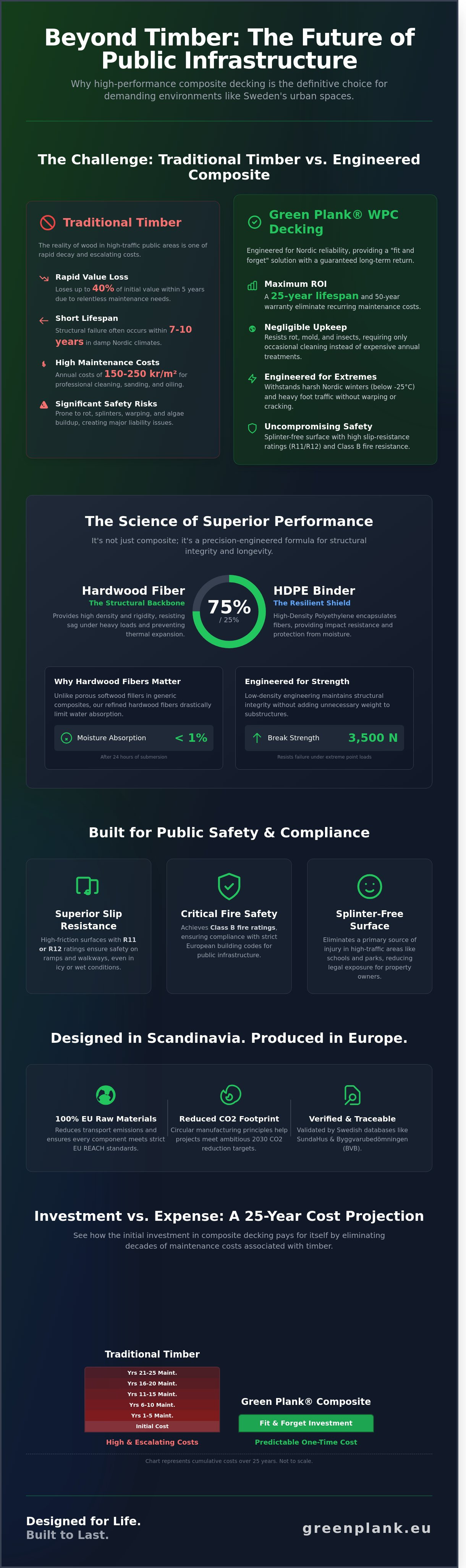
In Sweden, public infrastructure projects often lose up to 40% of their initial value within five years due to the relentless maintenance requirements of traditional timber. You understand that while natural wood offers an initial aesthetic appeal, the reality of splinters, warping, and the recurring costs for professional cleaning in high-traffic zones like Stockholm’s urban squares creates a significant liability. It's a challenge that pits architectural vision against the harsh reality of Swedish winters and heavy footfall.
Discover how high-performance WPC engineering and traceable European raw materials provide the ultimate low-maintenance solution for these demanding environments. This guide details how commercial composite decking delivers a "fit and forget" 25-year lifespan while strictly adhering to Boverket safety and fire regulations. We'll examine the engineering precision behind our natural-fiber composites. We'll verify the sustainable sourcing that helps your project meet 2030 CO2 reduction targets. Designed for life. Built to last.
Key Takeaways
- Understand why traditional timber fails in high-traffic public spaces and how engineered WPC eliminates long-term liability from rot and splinters.
- Decode the science behind the 75/25 hardwood-to-HDPE ratio that delivers superior mechanical strength and impact resistance for urban infrastructure.
- Compare specialized profiles to select the right commercial composite decking for your project’s specific load-bearing and frequency requirements.
- Learn how the HidLoc™ installation system and a 50-year warranty maximize ROI for Swedish developers by significantly reducing labor and maintenance costs.
- Discover the benefits of professional-grade infrastructure designed in Scandinavia and produced in Europe using 100% traceable, sustainable raw materials.
Why Commercial Projects are Moving Beyond Traditional Timber
Public infrastructure demands more than what traditional timber can provide. Commercial composite decking represents a specialized class of Wood Plastic Composite (WPC) engineered for extreme load-bearing and high-frequency foot traffic. While residential boards focus on aesthetics, these professional-grade profiles are built to withstand the rigorous demands of Swedish urban environments. They don't warp under heavy loads or degrade when exposed to the harsh freeze-thaw cycles of the Nordic climate.
The failure of softwood is a growing concern for municipal planners. In damp climates, timber often fails within 7 to 10 years. Rot, structural instability, and algae build-up create significant liability risks in public squares. Maintenance cycles for timber typically cost between 150 kr and 250 kr per square meter annually when factoring in professional labor, sanding, and oiling. Within a 5-year window, these cumulative costs often surpass the initial investment of a high-end composite installation. This economic reality has fueled a shift toward "Nordic Reliability" in European urban planning, prioritizing longevity and predictable budgets over low upfront costs. Built to last. Designed for life.
Safety and Compliance in Public Spaces
Slip resistance ratings are a non-negotiable metric for modern architects. High-friction surfaces with R11 or R12 ratings ensure safety on ramps and walkways during icy winters or rainy autumns. Fire safety is equally critical for commercial infrastructure. Specifying materials that meet Class B fire ratings ensures compliance with strict European building codes for public areas. In schools and public parks, the elimination of splinter risks is a key factor. It removes a primary source of injury for children and reduces the legal exposure for the property owner.
The Environmental Mandate for Modern Specifiers
Choosing the right composite helps reduce the CO2 footprint of a project through circular manufacturing. The use of 100% EU raw materials is a strategic decision that significantly reduces transport-related emissions compared to deep-sea imports. Traceable sourcing has become a standard requirement in commercial tenders across Sweden. Architects and contractors now utilize databases like SundaHus and Byggvarubedömningen (BVB) to ensure every component meets rigorous environmental standards. This commitment to engineering precision and environmental ethics ensures that modern developments respect nature while serving the public. Designed in Scandinavia. Produced in Europe.
The Science of High-Performance WPC: Why Material Composition Matters
The integrity of commercial composite decking depends entirely on its molecular foundation. While standard retail boards often rely on a 50/50 mix of plastic and wood flour, Green Plank utilizes a precision-engineered 75/25 ratio. This 75% hardwood fiber content acts as the structural backbone, providing a high modulus of elasticity that resists sagging under heavy pedestrian loads. By pairing this with 25% High-Density Polyethylene (HDPE), the material achieves a balance of rigidity and impact resistance. HDPE serves as a resilient binder that protects the fibers, ensuring the boards don't become brittle during harsh Swedish winters where temperatures frequently drop below -25°C.
Many manufacturers increase weight to simulate quality, but Green Plank employs low-density engineering to maximize performance. This approach reduces the dead load on commercial substructures while maintaining a 3,500 N break strength. Using 100% European raw materials ensures that every plank is free from the contaminants often found in global "mystery blends." Traceable sourcing means architects can specify these materials with confidence, knowing the chemical composition meets strict EU REACH standards. It's a level of Nordic reliability that cheaper imports simply can't match.
Hardwood Fiber vs. Softwood Fillers
The choice of fiber is the primary determinant of long-term stability. Most generic composites use softwood sawdust, which features large, porous cells that readily absorb moisture. In contrast, Green Plank uses refined hardwood fibers. These fibers have a higher natural density, which significantly limits internal moisture absorption to less than 1% after 24 hours of submersion. This density is critical for thermal stability; it prevents the warping and internal expansion that occurs when temperatures fluctuate between the freezing nights and sunny days common in the Scandinavian climate.
The Cradle to Cradle Ownership Model
True sustainability requires a circular approach to manufacturing. Green Plank operates as a Responsible Innovator, ensuring that every board is designed for a 50-year service life and is 100% recyclable at its conclusion. This Cradle to Cradle philosophy means the material never enters a landfill. Instead, old decks are reprocessed into new high-performance products. This commitment to a circular economy allows developers to meet BREEAM and LEED requirements while investing in a professional-grade natural-fiber composite that respects the environment.
- Density Advantage: Hardwood fibers provide superior mechanical strength compared to softwood alternatives.
- Thermal Control: High-quality commercial composite decking resists expansion even in extreme Swedish temperature swings.
- Traceable Quality: 100% European sourcing eliminates the risk of toxic additives or unstable recycled "mystery" plastics.
- Circular Lifecycle: Fully recyclable materials support long-term environmental goals and carbon footprint reduction.
By focusing on the "why" behind the material science, architects can move past aesthetic preferences and make decisions based on engineering facts. Designed in Scandinavia. Produced in Europe. Built to last. Designed for life.
Comparing Commercial Decking Profiles: Terra Tuff vs. Smart System
Selecting the right profile for commercial composite decking involves balancing structural load requirements with architectural vision. Architects must choose between solid and cellular profiles based on the specific application's traffic and weight demands. Solid profiles offer maximum impact resistance; cellular systems provide a lightweight solution without sacrificing surface durability. Each profile serves a distinct purpose in the Swedish urban landscape, from bustling harbor fronts to serene office rooftops.
- Solid Profiles: Ideal for high-impact zones, public infrastructure, and areas with heavy furniture or equipment.
- Cellular Profiles: Best for weight-sensitive projects like balconies and roof terraces where ease of installation is paramount.
Terra Tuff: Engineered for Extreme Environments
Terra Tuff represents the peak of heavy-duty engineering. Designed for public piers, marinas, and urban plazas, this solid profile handles extreme foot traffic and commercial equipment. It requires a maximum span of 600 mm (cc) for commercial installations to maintain structural integrity under heavy loads. This profile is the standard for coastal infrastructure because it's impervious to saltwater rot. In a 2022 maritime project in Gothenburg, Terra Tuff was selected for its ability to withstand the harsh Baltic Sea climate while maintaining a slip-resistant surface. It's built to last and designed for life.
Smart System: The Modern Architect’s Choice
Smart System provides a refined Nordic character that complements contemporary Scandinavian architecture. It's the preferred choice for office rooftop terraces in city centers like Stockholm. This system integrates seamlessly with commercial cladding and fencing, creating a cohesive facade that wraps the entire building envelope. While it offers a lighter footprint, it doesn't compromise on brawn. Architects favor it for its clean lines and the way it mirrors natural timber aesthetics without the maintenance burden. It's a professional-grade solution that bridges the gap between high-end design and circular sustainability.
Large-scale branding requires absolute color-fastness. Green Plank products feature advanced UV resistance to ensure the deck looks the same in year 15 as it did on day one. In the Swedish climate, where summer sun exposure can be intense, maintaining the integrity of the pigment is vital for commercial identity. Our natural-fiber commercial composite decking is engineered to resist fading, ensuring that your investment remains a vibrant part of the urban fabric for over 25 years. This durability is backed by our professional-grade warranties, giving architects and developers the confidence they need for large-scale urban planning.
Maximizing ROI with Low-Maintenance Circular Design
Investing in commercial composite decking isn't just an aesthetic choice; it's a strategic financial decision for the modern developer. Green Plank provides a 50-year limited warranty on its professional-grade profiles, offering a level of financial security that traditional timber cannot match. This longevity allows Swedish developers to project costs with precision over several decades. While traditional materials often require replacement or heavy refurbishment every 12 to 15 years, our engineered natural-fiber composite remains structurally sound. This durability directly supports future-proofing efforts as EU sustainability regulations, such as the EU Taxonomy, begin to favor circular materials with documented lifespans.HidLoc™: The Secret to a Flawless, Safe Surface
Labor costs in Sweden represent a major portion of any construction budget. The HidLoc™ system reduces installation labor by up to 30% because it eliminates the need for pre-drilling and individual surface screwing. This hidden fastening system creates a smooth, fastener-free surface that removes trip hazards, a critical safety requirement for high-traffic public areas. Beyond safety, the system is engineered to manage the natural expansion and contraction of the boards. By allowing controlled movement, HidLoc™ prevents the buckling and warping often seen in poorly installed decks. Architects can learn more about hidden deck fasteners to understand how this engineering choice protects the long-term integrity of the installation.Lifecycle Cost Analysis: WPC vs. Hardwood
When comparing the 25-year cost of hardwoods like Ipe or Teak against Green Plank composite, the financial gap is clear. Hardwood requires annual sanding, staining, and oiling to prevent splintering and UV degradation. In the Swedish climate, these maintenance cycles are non-negotiable. Over 25 years, the cumulative cost of oils and professional labor can exceed 1,800 kr per square meter. For restaurant and cafe owners, "easy-clean" surfaces are essential. Green Plank decks require only periodic cleaning with soap and water, meaning zero downtime for maintenance and no lost revenue during peak seasons.- Maintenance Downtime: Hardwood requires 2-3 days of closure for drying; Green Plank requires zero.
- Resource Efficiency: 50-year service life reduces the need for replacement materials by 200%.
- Safety: High slip resistance (R11/R12 ratings) remains consistent without chemical treatments.
Green Plank: Your Partner in Professional-Grade Infrastructure
Green Plank's identity is rooted in the "Designed in Scandinavia. Produced in Europe" philosophy. This identity serves as a quality guarantee for professionals who demand Nordic reliability and engineering precision. We manufacture our commercial composite decking using 100% traceable raw materials sourced within the European Union. This local production ensures every plank meets rigorous European standards for safety and environmental impact. It also minimizes transport distances to Swedish construction sites, significantly reducing the project's overall carbon footprint compared to products imported from overseas.
We provide specialized profiles that go beyond standard decking. These heavy-duty infrastructure solutions feature reinforced internal geometries designed to withstand the mechanical stresses of high-occupancy public areas. Architects receive full technical support from the initial specification phase through to on-site installation. We provide the engineering precision required to ensure long-term stability in Sweden's varied climate, where temperature fluctuations can challenge lesser materials. Our profiles are engineered for stability, strength, and a refined Nordic character that complements modern architectural visions.
From Coastal Piers to Urban Plazas
Our natural-fiber composites are versatile enough for diverse applications like boardwalks, balconies, and public stairs. They offer superior slip resistance and durability in harsh conditions, from the salt-sprayed piers of Gothenburg to the bustling urban plazas of Stockholm. For a polished, professional finish, you can integrate modern deck skirting ideas that hide structural supports while maintaining essential airflow. This versatility proves our "Built to last. Designed for life." promise in real-world settings, where maintenance-free performance is a financial necessity for municipalities and private developers alike.
Starting Your Commercial Project with Green Plank
Large-scale infrastructure projects benefit from our dedicated consultation services. We help you navigate the technical requirements of your next tender by providing comprehensive technical data sheets (TDS), CAD drawings, and physical samples. Our 100% EU traceable supply chain ensures your project aligns with circular economy goals and strict EU environmental regulations like the EUTR. It's a transparent process that prioritizes quality and ethical manufacturing.
Don't leave your material selection to chance. We invite you to request the technical documentation and physical samples needed to verify the durability of our commercial composite decking for your specific site requirements. Contact our commercial team today to begin your consultation and ensure your next project is built on a foundation of sustainable durability.
Future-Proof Your Projects with Circular Engineering
Designing for the Swedish climate requires materials that withstand extreme seasonal shifts without compromising on aesthetics or ethics. Choosing Green Plank commercial composite decking means investing in a circular economy. Our products utilize 100% EU raw materials to ensure every board meets strict European environmental standards. By prioritizing Cradle to Cradle design principles, you eliminate the waste associated with traditional timber while significantly reducing long-term maintenance costs. You also secure lasting value through an industry-leading 50-year commercial warranty. It's about engineering professional-grade infrastructure that respects the landscape. Whether you specify the high-traffic Terra Tuff profile or the versatile Smart System, you're choosing a solution that's designed in Scandinavia and produced in Europe. It's a commitment to Nordic reliability and technical excellence. We're ready to help you bridge the gap between architectural vision and sustainable reality.
Request a Commercial Sample Pack and Technical Spec Sheet
Let's build something that lasts for generations.
Frequently Asked Questions
What makes composite decking "commercial grade" compared to residential boards?
Commercial grade decking is defined by its superior density and structural reinforcement. Green Plank's commercial profiles are engineered with a solid cross-section or reinforced internal ribbing to withstand loads exceeding 500 kg per square meter. While residential boards prioritize weight reduction for easier DIY installation, commercial composite decking focuses on structural integrity for public spaces. This ensures the boards won't flex or warp under constant use in demanding Swedish urban environments.
Can commercial composite decking handle heavy furniture and high foot traffic?
Yes, our professional-grade profiles are specifically designed for high-density traffic areas like restaurant terraces and public boardwalks. These boards feature a Shore D hardness rating of 70 or higher; this prevents indentations from heavy bistro tables or high heels. In high-traffic Swedish shopping centers, these surfaces maintain their aesthetic finish for decades without the splintering common in traditional timber. It's a durable solution that stays beautiful under pressure.
Is commercial WPC decking slip-resistant when wet?
Green Plank commercial decking achieves an R11 or R12 slip resistance rating according to DIN 51130 standards. This high friction coefficient remains effective even when the surface is wet from rain or snow. It's a critical safety feature for public infrastructure in the unpredictable Nordic climate. The brushed surface texture provides a secure grip, which reduces the risk of accidents in busy commercial zones and public walkways.
How does the 50-year warranty work for commercial applications?
The 50-year limited warranty covers structural integrity, rot, and fungal decay in specified commercial applications. It's a performance guarantee that reflects our confidence in European manufacturing standards and 100% traceable raw materials. If a board fails due to manufacturing defects within this period, Green Plank provides replacement materials according to the warranty schedule. This long-term commitment significantly reduces life-cycle costs for Swedish developers and municipal planners.
Does commercial composite decking require special joist spacing?
Commercial installations typically require a maximum joist spacing of 300 mm to 400 mm on center. While residential projects might allow 450 mm spans, the increased load requirements of public spaces demand a tighter substructure. Using a 300 mm span ensures the deck remains rigid under heavy point loads and prevents any perceived bounce. Always consult the specific technical data sheet for your chosen profile to ensure compliance with Swedish building codes.
What fire ratings do Green Plank commercial profiles meet?
Green Plank commercial composite decking profiles meet the Euroclass Bfl-s1 fire rating requirements for flooring. This classification means the material has a very limited contribution to fire and produces minimal smoke during combustion. It's an essential specification for decking used in Swedish multi-story balconies or public gathering areas. These fire-retardant properties are achieved through precision engineering without compromising the environmental profile of our natural-fiber composites.
How does WPC contribute to LEED or BREEAM certifications in commercial builds?
Our products contribute to LEED and BREEAM credits by utilizing up to 90% recycled content and traceable wood fibers. We provide Environmental Product Declarations (EPD) to support the "Materials and Resources" category. In Sweden, where BREEAM-SE is the standard for sustainable construction, using our FSC-certified natural-fiber composite helps projects achieve "Excellent" or "Outstanding" ratings. This circular approach ensures your build meets modern environmental mandates while delivering long-term performance.
Specifikér produktet
Brug denne guide i en Green Plank-specifikation
Tekniske WPC-artikler skal understøtte de kommercielle sider — ikke konkurrere med dem. Fortsæt til kompositterrasse, TerraTuff, Nordeka eller de tekniske downloads.