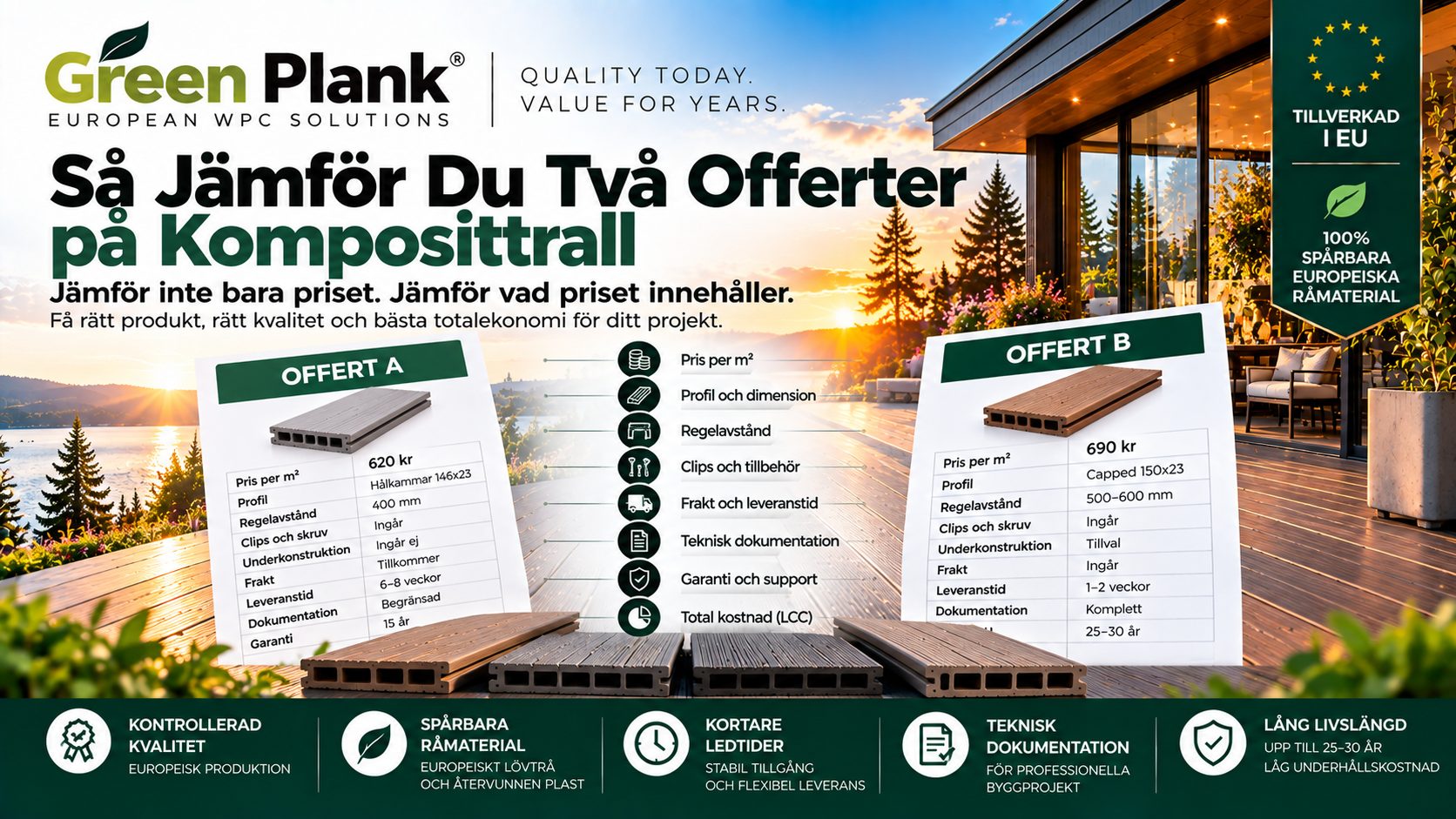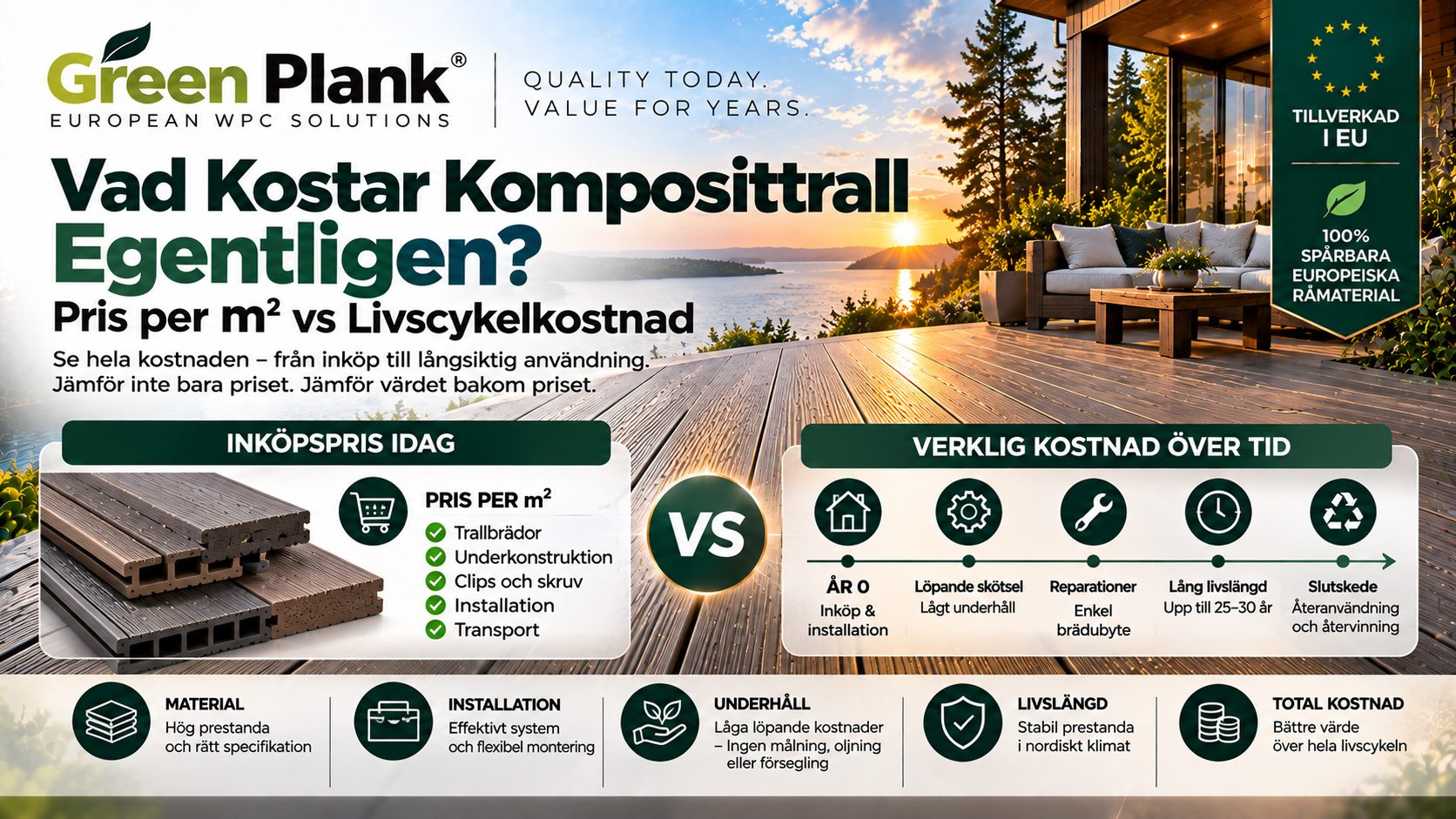




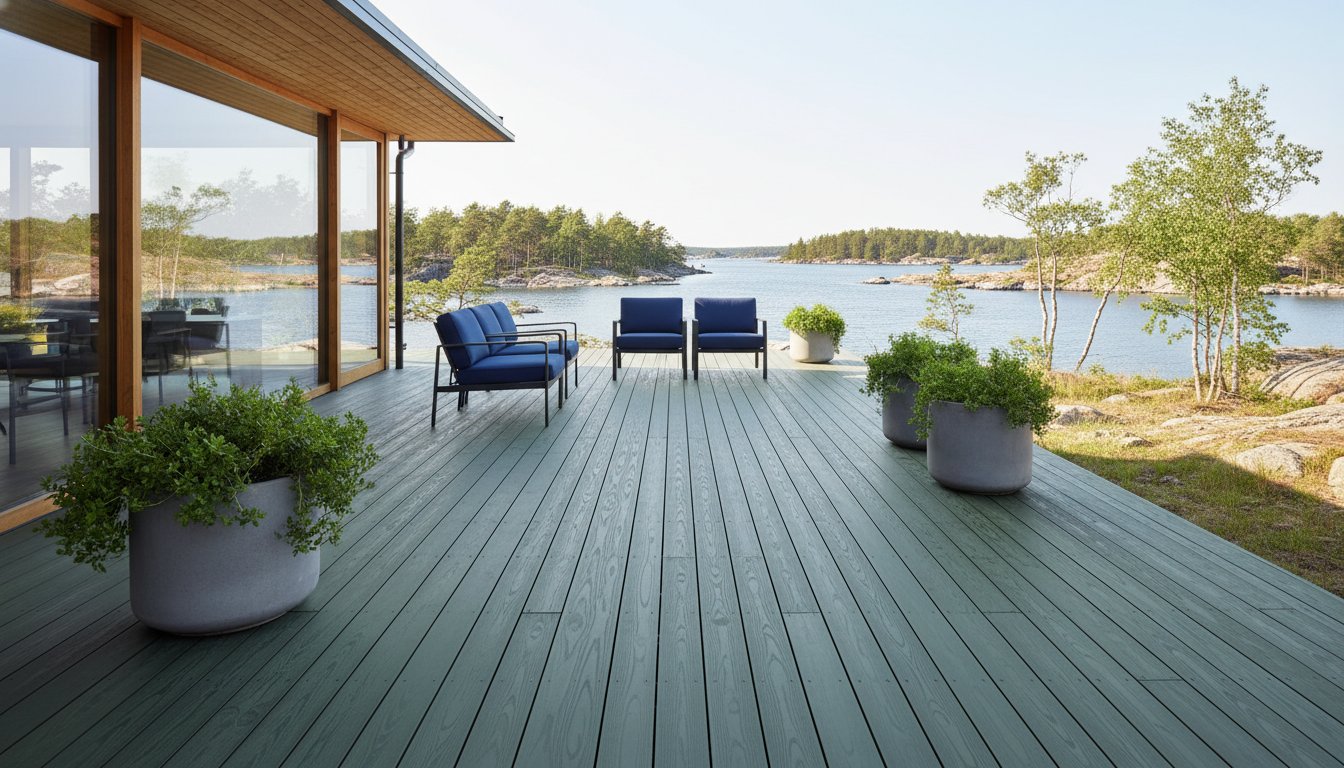
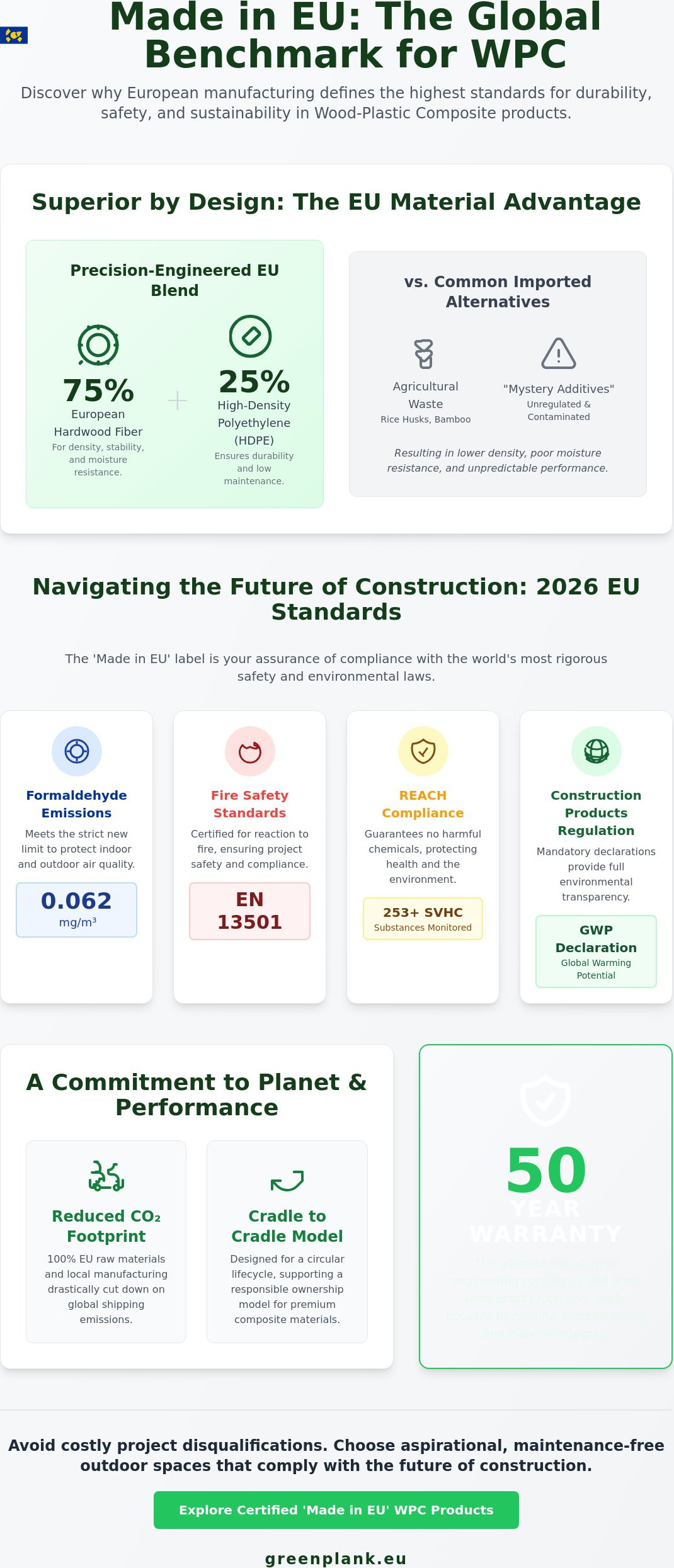
In 2026, the "Made in EU" label is far more than a mark of origin. It's a rigorous technical specification that determines if your construction project complies with the strictest safety and environmental laws in history. You've likely felt the increasing pressure of shifting regulations, such as the new 0.062 mg/m³ formaldehyde emission limits or mandatory Global Warming Potential declarations under the revised Construction Products Regulation. Understanding why made in eu is important in wpc products is now the difference between a successful, long-term installation and a costly project disqualification.
This article demonstrates how European manufacturing and 100% EU raw materials define the global benchmark for WPC durability, safety, and sustainability. We'll explore the engineering precision that allows for a 50-year warranty and how regional production ensures total compliance with the latest REACH and fire safety standards. You'll discover how choosing locally crafted composites like Terra Tuff or our Smart System decking reduces your environmental impact while providing an aspirational, maintenance-free outdoor space that respects nature.
Key Takeaways
- Learn how a precision blend of 75% hardwood fiber and 25% HDPE creates a denser, more moisture-resistant profile than standard imported alternatives.
- See how sourcing 100% EU raw materials significantly reduces the CO2 footprint of your construction project by eliminating long-distance global logistics.
- Discover why made in eu is important in wpc products for maintaining absolute compliance with the latest REACH safety standards and EN13501 fire regulations.
- Explore the engineering confidence behind a 50 year warranty and how regional manufacturing ensures consistent material integrity across all decking and cladding systems.
- Understand the Cradle to Cradle ownership model and how it supports a circular lifecycle for premium composite materials like Terra Tuff and Nordeka.
Table of Contents
- The Strategic Importance of 'Made in EU' for WPC Products
- Material Integrity: Why 100% EU Raw Materials Outperform Global Alternatives
- The Carbon Calculus: Reducing CO2 Footprints through Local Manufacturing
- Navigating EU Standards: Safety, Fire Resistance, and REACH Compliance
- Choosing Green Plank: A Cradle to Cradle Commitment to European Excellence
The Strategic Importance of 'Made in EU' for WPC Products
In 2026, the geographical origin of building materials has evolved from a simple logistics detail into a critical technical specification. For project specifiers and developers, understanding why made in eu is important in wpc products is essential for long-term asset protection. European manufacturing represents a commitment to material integrity that global imports often struggle to match. By sourcing within the region, builders ensure that every profile meets the revised Construction Products Regulation (CPR) requirements that became applicable on January 8, 2026. This origin signifies a shift toward transparency; material performance and environmental ethics are now inextricably linked.
The link between European manufacturing and long-term asset protection is grounded in engineering precision. When a product is manufactured in the EU, it adheres to the EN 15534-1:2014+A1:2017 standard, providing a predictable service life that justifies the investment in high-end commercial infrastructure. This regional reliability allows for specific long-term performance guarantees, such as a 50 year warranty, which serves as a primary signature of engineering confidence. It's a promise that ensures the outdoor space remains beautiful and maintenance-free for decades while respecting the natural world.
Beyond the Label: A Benchmark for Quality
European production facilities utilize advanced material science to create Wood-plastic composites (WPCs) with consistent density and structural integrity. By utilizing a precise blend of 75% hardwood fiber and 25% HDPE, manufacturers achieve a level of moisture resistance and durability that surpasses many global alternatives. This technical attribute is a practical advantage; it prevents the warping and degradation often seen in non-compliant materials. In high-end commercial projects, "Made in EU" serves as the first filter for sustainable procurement, ensuring that every board contributes to the overall stability of the structure and the safety of its users.
Supply Chain Resilience in Modern Construction
Choosing regional supply chains effectively eliminates the project delays associated with global shipping. Local production allows for shorter lead times and more responsive communication between the architect and the manufacturer. This transparency extends to raw material sourcing. Every component is traceable from the forest to the finished board, ensuring that the 100% EU raw materials meet the latest safety requirements. As the August 6, 2026, deadline for stricter formaldehyde emission limits approaches, having a direct line to a European manufacturer provides the certainty needed to avoid project disqualification. It's a model of regional reliability that protects both the builder and the environment.
Material Integrity: Why 100% EU Raw Materials Outperform Global Alternatives
The structural performance of Wood Plastic Composite is entirely dependent on the purity of its ingredients. Mass-market imports often rely on agricultural waste such as rice husks or bamboo, which lack the inherent density of slow-grown European timber. This technical distinction is a primary reason why made in eu is important in wpc products; it ensures the material behaves predictably under environmental stress. By utilizing 100% EU raw materials, manufacturers eliminate the risks associated with "mystery additives" and contaminated recyclables often found in unregulated supply chains. These contaminants can compromise the chemical safety of the product, particularly as REACH regulations expand to include 253 substances of very high concern as of February 2026.
Quality is measurable. Our proprietary blend consists of 75% hardwood fiber and 25% HDPE, creating a low-density yet high-strength profile. This specific ratio avoids the brittleness of PVC-based composites and the soft, sponge-like behavior of tropical fillers. When you choose materials with a transparent European origin, you're opting for a product that has been engineered for regional heritage and manufacturing quality. It's a grounded, eco-conscious choice that prioritizes long-term performance over short-term savings.
Hardwood Fibre vs. Alternative Fillers
European hardwood offers superior thermal stability compared to tropical alternatives. Because the fibers are sourced from regional species, they're naturally adapted to the temperature fluctuations found in European climates. The longer fiber length of these hardwoods provides a superior structural "bite" for systems like the HidLoc™ Hidden Fastening Systems, ensuring boards remain secure without splitting. Sourcing hardwood from managed European forests prevents the internal rot that often plagues WPC products filled with high-moisture agricultural byproducts.
The HDPE Advantage for Longevity
High-Density Polyethylene (HDPE) serves as the ideal binder for premium decking. Unlike lower-grade plastics or PVC used in mass-market imports, HDPE provides exceptional moisture resistance and flexibility. The 75/25 blend ratio optimizes the balance between the natural aesthetic of wood and the industrial durability of polymer. This material purity is exactly what allows us to offer specific long-term performance guarantees, including a 50 year warranty on products like Nordeka and Terra Tuff. You're not just buying a board; you're investing in an engineered asset. Explore our range of sustainable composite solutions to see these materials in action.
The Carbon Calculus: Reducing CO2 Footprints through Local Manufacturing
The environmental impact of construction materials is often obscured by complex global supply chains. When analyzing the total lifecycle of a project, the distance a product travels becomes a decisive factor in its sustainability rating. This reality is a core reason why made in eu is important in wpc products; it eliminates the excessive carbon debt incurred by transoceanic shipping. Heavy materials like composite decking require significant energy to transport across oceans, often negating the eco-friendly benefits of the recycled content within the boards themselves. By choosing regional production, specifiers ensure that the product's environmental claims aren't undermined by its logistics profile.
Sourcing 100% EU raw materials ensures that the "hidden" carbon in the supply chain remains as low as possible. This transparency is now a regulatory necessity. As of January 8, 2026, the revised Construction Products Regulation (CPR) mandates a declaration of Global Warming Potential (GWP) for specific construction categories. European manufacturers are uniquely positioned to provide this data accurately because they operate within a highly regulated, transparent ecosystem. Choosing regional production isn't just an ethical preference; it's a strategic move to meet net-zero project goals through verifiable engineering data.
Logistics and the CO2 Equation
Regional manufacturing drastically reduces transport emissions by keeping the supply chain within the continent. This proximity allows architects and developers to secure higher scores in BREEAM and LEED certification processes, where localized sourcing is heavily weighted. Beyond the environmental math, local supply chains offer practical site advantages that reduce waste:
- Lower transport distances result in reduced fuel consumption and fewer atmospheric pollutants.
- Just-in-time delivery schedules minimize the need for large on-site storage areas and potential material degradation.
- Localized distribution networks allow for smaller, more frequent shipments that align with specific construction phases.
Energy-Efficient Production Standards
European factories operate under some of the world's most stringent environmental mandates. These facilities often utilize a higher percentage of renewable energy compared to global manufacturing hubs, further lowering the embodied carbon of each profile. Strict EU waste management laws also ensure that material purity is maintained throughout the production cycle, preventing the cross-contamination that occurs in less regulated markets. For a deeper look at how these standards influence the industry, consult our sustainable building materials guide. This commitment to energy efficiency ensures that your outdoor space respects nature while providing the premium quality expected of professional-grade composites.
Navigating EU Standards: Safety, Fire Resistance, and REACH Compliance
Adherence to safety protocols is a non-negotiable requirement for modern construction. While many global manufacturers view the CE mark as a gold standard, it actually serves as the minimum regulatory baseline for market entry. For professionals, understanding why made in eu is important in wpc products involves looking deeper into the specific chemical and structural safeguards that protect end-users. European manufacturing ensures that every profile, from our Sapphire decking to our commercial infrastructure profiles, is engineered to exceed these baselines rather than merely meeting them. This commitment prevents the inclusion of toxic heavy metals, phthalates, and unregulated binders often found in mass-market imports.
Chemical transparency has become particularly critical following the February 2026 update to the REACH SVHC candidate list, which now includes 253 substances of very high concern. Products manufactured outside the EU often lack the rigorous oversight necessary to guarantee the absence of these compounds. By utilizing 100% EU raw materials, we ensure that our composite systems remain safe for both the environment and the people who inhabit these spaces. This level of material purity is a primary signature of our engineering confidence.
Chemical Safety and REACH Regulations
Specifiers must prioritize volatile organic compound (VOC) emissions when selecting materials for residential or public projects. The upcoming August 6, 2026, deadline enforces a strict formaldehyde emission limit of 0.062 mg/m³, which is exactly half of the previous E1 threshold. Sourcing 100% EU raw materials provides an absolute guarantee that these restricted substances are absent from the production line. REACH compliance ensures that our decking and cladding systems provide a safe, non-toxic environment for children and pets in residential settings and for the general public in high-traffic urban areas.
Fire Performance in Commercial Projects
Navigating fire ratings is essential for high-traffic infrastructure such as public piers and boardwalks. The revised European standard for cladding fire safety, EN 13501-1, became effective on January 31, 2026, replacing subjective visual assessments with an objective temperature-based system. Any material that exceeds a 270°C temperature rise is now classified as a failure. EU-certified testing laboratories provide a level of data reliability that self-certified imports cannot match. Green Plank’s engineered profiles are designed to meet these stringent national safety codes, ensuring that your project remains both beautiful and legally compliant. To secure your project with certified safety, view our range of fire-resistant WPC solutions.
Choosing Green Plank: A Cradle to Cradle Commitment to European Excellence
Green Plank embodies the principle of regional reliability by merging Swedish engineering precision with a strict 100% EU material mandate. This philosophy isn't merely a marketing stance; it's a technical requirement for ensuring long-term asset protection. When professionals ask why made in eu is important in wpc products, the answer lies in the ability to control every variable of production. From the specific 75/25 blend of hardwood fiber and HDPE to the final extrusion, regional oversight allows us to offer a 50 year warranty. This level of engineering confidence is impossible to achieve when relying on fragmented, global supply chains where material purity is often compromised.
Our commitment to excellence extends beyond the initial installation through the Cradle to Cradle ownership model. This framework treats every board as a technical nutrient within a circular lifecycle, ensuring that materials are designed for eventual reuse rather than landfill disposal. It's a responsible innovation that aligns with the EU’s circular economy goals. By choosing profiles like Nordeka or our commercial infrastructure systems, you're investing in a product that respects nature's limits while providing an aspirational, maintenance-free lifestyle. The HidLoc™ Hidden Fastening Systems further enhance this value, providing a seamless aesthetic and superior structural "bite" that only high-density, EU-sourced hardwood fibers can support.
Innovation in Circular Design
The Cradle to Cradle approach is central to how we minimize environmental impact. We engineer low-density profiles that reduce overall material consumption without sacrificing the load-bearing strength required for private 600 cc spans. This material efficiency is a core part of our mission to reduce the CO2 footprint of modern construction. For those seeking a deeper technical understanding of our material composition and sustainability benchmarks, we invite you to view our WPC composite decking pillar. This guide provides the comprehensive data needed for informed, eco-conscious decision-making.
Engineered for the European Climate
European architecture faces unique challenges, from humid coastal regions to the freezing temperatures of the north. Products like Terra Tuff are specifically engineered to withstand these extreme fluctuations without warping or losing structural integrity. We understand regional architectural needs because we are part of the same landscape. This localized knowledge ensures that our decking, cladding, and fencing systems perform predictably in the environments they were designed for. It's a grounded responsibility that global importers simply cannot replicate. Explore Green Plank's EU-made WPC solutions to find the perfect balance of engineering precision and ecological ethics for your next project.
Building a Legacy of Regional Excellence
Selecting the right composite material is a decision that impacts the longevity of your project and the health of our planet. We've explored how the precise engineering of 75% hardwood fiber and 25% HDPE creates a profile that outperforms global alternatives in density and moisture resistance. You now understand why made in eu is important in wpc products for ensuring absolute compliance with REACH safety standards and the latest fire regulations. By prioritizing 100% EU raw materials, you eliminate hidden carbon costs and project delays while securing a product designed for a circular lifecycle.
Our Cradle to Cradle approach ensures your outdoor space is not just beautiful today, but remains a sustainable asset for decades. With a specific 50-year service life warranty, we provide the engineering confidence required for high-end commercial and residential infrastructure. It's time to align your construction goals with a brand that values regional heritage and material science equally. Partner with Green Plank for your next sustainable project and invest in quality that lasts. Let's build a maintenance-free future that respects nature's boundaries.
Frequently Asked Questions
Why is 'Made in EU' better for WPC products than imported alternatives?
'Made in EU' signifies a commitment to material integrity and regional reliability that global imports often lack. This origin ensures that every profile meets the EN 15534 standard for performance and durability. Understanding why made in eu is important in wpc products allows specifiers to avoid the risks of non-compliant materials. It's a hallmark of professional standards and engineering precision.
Does EU-made WPC really have a lower CO2 footprint?
EU-made WPC significantly reduces environmental impact by shortening the supply chain. Sourcing 100% EU raw materials eliminates the massive carbon debt associated with shipping heavy profiles from overseas manufacturing hubs. This local approach supports net-zero project goals and simplifies the documentation required for Global Warming Potential declarations under the latest Construction Products Regulation.
What are the specific fire safety standards for WPC in Europe?
Fire safety is governed by the EN 13501-1 standard, which provides a rigorous classification for reaction to fire. This standard is essential for high-traffic infrastructure and public cladding projects. European-made products undergo testing in certified laboratories to ensure they meet objective temperature thresholds. This provides a level of safety that self-certified global imports cannot consistently provide.
Is all WPC sold in Europe REACH compliant?
REACH compliance is not guaranteed for all products sold in Europe, particularly those imported from less regulated markets. While the CE mark is required, it doesn't always reflect the deep chemical transparency found in regional manufacturing. Choosing products made with 100% EU raw materials ensures that the final boards are free from restricted substances of very high concern.
What is the difference between hardwood fibre and bamboo in WPC?
European hardwood fiber offers superior thermal stability and structural density compared to bamboo or rice husks. The longer fiber length of hardwood provides a better "bite" for hidden fastening systems, preventing boards from shifting over time. Unlike bamboo, which is a grass with high moisture absorption, our 75% hardwood blend is engineered to prevent internal rot.
How does the Cradle to Cradle model apply to composite decking?
The Cradle to Cradle model ensures that composite decking is designed for a circular lifecycle. This approach treats materials as technical nutrients that can be safely recycled or reused at the end of their service life. It moves away from the "take-make-waste" pattern. This provides a sustainable solution that respects the natural world while maintaining premium quality.
Why do Green Plank products offer up to a 50-year warranty?
A 50-year warranty is possible because of the high-purity HDPE and slow-grown hardwood fibers used in our production. Regional manufacturing allows for total control over the 75/25 blend ratio, ensuring every profile meets our internal benchmark for structural integrity. This long-term guarantee is a primary signature of our engineering confidence and commitment to lasting quality.
Are EU-made WPC products more expensive to install?
EU-made WPC products follow the same installation principles as other composites but often include proprietary systems that save time. For instance, the HidLoc™ Hidden Fastening System is designed for professional efficiency and a seamless aesthetic. While the initial material investment reflects premium quality, the 50-year service life and maintenance-free nature result in a much lower total cost of ownership.
Specificera produkten
Använd den här guiden i en Green Plank-specifikation
Tekniska WPC-artiklar ska stärka de kommersiella sidorna — inte konkurrera med dem. Fortsätt till komposittrall, TerraTuff, Nordeka eller de tekniska nedladdningarna.