



The most recognizable brand name in the industry might actually be the least efficient choice for your 2026 carbon footprint. While many homeowners default to familiar US labels, the environmental cost of long-distance shipping and high-plastic content often outweighs the convenience. When you search for trex decking alternatives, you aren't just looking for a substitute; you're looking for a superior engineering standard that respects the planet. We understand that you want the warmth of natural wood without the burden of maintenance or the "plastic" finish that plagues lower-grade composites.
You'll discover why European-engineered WPC provides a 30 percent increase in material density and significantly better slip resistance for high-traffic commercial zones. We'll explain how 100 percent traceable raw materials and circular manufacturing create a product that's truly built to last and designed for life. This article outlines the technical shift toward professional-grade Nordic composites that offer lower lead times and a refined Scandinavian aesthetic for the modern landscape. Designed in Scandinavia. Produced in Europe.
Key Takeaways
- Understand why professional-grade trex decking alternatives are shifting the industry toward traceable, European-made materials that resolve common heat and aesthetic limitations.
- Gain clarity on the material composition of your deck boards by breaking down the environmental and performance trade-offs between PVC and natural-fiber composites.
- Learn to apply Scandinavian engineering principles to your project, ensuring your choice meets the highest standards for fire safety and slip resistance.
- Discover how a circular manufacturing approach and long-term warranties provide a sustainable, low-maintenance foundation for an aspirational lifestyle.
- Evaluate the "Built to last. Designed for life." philosophy to see how European engineering delivers superior stability and refined Nordic character.
Why Search for Trex Decking Alternatives in 2026?
Trex established the composite decking category in 1996. It has long served as the default choice for homeowners transitioning away from traditional timber. However, the requirements for outdoor living spaces have changed significantly over the last decade. In 2026, the demand for trex decking alternatives is driven by a need for higher thermal efficiency, localized production, and a more refined architectural aesthetic. While mass-market brands focus on high-volume production, European engineering has pivoted toward precision and circularity.
Mass-market composites often struggle with heat absorption, reaching surface temperatures that make barefoot use uncomfortable during peak summer months. Sourcing these materials from North America also creates a significant carbon footprint due to trans-Atlantic logistics. Professionals now seek materials that reflect a commitment to European manufacturing standards. This shift ensures that the products used in local projects support regional economies and adhere to strict EU environmental regulations.
The Evolution of the Wood-Alternative Market
The industry has moved far beyond the basic formulations of the early 2000s. Modern Wood-plastic composites (WPCs) now utilize Natural Fiber Composites (NFC) that offer superior dimensional stability. These second and third-generation materials replace heavy, solid profiles with engineered, low-density shapes. This engineering choice reduces the weight of the boards by up to 20 percent, making installation faster and reducing physical strain on contractors. Professional specifiers no longer settle for "one size fits all" solutions; they require materials designed for specific climate challenges and load-bearing requirements.
Common Reasons Professionals Look Beyond the Big Brands
Supply chain reliability is a critical factor for modern construction timelines. Importing boards from the US often results in lead times exceeding 10 weeks, which can derail project schedules. Local European manufacturing eliminates these delays and ensures consistent availability. Beyond logistics, the aesthetic preference has shifted. The heavy, deep-grain embossing found on many US brands can appear artificial in contemporary settings. Architects increasingly favor a Nordic aesthetic, which features clean lines and a matte, natural finish that complements modern Scandinavian design.
Choosing a high-performance alternative allows for a more tailored approach to outdoor spaces. Green Plank products are designed in Scandinavia and produced in Europe to meet these exact needs. Our materials are:
- Manufactured using 100% traceable raw materials for ethical transparency.
- Engineered with high-strength profiles to deliver long-term structural integrity.
- Designed with a circular mindset to ensure every board is fully recyclable at the end of its life.
High-performance decking is no longer just about avoiding rot. It is about creating a maintenance-free environment that respects the planet. By selecting European-engineered NFC, you invest in a product that is built to last and designed for life.
Understanding the Composition: PVC vs. WPC vs. Natural Fiber Composites
Selecting the right material for an outdoor space requires a look beneath the surface. When homeowners explore trex decking alternatives, they typically encounter three distinct chemical compositions: Cellular PVC, standard Wood Plastic Composites (WPC), and Natural Fiber Composites (NFC). Each material reacts differently to environmental stress, and the choice impacts both the deck's lifespan and its ecological footprint.
Cellular PVC is a fully synthetic option. It contains no organic fibers, which makes it immune to rot and mold. However, PVC production is energy-intensive and the material is notoriously difficult to recycle at the end of its life cycle. Standard WPC boards usually balance wood flour with plastic, often in a 50/50 ratio. While these are more affordable, they frequently use softwood sawdust or "wood flour" which can absorb moisture if the encapsulation fails. Green Plank takes a different path with Natural Fiber Composites. We use high-density engineering to create a board that behaves like wood but performs like a high-grade polymer.
- PVC: 100% plastic, high thermal expansion, limited recyclability.
- Standard WPC: Mixed wood and plastic, prone to "mushrooming" if low-quality fillers are used.
- Green Plank NFC: Engineered with 75% hardwood fiber and traceable HDPE for maximum stability.
The Role of Hardwood Fiber in Durability
Stability in a deck board starts with the type of fiber used. Green Plank utilizes a 75% hardwood fiber ratio, which provides a significant mechanical advantage over the 50% industry standard found in many trex decking alternatives. This high fiber density creates a rigid internal matrix. It reduces the expansion and contraction cycle by 40% compared to boards using softwood or generic sawdust fillers. Because hardwood fibers are naturally denser, they resist the internal pressure changes caused by humidity. You can explore the technical specifics in our detailed breakdown of The Role of Hardwood Fiber in Composite Durability.
HDPE vs. PVC: Which is Superior for the European Climate?
The European climate demands materials that can handle 70-degree temperature swings. Green Plank utilizes High-Density Polyethylene (HDPE) because it maintains its structural integrity from -30°C in Scandinavian winters to 40°C summer peaks. Unlike PVC, which can become brittle and crack in extreme cold, HDPE remains flexible yet strong. It is also a cornerstone of the circular economy; it is 100% traceable and recyclable. For professionals deciding on material specifications, our comparison of HDPE vs. PVC Decking: Which Composite Material is Superior in 2026? offers a deep dive into these performance metrics. If you're ready to see the difference in person, you can order a sample pack to feel the density of European-engineered NFC.
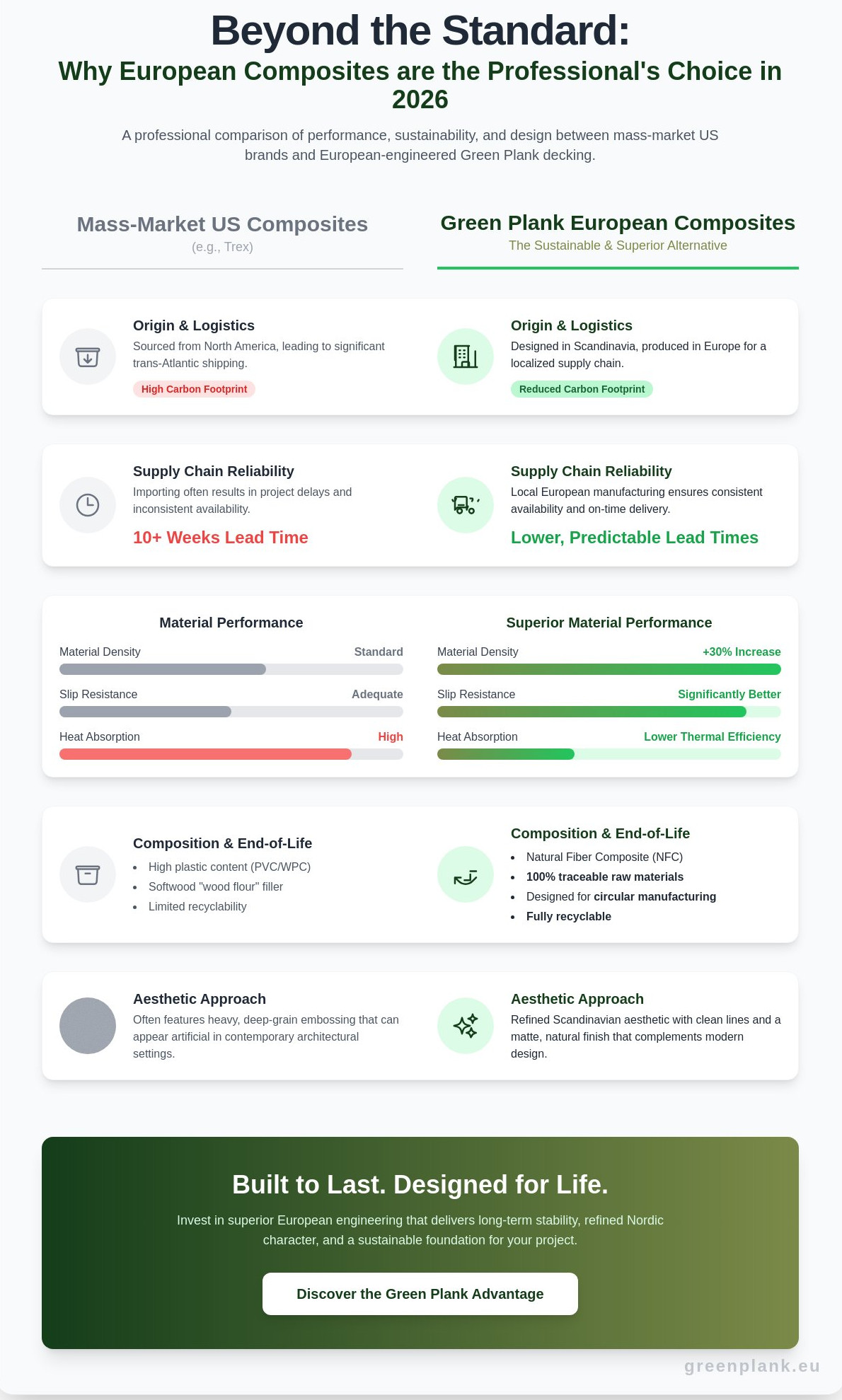
Trex vs. Green Plank: A Professional Comparison of Performance & Sustainability
Selecting high-performance trex decking alternatives in 2026 requires a shift from global commodity products toward regional, precision-engineered solutions. While Trex relies on global waste streams for its composite makeup, Green Plank utilizes 100% traceable European raw materials. This distinction is critical for architects and contractors who prioritize material purity and supply chain transparency. By sourcing wood fibers and polymers exclusively from within the EU, Green Plank avoids the contaminants often found in international recycling batches, resulting in a more stable and predictable board.
The engineering philosophy also differs significantly in how these systems are secured. While many generic alternatives use traditional top-down screws or basic plastic clips, Green Plank utilizes the HidLoc™ hidden fastening system. This professional-grade hardware manages thermal expansion and contraction with 100% accuracy, preventing the warping or "creeping" that can plague decks in fluctuating climates. Additionally, local European production slashes the CO2 footprint of every project. Avoiding transatlantic shipping reduces transport emissions by approximately 80% compared to North American imports, making it the logical choice for LEED or BREEAM certified builds.
Engineering for Longevity: Built to Last, Designed for Life
Green Plank products target a 50-year service life, a benchmark that redefines expectations for outdoor flooring. This durability is achieved through a low-density core design. While it sounds counterintuitive, this specific density allows for superior structural integrity without the excessive weight of solid-plastic boards. It's easier for crews to handle on-site, reducing labor fatigue and installation errors. This commitment to longevity is backed by a comprehensive 50-year warranty on professional-grade lines, signaling a level of engineering confidence that exceeds industry standards. For a deeper dive into these technical specifications, see our guide on Green Plank vs Trex: The Ultimate Decking Showdown for 2026.
The Sustainability Edge: Cradle to Cradle Ownership
Sustainability isn't just about recycled content; it's about the entire lifecycle. Green Plank operates on a "Cradle to Cradle" philosophy, ensuring every board is part of a circular economy. Because the raw materials are 100% EU-sourced, they meet the strictest environmental and safety regulations in the world. There are no hidden toxins or "forever chemicals" that often bypass inspections in global waste streams. When you choose Green Plank, you're investing in a product that can be reclaimed and repurposed at the end of its life, rather than contributing to a landfill. It's a responsible approach to modern architecture. Learn more about these principles in our Sustainable Building Materials: The 2026 Guide to Circular Construction.
- Traceable Materials: 100% European-sourced fibers for maximum purity.
- Extended Warranty: 50-year coverage reflecting Nordic engineering standards.
- Precision Fastening: HidLoc™ systems ensure structural stability over decades.
- Carbon Efficiency: Local production minimizes the environmental cost of transport.
Designed in Scandinavia. Produced in Europe. Built to last. Designed for life.
How to Evaluate a Wood-Alternative Brand for Your Project
Choosing between trex decking alternatives requires looking beyond the brand name. You've got to scrutinize technical certifications to ensure the product survives the local climate. When assessing trex decking alternatives, the Bfl-s1 fire safety classification is a non-negotiable benchmark. This European standard ensures the material is flame-retardant, which is a critical requirement for multi-story balconies and public infrastructure. High-performance WPC must also provide certified slip resistance. This protects your family and the public in wet Nordic conditions.
Don't ignore the "hidden costs" that often inflate a project's budget. Check the required joist spacing before purchasing. While some brands require tight spacing that increases material costs, Green Plank's engineered profiles often allow for 600cc spacing in private residential settings. This reduces the amount of subframe timber and fasteners you need to buy. Always request physical samples. You can't judge the refined Nordic character or the deep-brushed texture through a digital screen. A physical sample reveals the material's density and the authentic feel of its wood-grain finish.
Residential vs. Commercial Requirements
High-traffic public infrastructure demands a different grade of material than a private garden. For commercial boardwalks or restaurant terraces, Terra Tuff provides the extreme durability needed for constant footfall. Residential projects benefit from the Smart System. It's designed for efficiency and ease of installation without sacrificing the premium aesthetic. High-density composites allow for wider joist spans, which saves labor time and material costs during the build phase. Built to last. Designed for life.
Solving the "Wood Problem" Permanently
Traditional timber is beautiful until it isn't. High-quality WPC solves the "wood problem" by eliminating the internal stresses that cause splintering, rotting, and warping. You won't spend your weekends sanding or oiling. This leads to a superior long-term ROI. While timber might seem cheaper initially, the cost of stains, sealants, and eventual replacement makes it more expensive over a 25-year lifecycle. Read more about Wood Decking Problems: Why Traditional Timber Fails and How to Solve It to understand the engineering behind these common failures.
Designed in Scandinavia. Produced in Europe. Order your Nordic-engineered samples today to experience the Green Plank difference firsthand.
Green Plank: The Leading European Alternative for Sustainable Decking
Green Plank represents the pinnacle of natural-fiber composite engineering. Designed in Scandinavia and produced in Europe, the brand offers a sophisticated response for those seeking high-performance trex decking alternatives that prioritize local manufacturing and environmental transparency. It's built to last; it's designed for life. This philosophy ensures that every installation meets the rigorous demands of the European climate while maintaining a minimal ecological footprint.
The product range reflects a deep commitment to engineering precision. Terra Tuff provides a robust, heavy-duty solution for high-traffic areas, utilizing a high-density core for maximum impact resistance. The Smart System offers a versatile, reversible profile that simplifies installation for residential contractors. For those desiring a refined, wood-like aesthetic, Nordeka delivers a deep-embossed grain that captures the essence of Nordic timber without the maintenance burden of traditional wood. Each product line is manufactured to deliver stability, strength, and refined Nordic character.
Aesthetics matter as much as durability in modern architecture. The HidLoc™ hidden fastening system ensures a flawless, screw-free surface that preserves the clean lines of the design. This technical innovation eliminates visible hardware, creating a safe, barefoot-friendly environment while allowing for the natural thermal expansion of the composite boards. It's a professional-grade solution that combines safety with a premium finish.
Specifying Green Plank for your next project is a streamlined process. Architects and developers can access our full library of technical specifications and installation guides directly through our professional portal. Whether you're planning a private residential terrace or a sprawling public boardwalk, our engineering team provides the data necessary to ensure your vision is realized with precision and longevity.
Specialized Solutions for Infrastructure
Our team supports large-scale developments with custom commercial profiles designed for public piers, boardwalks, and balconies. When evaluating trex decking alternatives for commercial use, the technical specifications of Green Plank often exceed standard requirements. We provide architects with comprehensive technical documentation and BIM data, updated in 2024 to support the latest digital twin modeling. The 50-year warranty on infrastructure products serves as a safeguard for long-term municipal and private investments, ensuring structural integrity for decades.
Join the Circular Movement
Selecting a European manufacturer significantly reduces a project's carbon footprint by shortening supply chains and reducing transport emissions. Our commitment to 100% traceable, sustainable raw materials means every board supports a circular economy. We don't just manufacture decking; we engineer legacy spaces that respect the planet. Choosing Green Plank is a vote for quality, ethics, and a greener future for the construction industry.
Invest in a Sustainable Scandinavian Legacy
Selecting the right materials for your outdoor project requires a shift from short-term fixes to long-term engineering. While the market offers various trex decking alternatives, Green Plank sets a higher benchmark through its commitment to European manufacturing and circularity. Our products utilize 100% EU-sourced raw materials, ensuring every board meets strict environmental standards and provides traceable quality you can trust. It's a system built on the Cradle to Cradle ownership model, where waste is designed out of the process entirely.
Performance remains the core of our Nordic design philosophy. We back our premium lines with a 50-year limited warranty, reflecting our confidence in the durability of our natural-fiber composites. You'll enjoy a high-end, low-maintenance surface that resists the elements without the need for toxic stains or frequent repairs. It's a professional-grade choice that balances technical precision with a deep respect for nature. Your outdoor space should be a sanctuary that lasts for generations.
View our range of sustainable WPC decking and request a professional sample kit to see the quality of European engineering for yourself.
Frequently Asked Questions
Is Trex the same as WPC decking?
Trex is a specific brand of Wood Plastic Composite (WPC) decking, but not all WPC products share the same engineering standards. Green Plank utilizes a different manufacturing approach by combining 100% traceable wood fibers with recycled polymers to create a high-performance material. Our European-engineered boards feature up to 90% recycled content, delivering a circular product that prioritizes both structural stability and environmental responsibility.
Are Trex alternatives cheaper than the original brand?
The cost of trex decking alternatives varies based on the quality of the raw materials and the manufacturing region. Premium European WPC focuses on the total lifecycle value rather than just the initial price point. By eliminating the need for annual oiling or sanding, our professional-grade boards offer a 25 year service life that often proves more economical than lower-quality options that require frequent replacement.
Does composite decking from European manufacturers last as long as US brands?
European-made composite decking is engineered to meet or exceed the durability of major US brands. Green Plank products are backed by warranties of up to 30 years and are tested rigorously against UV degradation and moisture absorption. We follow ISO 14001 standards to ensure every board maintains its integrity in diverse climates. Designed in Scandinavia. Produced in Europe. Built to last. Designed for life.
What is the most eco-friendly alternative to Trex decking?
Green Plank is a leading sustainable choice among trex decking alternatives because we use 100% traceable, recycled wood fibers and polymers. Our production facility operates with a zero-waste policy, meaning 0% of our manufacturing scrap enters landfills. This circular manufacturing process, combined with our use of renewable energy, significantly reduces the carbon footprint of your outdoor project compared to traditional composite manufacturing methods.
Can I install Green Plank decking using Trex fasteners?
You should use Green Plank’s proprietary stainless steel or composite fasteners to ensure a secure fit and maintain your warranty coverage. Our clipping systems are specifically engineered to manage the natural thermal expansion of our boards. Using our dedicated hardware ensures a consistent gap of exactly 5 millimeters between boards, which is vital for proper drainage and the long-term structural health of the deck.
How does the heat retention of Green Plank compare to other composite brands?
Green Plank boards stay cooler than many solid plastic or dark-capped composites because they contain a high ratio of natural-fiber composite material. Our Scandinavian-inspired light gray and sand tones reflect more solar radiation than darker alternatives. Internal testing shows our boards remain up to 15% cooler than traditional dark-colored WPC products during peak summer months, making them more comfortable for bare feet.
Is there a composite decking that doesn’t look like plastic?
Our natural-fiber composite is designed to replicate the matte finish and organic texture of real timber without the synthetic shine of plastic. We use a 3D embossing process to create unique grain patterns that give each board a refined Nordic character. This engineering approach ensures your deck feels authentic to the touch and blends seamlessly with the natural environment, fulfilling our promise: Designed for life.
What is the best Trex alternative for a commercial project with high foot traffic?
Green Plank professional-grade solid boards are the ideal choice for commercial environments due to their high density and slip resistance. These boards are tested to withstand loads of 500 kilograms per square meter, making them suitable for public boardwalks and heavy-use restaurant terraces. The solid profile ensures the boards remain scratch-resistant and structurally sound even under the pressure of thousands of visitors every year.
Specificera produkten
Använd den här guiden i en Green Plank-specifikation
Tekniska WPC-artiklar ska stärka de kommersiella sidorna — inte konkurrera med dem. Fortsätt till komposittrall, TerraTuff, Nordeka eller de tekniska nedladdningarna.