



Most homeowners believe a thick plastic coating is the only defense against surface damage, yet the reality of high-performance scratch resistant composite decking lies much deeper within the board's engineering. You want an outdoor space that maintains its premium aesthetic without the constant anxiety of pet claws or sliding furniture legs leaving permanent scuffs. It's discouraging to invest in a luxury deck only to see it marred by the first summer gathering. True durability is engineered, not just applied. We believe your sanctuary should be resilient enough to handle life's traffic without sacrificing its natural beauty.
This 2026 guide reveals the material science behind surface integrity and explains why European-engineered composites are the definitive choice for high-traffic living. You'll discover how a 75% hardwood fiber core provides the structural density that cheaper alternatives lack. We'll also examine the technical benchmarks of ASTM D7032-21 and the practical benefits of our 50-year warranty. This overview provides the technical clarity you need to choose a sustainable material that stays looking new for decades while honoring its Cradle to Cradle origins.
Key Takeaways
- Learn why a 75% hardwood fiber core is the critical engineering factor in preventing surface deformation and deep structural scuffs.
- Understand the Shore D Hardness scale and how technical indentation ratings determine the true longevity of scratch resistant composite decking.
- Compare the surface resilience of European-engineered WPC against traditional softwoods to see how material density reduces long-term maintenance.
- Discover professional restoration techniques for removing minor surface marks using heat and specialized brushes to maintain a flawless aesthetic.
- Identify the specific performance advantages of the Terra Tuff and Smart System lines for high-traffic commercial and residential applications.
Table of Contents
- Understanding Scratch Resistance in Modern Composite Materials
- The Material Science: Why 75% Hardwood Fiber Outperforms Plastics
- Composite vs. Wood: Comparing Surface Durability Under Pressure
- Best Practices for Maintaining a Flawless Deck Surface
- Green Plank Solutions: European Engineering for High-Traffic Spaces
Understanding Scratch Resistance in Modern Composite Materials
Resilience is the hallmark of a premium outdoor space. For homeowners and architects, scratch resistance describes a material's ability to withstand localized mechanical stress without permanent deformation. In the context of Wood-plastic composites (WPCs), this quality is measured by the Shore D Hardness scale. This standardized test uses a hardened steel rod to press into the surface, providing a numerical value for indentation resistance. A higher rating ensures that everyday friction from furniture or pet activity doesn't penetrate the aesthetic layer.
Modern engineering separates surface scuffs from structural gouges. Scuffs are typically superficial friction marks on the polymer shield that don't compromise the board's integrity. Structural gouges occur when the core material is too soft to support the outer layer, leading to deep tears. Choosing scratch resistant composite decking manufactured to 2026 standards means investing in a board where the core and shield act as a single, high-density unit. This structural unity prevents the surface from yielding under the pressure of heavy patio furniture or active pets.
The Anatomy of a High-Performance Deck Board
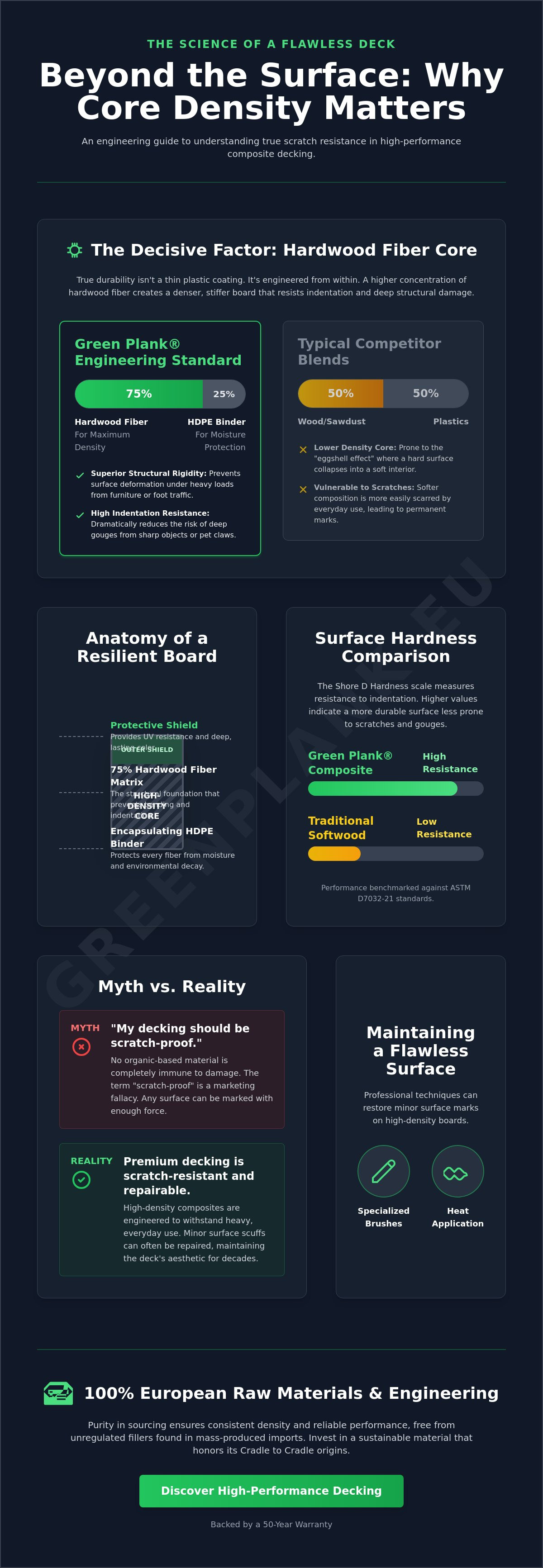
Premium boards utilize a dual-component architecture to ensure longevity. The outer shield provides the UV resistance and color depth, while the internal composite matrix delivers the necessary stiffness. Material density remains the most overlooked factor in surface performance. A high-density core prevents the "eggshell effect," where a hard outer layer collapses into a soft interior under pressure. By utilizing a 75% hardwood fiber blend, the internal matrix provides a solid foundation that reinforces the surface against impacts and keeps the board dimensionally stable.
Common Myths: Scratch-Proof vs. Scratch-Resistant
Integrity requires transparency; no organic-based decking is entirely scratch-proof. High-quality WPC is scratch-resistant, meaning it's designed to endure heavy use while offering repairable surface properties. Traditional pressure-treated wood often fails the scratch test because its soft fibers tear easily under claw pressure. In contrast, engineered composites offer superior hardness that resists tearing. Some advanced materials even exhibit "self-healing" tendencies, where minor scuffs blend back into the grain pattern over time through natural weathering and thermal expansion. This evolution in material science ensures your deck remains an aspirational space rather than a maintenance burden.
The Material Science: Why 75% Hardwood Fiber Outperforms Plastics
The performance of scratch resistant composite decking is dictated by its internal composition. While many manufacturers rely on a 60/40 or 50/50 wood-to-plastic ratio, the Green Plank engineering standard utilizes a 75% hardwood fiber and 25% HDPE blend. This higher wood concentration significantly increases the material's modulus of elasticity. A stiffer board is a more resilient board. By prioritizing hardwood fibers over softer plastics, the surface achieves a level of hardness that resists the indentation common in lower-density products.
HDPE (High-Density Polyethylene) serves as the essential binding agent in this matrix. It encapsulates every hardwood fiber, providing a barrier against moisture and environmental decay. This precision-engineered balance ensures the board remains dimensionally stable across varying temperatures. High-density cores provide the necessary internal support to prevent the microscopic compression of the surface layer that typically manifests as visible scratches. Without this internal rigidity, even the thickest plastic shell will eventually yield to the pressure of heavy furniture or sharp objects. This structural integrity is why professionals prioritize core density over superficial coatings.
The Advantage of 100% EU Raw Materials
Purity in sourcing is the foundation of structural reliability. We utilize 100% EU raw materials to ensure every board meets strict manufacturing tolerances. This regional commitment eliminates the risk of "filler" materials, such as unregulated scrap plastics or low-grade sawdust, which are often found in mass-produced imports. Material purity leads to consistent density. When the density is uniform, the surface aesthetics remain stable for decades. You can explore our full range of European-engineered WPC solutions to see how regional quality transforms outdoor living.
Sustainability as a Durability Factor
A product's environmental impact is inextricably linked to its lifespan. By engineering boards with a service life supported by a 50-year warranty, we significantly reduce the total CO2 footprint associated with replacement and disposal. This is the essence of our Cradle to Cradle ownership model. We design for a circular economy where materials are treated as valuable resources rather than waste. Choosing a durable, high-density surface is the most responsible choice for 2026 construction because the most sustainable product is the one you only install once.
Composite vs. Wood: Comparing Surface Durability Under Pressure
Pressure-treated softwood is the most common choice for budget-conscious projects, yet its cellular structure is fundamentally ill-equipped for mechanical stress. Softwood fibers are long and hollow. When a pet's claw or a heavy chair leg applies pressure, these fibers collapse or tear, leaving deep, permanent marks. Even premium hardwoods like Ipe, while naturally dense, aren't immune to damage. Hardwood requires consistent oiling to prevent the surface from becoming brittle. Without this labor-intensive maintenance, the wood silvering process leads to surface checking, where small cracks appear that trap dirt and mimic scratches.
Modern scratch resistant composite decking takes a different approach to surface integrity. Instead of relying on vulnerable organic fibers alone, the 75% hardwood and HDPE matrix creates a homogenized surface that distributes pressure evenly. Minor scuffs on WPC don't require the aggressive intervention wood does. Over a few months of UV exposure and natural weathering, the polymer slightly adjusts, a process known as "blending," which naturally masks superficial marks. A common question from traditionalists is whether composite can be sanded like timber. The answer is no; sanding would remove the precision-engineered texture and protective shield. However, the trade-off is a surface that never needs the restorative labor wood demands.
The Hidden Cost of "Cheap" Decking
Initial savings on softwood often vanish within five years of installation. Maintaining a wood deck requires biennial cleaning, sanding, and re-staining to hide the inevitable accumulation of scratches and weathering. These chemicals are expensive and environmentally taxing. In contrast, our WPC profiles, such as the Terra Tuff or Nordeka lines, maintain their aesthetic with simple soap and water. Commercial developers favor these profiles for high-footfall public spaces because they eliminate the labor costs and service disruptions associated with wood repair. Choosing a durable surface is a financial decision as much as an aesthetic one.
Thermal Expansion and Surface Integrity
Wood is hygroscopic, meaning it constantly absorbs and releases moisture from the environment. This cycle causes the material to warp and develop fissures that compromise surface integrity. Green Plank’s HDPE-based composites are engineered for the varied European climate, from Nordic winters to Mediterranean summers. Our low-density, high-strength profiles remain dimensionally stable. They resist the internal stresses that cause traditional timber to crack, ensuring that the surface remains smooth and safe for decades. This stability is backed by our signature 50-year warranty, a primary marker of our engineering confidence.
Best Practices for Maintaining a Flawless Deck Surface
Preserving the pristine aesthetic of your outdoor space is a matter of simple, consistent engineering. While scratch resistant composite decking is designed for high-traffic endurance, proper care ensures the surface remains an aspirational centerpiece for decades. Most visible marks are not permanent damage. They're often superficial transfers from rubber soles or trapped abrasive grit. Regular cleaning is the most effective defense. By removing sand and dirt, you prevent these particles from acting like sandpaper under the weight of foot traffic.
If a minor scuff occurs, it doesn't require the aggressive sanding that traditional timber demands. You can often restore the surface using a stiff nylon brush to gently blend the mark back into the grain pattern. For more stubborn scuffs, a heat gun applied with caution can soften the polymer shield, allowing the texture to reset. This technical advantage stems from the material's thermal properties. Always test a small, inconspicuous area before applying heat to the main deck surface. You can find detailed guides and professional tools in our maintenance-free decking collections.
Furniture selection plays a vital role in surface longevity. We recommend choosing pieces with wide, protective glides made of felt or high-density plastic. Avoid metal legs with sharp edges, as these can concentrate pressure beyond the material's indentation limit. Similarly, pet owners should maintain their animals' claws. While the 75% hardwood core provides exceptional resistance to indentation, trimmed nails reduce the risk of mechanical shearing on the decorative grain.
Preventative Measures for High-Traffic Zones
Strategic placement of breathable, low-profile outdoor rugs in transition areas can significantly reduce surface wear. These rugs act as a primary filter for grit before it reaches the main deck. Practice a "lift and place" policy for heavy planters or furniture. Dragging heavy objects creates unnecessary mechanical stress that can mar even the most resilient surfaces. Our HidLoc™ Hidden Fastening Systems further contribute to surface safety. By eliminating protruding screw heads, they create a perfectly smooth plane that is easier to clean and safer for bare feet.
Seasonal Maintenance for 2026
Winter care requires a specific technical approach to protect the polymer layer. When removing snow, always use a plastic shovel rather than a metal one. Metal blades can gouge the surface if they catch on the grain. For ice removal, utilize calcium chloride or rock salt, but ensure the deck is rinsed thoroughly once the weather warms. Avoid using ice picks or sharp tools. Before assuming a mark is a scratch, clean the area with a pH-neutral soap. In many cases, what appears to be a permanent mark is simply surface debris that has bonded to the shield.
Green Plank Solutions: European Engineering for High-Traffic Spaces
Green Plank Solutions represents the pinnacle of regional manufacturing and ethical craftsmanship. By sourcing 100% EU raw materials, we ensure a level of material purity that is often absent in global imports. Our scratch resistant composite decking is not merely a surface; it's an engineered system designed for the rigors of 2026 outdoor living. We prioritize the technical needs of specifiers and homeowners who refuse to compromise on durability or environmental ethics. Every profile we manufacture reflects our identity as a responsible innovator, blending engineering precision with a deep respect for the natural world.
The Terra Tuff line stands as our premier solution for environments where surface failure is not an option. This range utilizes a high-density profile specifically engineered for public infrastructure and extreme commercial use. The increased hardwood fiber content provides superior indentation resistance. This density ensures the surface remains unmarred by heavy foot traffic or movable equipment. It offers exceptional saltwater and UV resistance, which makes it the ideal choice for coastal boardwalks and exposed urban plazas. You can learn more about the technical foundations of these materials in our guide to Terra Tuff Composite Decking.
The Terra Tuff Advantage
Coastal and exposed environments demand materials that can withstand both mechanical and chemical stress. Terra Tuff excels in these conditions because its specialized HDPE matrix remains inert when exposed to salt spray. The high hardwood concentration ensures that the boards don't become brittle under intense UV exposure. This stability is critical for public safety and long-term aesthetic maintenance. By choosing a profile designed for the most demanding commercial applications, residential owners gain a level of security that standard consumer-grade products simply cannot provide.
Custom Profiles for Professional Specifiers
Innovation and aesthetic perfection converge in our Smart System WPC. This range provides the sophisticated look of exotic hardwoods while maintaining the mechanical resilience required for high-traffic spaces. To achieve a truly flawless finish, professional installers rely on the HidLoc™ Hidden Fastening System. This technology secures the boards from below. By eliminating the need for surface-penetrating fasteners, we preserve the structural integrity of the polymer shield and create a seamless visual plane. It's the professional choice for those who value both safety and design sensibility.
Our commitment to long-term performance is codified in our 50-year warranty. This is a primary signature of our engineering confidence. We embrace a Cradle to Cradle ownership model, ensuring that every board is part of a circular economy. This approach supports architects in meeting modern sustainability benchmarks for large-scale projects. For those beginning a new build, our Professional Deck Installation Guide offers the technical roadmap necessary for a successful, sustainable outcome. Choosing Green Plank means investing in a future where high-performance materials and ecological responsibility exist in perfect harmony.
Engineering Your Outdoor Legacy
The 2026 standard for outdoor living requires a shift from superficial coatings to deep-core engineering. We've explored how a 75% hardwood fiber matrix provides the essential density that defines high-performance scratch resistant composite decking. This structural integrity ensures your investment resists the mechanical stresses of daily life while maintaining a premium, natural aesthetic. By choosing materials with 100% EU manufactured origins, you prioritize material purity and regional reliability over mass-produced alternatives.
Our commitment to your space is backed by a 50-year warranty and Cradle to Cradle certified sourcing. These aren't just technical specifications; they're a promise of longevity and environmental stewardship. You can experience the difference in density and texture firsthand before finalizing your design. We invite you to Request a Professional Sample Kit to see how European innovation transforms durability into a lasting legacy. Your future outdoor sanctuary deserves the precision of a sustainable craftsman.
Frequently Asked Questions
Is composite decking really scratch resistant for dogs?
High-density WPC is engineered to withstand the mechanical stress of active pets. The 75% hardwood fiber core provides the necessary indentation resistance to prevent claws from penetrating the surface shield. While no organic-based material is entirely scratch-proof, our professional-grade profiles significantly outperform traditional timber in pet-heavy environments. This durability ensures your deck remains a beautiful, stress-free space for every family member.
How do you fix a scratch on a composite deck?
Minor surface scuffs can often be blended using a stiff nylon brush or carefully applied heat. Because the polymer shield has thermal-memory properties, a heat gun can soften the material just enough to let the texture reset. This technical advantage allows you to maintain a flawless aesthetic without the aggressive sanding or staining required by wood. For deeper marks, the homogenized nature of the board helps the damage blend in over time through natural weathering.
Can I use a pressure washer on scratch-resistant decking?
You can use a pressure washer provided you follow specific engineering safeguards to protect the polymer layer. We recommend using a fan-tip nozzle and maintaining a minimum distance of 30 cm from the board surface. Keep the pressure below 1500 PSI to prevent etching the grain pattern. This cleaning method effectively removes abrasive grit that could otherwise cause micro-scratches during daily foot traffic.
Does furniture leave permanent marks on WPC decking?
Permanent marks are avoided when you choose furniture with wide, protective glides made of felt or high-density plastic. The internal rigidity of our scratch resistant composite decking prevents the "compression" marks that occur when heavy weight is concentrated on a small point. By lifting rather than dragging heavy planters or seating, you preserve the structural integrity of the surface for the duration of its 50-year warranty.
What is the most scratch-resistant composite decking material?
The most resilient materials are those with a high hardwood-to-plastic ratio and a high Shore D Hardness rating. Our Terra Tuff line is the definitive choice for extreme durability, utilizing a dense 75% hardwood and 25% HDPE matrix. This specific engineering blend provides the stiffness required for public infrastructure and high-traffic commercial spaces. It offers a level of surface hardness that lighter, plastic-heavy alternatives simply cannot match.
Are capped composite boards better for scratch resistance than uncapped?
Capped boards feature a specialized polymer shield that provides superior resistance to scratching, staining, and UV degradation. This outer layer acts as the primary defense against mechanical shearing. However, the cap is only as strong as the core beneath it. Our high-density hardwood core supports the cap, preventing the "eggshell effect" where a hard surface collapses into a soft interior under localized pressure.
How does Green Plank ensure its decking is more durable than competitors?
We prioritize material purity by using 100% EU raw materials and a proprietary 75% hardwood fiber blend. Many competitors utilize a 60/40 split or unregulated fillers that compromise the board's modulus of elasticity. Our regional manufacturing standards ensure consistent density across every profile. This commitment to engineering precision allows us to offer a 50-year warranty, a testament to the long-term performance of our sustainable craftsman approach.
Will high-heeled shoes scratch my composite deck?
Standard high heels won't damage a high-density WPC surface, but stiletto heels can concentrate immense pressure on a very small area. This localized force can occasionally exceed the indentation limit of residential-grade materials. For spaces frequently used for social events, we recommend our commercial infrastructure profiles. These are engineered to handle extreme point-load pressures, ensuring the surface remains smooth and unmarred regardless of the footwear worn by your guests.
Specificera produkten
Använd den här guiden i en Green Plank-specifikation
Tekniska WPC-artiklar ska stärka de kommersiella sidorna — inte konkurrera med dem. Fortsätt till komposittrall, TerraTuff, Nordeka eller de tekniska nedladdningarna.