




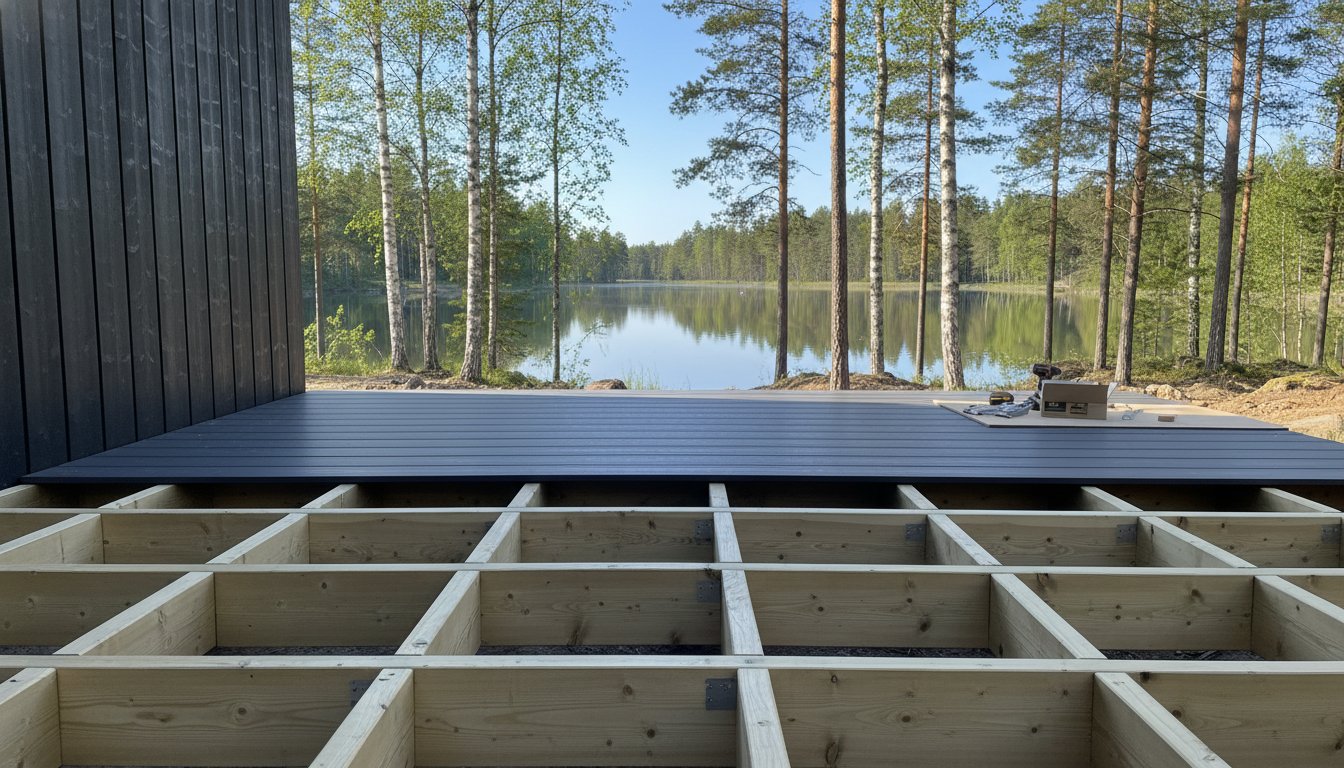
What if you could build a deck that uses 30% less timber, costs less to install, and remains rock-solid for up to 50 years? While standard industry guidelines often limit joist spacing to 40 cm to prevent sagging, our high-density European engineering is specifically good for 60 cc for private joist span applications. This shift in structural design allows you to rethink the foundation of your outdoor living space by prioritizing material efficiency and engineering precision.
We recognize that the rising cost of timber sub-structures and the fear of a bouncing deck often lead to over-engineered, expensive frames. You shouldn't have to choose between structural integrity and environmental responsibility. You'll learn how our proprietary material science enables these wider spans without sacrificing the stability of your Terra Tuff or Nordeka decking. We will walk through the technical reasons why 60 cm spacing is structurally sound for private projects. This approach helps you reduce your total CO2 footprint while achieving a professional-grade finish with HidLoc hidden fasteners.
Key Takeaways
- Understand the structural efficiency of 600 mm center-to-center spacing and why it is the preferred engineering standard for European residential timber framing.
- Discover how a high-density composition of 75% hardwood fiber provides the longitudinal stiffness required to eliminate sagging over wider spans.
- Learn why our European-engineered profiles are good for 60 cc for private joist span, allowing you to reduce timber volume and labor costs significantly.
- Achieve a flawless, professional finish by pairing wider joist layouts with the HidLoc™ hidden fastening system for a secure, screw-free surface.
- Lower the total CO2 footprint of your project by optimizing sub-frame materials without compromising the long-term performance of your deck.
Understanding Joist Spacing: What Does 60 cc Mean for Your Deck?
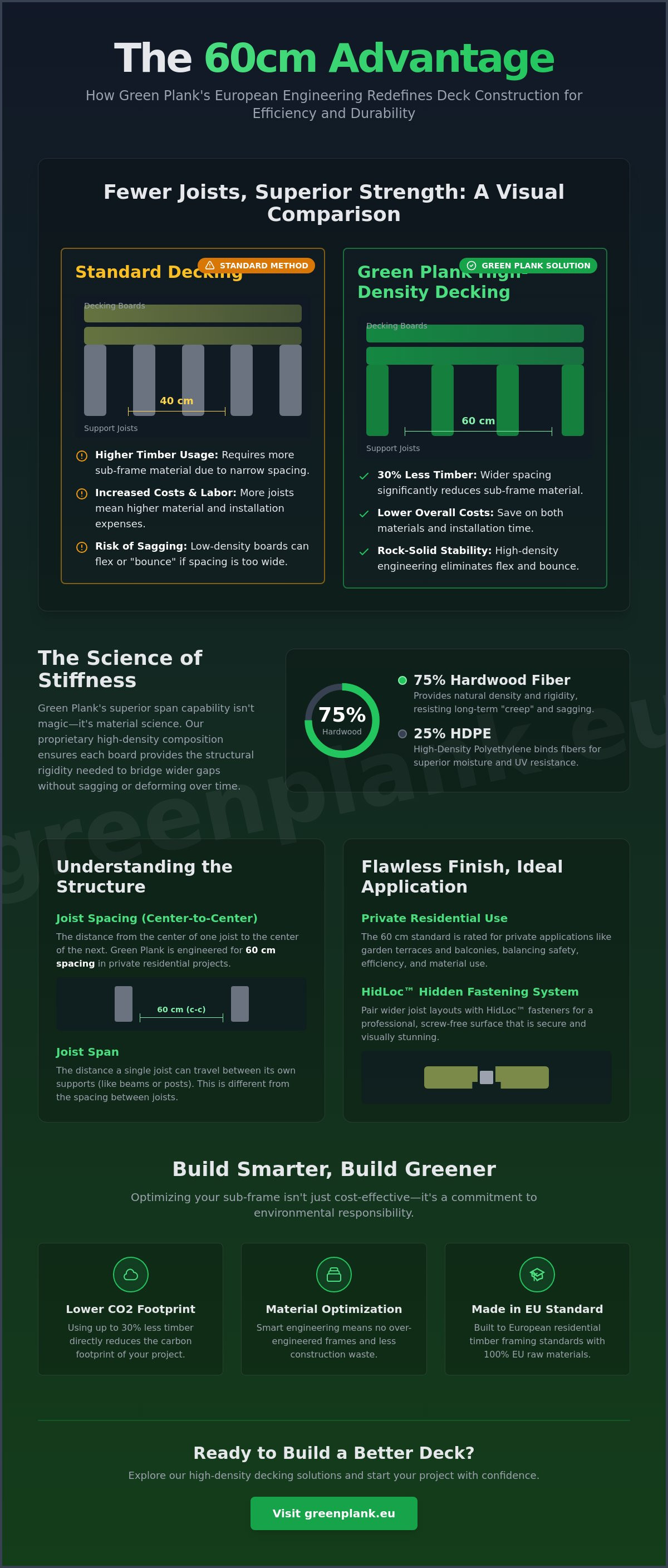
In technical construction, the term "cc" stands for center-to-center. It defines the distance from the middle of one joist to the middle of the next. This measurement is vital for ensuring your deck doesn't flex or bounce underfoot. For a deeper look at the engineering behind these supports, Understanding Joist Spacing reveals how these parallel elements distribute weight across a frame. While many standard composite boards require narrow gaps of 30 or 40 cm, our high-density profiles are specifically engineered to be good for 60 cc for private joist span projects. This allows for a more efficient sub-structure that aligns perfectly with European residential timber framing standards.
The relationship between spacing and deflection is simple: the wider the gap, the more stress is placed on the decking board. Most low-density composites use a higher percentage of plastic or softer wood fillers. This often leads to sagging or a "spongy" feeling if the joists are spaced too far apart. We solve this through material science. By utilizing a blend of 75% hardwood fiber and 25% HDPE, our boards achieve the longitudinal stiffness necessary to span 600 mm without perceptible flex. This engineering choice reduces the amount of timber needed for your frame. It lowers your costs and reduces the total carbon footprint of the build.
The Difference Between Joist Span and Joist Spacing
It's easy to confuse these two terms during the planning phase. Joist span describes the distance a joist travels between its own supports, such as beams or posts. Joist spacing is the parallel gap between the joists where the decking is attached. When we say a product is good for 60 cc for private joist span, we're highlighting the board's internal strength. It means the composite material is stiff enough to bridge a 60 cm gap while maintaining total structural integrity. You get a solid surface that feels like a traditional timber deck but with the longevity of modern material science.
Private vs. Commercial Spacing Requirements
Private residential decks have different load-bearing expectations than public boardwalks or commercial plazas. A garden terrace or private balcony typically handles lower weight loads and less frequent foot traffic. Residential codes in many regions recognize the 600 mm layout as a standard for timber framing. Our Terra Tuff and Nordeka lines are specifically rated for these private applications. This allows homeowners to build a premium, maintenance-free space while using fewer resources than high-traffic commercial infrastructure requires. It's a balance of safety, efficiency, and quiet confidence in your outdoor investment.
Engineering the Span: Why Material Density Dictates Joist Centers
Density isn't just a technical specification; it's the primary factor in long-term structural reliability. When you choose a composite board, its internal composition determines whether the surface will remain flat or bow under the weight of daily use. Many market alternatives rely on low-density fillers or recycled plastics with inconsistent properties, which necessitates narrow supports to avoid failure. In contrast, our high-performance manufacturing process creates profiles that are specifically good for 60 cc for private joist span installations. This capability stems from a precise ratio of 75% hardwood fiber and 25% HDPE, ensuring each board acts as a rigid structural element rather than a decorative plastic covering.
The technical reality of Engineering the Span requires a deep understanding of how organic fibers interact with polymers under load. By sourcing 100% EU raw materials, we maintain strict control over the mechanical properties of every batch. This consistency is the reason architects and builders prioritize our high-density WPC profiles for projects where material efficiency and longevity are the core objectives. Our commitment to quality ensures that the structural integrity of your deck is never left to chance.
Hardwood Fiber vs. Softwood Fillers
Hardwood fibers are naturally denser and more rigid than the softwood alternatives often found in budget-grade composites. This material difference is critical when addressing "creep," which is the gradual, permanent deformation of a material under constant stress. Our hardwood-rich blend resists this deformation, allowing for wider joist centers without the risk of permanent sagging. Because we use 100% EU-sourced fibers, the structural performance remains predictable and uniform across every plank. You don't have to worry about weak spots or inconsistent density that could compromise the safety of a 60 cm layout.
The Science of Deflection Limits
In the context of residential decking, the L/180 deflection limit serves as the standard benchmark for both safety and tactile comfort. This engineering formula ensures that a board doesn't flex more than 1/180th of its span when subjected to a standard load. While low-density products may struggle to meet this limit even at 40 cm, our boards maintain a flat, stable surface at 600 mm centers. The specific stiffness of our material is achieved through a high hardwood-to-HDPE ratio that provides the internal skeleton necessary to bridge wider gaps. It's an engineering solution that delivers a solid, timber-like feel underfoot without the maintenance requirements of natural wood.
Cost and Sustainability: The Benefits of 60 cm Joist Spacing
Building a high-end outdoor space involves balancing upfront investment with long-term ecological impact. When a decking profile is engineered to be good for 60 cc for private joist span, it transforms the financial and environmental profile of the entire project. Most traditional composite materials require a 40 cm grid, which necessitates a significant amount of timber and hardware. By extending the span to 60 cm, you optimize the sub-structure without compromising the stability of the finished surface. This efficiency is a direct result of our high-density manufacturing, allowing you to achieve more with less material.
The environmental advantage of this wider spacing is measurable. Reducing the number of joists by roughly one-third significantly lowers the total carbon footprint of your build. Fewer timber beams mean fewer trees harvested and less energy consumed during the transportation of heavy framing materials. Our commitment to sustainability isn't just about the boards themselves; it's about a holistic approach to construction that prioritizes resource efficiency. Investing in a durable sub-frame that matches the 50-year service life of our decking ensures that you won't need to replace the structure prematurely, further supporting a circular economy.
Sub-structure Material Comparison
Moving from a 400 mm center-to-center layout to a 600 mm layout provides immediate material savings. You'll require fewer timber joists, fewer joist hangers, and fewer structural screws. This reduction in hardware doesn't just lower your shopping list; it simplifies the engineering of the deck's foundation. Utilizing high-density wpc composite decking as your primary surface allows you to leverage these wider spans safely. This material choice supports our Cradle to Cradle ownership model, where every component of the system is designed for maximum utility and minimal waste.
Labor and Installation Speed
Time is a critical factor in any residential project. A 60 cm layout requires fewer joists to be measured, cut, and leveled, which accelerates the framing phase of construction. For professional contractors, this means faster project turnover and reduced labor costs. For DIY enthusiasts, it simplifies the layout process and reduces the margin for error. Additionally, because there are fewer joists, you will need fewer HidLoc™ hidden fasteners per square meter. You get a cleaner, screw-free finish in less time, allowing you to enjoy your maintenance-free outdoor space sooner.
Installation Best Practices for a 60 cc Residential Deck
Executing a 600 mm layout requires a shift in perspective from traditional 40 cm builds. Because our high-density profiles are good for 60 cc for private joist span projects, the focus moves from supporting the board to ensuring the frame itself is perfectly level and stable. You should select joists with a minimum width of 45 mm to provide an adequate landing for the board ends and HidLoc™ clips. This width ensures that even with slight variations in the timber, the fastening system remains secure. This confirms that our European-engineered boards are good for 60 cc for private joist span when installed on a stable, level frame.
Thermal management is equally important for long-term aesthetics. WPC boards naturally expand and contract with temperature changes. At 60 cm intervals, the fastening system must allow for this movement without stressing the boards or the clips. Proper ventilation is the second half of this equation. Maintaining a minimum clearance of 20 mm beneath the deck allows for continuous airflow, which prevents heat buildup and moisture accumulation. This airflow protects the timber sub-structure and ensures the composite remains stable through every season.
The HidLoc™ Advantage
Hidden fasteners are more than an aesthetic choice; they're a functional necessity for modern WPC systems. The HidLoc™ system secures the board while allowing for the subtle longitudinal movement that occurs during seasonal shifts. You must place a clip at every joist intersection to distribute the load evenly across the 60 cc span. This prevents the boards from shifting and maintains the uniform gaps required for drainage. For a detailed walkthrough of this process, consult our deck installation guide to ensure your project meets professional standards.
Structural Support and Skirting
Stability across a wider span depends on the lateral rigidity of the sub-frame. We recommend installing blocking or bridging between joists every 1.5 to 2 meters. This prevents the joists from twisting or bowing over time, keeping the surface perfectly flat. To protect the longevity of your timber frame, apply Skerting wpc decking around the perimeter. This provides a clean finish while hiding the sub-structure from direct UV exposure and debris. Proper drainage is also essential; ensure the ground beneath the deck is sloped to prevent water from pooling around the joist footings. A dry sub-structure is a durable sub-structure.
Ready to build your maintenance-free terrace? View our sustainable decking solutions to find the perfect profile for your home.
Green Plank Solutions Rated for 60 cm Joist Spans
Selecting the right material is the final step in ensuring a safe, efficient build. While many manufacturers remain vague about their span ratings or hide them in fine print, we provide clear engineering data for our European-made profiles. Every board we produce is a result of regional manufacturing excellence and a commitment to 100% EU raw materials. This focus on quality assurance means our products are consistently good for 60 cc for private joist span layouts. You can trust that the structural integrity of your deck is backed by rigorous testing and a transparent supply chain that prioritizes long-term performance over short-term savings.
Our "Made in EU" guarantee serves as a core identity marker for our brand. It signals a design sensibility that understands the specific needs of regional residential projects. By controlling the manufacturing process from raw material to finished plank, we ensure that every profile meets the high standards required for wider joist centers. This reliability allows us to offer a 50-year service life warranty, providing you with peace of mind that your investment will remain stable and beautiful for decades. It's a commitment to being a responsible innovator in the composite industry.
Terra Tuff™: The Heavy-Duty Choice
The Terra Tuff™ line represents our most robust engineering for residential applications. It utilizes a high-strength profile that provides exceptional rigidity without the excessive weight found in lower-quality alternatives. This unique composition allows homeowners to create expansive, maintenance-free terraces with quiet confidence. Because the material resists moisture and longitudinal flex so effectively, it is specifically good for 60 cc for private joist span installations. You get a solid, premium feel underfoot while using a sub-structure that is both cost-effective and environmentally responsible. It's the ideal solution for those who refuse to compromise on quality or sustainability.
Smart System™ for Residential Efficiency
Our Smart System™ is designed for those who prioritize both innovation and installation efficiency. These boards are perfectly compatible with standard European timber dimensions, making them the preferred choice for modern decks and sustainable facades. The system simplifies the construction process by aligning perfectly with the 600 mm center-to-center standard common in regional residential framing. By choosing this system, you're participating in a Cradle to Cradle ownership model that respects nature while delivering an aspirational outdoor lifestyle. Explore our 60 cc rated composite decking collections to see how high-density engineering can transform your next project.
Build Your Sustainable Outdoor Legacy
Engineering a deck with wider joist centers is a choice that balances material efficiency with high-end performance. We've explored how a composition of 75% hardwood fiber provides the necessary stiffness to eliminate sagging, while 100% EU raw materials ensure predictable quality. This technical foundation confirms our profiles are good for 60 cc for private joist span applications. By optimizing your sub-structure, you reduce both your initial investment and the total CO2 footprint of your project.
Our commitment to being a responsible innovator is backed by a 50-year service life warranty. This guarantee reflects our confidence in European manufacturing standards and the longevity of our high-density WPC technology. When you choose a system designed for regional reliability, you're investing in a maintenance-free lifestyle that respects the natural world. You can achieve a flawless, professional finish that remains stable through decades of seasonal changes.
View our range of 60 cc rated composite decking to discover the perfect balance of engineering precision and aesthetic beauty. Your vision of a durable, eco-conscious outdoor space is ready to become a reality.
Frequently Asked Questions
Can all composite decking boards handle 60 cm joist spacing?
No, most standard composite boards are restricted to 30 or 40 cm spacing to prevent structural failure. Only high-density profiles, such as those engineered with 75% hardwood fiber, are good for 60 cc for private joist span projects. These materials provide the necessary longitudinal stiffness to bridge wider gaps without sagging. You should always verify the manufacturer's technical specifications before planning your sub-structure layout.
Will a 60 cm joist span cause my composite deck to bounce?
A 60 cm span won't cause bouncing if you use a board with high material density and stiffness. Bouncing or "sponginess" typically occurs when a low-density board is pushed beyond its deflection limits. High-performance lines like Terra Tuff maintain a solid, timber-like feel at 600 mm centers. This structural reliability ensures a premium walking surface that remains stable under daily residential loads.
How much money can I save by using 60 cc spacing instead of 40 cc?
You can achieve substantial savings by reducing the volume of timber and hardware required for the sub-frame. Using 600 mm centers instead of 400 mm centers requires approximately one-third fewer joists. This reduction also applies to joist hangers, structural screws, and installation labor time. It's an efficient way to lower the total project investment while simultaneously reducing the ecological footprint of the build.
Does Green Plank offer a warranty for boards installed at 600 mm centers?
Yes, we provide a long-term performance guarantee of up to 50 years for private residential installations at 600 mm centers. This warranty covers structural integrity and resistance to rot or decay. Because our boards are specifically good for 60 cc for private joist span, we stand by their performance in these layouts. Always ensure you follow the official installation guidelines to maintain full warranty coverage.
What joist material is best for a 60 cm composite deck span?
High-quality pressure-treated timber, such as C24 grade wood, is the standard choice for 60 cm spans. Aluminum joist systems also offer excellent stability and are becoming popular for their longevity and fire resistance. The key is ensuring the joist itself is wide enough, at least 45 mm, to provide a secure landing for the decking boards and hidden fasteners. A stable foundation is essential for any wide-span project.
Is 60 cm joist spacing safe for a balcony or elevated deck?
60 cm spacing is entirely safe for balconies and elevated decks provided the decking material is rated for those spans and the sub-structure meets local building codes. Safety depends on the board's ability to handle the expected residential load without excessive deflection. For elevated structures, you should always consult a structural professional to ensure the posts and beams are sized correctly for the specific height and load requirements.
Do I need more fasteners for a 60 cc joist layout?
You actually require fewer fasteners with a 60 cc layout compared to a standard 40 cc frame. Because there are fewer joists per square meter, there are fewer intersections where the boards need to be secured. This reduces the total count of HidLoc™ hidden fasteners needed for the project. It simplifies the installation process and creates a cleaner, screw-free aesthetic with less effort and hardware.
Can I use 60 cm spacing for a commercial project?
No, 60 cm spacing is generally not recommended for commercial or high-traffic public areas. Commercial codes usually mandate narrower joist centers, typically 300 mm or 400 mm, to accommodate significantly higher weight loads and constant foot traffic. While our profiles are exceptionally strong, the 600 mm standard is specifically designed for private residential use where load expectations are lower and more predictable.
Specificera produkten
Använd den här guiden i en Green Plank-specifikation
Tekniska WPC-artiklar ska stärka de kommersiella sidorna — inte konkurrera med dem. Fortsätt till komposittrall, TerraTuff, Nordeka eller de tekniska nedladdningarna.